Key takeaways
- Electronics and appliance shoppers ask AI engines spec-heavy, comparison-heavy questions, so the best GEO tools track prompts at the product and category level, not just the brand level.
- In Promptwatch Data, product pages were the most cited content type in ChatGPT at 22.4% of citations (Sep 28 to Oct 4, 2026). Your spec pages are the asset to protect.
- A pure monitoring dashboard is not enough. Pick a tool that also shows AI crawler access and helps you fix content gaps.
- YouTube matters for Google AI Overviews, while Reddit seeding has stopped moving ChatGPT.
- Ecommerce-specific tools (Yotpo Discover, Ranketta, Alhena AI) are worth a look if your catalog has hundreds of SKUs.
Why electronics and appliances are a different GEO problem
A shopper asking ChatGPT "best robot vacuum for pet hair under $500" gets a short list of named models, with specs and prices. Not ten blue links. If your model is not on that list, the sale is gone before anyone visits a retailer.
Electronics and appliances have a few traits that make GEO harder than, say, a SaaS brand:
- Hundreds or thousands of SKUs, with model numbers that differ by region.
- Prompts are comparison-driven: "Dyson vs Shark", "OLED vs QLED for a bright room".
- Retailers (Amazon, Best Buy, Walmart) and review publishers often outrank the manufacturer in citations.
- Support content matters. People ask AI how to reset a dishwasher or pair earbuds, and the answer comes from manuals and help pages.
- Specs go stale quickly. A last-year model number in an AI answer is a real revenue leak.
The broader demand signal is real. Pew Research found about 49% of US adults say they have used an AI chatbot such as ChatGPT or Gemini (June 2026), and TechCrunch reported AI-referred traffic to US retail sites rose 393% year over year in Q1 2026.
What the data says about where AI gets product answers
I could not find a consumer-electronics-specific citation report, so treat the following as cross-industry evidence that likely carries over, not as proof.
Promptwatch Data's content type report (Sep 28 to Oct 4, 2026) found:
- Product pages get 22.4% of ChatGPT citations, landing pages 16.8%, listicles 13.6%, how-tos 8.7%, comparisons 5.9% and reviews 1.7%.
- For commercial prompts (the "best X" kind), product pages rise to 26.0%, landing pages 20.6% and listicles 15.0%. Comparisons climb to 7.9%.
- For branded prompts, reviews rise to 5.6%, more than three times their overall share.
Another angle: Promptwatch's software citation report shows docs and help centers earning more citations than vendor sites or review sites. That is a software result, but it hints that manuals, troubleshooting pages and support articles are a real citation surface for hardware brands too.
On social, the October 2026 social citations report found social platforms make up just 0.46% of ChatGPT citations but 12.2% of Google AI Overviews citations, with YouTube leading at 4.28%. For electronics, where reviews, unboxings and how-tos live on video, that makes YouTube the social channel worth investing in. Reddit's share of ChatGPT citations collapsed from about 4% to 0.5% in August (Reddit citations report), so forum seeding is a weak bet for ChatGPT right now.
Content age matters as well. The content half-life report shows landing pages and docs stay cited for months, while news pages lose half their citations in roughly five weeks. Launch-day press coverage fades quickly. Evergreen product and support pages do not.
What to look for in a GEO tool as an electronics brand
- Prompt-level tracking by category and persona. You need "best noise-cancelling headphones for flights" as its own tracked prompt, run by buyer type (audiophile, commuter, gift buyer).
- Citation source analysis. Which retailers, review sites and YouTube channels does AI quote about your product line?
- Real interface data. Shopping carousels and product cards differ from API output.
- AI crawler logs. If GPTBot or OAI-SearchBot cannot read your JavaScript-heavy product pages, no amount of content work matters.
- Content workflow. Spec pages, comparison pages and FAQs need to be written and kept current.
- Multi-region support. Model names, prices and availability vary by country.
- Traffic attribution. Did AI send visitors who bought?
The vendor-neutral Olostep buyer's guide covers the same core jobs (mention tracking, citation tracking, sentiment, share of voice) and is a useful sanity check when reading vendor roundups, most of which are published by the vendors they rank.
The best GEO tools for electronics and appliance brands in 2026
Promptwatch: best end-to-end option
Promptwatch is the one I would shortlist first for a brand that wants to act on the data, not only watch it. It tracks ChatGPT, Gemini, Perplexity, Google AI Overviews, AI Mode, Copilot, Meta AI and Amazon Alexa through their real interfaces, in each country and language, which matters when model names differ by region.
For electronics specifically, a few things line up well:
- ChatGPT Shopping and Alexa product results tracking show which products AI recommends and which competitors it picks instead (Business plan and up).
- AI crawler logs are IP-verified, so you can tell whether a product page is unreadable to bots or simply not good enough to cite.
- Citation Trends, plus YouTube, Reddit and LinkedIn reports, show which review channels AI actually leans on.
- Content gap analysis and the Content Agent write and publish comparison pages and FAQs to WordPress, Webflow or Framer, then track whether those pages get crawled and cited.
- Persona tracking lets you prompt like a gamer versus a parent buying a first laptop.
Pricing starts at $95/mo (Essential), with Professional at $245/mo and Business at $579/mo. Confirm at promptwatch.com/pricing. The Content Agent, local targeting and shopping insights start at Business. There is a 7-day free trial, and a free AI visibility report if you want a quick look first. Compare it directly with others on the 2026 platform comparison page.

Profound: enterprise monitoring depth
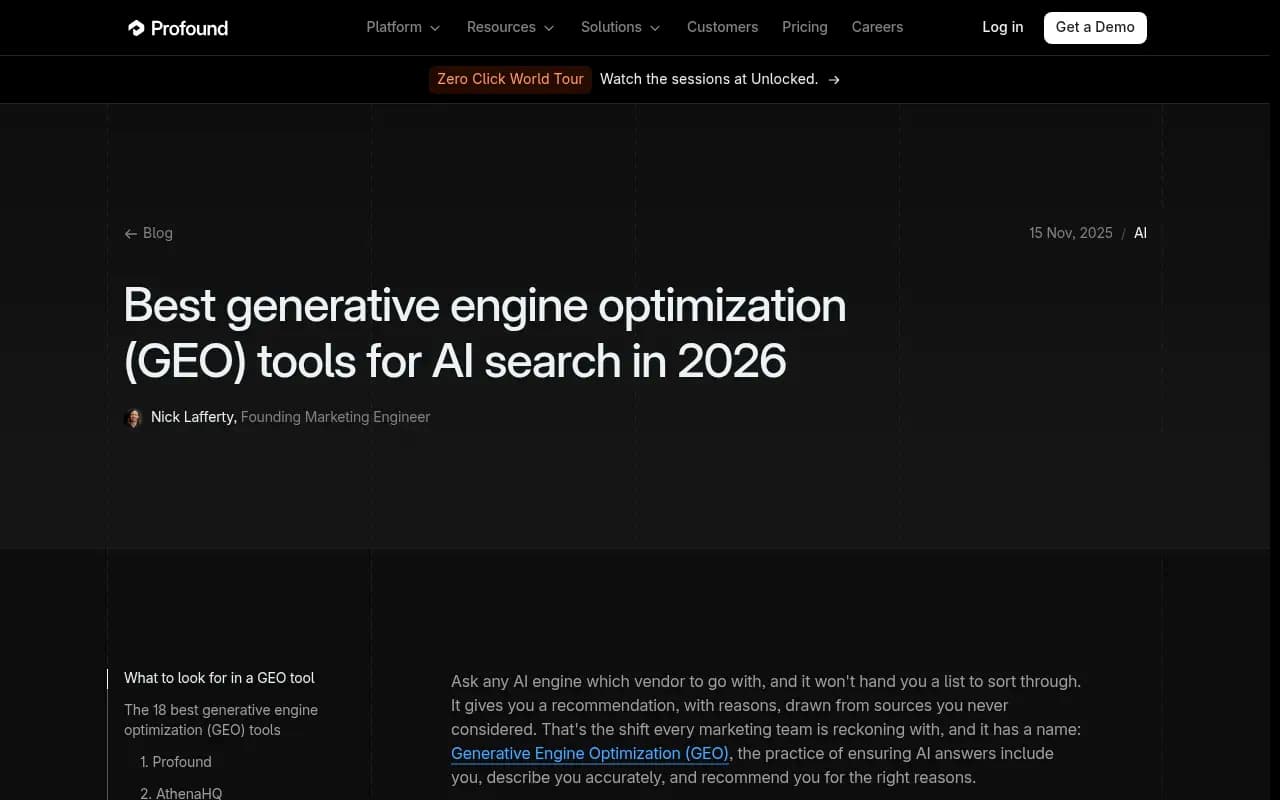
Profound is an enterprise platform with daily tracking across major engines and agent features. It suits large manufacturers with a dedicated AI search team and budget. Its own roundup (see the screenshot below) is, unsurprisingly, a vendor-published list. Expect higher price points than mid-market tools. See Promptwatch vs Profound for a side-by-side.

Yotpo Discover: reviews and purchase data
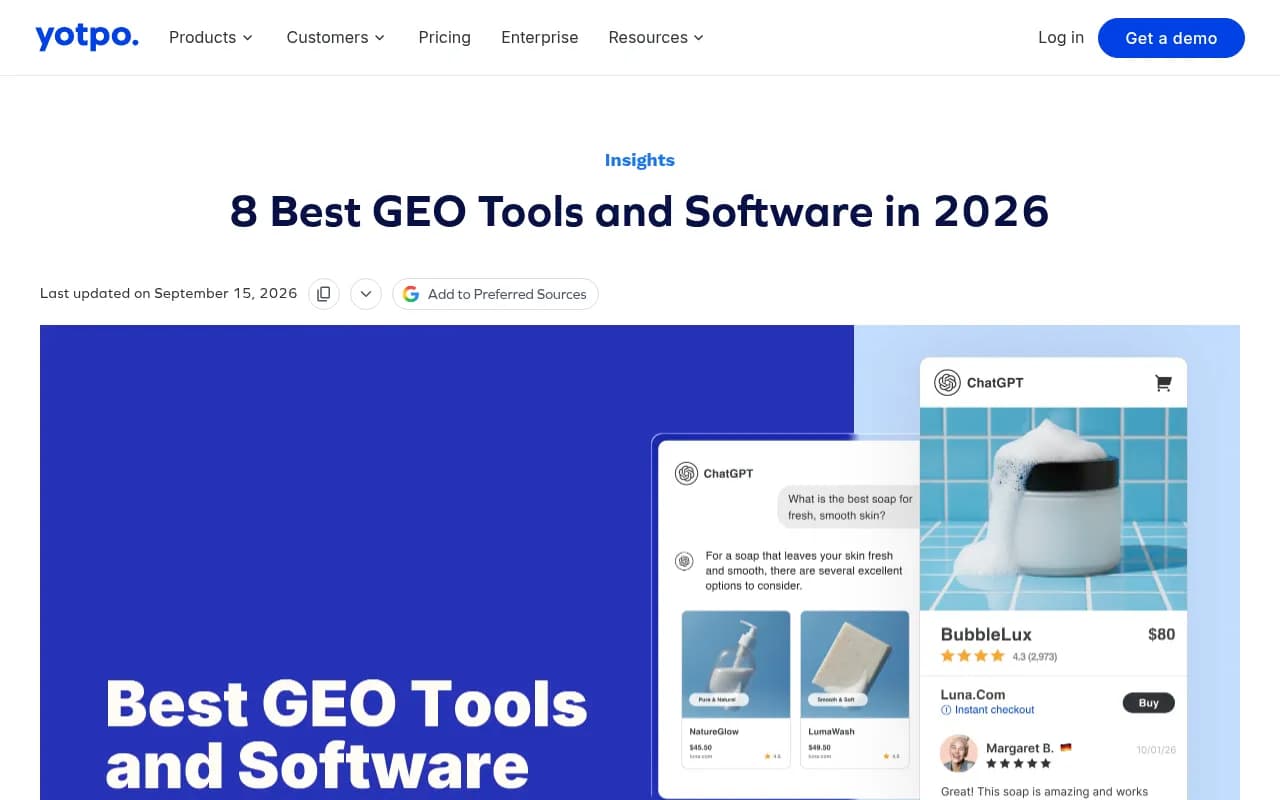
Yotpo positions Discover as an ecommerce-specific AI visibility tool built on its reviews, verified purchases and loyalty data. That is a vendor claim, but the logic is sound for brands that already run Yotpo for reviews, since review volume feeds branded-prompt citations.
Yotpo Discover
Ranketta and Alhena AI: product-level catalog tracking
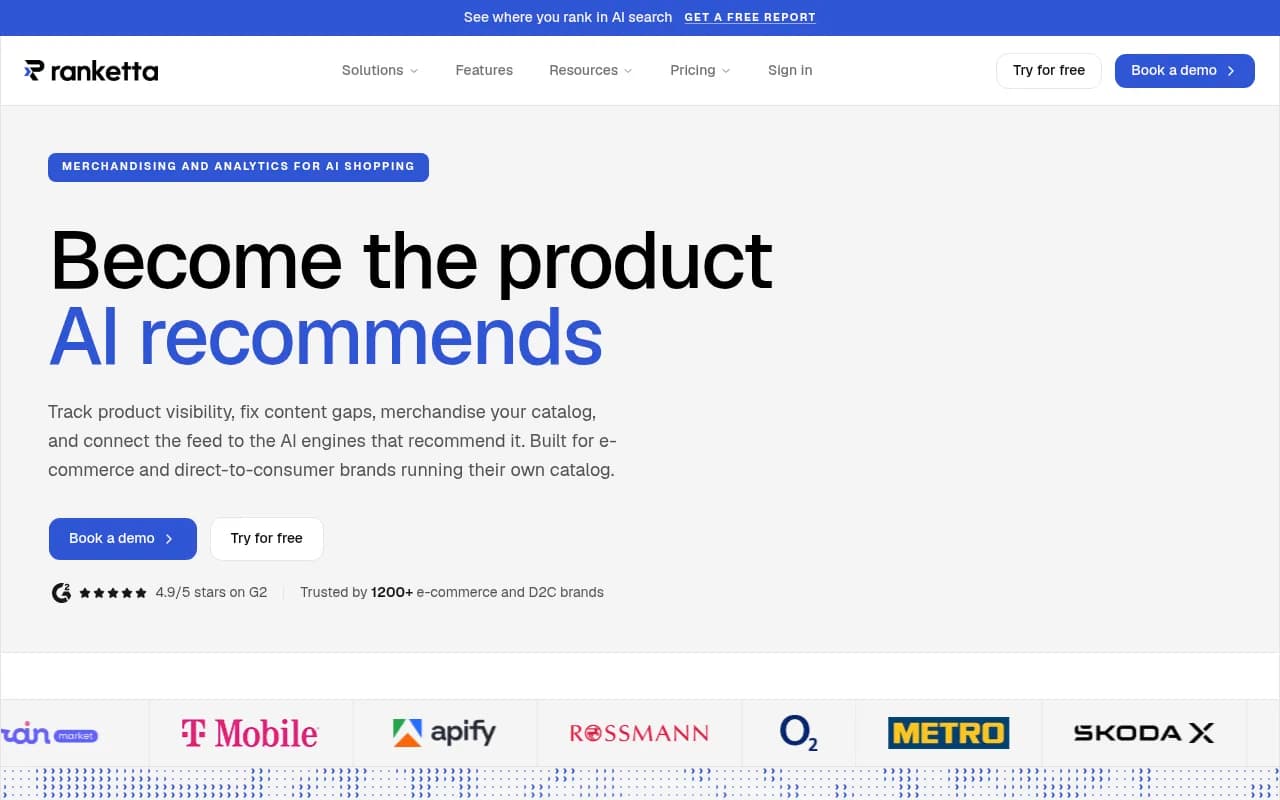
Both are built around ecommerce catalogs. If you sell 500 SKUs across several appliance lines, product-level tracking is the feature that generic brand monitors lack. I would pilot one of these alongside a broader platform, not as a replacement.
Azoma and Bluefish: agentic commerce
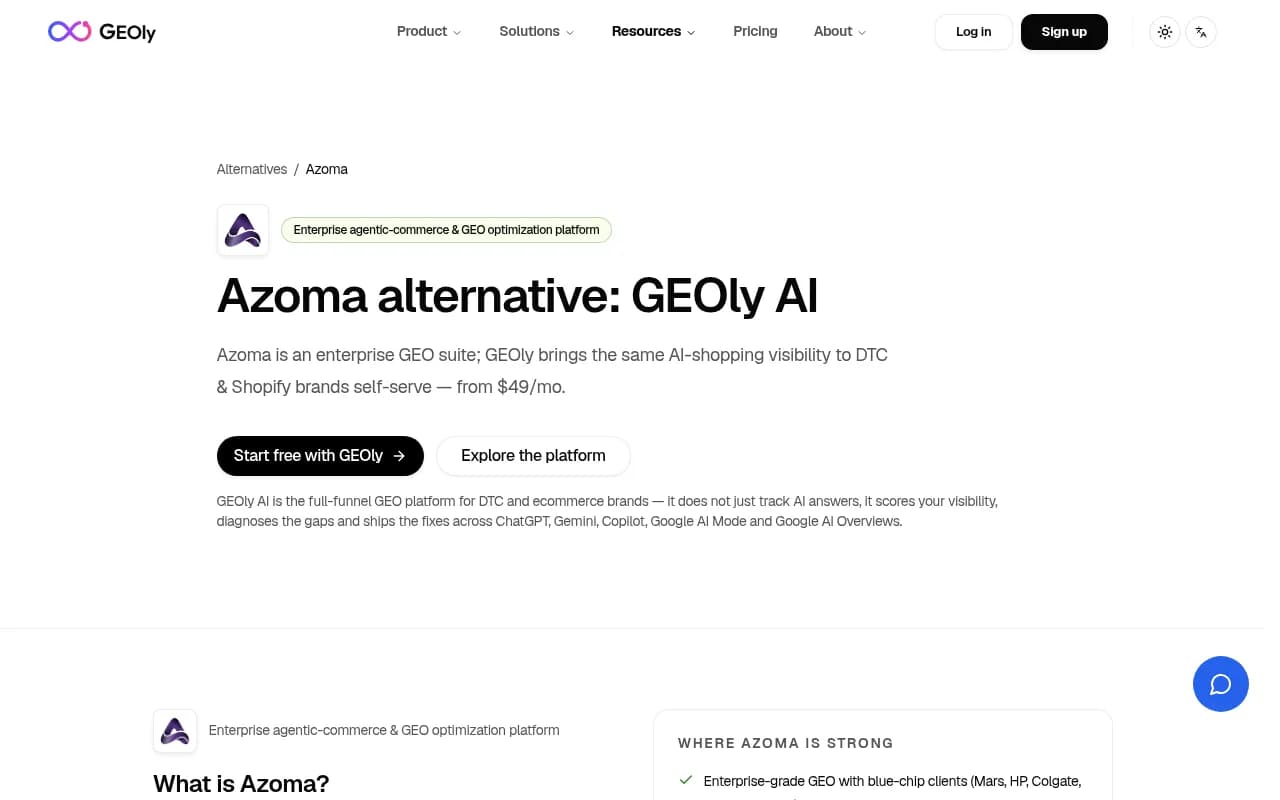
Azoma targets AI shopping agents, and Bluefish AI pitches enterprise visibility plus agentic commerce. Worth a conversation if your growth plan includes buying agents that complete purchases, though the category is early.

Peec AI and Otterly.AI: lightweight monitors
Peec AI and Otterly.AI are cheaper prompt trackers. Anagram's roundup lists Otterly at $29/mo, though I did not verify that against Otterly's pricing page. They work for a small brand testing the water. They generally lack crawler logs, visitor analytics and content generation, so you will need other tools to act on what you find.


Semrush and Ahrefs Brand Radar: add-ons to your SEO suite
If your team already lives in Semrush or Ahrefs, the AI modules are convenient. They are SEO suites with AI tracking bolted on, so expect shallower AI-specific data and no crawler-level insight.

Scrunch and Brandlight: brand governance
Scrunch pairs monitoring with agent-ready pages, and Brandlight positions itself as an enterprise visibility operating system. Both fit brand-control use cases more than SKU-level execution.


Comparison table
| Tool | Best for | Product/shopping angle | Crawler logs | Content execution |
|---|---|---|---|---|
| Promptwatch | End-to-end monitor, fix and measure | ChatGPT Shopping and Alexa results (Business+) | Yes, IP-verified | Content Agent with CMS publishing |
| Profound | Large enterprise programs | Enterprise tracking | Agent analytics | Agents |
| Yotpo Discover | Brands already on Yotpo | Review and purchase data | Check with vendor | Limited |
| Ranketta | Large SKU catalogs | Product-level tracking | Check with vendor | Limited |
| Alhena AI | Ecommerce catalogs | Catalog-focused | Check with vendor | Limited |
| Peec AI / Otterly.AI | Budget monitoring | Prompt tracking only | No | No |
| Semrush / Ahrefs | Existing SEO suite users | Fixed prompt sets | No | Separate tools |
| Scrunch / Brandlight | Brand governance | Brand-level | Varies | Agent-ready pages (Scrunch) |
I did not verify current vendor pricing or feature sets for every tool above. Check each vendor's pricing page before buying.
How to choose by brand type
Mid-size appliance or electronics brand
You need monitoring and execution in one tool, because you probably do not have a team of ten for AI search. An end-to-end platform like Promptwatch fits, since the same tool shows the gap, writes the page and checks whether it got cited.
Large global manufacturer
Multi-region tracking, SSO, audit logs and procurement-friendly security matter. Promptwatch is ISO/IEC 27001 certified and GDPR compliant, and Profound is the other usual name on enterprise shortlists. Run both through a pilot with the same 100 prompts.
Challenger or DTC brand
Start cheap. A $29 to $95 monthly tool tells you whether you exist in AI answers at all. Spend the rest of the budget on product page quality and review collection.
Ecommerce-heavy catalog sellers
Add a product-level tool such as Ranketta or Alhena AI if you need per-SKU visibility, and pair it with a broader platform for crawler and content work.
A practical 30-day plan
- Week 1: build 50 to 100 prompts across three buckets: category ("best 4K TV for gaming"), comparison ("LG C5 vs Samsung S90"), and support ("why is my washer showing an error"). Tag by persona.
- Week 1: check crawler access. Make sure GPTBot, OAI-SearchBot, ClaudeBot and PerplexityBot are not blocked and that spec tables render without JavaScript. The free AI crawler URL inspector and robots.txt generator for AI help.
- Week 2: audit which retailers and review sites get cited for your category. Those are your outreach and affiliate targets.
- Week 2 to 3: fix product pages. Complete specs, current model numbers, price, compatibility, and a clear comparison table against the closest rival.
- Week 3 to 4: publish a support FAQ and comparison pages. Add YouTube reviews if Google AI Overviews matters in your category.
- Week 4: re-measure Visibility Score, Share of Voice and citation share, and check which pages AI bots actually crawled.
A mention without a self-citation usually points to a content or crawlability problem, while low Share of Voice is a coverage problem. Reading both together tells you where to spend.
Mistakes I see electronics brands make
- Tracking only the brand name. Almost nobody asks "what is Brand X"; they ask "best air fryer for a family of four".
- Letting retailers own the narrative. If Best Buy's page is the one AI cites for your TV, improve the feed and content you give retailers.
- Ignoring old model numbers. Stale pages for discontinued models confuse AI answers. Redirect or label them.
- Chasing Reddit for ChatGPT. The data shows that channel has largely dried up there.
- Buying a dashboard and stopping. A visibility score does nothing until someone ships the pages.
Where to explore more
If you want to browse beyond this shortlist, the GEO software directory at bestgeosoftware.com lists many more options, and Promptwatch Data at promptwatch.com/data keeps publishing citation research you can use to benchmark your category.
Final take
For electronics and appliance brands, the winning tool is the one that connects product-level prompts to crawler access to content fixes. Product pages are the most cited content type in ChatGPT, so the work is mostly unglamorous: complete specs, easy comparisons, fresh model data, and support pages AI can read. Start with a free trial or visibility report, run the same prompt set through two or three finalists, and pick the one that tells you what to do next.