Bluefish AI Review 2026
Bluefish AI is an enterprise agentic marketing platform that monitors brand visibility across ChatGPT, Gemini, Claude, Perplexity, Copilot, and Amazon Rufus/Alexa for Shopping. Its differentiators are proprietary Impact Score and Influence Rank metrics, an AI Brand Vault for feeding verified brand f

Key takeaways
- Bluefish AI is a serious enterprise platform for AI visibility, GEO, and agentic commerce, with real Fortune 500 traction: Adidas, American Express, LVMH, Ulta Beauty, and Hearst are named customers, and it claims roughly 10% of the Fortune 500 as users.
- Its genuinely different features are the Impact Score and Influence Rank metrics (which weight how much a cited source actually shapes an AI answer), the AI Brand Vault (a structured, verified brand-facts repository meant for AI ingestion), and AI Accuracy monitoring that flags hallucinated claims about your brand.
- It is the only platform we've reviewed that tracks Amazon Rufus and Alexa for Shopping alongside ChatGPT, Gemini, Claude, Perplexity, and Copilot, which matters if agentic commerce is a revenue line for you.
- Pricing is quote-only and reportedly runs $100K-$500K+ per year, with no self-serve tier, no free trial, and annual non-refundable prepaid contracts. This is a procurement project, not a subscription.
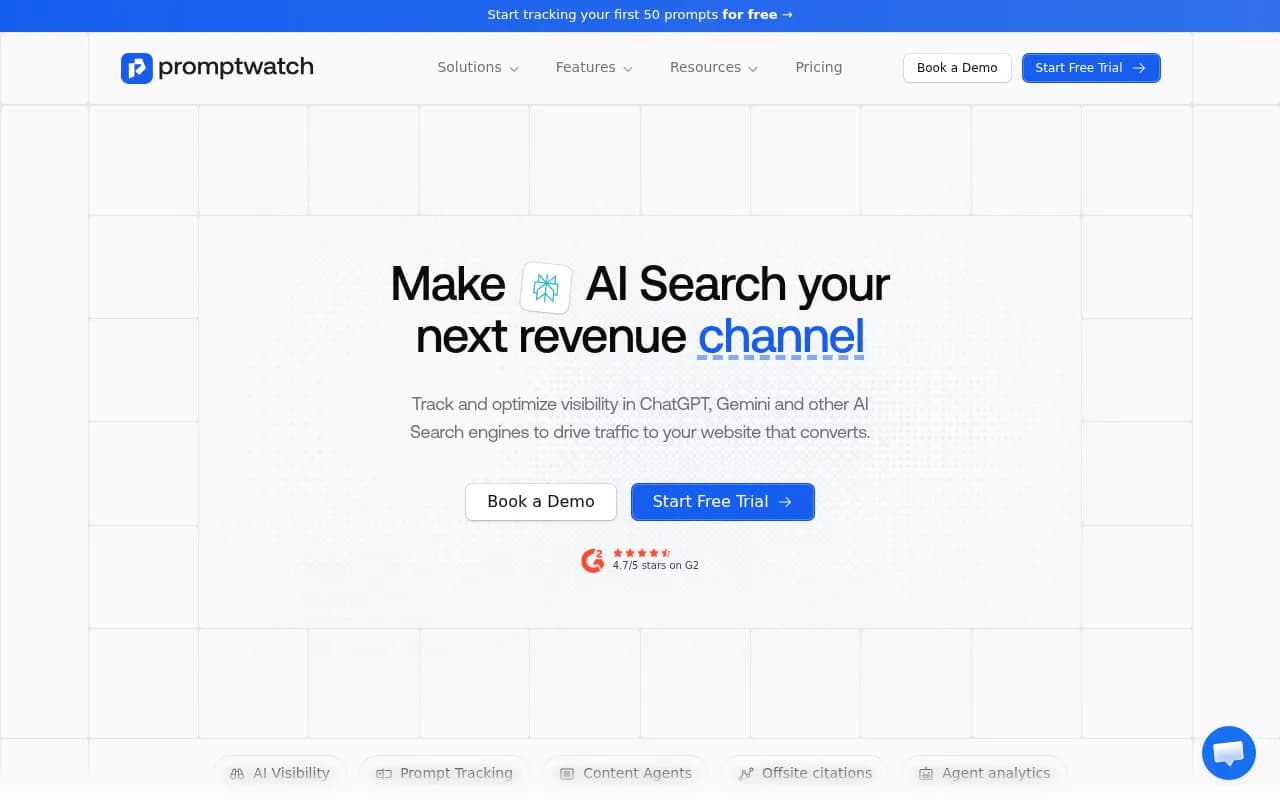
- Compared to Promptwatch, Bluefish lacks AI crawler logs, visitor analytics that tie AI visibility to actual traffic and conversions, Reddit and YouTube citation tracking, ChatGPT Shopping and Ads Radar, and automated content generation with CMS publishing. It measures and verifies; it does not close the loop by producing optimized content.
What Bluefish AI does
Bluefish, founded in 2024 by Alex Sherman, Jing Feng, and Andrei Dunca (a team that previously built and sold marketing platforms to Microsoft and Meta), pitches itself as "the AI marketing platform of choice for the Fortune 500." That's marketing-speak, but the customer list backs it up: Adidas, American Express, Hearst, LVMH, Ulta Beauty, and Tishman Speyer are named users, and the company says roughly 10% of the Fortune 500 is on the platform across 12+ verticals. With $68M raised in two years, including a $43M Series B in April 2026 co-led by Threshold Ventures and NEA, it has the funding and the logos to be taken seriously.
The platform is organized around five pillars: AI Monitoring, AI Optimization (GEO), GEO Measurement, AI Commerce, and AI Accuracy (the newest, launched May 2026). Coverage spans ChatGPT, Google AI Overviews and Gemini, Claude, Perplexity, Microsoft Copilot, and Amazon Rufus and Alexa for Shopping.
The features that actually matter
Impact Score and Influence Rank
Most AI visibility tools tell you whether you were mentioned. Bluefish's proprietary metrics try to answer a harder question: how much did the cited source actually shape the answer? An Impact Score weights how influential a citation is within the response, and Influence Rank grades the source's authority. This is a real attempt to move past share-of-voice counting, and it's the part of the product I'd point enterprise buyers to first. If you're a brand manager who needs to explain to a CMO why a competitor's third-place mention mattered more than your first-place one, this is the feature for that conversation.
AI Brand Vault and AI Accuracy
Launched together in May 2026, these two features are Bluefish's most original contribution. The Brand Vault is an enterprise-controlled repository of verified brand facts, specs, and messaging, structured so AI systems can ingest it as a source of truth. AI Accuracy then continuously extracts and verifies every factual claim AI systems make about your brand and flags hallucinations against Vault data. For pharma, financial services, and luxury brands, where an AI assistant inventing a product spec or a price is a genuine business risk, this is a capability most competitors simply don't have.
Collections
Collections (February 2026) groups owned content, earned media, and product pages into a single campaign-level view, so you can measure the AI-channel ROI of a launch or a repositioning effort using Impact, Frequency, and Influence Rank. It's a good idea in principle. In practice, it has a real limitation: there's no GA4, CRM, or conversion-data integration, so Collections shows citation and visibility lift but can't tie any of it to actual traffic, leads, or pipeline. You get AI-channel ROI in the visibility sense, not the revenue sense.
AI Commerce
Bluefish claims to be the only enterprise platform tracking both Amazon Rufus and Alexa for Shopping, and claims customers have seen product rankings climb over 550 positions in eight weeks after optimization. I can't independently verify that number, but the coverage itself is real and, as of late 2026, genuinely rare. If agentic commerce is a revenue line for your business, this alone justifies a demo call.
Where it falls short
No traffic or conversion attribution. This is the biggest gap. Bluefish tells you how AI systems talk about you, but not what that does to your website. There are no visitor analytics connecting AI platforms to actual sessions and conversions, and no AI crawler logs showing when ChatGPTBot or ClaudeBot visited your pages, what they read, or whether they hit errors. You're measuring influence without measuring impact on your own domain.
No content production loop. There's no content gap analysis feeding into automated content generation, no CMS publishing, no AI-generated optimization to-do list. Bluefish surfaces insights and automates some optimization workflows, but the actual content work is still on your team. Platforms like Promptwatch close this loop with Content Agents that plan, write, and publish GEO-optimized content directly to Webflow, Framer, or WordPress, plus Unified Actions that turn visibility data into a prioritized task list. Bluefish stops well short of that.
No Reddit or YouTube citation tracking. Given that Reddit was the single most-cited domain in ChatGPT Search responses in June 2026 at 3.71% share, per Promptwatch's citation share data, ignoring the two community platforms AI assistants lean on hardest is a strange omission for a monitoring platform at this price point.
No prompt volume or difficulty data. You can track custom prompts and audiences, but there's no monthly search volume, difficulty scoring, or query fan-out analysis to help you prioritize which prompts are worth fighting for.
Operational weight. An independent review put it well: the platform is "sized for teams that don't exist at most companies." Maintaining prompt groups, managing the Brand Vault, running Collections campaigns, and triaging alerts all require dedicated headcount. For a Fortune 500 brand team with 50+ marketers, that's fine. For everyone else, it's overkill.
Data portability. API access is restricted on lower tiers, and getting data out into other systems is reportedly difficult.
Pricing: the elephant in the room
There is no public pricing page, no self-serve tier, and no free trial. Everything is a sales demo and a custom quote. Third-party estimates (CheckThat.ai, March 2026) put annual contract values at $100K-$150K for a basic single-business-unit setup, $250K-$350K for expanded coverage with a dedicated CSM, and $500K+ for full enterprise. Bluefish's terms of service reportedly specify annual billing with non-refundable prepaid fees. One reviewer mentions entry tiers of $99-$799/month, but I'd treat that with skepticism given everything else points to enterprise-only contracts.
For comparison, Promptwatch's Professional plan runs $245/month with 150 prompts and 18,000 responses, and its agency tiers top out at $799/month with unlimited projects. If you're a mid-market team wanting to test whether AI visibility work moves the needle before committing six figures, Bluefish is the wrong door to knock on.
Who it's for
Bluefish AI is built for Fortune 500 CMOs, brand and PR teams, and commerce leaders with six-figure budgets and dedicated staff. Specifically:
-
Pharma, finance, and luxury brand teams who need hallucination monitoring and a verified brand-facts repository, and who face real regulatory or reputational risk when AI gets their facts wrong.
-
CPG and retail commerce teams who need visibility into Amazon Rufus and Alexa for Shopping and want to optimize product rankings inside agentic shopping experiences.
-
Enterprise PR and comms teams running major launches who need campaign-level AI visibility measurement through Collections.
It is not for SMBs, mid-market growth teams, agencies managing client portfolios, or anyone who needs to prove AI-driven revenue rather than AI-driven visibility. If you're an agency, the lack of white-label reporting and the per-brand cost structure make it a poor fit.
Bottom line
Bluefish AI is a well-funded, genuinely innovative enterprise platform with two features, the Brand Vault and AI Accuracy, that no one else in the category has nailed. Its Influence Rank methodology is a real step past raw mention counting, and its Amazon Rufus and Alexa coverage is unique. If you're a Fortune 500 brand with a dedicated team and a compliance-driven need for hallucination monitoring, put it on your shortlist.
For everyone else, the math doesn't work. At a reported $100K+ per year with no traffic attribution, no crawler logs, no content production, and no Reddit or YouTube tracking, you're paying enterprise money for a partial picture. Promptwatch covers the full stack, from crawler logs and visitor analytics through automated content generation and CMS publishing, at a fraction of the cost, and it's the better choice for mid-market teams, agencies, and any brand that wants to fix its AI visibility rather than just measure it. If you want to explore the broader category first, the GEO software directory at bestgeosoftware.com is a good starting point.
Frequently asked questions
How much does Bluefish AI cost?
Who uses Bluefish AI?
What AI platforms does Bluefish AI track?
What is the Bluefish AI Brand Vault?
Is Bluefish AI a good fit for small businesses or agencies?
How does Bluefish AI compare to Promptwatch?
Similar and alternative tools to Bluefish AI