Ranketta Review 2026
Tracks which products AI shopping engines recommend, enriches product feeds, and exposes data via an MCP server for AI agents.
Key takeaways
- Ranketta tracks AI visibility per SKU, not per brand. That is its main difference from generic AI visibility trackers, and it matters if you sell physical products from your own catalog.
- The merchandising module rewrites titles, descriptions and attributes, with a 0-100% confidence score on each proposal, and connects feeds to Google Merchant Center and marketplaces.
- It competes directly with Promptwatch, and it lacks several things Promptwatch has: IP-verified AI crawler logs, Reddit/YouTube/LinkedIn citation reports, prompt volume and difficulty scoring, query fan-outs, Search Console and Bing data per page, and CMS publishing to Webflow or Framer.
- Entry pricing is low (from EUR 29/month with a 7-day trial), but the cheap tiers are narrow: 2 models, 30 prompts per model, one site, one country.
- Best fit: online stores and D2C brands with their own GTINs and feeds. Weaker fit for content publishers, B2B teams, or anyone who needs deep AI-search analytics beyond products.
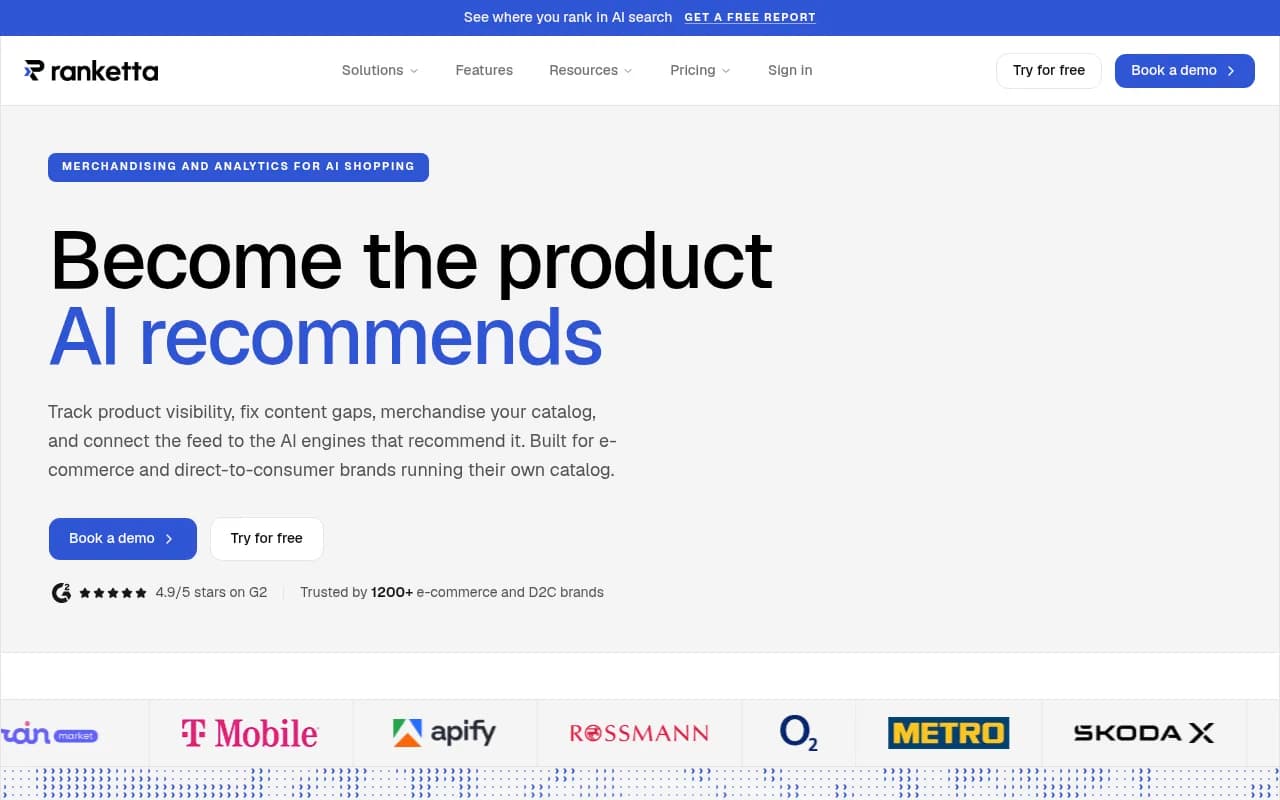
Ranketta is a merchandising and analytics platform for AI shopping, built by a Brno, Czech Republic team around founder Vojtech Oravec. It reportedly raised EUR 1M in pre-seed funding led by Lighthouse, according to LinkedIn posts from late 2025. The pitch is simple: most AI visibility tools count how often your brand name shows up in an answer, but if you run an online store, that doesn't tell you which of your 4,000 SKUs to fix. Ranketta tracks the products.
The platform covers ChatGPT, Google AI Overviews and AI Mode, Perplexity, Gemini, Claude, Copilot, Grok, Amazon Alexa and Meta Muse, depending on plan. It sits in the same broad category as Otterly.AI, AthenaHQ and Peec.ai, and it has been publishing comparison posts against those tools on its own blog. Those posts are vendor-authored, so read them with that in mind. The homepage claims 1,200+ e-commerce and D2C brands and a 4.9/5 rating on G2, where I saw roughly 20 reviews. Logos shown include T-Mobile, Rossmann, O2, E.ON, GymBeam and Apify.
The audience is clear from the product: e-commerce teams with their own catalog, D2C brands, and agencies reporting AI visibility for several clients. B2B and SaaS teams are also listed, though that use case feels like a secondary add-on.
Key features
Product-level tracking. This is the core. Ranketta shows which products in your category win AI recommendations and which get skipped. Metrics are mention frequency, ranking position and sentiment, and results are cross-validated across runs to reduce the noise of single snapshots. For a store with a large catalog, SKU-level data is the thing brand-level trackers can't give you.
Merchandising. An AI agent proposes rewrites for weak titles, generates descriptions where yours are thin, and maps products to the Google product taxonomy. According to Ranketta's own blog, it fills in missing GTINs where they can be derived confidently and flags broken fields like condition, currency and multipack markers. Each proposal gets a confidence score from 0 to 100%, which is a sensible way to avoid blindly accepting machine edits. Then the feed gets connected to the AI engines and storefronts.
Prompt research. For each prompt you track, Ranketta surfaces demand signals so you pick prompts that matter rather than guessing. It's less extensive than what Promptwatch does with monthly volumes, difficulty scores and query fan-outs, but it covers the basic need.
Citation tracking. You can see which domains AI cites in your category and target the ones that matter. Useful for outreach and content planning.
Content studio. Generates listicles, comparisons and guides built from the prompts you track. Nothing goes live without approval: you review, edit or reject any article before it syncs to your site.
Agent mode. An AI agent runs workflows from research to fixes. G2 describes a conversational interface where you ask things like where you're losing visibility, instead of clicking through dashboards. It draws from the shared credit pool.
AI traffic attribution. Via Cloudflare, Ranketta tracks AI bot visits at the edge and shows which models crawl your site and how often. Reporting can also pull from Google Analytics. This is the closest it gets to crawler analytics, though it's framed around bot visits rather than the full crawl-to-citation path.
MCP server and Looker Studio. The MCP server exposes tools like list_prompts, get_citations, run_site_audit, get_sentiment and list_products to Claude, Cursor or any MCP client. The Looker Studio integration pipes visibility metrics next to revenue and traffic.
Who is it for
The sweet spot is a mid-sized online store, say a supplement, cosmetics or electronics retailer with a few hundred to a few thousand SKUs, running its own GTINs and feeding Google Merchant Center. Shopify, Shoptet, Adobe Commerce, Wix and BigCommerce integrations are listed, plus Amazon and Walmart on the marketplace side. D2C brands where the brand is the product also fit, since Ranketta tracks how AI describes both.
Agencies are the second persona. Agency plans include unlimited client seats, white-label reports, a partner portal and API access at higher tiers, which is a reasonable setup for a shop reporting AI visibility on 10 to 25 e-commerce clients.
Who should skip it? Publishers, SaaS companies and service businesses that care about brand mentions, Reddit and YouTube citations, or technical AI crawlability will find it thin. If you need volume data, query fan-outs, Search Console overlays or heavy-duty crawler logs, look elsewhere. Teams outside Europe may also care that pricing is in EUR.
Integrations and ecosystem
- Commerce platforms: Shopify, Shoptet, Adobe Commerce, Wix, BigCommerce.
- Marketplaces and feeds: Amazon, Walmart, Google Merchant Center.
- Analytics and infrastructure: Google Analytics, Cloudflare, Looker Studio.
- AI engines: ChatGPT, AI Overviews, AI Mode, Gemini, Perplexity, Copilot, Claude, Grok, Alexa, ChatGPT Ads.
- Developer access: a hosted MCP server and API access (Growth tier on agency plans). Public docs live at docs.ranketta.com.
Custom feeds can be mapped through a demo request. The agency pricing page also lists Search Console, though I couldn't confirm which tier gets which integration. Check that before buying.
Pricing and value
Pricing is in EUR, with a 7-day free trial on every plan and annual billing giving 2 months free.
Online stores
- Tracker: EUR 29/month. 2 AI models, 30 prompts per model, one website, one country.
- Starter: EUR 79/month. Choose 3 models.
- Growth: EUR 199/month. Choose 4 models.
- Scale: EUR 449/month.
Brands
Tracker EUR 29, Starter EUR 69, Growth EUR 169, Scale EUR 399 per month.
Agencies
- Tracker: EUR 149/month. 2 models, 3 websites, 100 prompts per model.
- Starter: EUR 299/month. 3 models, 10 websites, 300 prompts per model, 5k credits, Agent Mode, white-label reports.
- Growth: EUR 599/month. 4 models, 25 websites, 500 prompts per model, 15k credits, API access, Slack support.
- Enterprise: custom, with SLA, SSO and a dedicated AEO specialist.
Merchandising, Agent Mode and article generation share a credit pool. Extra credits cost EUR 1 per 1,000, with packs from EUR 10/month. Claude, Copilot, Alexa, Grok and Meta Muse are marked Premium and aren't available on entry plans.
Value-wise, EUR 29 is cheap for a starting point and the 7-day trial lowers risk. For comparison, Promptwatch's Essential plan is $95/month and includes all AI models, a site audit, content gap analysis, crawler and visitor analytics and MCP/API access. Ranketta is cheaper at the bottom, but you get less.
Strengths and limitations
Strengths
- SKU-level focus. Few competitors track visibility per product, and it's the right unit for retail.
- Product data fixes. Feed enrichment with confidence scores addresses the cause, not just the symptom.
- Low entry price with a free trial.
- Open access for agents. The MCP server and Looker Studio connector make it easy to fold data into existing workflows.
- Approval control. Nothing publishes without sign-off.
Limitations
- Entry plans are narrow, and several major engines are locked behind Premium.
- The shared credit pool can drain quickly if you lean on Agent Mode and article generation.
- G2 reviews are few (about 20) and all the snippets I saw were positive, so there's little independent criticism to evaluate.
- It's narrower than a full GEO platform.
What it lacks compared to Promptwatch
Ranketta competes directly with Promptwatch, and the gaps are real. Based on public materials, Ranketta doesn't show:
- IP-verified AI crawler logs with a crawl-to-citation path and spoofed-bot filtering (it has Cloudflare-based bot visit tracking, which is lighter).
- Prompt volumes, difficulty scores and query fan-outs.
- Google Search Console and Bing Webmaster data overlaid per page with AI crawls and citations (360 Insights).
- Dedicated Reddit, YouTube and LinkedIn citation reports, plus Citation Trends by content type.
- Page-level tracking and Offsite Mentions.
- A Content Agent with scheduled publishing to WordPress, Webflow and Framer, plus the Action Board.
- Local GEO/SEO targeting at exact coordinates and coding agent visibility (Codex, Claude Code, OpenCode).
- ISO/IEC 27001 certification, which matters for enterprise procurement.
Promptwatch also tracks real UIs across 15+ engines and has far larger data scale (26.5B+ citations, prompts and clicks analyzed). Ranketta's edge is the catalog and feed work, which Promptwatch doesn't center on.
Bottom line
If you run an online store with your own catalog and feed, Ranketta is worth a trial. The SKU-level tracking and feed enrichment target the thing that actually decides whether AI recommends your products, and EUR 29 to start is easy to justify. Agencies serving e-commerce clients will find the multi-client setup practical.
If you want optimization beyond product data, meaning crawler logs, citation sources on Reddit and YouTube, traffic attribution, content gap analysis and automated publishing, Promptwatch is the stronger alternative. Best use case in one sentence: a mid-sized online store fixing product titles, GTINs and attributes so AI shopping engines start recommending specific SKUs.
For more options, the GEO software directory at bestgeosoftware.com (https://bestgeosoftware.com) lists comparable platforms.
Frequently asked questions
What is Ranketta?
How much does Ranketta cost?
How is Ranketta different from brand-level AI trackers?
Does Ranketta have an MCP server and integrations?
How does Ranketta compare to Promptwatch?
Can Ranketta guarantee a ChatGPT recommendation?
Similar and alternative tools to Ranketta