Key Takeaways
- Jewelry and luxury buyers ask AI for shortlists ("best lab-grown engagement ring retailers"), and the answer often names resellers and marketplaces before the brand itself.
- Product pages and landing pages are the most cited content types in ChatGPT, so specs like metal, carat, certification, and price matter more than brand storytelling.
- Pick a tool by what it changes: monitors report, product-level trackers show which SKUs lose, and optimization platforms help fix and publish.
- Instagram and YouTube matter mostly for Google AI Overviews. ChatGPT barely cites social platforms now.
- Verify all pricing on vendor sites. This category moves monthly.
Why jewelry and luxury need a different GEO approach
A shopper types "best place to buy a vintage-style sapphire ring under $5,000" into ChatGPT. The answer names four retailers, a gemological guide, and a marketplace. Maybe your brand is in there. Maybe not. And if it is, maybe the answer says your pieces are "pricey" or gets your metal wrong.
That is the GEO problem for luxury. The purchase is high consideration, research-heavy, and trust-driven. Buyers ask about certification, ethical sourcing, resale value, and craftsmanship. AI engines answer in prose and cite a handful of sources, so who gets named matters a lot.
A few things make this category awkward for generic GEO advice:
- Brand names often double as common words or surnames, which breaks naive mention tracking.
- Resellers, auction houses, and review sites tend to dominate "best of" answers.
- Facts are high stakes. A wrong carat weight or a false claim about sourcing is a brand risk, not just a missed mention.
- Luxury brands often restrict discounting and syndication, so product data lives in fewer places than in mass retail.
The 5WPR agency published a Luxury Watches AI Visibility Index in 2026 that tested more than 60 consumer prompts across ChatGPT, Claude, Perplexity, Gemini, and Google AI. I could not verify its findings from the page, so treat it as a sign that PR firms are watching this space rather than as a data source.
What AI engines actually cite for luxury queries
Before choosing a tool, know what you are trying to move. Promptwatch Data analyzed ChatGPT citations from Sep 28 to Oct 4, 2026:
| Content type | Share of ChatGPT citations |
|---|---|
| Product pages | 22.4% |
| Landing pages | 16.8% |
| Listicles | 13.6% |
| How-tos | 8.7% |
| Documentation | 7.5% |
| Articles | 6.1% |
| Comparisons | 5.9% |
| News | 5.7% |
| FAQ | 3.3% |
| Reviews | 1.7% |
For commercial prompts like "best X" shortlists, product pages hit 26.0%, landing pages 20.6%, and listicles 15.0%. For branded prompts (someone asking about your brand by name), reviews rise to 5.6%, more than three times their overall share, and FAQ pages reach 4.8%.
The practical read for jewelry: your product pages are the main citation surface. Materials, carat, metal, dimensions, price, and certification need to be complete and factual in plain HTML. Get into the "best of" roundups AI already cites. Collect reviews on trusted sites. Publish a real brand FAQ.
There is no jewelry-specific Promptwatch report yet. The nearest sector data is automotive from August 2026, where marketplaces like Autotrader and Cars.com outrank every car brand. It would not surprise me if jewelry resellers behave the same way, but that is an inference, so test it on your own prompts.
Social is a Google story, not a ChatGPT story
Luxury brands pour effort into Instagram. Fair, but know where it pays off. In Promptwatch's social citation data for Sep 28 to Oct 4, 2026, all social platforms together made up just 0.46% of ChatGPT citations. Google AI Overviews drew 12.2% of its citations from social: YouTube 4.28%, Facebook 2.38%, Reddit 2.15%, Instagram 1.61%. If your buyers use Google, video and Instagram profiles still help. For ChatGPT, don't count on them.
The four kinds of GEO tool
Veristyle's November 2026 guide to fashion and beauty GEO tools sorts the market usefully by what each tool actually changes. I will borrow the logic, since it maps well to luxury.
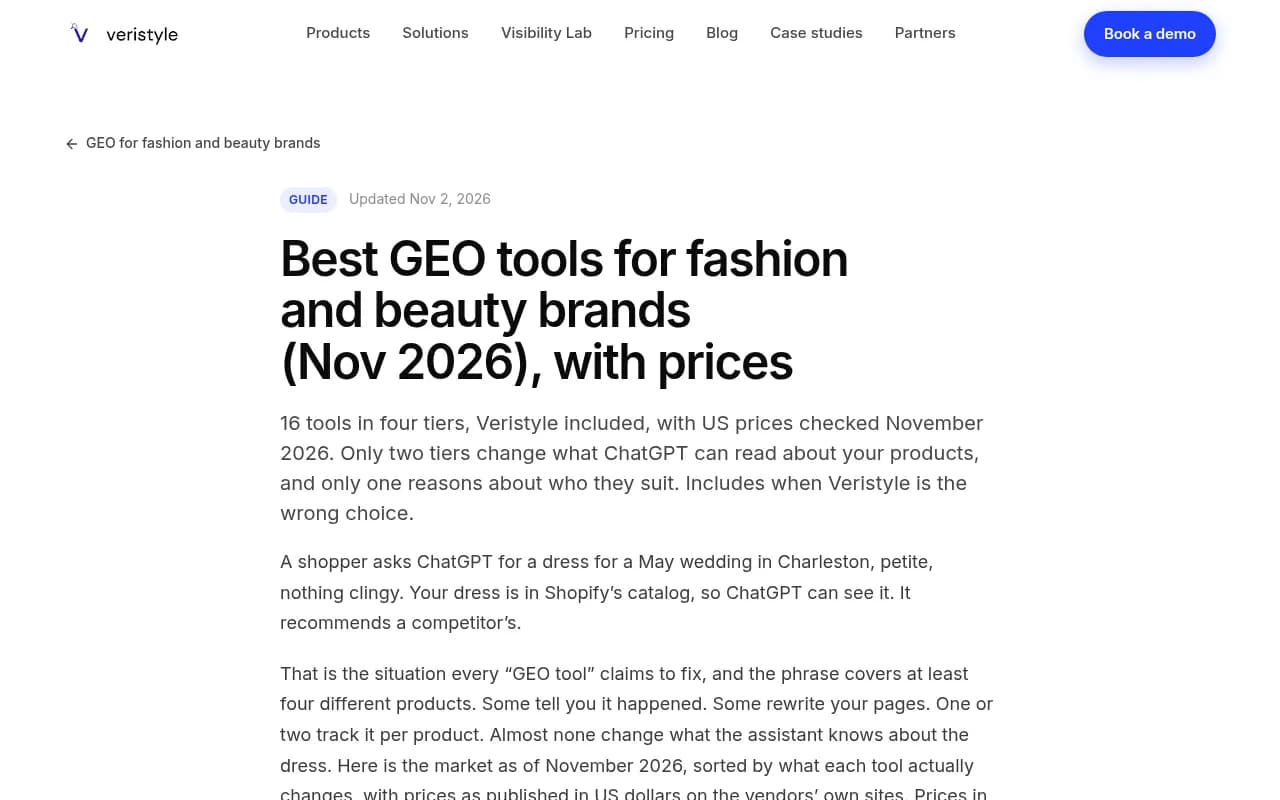
- Monitors run prompts and report mentions, citations, sentiment, and share of voice. They change nothing.
- Monitors plus page-level fixes add content agents, schema, and site audits.
- Product-level trackers report visibility per SKU, not just per brand.
- Platforms that touch the product data AI reads, such as feeds and catalogs.
For a jewelry brand with 40 hero pieces and a few hundred SKUs, the SKU view is genuinely useful. Knowing your brand is mentioned 30% of the time tells you little. Knowing your halo-cut pendant loses to a competitor's every time tells you where to work.
Best GEO tools for jewelry and luxury brands
Promptwatch: monitoring through to published fixes
Promptwatch is an end-to-end AI visibility platform rather than a dashboard. It tracks ChatGPT, Gemini, Claude, Perplexity, Google AI Overviews, AI Mode, Copilot, and others from the real interfaces, then traces which of your pages get cited and where competitors win instead. From there the Action Board lists what to fix, and the Content Agent can write and publish pages to WordPress, Webflow, or Framer. Visitor analytics and IP-verified crawler logs show whether the fix got crawled, cited, and clicked.
Several features fit luxury specifically:
- Brand Narrative pulls out the individual claims AI makes about you ("timeless but expensive", "ethically sourced") and scores them by theme, so you see reputation drift.
- Fact Check lets you mark a claim inaccurate and finds the page AI is learning it from (Business plan and up).
- Brand Book analysis instructions handle brand names that are also common words.
- Local GEO targeting at exact coordinates suits boutiques and flagship stores for "jeweler near me" queries.
- Offsite Mentions catch third-party roundups naming you without a link.
Plans run from Essential at $95/mo to Business at $579/mo, which is the first tier with the Content Agent, Fact Check, and local targeting. Confirm at promptwatch.com/pricing. There is a 7-day free trial and a free AI visibility report if you want a baseline first.

Peec AI: product-level tracking with Shopify import
Veristyle singles out Peec AI as the clearest product-level tracker, priced from $95 to $495 with Shopify catalog import on every tier. For jewelry brands on Shopify with a defined catalog, that is a fast route to a per-SKU picture. It is a tracker, so you still need a separate way to act on what it finds.

Alhena AI: ecommerce catalogs and fashion customers
Alhena is enterprise-priced (unpublished) and per Veristyle has the strongest fashion and beauty customer list it found. It pairs tracking with on-site assistants. A fit if you want visibility data and a shopping assistant from the same vendor.
Yotpo Discover: catalog and reviews
Reviews matter more than usual in branded luxury prompts, and Yotpo sits on review data. Discover is positioned as catalog-native, though Veristyle notes it does not publish exactly what it tracks. Ask for specifics in a demo.
Yotpo Discover
Profound: enterprise monitoring and fixes
Profound is aimed at large brands. Per Veristyle, its self-serve tiers were removed in September 2026, so it is now a trial or enterprise contract. Strong analytics, but expect a sales process and a higher price point.

AthenaHQ, Scrunch, and Otterly
AthenaHQ (around $295 per Veristyle, with a Shopify integration) adds content and schema work to monitoring. Scrunch ($250 to $500) pairs monitoring with a service that serves an AI-friendly copy of your site to crawlers. Otterly ($29 to $489 by prompt count) is the clean, cheap start for teams new to GEO. A Reddit tester roundup also called Otterly the simplest starting point.



Semrush and Ahrefs Brand Radar
If you already live in an SEO suite, Semrush's AI Visibility Toolkit ($99 for 25 prompts on one domain) and Ahrefs Brand Radar (from $50) are low-friction add-ons. Fixed prompt sets and shallower AI-specific data are the trade-off.

Naridon and Goodie for Shopify and SKU work
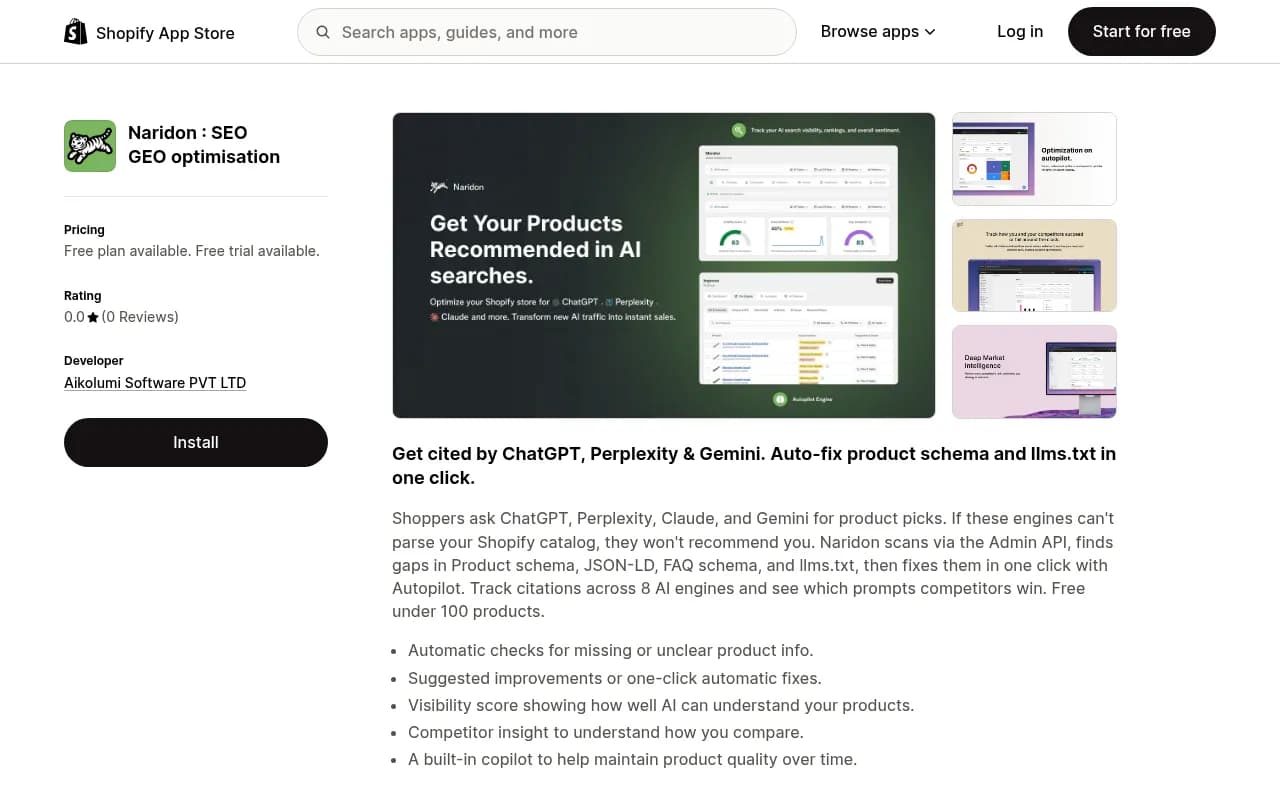
Naridon ($1,049 to $5,099 per Veristyle) publishes product-page edits with an undo log. Goodie ($295 to $999) offers SKU-level visibility on its Pro tier. Both are worth a look for catalog-heavy Shopify stores, though Naridon is a serious spend.


Comparison table
Prices are as published in the sources above and change often. Check each vendor.
| Tool | Type | Starting price (published) | Best for |
|---|---|---|---|
| Promptwatch | Monitor, fix, publish, measure | $95/mo | Brands that want to close the loop |
| Peec AI | Product-level tracker | $95/mo | Shopify jewelers wanting SKU data |
| Alhena AI | Tracker plus on-site assistant | Enterprise | Fashion and beauty enterprises |
| Yotpo Discover | Catalog and reviews | Unpublished | Review-heavy brands |
| Profound | Enterprise monitor and fixes | Trial or contract | Large global brands |
| AthenaHQ | Monitor plus page fixes | About $295/mo | Teams with Shopify |
| Scrunch | Monitor plus AI-ready site copy | $250/mo | Brands with crawl issues |
| Otterly.AI | Monitor | $29/mo | First-time GEO buyers |
| Semrush AI Visibility | Monitor in SEO suite | $99/mo | Existing Semrush users |
| Ahrefs Brand Radar | Monitor in SEO suite | From $50/mo | Existing Ahrefs users |
| Naridon | Shopify page edits | $1,049/mo | Large Shopify catalogs |
How to choose
Start with the catalog size
Under 50 key pieces, brand-level tracking with good fixes is usually enough. Hundreds of SKUs across collections, go product-level. A tool that scores the brand at 22% visibility without telling you which rings lose is a pretty chart and little else.
Check what happens after the report
Most tools stop at monitoring. Ask whether the vendor helps you write the missing product copy, FAQ, or comparison page, and whether it tells you if the page got crawled and cited afterwards. That last step is where IP-verified crawler logs and page tracking earn their keep.
Test your own prompts first
Build 30 to 50 prompts across buyer types: engagement ring shoppers, gift buyers, collectors, resale researchers. Include branded, competitor, and "best of" queries. Run them in a free report or trial before committing. Personas help here, since a gift buyer and a collector ask very differently.
Watch for reseller and marketplace dominance
If resellers outrank your own site in citations, a brand-site fix alone will not change the picture. You need to be present and accurate on those third-party pages, and in the roundups AI trusts. Offsite mention tracking and outreach tools matter more than usual here.
A simple 30-day plan
- Week 1: run a baseline across ChatGPT, Gemini, Perplexity, and AI Overviews for 40 prompts. Record visibility, position, and sentiment.
- Week 2: audit your top 20 product pages for complete specs, certification details, price, and plain-HTML content. Check that AI crawlers can read them with a free tool like the Agentic Readiness Check.
- Week 3: publish or fix a brand FAQ, care and sourcing pages, and comparison content. Pitch the listicles already being cited.
- Week 4: re-run the prompts, compare, and look at which pages got crawled and cited.
If you want more options, the GEO software directory at bestgeosoftware.com lists a wider set of tools.
Final thoughts
For luxury, the winning move is rarely a new dashboard. It is accurate, complete product data on pages AI can read, presence in the roundups it trusts, and a way to catch false claims early. Pick the cheapest tool that does the part you cannot do yourself. For a small catalog that may be Otterly plus careful page work. For a large one, a platform that tracks per product and publishes fixes will pay for itself faster.