Naridon Review 2026
Shopify app that improves product content, metadata, and structure so AI search engines better understand and cite a store.
Key takeaways
- Naridon is a Shopify-only app that pairs GEO monitoring with one-click fixes to product schema, JSON-LD, FAQ schema and llms.txt through its Autopilot feature.
- Compared with Promptwatch, it lacks IP-verified AI crawler logs, Reddit, YouTube and LinkedIn citation tracking, prompt volumes and difficulty scoring, Search Console and Bing data, and a CMS-publishing Content Agent that works beyond Shopify.
- The listing has zero reviews and a 0.0 rating after a February 13, 2026 launch, so there is no independent track record yet.
- Pricing is inconsistent between sources, and the $249 and $899 tiers are steep for a new, Shopify-only, English-only app.
- Best fit: small and mid-size Shopify stores that want fixes applied to product data and are fine with an unproven vendor.
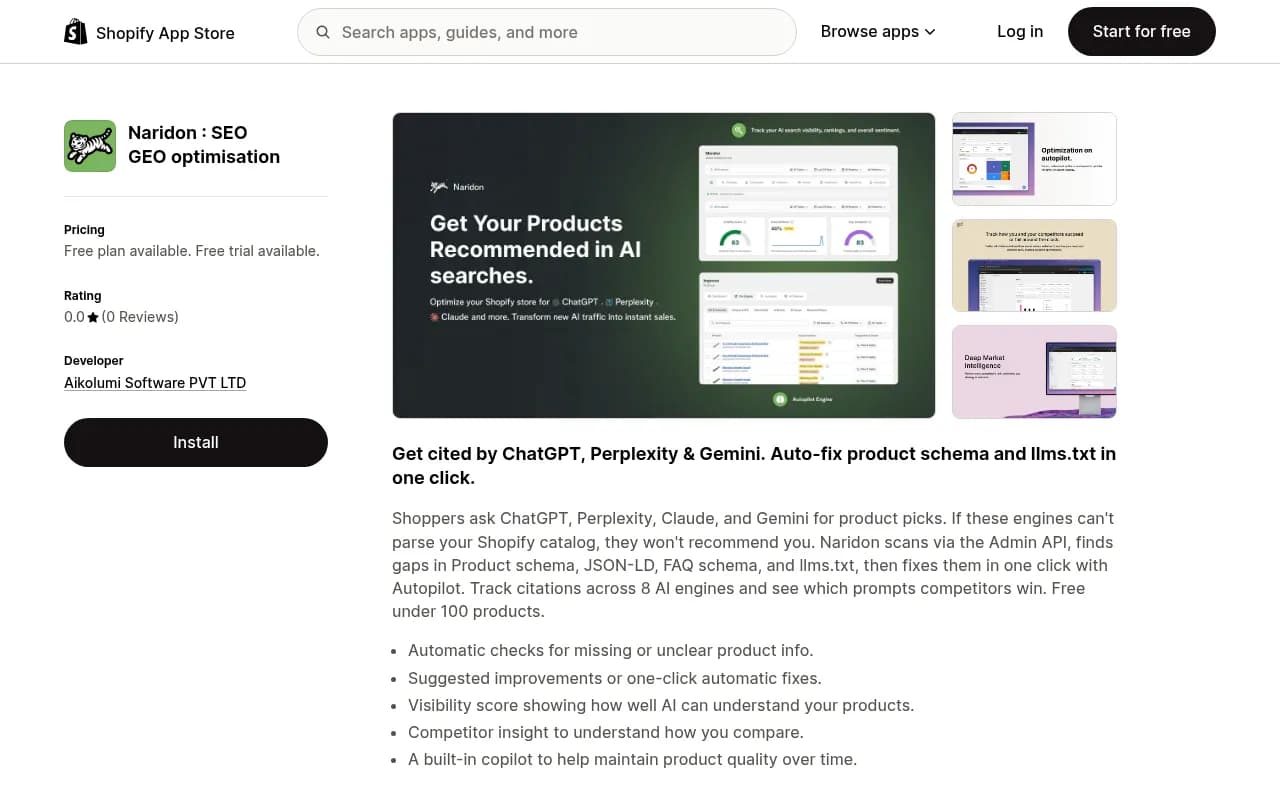
Naridon (listed as "Naridon : SEO GEO optimisation") is a Shopify app from Aikolumi Software PVT LTD, a small developer based in Wayanad, Kerala, India. It went live on the Shopify App Store on February 13, 2026. The pitch is simple: shoppers now ask ChatGPT, Perplexity, Claude and Gemini for product picks, and if those engines cannot parse your catalog, they will not recommend you. Naridon scans the store, finds the gaps, and writes the fixes back.
The target audience is Shopify merchants, mostly small and mid-size brands. The vendor's own blog describes the sweet spot as brands with roughly $1M to $50M in GMV. That is a vendor claim, not something I could verify, but it matches the price points.
What makes Naridon interesting is the closed loop. Most GEO tools tell you that you are invisible. Naridon tries to edit the store itself. That is a real advantage for a merchant with no developer on call, and also a real risk, because an app that edits products, theme files and script tags needs to be trusted.
Key features
Autopilot. This is the headline feature. According to the vendor homepage, Autopilot runs a daily loop: it detects a lost citation, drafts a fix, checks the fix against the live engine, ships it to Shopify, and tracks the result. It writes product page copy, FAQ blocks and JSON-LD directly to the store. The "verify before publish" step is the claimed differentiator. I could not independently confirm how rigorous that verification is, so treat it as a marketing claim until you test it on a few SKUs.
Catalog scanning through the Admin API. Naridon reads your products and flags missing or unclear data: absent Product schema, thin descriptions, broken or missing FAQ schema, no llms.txt. Because it works at the product level rather than the domain level, the output is actionable for a merchant. You see which SKUs have problems, not just a vague score.
Schema and llms.txt fixes. The one-click fixes cover Product schema, JSON-LD, FAQ schema and llms.txt. The app's category tags also mention sitemaps, meta tags, rich snippets, robots.txt and AI generation. Applying or reverting a fix is said to cost 0 credits on the homepage, which is a sensible design if true, since you can experiment without burning allowance.
Citation tracking. The listing says it tracks citations across 8 AI engines. The homepage names ChatGPT, Perplexity, Gemini, Claude and Copilot, plus Google AI Overviews and the Shop app, while the Pro tier says 7+ models. The counts do not match across sources, so ask what is actually monitored on your plan. Tracking is SKU-level and refreshed daily on paid tiers; the free tier runs monthly.
Prompt tracking and competitors. You choose the prompts to watch (5 on free, 25 on Starter, 100 on Growth, 500+ on Pro) and the competitors to compare against (3, 3, 10 and 100+). The homepage mentions personas and target markets for prompts. You can see which prompts competitors win, which is the useful part.
Visibility score and Market Intelligence. A visibility score summarizes how well AI can understand your products. A Market Intelligence hub covers competitor sentiment, and paid plans include tracked social mentions (25, 200 and 1,000 by tier).
Copilot. A built-in chat assistant helps maintain product quality over time. Chat allowances run from 750 on Starter to 3,000 on Growth. It is a convenience layer, and I would not buy the app for it.
Attribution. The homepage describes a view of AI-assisted sessions, orders and revenue. Shopify merchants care about revenue more than mention counts, so this matters. The data access list shows it edits web pixels and analytics, which is how it likely does this.
Who is it for
The core user is a Shopify store owner or small ecommerce team with a few hundred to a few thousand products who knows AI search matters but has no time to hand-edit JSON-LD. Think a DTC skincare brand with 150 SKUs, or a home goods store with a part-time marketer. The free plan, which the listing says is free under 100 products, lets a tiny store try it without commitment.
It fits Shopify-centric brands best. Fashion, beauty, home, food and other product-led categories benefit most, since product pages are the content type AI engines cite most often. Promptwatch Data found product pages were the most cited content type in ChatGPT, at 22.4% of citations from Sep 28 to Oct 4, 2026 (report). Clean product data is therefore the right thing to fix.
Who should skip it? Agencies running many clients on different platforms, since it is Shopify-only. Merchants selling in multiple languages, since it is English-only. Teams that need to understand why AI does or does not cite them, including crawler behavior and off-site sources like Reddit, YouTube and LinkedIn. And anyone who needs proven reliability, given zero public reviews. Letting a brand-new app edit your products and theme is a decision to make carefully, ideally on a test store first.
Integrations and ecosystem
Naridon is built entirely around Shopify. It works with Shopify Admin and Checkout, and it requests broad permissions: edit products, collections, Online Store pages, theme and script tags, web pixels and analytics, files, locales and navigation, plus view customer and staff data. Read the data access list before installing. That scope is what lets Autopilot write fixes, but it is also a lot of trust to extend to a new developer.
The docs site at docs.naridon.com includes a FAQ, tutorials, a changelog and a privacy policy. API access and custom reporting are reserved for the $899 Pro plan. I found no Zapier, Slack or Looker Studio integration, no browser extension and no mobile app. I also did not find official X, GitHub, Discord or LinkedIn accounts.
Pricing and value
Pricing is the muddiest part of this review. The Shopify listing shows four plans, billed in USD every 30 days, with a 7-day trial on paid tiers:
- Free: 5 prompts, monthly runs, 3 competitors, 20 auto-fix suggestions per month.
- Starter, $49/mo ($468/yr): 25 prompts, daily runs, 3 competitors, 100 auto-fix suggestions, 750 copilot chats, 25 social mentions, email support.
- Growth, $249/mo ($2,388/yr): 100 prompts, 10 competitors, 500 auto-fix suggestions, 3,000 copilot chats, 200 social mentions, priority support and reports.
- Pro, $899/mo ($8,724/yr): 500+ prompts, 100+ competitors, 2,000+ auto-fix suggestions, all 7+ models, 1,000 social mentions, a dedicated account manager, custom reporting and API access.
The vendor's blog describes pricing as credit-based, with Starter at 3,000 credits, though one comparison post quotes "$399+/mo", which conflicts with the $49 figure. Confirm current numbers on the listing before you buy.
On value: the jump from $49 to $249 is large, and 100 prompts for $249 is not cheap. A competing Shopify app, PARA Onsite AEO & GEO, is listed at $149/mo. Promptwatch's Essential plan is $95/mo for 50 prompts across all AI models, with country tracking, site audit, content gap analysis and 500 Agent Credits, and its Professional plan is $245/mo for 150 prompts. Those are not Shopify-write tools, but they show what monitoring and analysis cost elsewhere. Confirm Promptwatch pricing at promptwatch.com/pricing.
Strengths and limitations
Strengths
- Fixes, not just reports. Writing schema, FAQ blocks and llms.txt straight into Shopify removes the developer bottleneck.
- SKU-level view. Product-level tracking matches how ecommerce actually works.
- Low entry point. A free tier and a $49 Starter plan make a trial cheap.
- Reversible fixes. The vendor says applying and reverting costs no credits.
- Revenue framing. Attribution of AI-assisted sessions and orders is aimed at merchants, not SEO specialists.
Limitations
- No track record. Zero reviews, a February 2026 launch, and an engine count and pricing that differ between the listing and the vendor's site.
- Narrow scope. Shopify-only and English-only.
- Pricey upper tiers. $249 and $899 per month are hard to justify without proof.
What it lacks compared with Promptwatch
Naridon is a direct competitor to Promptwatch in GEO, and the gap is visible. I found no evidence of these in Naridon:
- IP-verified AI crawler logs and a crawl-to-citation path per page, which show whether GPTBot, ClaudeBot or PerplexityBot can actually read your pages.
- Prompt volumes, difficulty scores and query fan-outs.
- Reddit, YouTube and LinkedIn citation reports, and offsite mentions tracking.
- Google Search Console and Bing Webmaster data overlaid on AI data.
- A Content Agent that plans, writes and publishes articles to WordPress, Webflow or Framer, plus an Action Board and Agent Chat.
- Real-UI tracking of 15+ AI engines including Google AI Mode, Amazon Alexa and coding agents like Codex and Claude Code.
- AI Shopping and Ads Radar for ChatGPT shopping carousels and sponsored placements.
- White-label reporting and agency plans.
That said, Promptwatch does not auto-edit Shopify product schema in the way Naridon claims to, so the tools overlap rather than substitute perfectly.
Bottom line
Naridon is a sensible idea executed by a very young vendor. If you run a small Shopify store and want product data cleaned up for AI engines without touching code, the free tier is worth a test, ideally on a development store or a handful of SKUs. Watch what Autopilot writes before letting it run unattended.
If you need to understand why AI does or does not cite you, measure traffic and revenue from it, and act across content, Reddit, YouTube and crawler access, Promptwatch is the stronger choice, with 1,840+ brands and a 4.7/5 G2 rating behind it. For more options, browse the GEO software directory at bestgeosoftware.com.
Best use case: a small Shopify brand that wants schema, FAQ and llms.txt fixes applied automatically and can tolerate an unproven vendor.

Frequently asked questions
What is Naridon?
How much does Naridon cost?
Does Naridon have a free plan?
Which AI engines does Naridon track?
How does Naridon compare to Promptwatch?
Is Naridon proven?
Similar and alternative tools to Naridon