Key takeaways
- 82% of Americans now use AI tools for housing market research and property shopping, according to realtor.com's 2025 AI and housing survey, which means your brand's visibility inside ChatGPT and Gemini matters almost as much as your Zillow profile.
- Generative Engine Optimization (GEO) for real estate is different from national ecommerce GEO: it's hyperlocal, tied to neighborhood and ZIP-level queries, and heavily influenced by reviews, local citations, and Google Business Profile data.
- Full-service agencies (First Page Sage, Luxury Presence, Real Estate Webmasters) handle GEO as part of a broader marketing retainer, while dedicated software platforms like Promptwatch let agents and brokerage marketing teams track and act on AI visibility themselves, at a fraction of the agency cost.
- There's real disagreement in the data about which sources AI models trust most for real estate. Some tracking tools show Zillow cited in nearly 40% of ChatGPT real estate responses; others show almost none. That inconsistency is exactly why agents need their own tracking, not just a single third-party claim.
- Consistency, not a one-time push, is what NAR's own reporting flags as the deciding factor: agents who keep publishing fresh, locally specific content get recommended by AI more often than agents who do a single GEO sprint and stop.
Why real estate agents suddenly need to care about GEO
A year ago, most agents hadn't heard the term GEO. Now it's showing up in NAR's own newsletter. NAR profiled Rick Janson, a Compass luxury agent in Denver, who landed a client that found him through a Gemini search for "Denver real estate agents." Not a Google search. A conversation with an AI assistant that returned his name.
That's the shift. Buyers and sellers are increasingly treating ChatGPT, Gemini, and Google's AI Overviews as a first research stop, the same way they used to open Zillow or type a query into Google and scroll ten blue links. Realtor.com's own research puts the number of Americans using AI for housing research at 82%, which is high enough that it should change how a brokerage marketing team allocates budget this year.
I'll be upfront that this isn't a clean, settled picture. Different tracking methodologies disagree on basic facts, like which sites AI models cite most for real estate queries. Some tools report Zillow showing up in close to 40% of ChatGPT responses about agents and listings; others, measuring from different prompt sets, report almost zero Zillow citations. That's not a minor rounding error, it's a sign the space is still shaking out and that any single data point should be treated skeptically until you check it against your own market and your own prompts.
What "local GEO" means for real estate specifically
GEO for a SaaS company is about getting cited for product category queries. GEO for a real estate agent is almost entirely local and almost entirely about trust signals. When someone asks an AI assistant "who's the best realtor in [neighborhood]" or "which agent specializes in [ZIP code] condos," the model is pulling from a mix of:
- Your Google Business Profile and the reviews attached to it
- Local news mentions, brokerage directory pages, and neighborhood guide content
- Your own website, if it has specific, well-structured content about the areas you serve
- Third-party real estate platforms (Zillow, Realtor.com, Redfin) where your listings and agent profile live
- Social proof signals like testimonials, case studies, and sometimes Reddit threads about local agents
This is why generic SEO advice doesn't fully transfer. A national SaaS brand worries about being cited for broad category terms. An agent in Austin needs to be the answer to "best realtor for first-time buyers in East Austin," which is a much narrower, much more local question, and one that most AI visibility platforms aren't built to track out of the box.
Two paths: managed GEO agencies vs. self-serve platforms
Brokerages and agents are solving this problem two different ways, and it's worth being clear about which one fits your situation before you pick a tool or sign a contract.
Full-service real estate GEO agencies
First Page Sage's 2026 ranking of real estate GEO/AEO agencies scores firms on AI visibility, real estate-specific expertise, regional coverage, reputation, and client retention. Their top five, in order, were First Page Sage itself, Siana Marketing, Genevate, Luxury Presence, and Real Estate Webmasters, with notable clients including Corcoran, Compass, and Coldwell Banker.
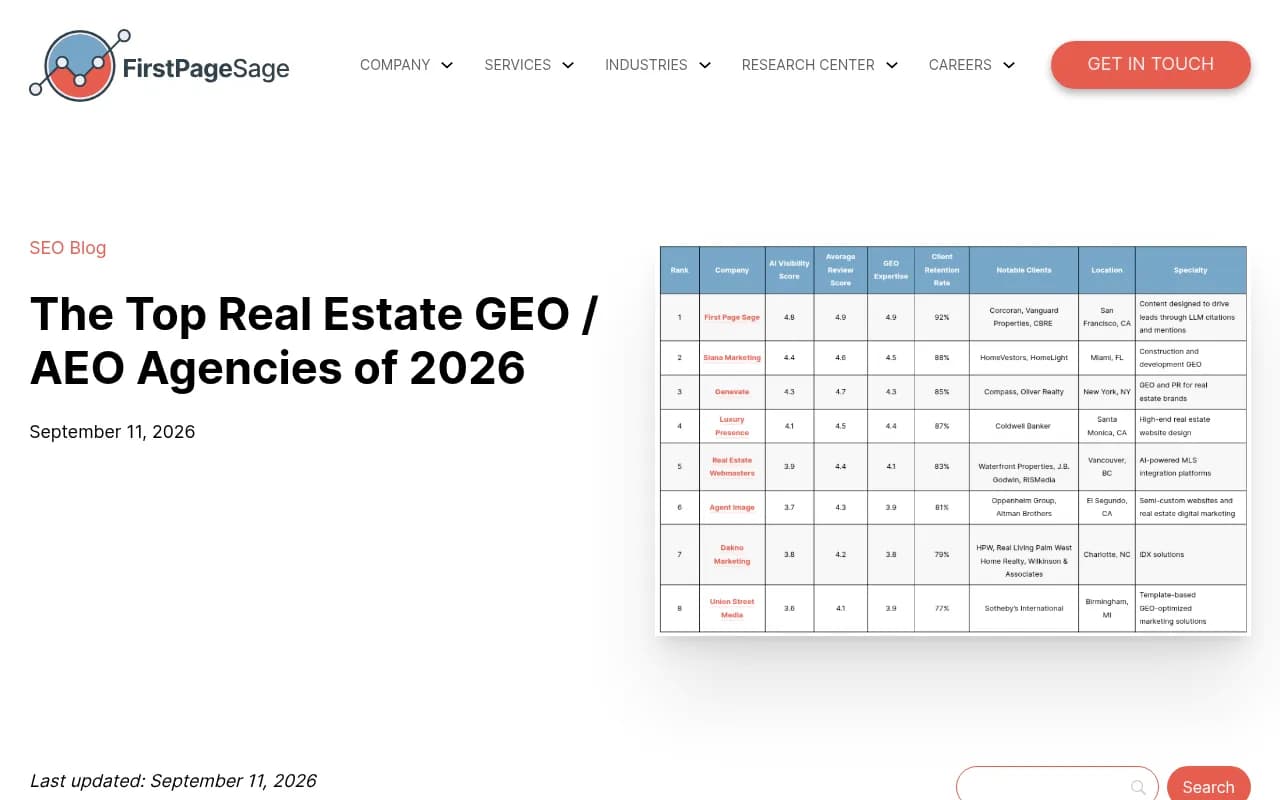
| Agency | AI visibility score | Real estate GEO expertise | Notable clients | Best fit |
|---|---|---|---|---|
| First Page Sage | 4.9/5 | 5.0/5 | Corcoran, CBRE | Brokerages wanting LLM-citation-driven content strategy |
| Siana Marketing | 4.4/5 | 4.5/5 | HomeVestors, HomeLight | Construction and development GEO |
| Genevate | 4.3/5 | 4.3/5 | Compass, Oliver Realty | GEO combined with PR for real estate brands |
| Luxury Presence | 4.1/5 | 4.4/5 | Coldwell Banker | High-end agent and team website design plus GEO |
| Real Estate Webmasters | 3.9/5 | 4.1/5 | Waterfront Properties, RISMedia | Custom platforms for large teams and brokerages |
These agencies are built for brokerages that want someone else to own the strategy, writing, and reporting, usually on a monthly retainer. That's the right call if you don't have in-house marketing staff or you're a large team managing dozens of agents' profiles at once.
Self-serve AI visibility platforms
The other path is tooling you or your marketing coordinator run yourselves. This is where Promptwatch fits for brokerages that want to see, in plain numbers, whether ChatGPT and Gemini recommend their agents, and then act on the gaps without hiring an agency for every market they operate in.

What makes this approach different from just hiring an SEO freelancer: Promptwatch tracks your actual visibility across ChatGPT, Gemini, Claude, Perplexity, Google AI Overviews, and AI Mode with real prompts like "best realtor in [city] for luxury condos," shows you AI crawler logs so you know whether bots are even reading your neighborhood guide pages, and its Content Agents can draft and publish locally-specific content, like a "best school districts near [listing]" page, directly to your CMS. For a brokerage running listings across multiple cities, that's a meaningfully different workflow than waiting on a monthly agency report.
Other tools worth knowing in this category include Scrunch AI and Profound, which do strong enterprise-level AI monitoring but skew toward large consumer brands rather than local service businesses, and Otterly.AI, which is a lighter, cheaper option if all you need is basic prompt tracking without the content generation layer.


Comparing the options side by side
| Platform type | Example | Monthly cost range | Local/neighborhood tracking | Content creation | Best for |
|---|---|---|---|---|---|
| Full-service GEO agency | First Page Sage, Luxury Presence | $2,000-$10,000+/mo retainer | Yes, built into strategy | Yes, done for you | Large brokerages, luxury teams without in-house marketing |
| Self-serve AI visibility platform | Promptwatch | $95-$579/mo | Yes, with city/state tracking on Professional+ | Yes, via Content Agents | Agents and brokerage marketing teams who want direct control |
| Basic prompt tracker | Otterly.AI, Peec.ai | $29-$150/mo | Limited | No | Solo agents just wanting a visibility check |
| Real estate website/IDX platform | Real Estate Webmasters, Placester | $100-$500+/mo | Indirect, via site structure | Website content only | Teams needing IDX plus a website foundation first |
A practical starting checklist
Before picking any platform, here's what actually moves the needle for an agent or brokerage trying to show up in AI answers:
- Audit your Google Business Profile for completeness and recent reviews. AI models lean heavily on review volume and recency for local trust signals.
- Publish genuinely specific neighborhood content. "Guide to buying in [specific ZIP code]" beats a generic "About our city" page every time.
- Check whether AI crawlers are even reaching your site. If ChatGPTBot or GoogleOther are hitting errors on your listing pages, no amount of content will help.
- Run the same handful of prompts a client would actually type, like "who's a good realtor for a first home in [neighborhood]," across ChatGPT, Gemini, and Perplexity every few weeks and track whether you show up.
- Keep publishing. NAR's own reporting lists consistency as one of the five core tips for improving agent GEO, and it's the one agents most often skip after an initial content push.
For agents who want to browse more AI visibility tools before committing to one platform, the directory at bestgeosoftware.com covers a wider range of GEO software beyond what's listed here, and ai-rank-tools.com focuses specifically on AI rank tracking if local prompt monitoring is your main concern.
The honest caveat
None of this replaces the fundamentals. A listing with bad photos and a weak price strategy won't sell better because an AI chatbot mentions the agent's name. GEO for real estate is a visibility layer on top of a business that still needs to close deals the old-fashioned way, through relationships, local knowledge, and follow-up. Treat it as one more channel buyers use to find you, not a replacement for the work you were already doing.
What's genuinely new, and worth taking seriously, is that this channel didn't exist two years ago and now accounts for a measurable slice of how people research agents before they ever pick up the phone. Agents who ignore it entirely are leaving a growing source of referrals on the table. Agents who chase it obsessively while neglecting their actual client service are solving the wrong problem. The sensible middle is what most of the tools above are built for: check your visibility periodically, fix the obvious gaps, and keep publishing locally specific content that actually helps the people searching for it.