Key takeaways
- PromptLayer is still a good pick when non-engineers own the prompt text. Teams usually leave over self-hosting, data residency, access controls, or the need for deeper evals.
- Langfuse is the default open-source option. It is MIT-licensed, self-hostable, and has prompt management on every tier, including the free one.
- LangSmith suits LangChain and LangGraph teams. Braintrust suits teams that want prompt changes gated by an eval suite. Maxim AI suits enterprises that want versioning, simulation, and observability in one place.
- Most vendor comparison articles are written by vendors. Read their rankings with that in mind, and test two tools against your own prompts before committing.
- Prompt history usually exports fine. Instrumentation is what traps you, so favor tools built on OpenTelemetry.
Why teams look for PromptLayer alternatives
PromptLayer does the core job well. You get a prompt registry, versions with commit messages, release labels like prod, a visual editor for domain experts, percentage splits and segment rules served server side, and in-product evaluations. If product managers or subject-matter experts edit your prompts, that visual workflow is a real advantage.
The friction tends to show up later. Based on PromptLayer's own pricing page and the comparisons I read while researching this guide, these are the recurring reasons people start shopping:
- Access controls are Enterprise-only. RBAC, SSO, and deployment approvals only come with the custom-priced Enterprise tier.
- Self-hosting and EU hosting are Enterprise-only too. Free, Pro, and Team are US cloud only. For public-sector tenders or GDPR-sensitive teams, that can end the conversation.
- Runtime dependency. If your app fetches templates from the registry at request time and logs outputs back, PromptLayer sits in your request path. ZenML's write-up flags the added control-plane dependency and a bit of latency.
- The price jump. Pro is $49/month with a 5-user cap and 2.5k base requests. Team is $500/month for 25 users. There is a big gap in between.
- Evaluation depth. Some teams that started with versioning later need trace-level scoring, CI/CD quality gates, and production-to-dataset loops.
None of that makes PromptLayer a bad tool. It just means the right alternative depends on which of those pains is yours.
What to evaluate before you switch
The most useful framing I found comes from Pydantic's comparison: saving a version and promoting it are separate steps, and delivery to the app is a third concern. Score each tool on these:
- Versioning. Are versions immutable and numbered? Can you see who changed what, with a message?
- Promotion. Can you move a label (
production,staging) without a redeploy? - Rollout and targeting. Is a percentage split handled server side, or do you write the router yourself?
- Eval integration. Can a prompt change be tested against a dataset before it ships?
- Delivery. How does the prompt reach your app, and what happens if the vendor is down? A fallback to a default shipped in your code is the safe answer.
- Deployment. Self-host, EU region, or US cloud only?
- Lock-in. Prompt history exports broadly. Instrumentation does not travel. Tools built on OpenTelemetry leave you less stuck than a proprietary SDK wrapper.
Also ask the boring question: which version served this run? If you cannot answer that after a bad output, you do not have versioning, you have a folder.
Comparison at a glance
| Tool | Best for | Self-host | Prompt versioning | Eval depth | Entry price |
|---|---|---|---|---|---|
| PromptLayer | Non-engineers editing prompts | Enterprise only | Commit messages, release labels | In-product evals | Free, Pro $49/mo |
| Langfuse | Open-source, self-hosting teams | Yes (MIT) | Labels, SDK deployment, caching | Dataset evals, LLM-as-a-judge | Free, Core $29/mo |
| LangSmith | LangChain and LangGraph teams | Check vendor | Hash-based versioning | Side-by-side prompt evals | Free tier, paid per seat (verify current price) |
| Braintrust | Eval-gated prompt changes | Check vendor | Versioning and deployment | Trace-level scorers, CI/CD gates | See vendor pricing |
| Maxim AI | Enterprise cross-functional teams | Check vendor | Version history, partials, folders | Evals plus simulation | See vendor pricing |
| Pydantic Logfire | Teams already on Pydantic or OpenTelemetry | Enterprise only | Immutable numbered versions | Scenarios, up to 500 cases per batch | See vendor pricing |
| Agenta | Versioning whole configurations | Open source | Config-level versioning | Evals available | See vendor pricing |
Pricing outside PromptLayer and Langfuse was not verified for this guide, so confirm each vendor's page before you budget.
The best PromptLayer alternatives in 2026
Langfuse
Langfuse is the one most people name first, and Reddit threads in r/LangChain keep recommending it alongside LangSmith. It is an open-source LLM engineering platform that combines prompt management, tracing, and evaluation. It is MIT-licensed and free to self-host.
Prompt management is available on every cloud tier, including the free one: versioning, unlimited prompt fetching, release management, composability, server and client caching, a playground, prompt experiments, webhooks, and protected deployment labels.
Current cloud pricing:
- Hobby: free, 50k units/month, 30 days of data, 2 users
- Core: $29/month, 100k units, then $8 per extra 100k, 90 days of data, unlimited users
- Pro: $199/month, 3 years of data, unlimited annotation queues, SOC2 and ISO27001 reports
- Teams add-on: $300/month for enterprise SSO and fine-grained RBAC
- Enterprise: $2,499/month with audit logs, SCIM, and an SLA
One thing to know. Older articles, including ZenML's, quote paid plans starting at $20/month. That is stale. The entry price is now $29.
The real limitation is A/B testing. Langfuse's docs show labelling two versions and choosing between them with random.choice in your own code. There is no server-side percentage rollout. Braintrust's comparison also notes the lack of CI/CD quality gates. If you want a rollout router handled for you, that is a gap.
Best for: teams that want control of their data, a free self-hosted path, and a mature prompt workflow.
LangSmith
If your stack is LangChain or LangGraph, LangSmith is the path of least resistance. It offers LangChain-native tracing, side-by-side prompt evaluations, and hash-based prompt versioning for debugging. Both Pydantic's and ZenML's comparisons put it at the top of the list for that audience.
One of the research sources lists paid plans at $39 per seat per month, but I could not verify that for 2026, so check the pricing page. Per-seat pricing can get uncomfortable once product managers and domain experts need access too.
Best for: teams already committed to the LangChain ecosystem.
Braintrust
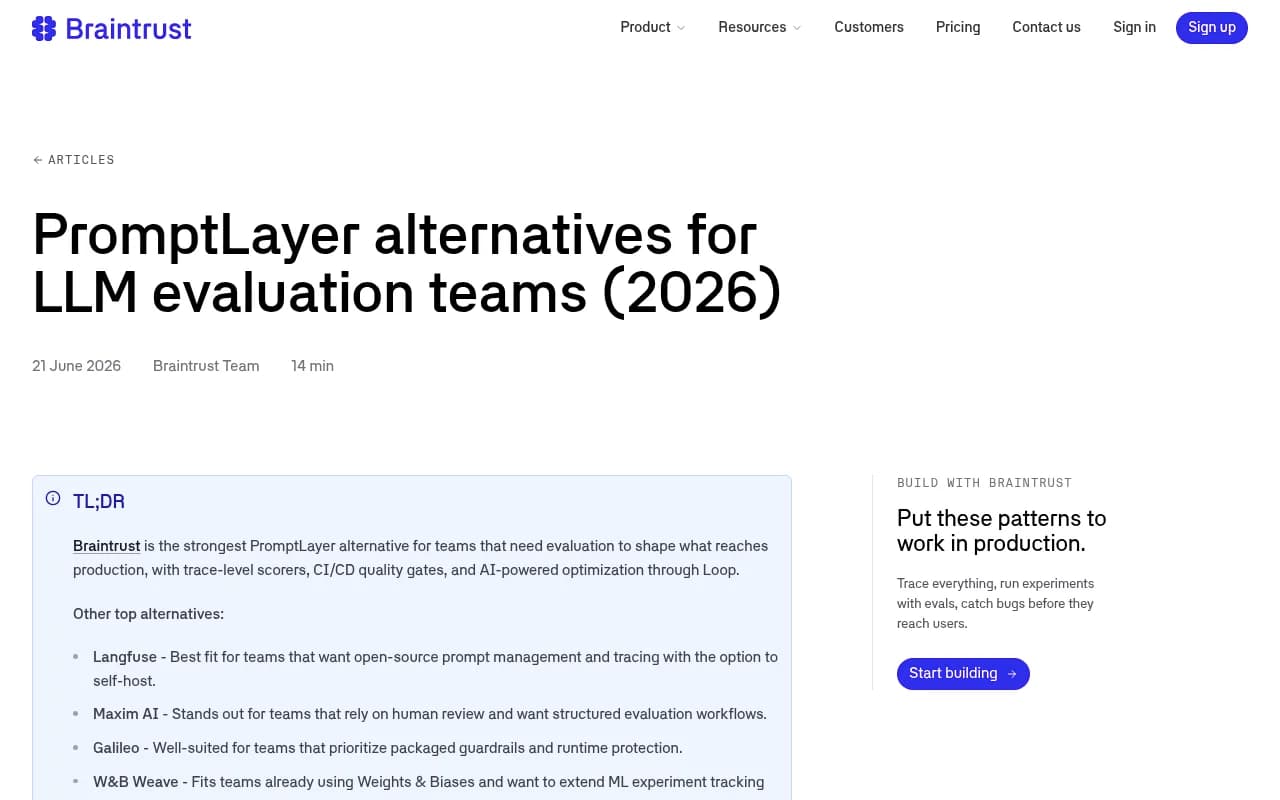
Braintrust takes a different angle. Where PromptLayer versions and deploys prompts, Braintrust is built around measuring whether those prompts work and blocking the ones that do not before they ship. It has trace-level scorers, CI/CD quality gates, and an AI agent called Loop that generates test datasets, writes scorers, and iterates on prompts from natural-language instructions.
Note that the source describing this is Braintrust's own article, so the "strongest alternative" framing is marketing. The capability itself, though, is real and is exactly what teams mean when they say they have outgrown a prompt registry. Pydantic's comparison gives the same pointer: choose Braintrust if prompt changes should be gated on an eval suite.
Best for: teams where a prompt regression is expensive and evaluation should decide what reaches production.
Maxim AI
Maxim embeds prompt versioning inside a full lifecycle platform: experimentation, evaluation, simulation, and production observability. The prompt side has a centralized Prompt CMS with folders and tags, version history with author attribution and comments, and prompt partials, which are reusable snippets such as tone guidelines or safety rules that you version independently and inject with template syntax like {{partials.brand-voice.v1}}.
Partials are the feature I would look at hardest. If you maintain ten prompts that all share the same brand voice block, editing it in one place is worth a lot. Maxim's own ranking lists PromptLayer fourth, with the note that it fits teams where domain experts drive optimization and lightweight versioning matters more than deep evaluation. That is a fair description, and it is also a vendor ranking.
Best for: enterprise teams where engineering and product both collaborate on prompts and want evals and simulation in the same tool.
Pydantic Logfire
Logfire's pitch is the cleanest separation of save and promote. Prompt versions are immutable and numbered, and a version freezes only the template. Promotion works by moving a production label on a managed variable, with no redeploy. It supports percentage rollout and targeting with sticky assignment through a targeting_key, and if Logfire is unreachable the SDK falls back to the default shipped in your code.
The caveats are honest ones. Anyone with write_variables can both save and promote, so there is no reviewer gate. Self-hosting is Enterprise only. And the prompt workflow is younger than Langfuse's or LangSmith's. Since the source comparison is written by Pydantic, I would treat its ranking cautiously and its feature descriptions as the useful part.
Best for: Python teams already using Pydantic or OpenTelemetry-style instrumentation who want server-side rollout.
Agenta
Agenta is the pick if what you version is a whole configuration, not a string. A real LLM app often has a prompt, a model, a temperature, and tool settings that change together. Versioning them as one unit is more honest than versioning a template while the model drifts underneath it. PromptLayer's own roundup of versioning tools also includes Agenta, alongside Mirascope, LangSmith, and Helicone.
Best for: teams iterating on full app configurations.
Helicone
Helicone started as a cost monitoring and API logging gateway. Pydantic's comparison points out that the platform is in maintenance mode, so I would only consider it if its gateway is already in your request path. Starting a new prompt management workflow on it in 2026 is hard to recommend.
Other names that come up
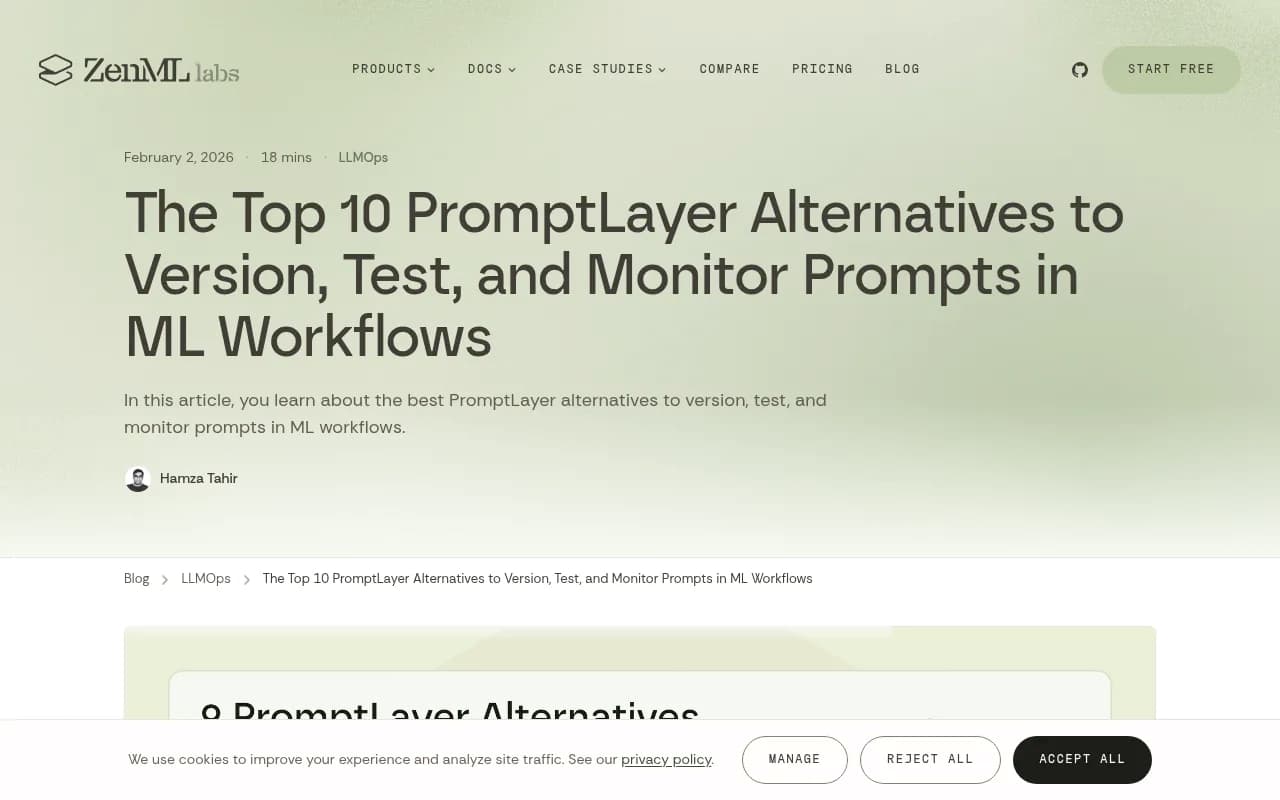
ZenML's list covers ten options and frames the choice around deployment flexibility, evaluation depth, and integration with the wider MLOps lifecycle. It is worth reading if you already run pipelines in ZenML. Galileo, W&B Weave, and Fiddler AI appear in Braintrust's list: Galileo for packaged guardrails, Weave for teams on Weights & Biases, and Fiddler for compliance-heavy enterprises needing unified ML and LLM monitoring. PromptHub and Visual Studio with Prompty also come up in community threads for lighter-weight versioning.
Which one should you pick?
Skip the feature matrix and start from your actual constraint:
- You need self-hosting or data residency without an Enterprise contract: Langfuse.
- You are on LangChain or LangGraph: LangSmith.
- Prompt changes must pass an eval suite before shipping: Braintrust.
- Product and design teams need to own prompts, and you want evals and simulation too: Maxim AI.
- You want server-side rollout and a clean save/promote split: Pydantic Logfire.
- You version whole configurations: Agenta.
- Non-engineers own the prompt text and you are fine with US cloud: stay with PromptLayer.
One more option gets overlooked: source control. A prompt in git is fine for a small team with one developer-owned prompt. It breaks down when a one-clause edit costs a full deploy pipeline (Pydantic's example is 40 minutes), domain experts cannot open pull requests, you cannot say which version served a run, and percentage rollout means building your own router. If none of those hurt yet, you may not need a tool.
How to run a fair migration test
- Export your current prompts and their history. Most tools make this straightforward.
- Pick your three highest-traffic prompts and one that non-engineers edit often.
- Recreate them in your top two candidates and wire in tracing with OpenTelemetry where supported, so you are not rewriting instrumentation twice.
- Run a week of real traffic. Check how fast you can promote a version, how fast you can roll back, and whether you can answer which version produced a given output.
- Kill the vendor connection on purpose in staging. Confirm your app falls back to a default prompt and keeps working.
- Price it at your real volume, including overage and the SSO or RBAC add-ons that tend to hide in higher tiers.
Prompt tooling is also adjacent to a different problem: how your brand shows up when other people's LLMs answer questions about you. If that is on your list, tools like Promptwatch track brand visibility across AI search engines, and the GEO software directory at bestgeosoftware.com covers the wider category. It is a separate job from managing your own prompts, but teams building LLM products often end up needing both.

Bottom line
PromptLayer is not broken. Its gaps are specific: Enterprise-gated RBAC, SSO, self-hosting, and EU hosting, a US-only cloud on lower tiers, and lighter evaluation depth than eval-first platforms. Langfuse covers the open-source route, LangSmith covers LangChain shops, Braintrust covers eval-gated releases, and Maxim and Logfire cover the broader lifecycle and rollout cases. Pick on your biggest constraint, run a one-week test on real prompts, and verify the pricing pages yourself, since several figures in the public comparisons are already out of date.