Key takeaways
- Apify is the safest first stop for SEO scraping if you want a ready-made Actor for Google Maps, SERPs or competitor sites. Its cost is the hardest to predict.
- Bright Data is the strongest pick for SERP data at volume and for heavily protected sites. Pay-as-you-go starts at $1.50 per 1,000 successful requests, and the Scale plan is $499/month.
- Firecrawl is best at turning pages into clean markdown or JSON for content audits, competitor analysis and anything feeding an LLM. It is not a SERP tool first.
- Browse AI is the one for non-developers who want to monitor a known set of pages (prices, titles, rankings tables) and get alerts when something changes.
- Most SEO teams end up with two of these, not one. There are no independent benchmarks of these four on SEO-specific tasks, so test on your own targets before committing.
What SEO teams actually need from a scraper
Scraping for SEO is not one job. It is at least five, and the tools split along those lines.
- SERP collection: pulling the top results for a keyword list, by country and device.
- Competitor monitoring: tracking changes to titles, meta descriptions, pricing pages and content.
- Content extraction: pulling the full text of ranking pages for gap analysis and entity research.
- Site crawling: auditing your own site or a competitor's structure at scale.
- Directory and review data: Google Maps listings, reviews, job boards, marketplaces.
A tool that is great at the third job can be mediocre at the first. Keep that in mind as we go through them. I'd rather you pick based on the job than on a feature checklist.
Quick comparison
| Tool | Best SEO use | Entry paid price | Free tier | Anti-bot | Needs code? |
|---|---|---|---|---|---|
| Apify | Ready-made scrapers for Maps, SERPs, social, e-commerce | $19/mo + usage | $5 usage/mo | Varies per Actor, Unblocker add-on | Optional |
| Bright Data | SERP at volume, protected sites | Pay as you go, $1.50/1K records; $499/mo Scale | 5,000 records/mo | Best in class, bundled | Optional |
| Firecrawl | Page-to-markdown, content audits, crawls | $19/mo monthly, $16 annual | 1,000 credits/mo | Managed, results vary by site | Yes, API |
| Browse AI | Monitoring known pages, change alerts | $19/mo billed annually | 50 credits/mo | Auto-adapts, residential proxies included | No |
Prices come from each vendor's pricing page as researched in autumn 2026. Confirm them before you budget, since all four have changed their plans in the last few months.
Apify: the marketplace option
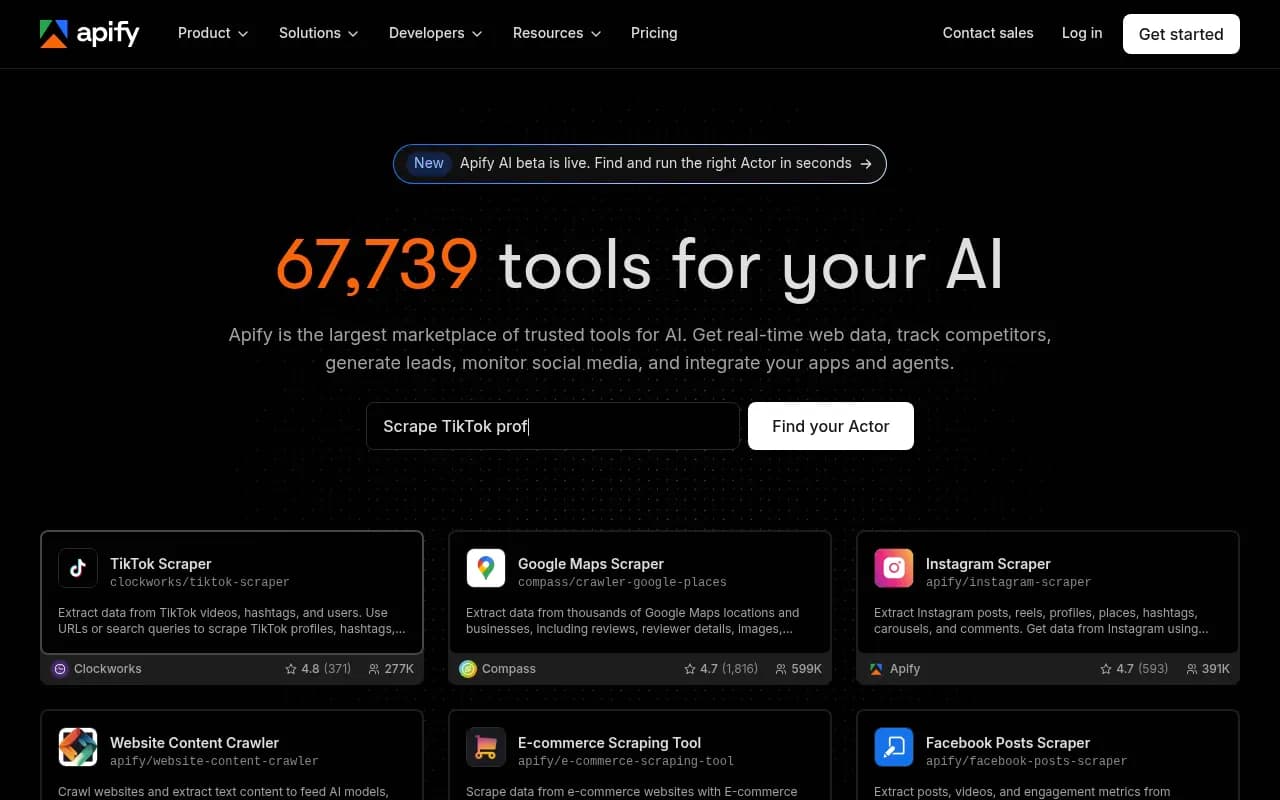
Apify is a cloud platform built around Actors, which are containerized scrapers that you run, schedule and pipe into storage. The Store is huge. Counts vary by source (Apify's own pricing page now cites 95,000+ pre-built tools, third-party roundups say 53,000 to 67,000), so treat any single number loosely. What matters is that for most popular SEO targets, someone has already built the scraper.
Where it fits SEO work
Google Maps, Google Search results, LinkedIn jobs, Instagram, TikTok, Amazon. If your task is "get me the top 100 results for these 500 keywords" or "export every competitor location from Maps," you can often be running in minutes with no code. Apify also maintains some Actors itself, and those tend to be more reliable than community ones. Check ratings and recent run history before you trust one. A community Actor with a mediocre rating across hundreds of reviews is a signal, not noise.
Pricing
- Free: $5 of prepaid usage per month.
- Starter: $19/month plus pay-as-you-go.
- Scale: $199/month. Business: $999/month. There is no middle step, which annoys people.
- Compute units cost $0.20 on Free and Starter, $0.16 on Scale, $0.13 on Business.
- Google SERP proxies run $2.50 per 1,000 SERPs on lower plans, down to $1.70 on Business.
- Actors price themselves in one of three ways: pay per event, pay per usage, or both.
The catch
Cost forecasting. A Capterra reviewer in April 2026 said estimating an Actor run's cost beforehand is "largely guesswork," and I think that is fair. Compute, Actor rental and proxy bandwidth stack up differently per Actor. Run a small test, look at the real bill, then scale. Unused monthly credit does not roll over either.
If you code in Node.js, the open-source Crawlee library is a legitimate free alternative for custom crawlers. It gives you control but you carry the infrastructure.
Bright Data: SERPs and hard targets

Bright Data is proxy infrastructure first. The residential and datacenter networks sit underneath a SERP API, a Web Scraper API with prebuilt scrapers, a Web Unlocker for bot-protected pages and a browser product. For SEO, the SERP API is the headline.
Pricing for SEO use
- Free tier: 5,000 requests or records per month, shared across request-based products.
- Pay as you go: $1.50 per 1,000 successful requests.
- Scale: $499/month for roughly 380,000 requests, then $1.30 per 1,000.
- Billing is per successful request. Bright Data's own blog says the rate falls to $1 per 1,000 on the $1,999 plan.
The SERP figures above come from a third-party write-up plus Bright Data's own docs and blog, so verify on the live pricing page. Also note the comparison with Apify is not apples to apples. Apify's SERP proxies cost $1.70 to $2.50 per 1,000, so Bright Data is cheaper at low volume on paper, but the two bill differently. Check what each rate includes (rendering, retries, geo targeting) before you decide.
Strengths
Success rate on hard targets. A Scrapeway benchmark cited by DataImpulse put Bright Data around 98% average success, with 100% on Google among other targets. That is a vendor-adjacent claim to some degree, but it matches what people say in practice: if a site is fighting you, Bright Data is the one most likely to win.
Geo-targeting matters here too. SEO rankings are local, and a proxy network across 195 countries lets you see results as a user in a specific market would.
The catch
Product sprawl and the $499 floor for plans. Different products, different billing, zone setup before your first request. For a solo consultant checking a few hundred keywords a month, it is more than you need. The free tier and pay-as-you-go help, but the dashboard still takes some learning.
Firecrawl: clean content for analysis

Firecrawl is a developer API that turns a URL into clean markdown or structured JSON. It is open source (AGPL-3.0, SDKs MIT) with a hosted service, and its pitch is LLM-ready output. For SEO, that makes it the best of the four for one specific workflow: pull the full content of the pages that rank, then analyze it.
Where it fits SEO work
- Crawling a competitor's blog and extracting headings, word counts and entities.
- Feeding ranking pages into an LLM to find content gaps.
- Auditing your own site's content in bulk.
- Building a change monitor using its monitor feature, which costs 1 credit per page per check.
It also has a search endpoint (2 credits per 10 results), so you can do light SERP work. I would not treat it as a replacement for a dedicated SERP API if rank accuracy by location is the point.
Pricing
| Plan | Monthly | Annual (per month) | Credits |
|---|---|---|---|
| Free | $0 | $0 | 1,000 |
| Hobby | $19 | $16 | 5,000 |
| Standard | $99 | $83 | 100,000 |
| Growth | $399 | $333 | 500,000 |
| Scale | $749 | $599 | 1,000,000 |
Scrape, crawl and map cost 1 credit per page. The JSON, Question and Highlight formats add 4 credits per page, so structured extraction at scale costs about five times a plain scrape. Do that math before you plan a big crawl. Credits do not roll over except on Scale (one month) and Enterprise.
The catch
Anti-bot handling is managed but results depend on the site. One comparison put its coverage at 96%, and the missing 4% is often the protected, high-value stuff. Also, a lot of the comparison material online is written by Firecrawl itself or by Bright Data, so each side flatters its own product. Test it on your actual targets.
Browse AI: no-code monitoring

Browse AI is for people who do not want to write code. You point it at a page, train a robot by clicking the data you want, and it runs on a schedule. When the target site changes layout, it tries to re-identify the elements without you rebuilding the robot.
Where it fits SEO work
Monitoring. Competitor pricing pages, SERP feature snapshots on a handful of keywords, directory listings, review counts, product availability. Output goes to Google Sheets, Airtable, Zapier or Make, which is where most SEO teams want it anyway.
Pricing
- Free: 50 credits/month, 2 domains.
- Personal: $19/month billed annually ($228/yr), 12,000 credits per year, 5 domains.
- Professional: $69/month billed annually, 10 domains, 10 team members.
- Premium: from $500/month billed annually, with a 98% data-accuracy SLA and managed data engineers.
Credits work in a slightly unusual way. One credit covers one standard page, but 10 rows of data also cost 1 credit, and you pay whichever is higher. A list page with 50 products costs 5 credits. Premium-protected sites like Amazon cost 2 to 10 credits per run.
The catch
Volume. It is cheap to start and expensive at scale. For hundreds of thousands of pages, per-page API tools win. Also, the pricing page has inconsistent monitoring-frequency claims (every 5 minutes in one place, every minute in another), so confirm the frequency you actually need before you buy.
Which tool for which SEO job
| SEO job | First pick | Why | Runner-up |
|---|---|---|---|
| Bulk SERP collection by country | Bright Data | Geo network, per-success billing | Apify SERP Actors |
| Google Maps and local listings | Apify | Mature Actors, no code | Bright Data Web Scraper |
| Competitor content analysis | Firecrawl | Markdown and JSON output | Apify |
| Content audit of your own site | Firecrawl | Cheap per page crawl | Crawlee (free, self-run) |
| Competitor price and title monitoring | Browse AI | Change alerts, no code | Firecrawl monitor |
| Hard, protected targets | Bright Data | Web Unlocker | Apify with Unblocker |
| One-off niche site | Apify | Someone built it already | Browse AI |
A realistic stack
For a small agency I would start with Apify for local and directory data, Firecrawl for content extraction, and Browse AI for the monitoring jobs a non-technical account manager can own. Add Bright Data once you are running SERP collection at volume or getting blocked. That is more tools than anyone wants, but each does one job without fighting you.
Cost reality check
Sticker prices mislead. Compare cost per successful output, not cost per credit.
- Firecrawl is the easiest to forecast: 1 credit per page, plus 4 for structured formats.
- Bright Data only charges for successful requests, which protects you on hard targets.
- Apify is hardest to predict because compute, Actor fees and proxies all vary.
- Browse AI is cheap for small, curated lists and gets pricey fast at volume.
Run the same 500-URL test on each free tier. It takes an afternoon and will tell you more than any comparison article, this one included.
Legal and practical cautions
Respect robots.txt, rate limits and terms of service. Scraping Google results directly is against Google's terms, which is one reason SERP APIs exist as a managed layer, and I did not review the terms for each vendor's SERP product, so check that yourself. Public-data scraping has favorable precedent in the Meta v Bright Data ruling (January 2024), but publisher contracts are where recent lawsuits have landed. Reddit sued Anthropic in June 2025 and Perplexity in October 2025. Avoid personal data without a lawful basis, and talk to a lawyer for anything commercial and sensitive.
Scraping data about AI search, not just Google
A lot of SEO scraping now aims at a second question: are AI assistants citing you? Scraping chat interfaces yourself is fragile and the answers vary by country and model. A dedicated tracker like Promptwatch handles that, along with IP-verified AI crawler logs, so you can see what bots actually read on your site. For background on crawler volume, see Promptwatch Data's AI crawler traffic report.

If you want to compare trackers, the GEO software directory at bestgeosoftware.com lists most of them.
Final recommendation
- Solo SEO or small agency, no developer: Browse AI plus Apify's free tier.
- Developer building content analysis or LLM workflows: Firecrawl.
- Heavy SERP collection or blocked by protected sites: Bright Data.
- Wide variety of one-off targets: Apify.
There is a gap in the evidence worth stating plainly. I found no independent benchmark of these four on SEO tasks like rank tracking or site audits. Vendor comparisons lean toward their authors. Start on free tiers, test with your own keyword and URL lists, and let your own success rates decide.