Key takeaways
- Bluefish is a solid enterprise visibility platform, but it has no crawler log analysis: you see what got cited, never whether the bot reached the page or how long that took.
- Real crawler log monitoring means ingesting your server or CDN logs and correlating bot visits with citation outcomes. Only a handful of platforms do the full loop.
- Promptwatch includes Agent Analytics from its $245/month Professional tier, linking crawl → citation per page. Scrunch gates its equivalent (AXP) to Enterprise. OtterlyAI infers crawlability without reading your logs.
- Crawl volume alone is a weak signal: ClaudeBot crawls roughly 11,000–13,500 pages per referral click, and over half of AI crawler traffic is for training, not search.
- If you just want to see which bots hit your site, Cloudflare's free bot analytics or a raw log parse will do. If you want to know why a page isn't getting cited, you need crawl-to-citation correlation.
Why crawler logs matter when evaluating Bluefish
Most AI visibility platforms work backwards from the answer. They run thousands of prompts through ChatGPT, Gemini, and Perplexity, record which domains show up in citations, and score you on share of voice. That's useful, but it only tells you the outcome. When your brand is invisible on a prompt you care about, the platform shrugs: could be content quality, could be crawlability, could be that the bot got a 403 from your WAF and never saw the page at all.
Crawler log analysis closes that gap. You connect your CDN or server logs (Cloudflare, Fastly, Vercel, AWS, and similar) and watch, in real time, which AI bots fetched which pages, what status codes they hit, and how often they come back. The interesting part is correlating that with citations: a page that gets fetched repeatedly but never cited is a content problem. A page that never gets fetched at all is a technical problem. Those need completely different fixes, and without logs you're guessing which one you have.
The guessing matters more in 2026 than it did a year ago, because bot traffic is now the majority of the web. Cloudflare's CEO reported in June 2026 that bots generate 57.5% of HTML web traffic, the first machine majority on record. AI crawlers specifically make up about 20% of verified bot traffic, and roughly half of that is training-related fetching that will never send you a referral. On high-traffic sites, practitioners estimate AI bots can consume up to 40% of total crawl activity because they don't respect traditional crawl-budget norms.
And the crawler population keeps shifting under your feet. Promptwatch's crawler data shows Meta's new Meta-WebIndexer went from about 2% of tracked AI crawler requests in mid-July 2026 to nearly 38% by August 9, making it the heaviest AI crawler in their logs almost overnight. Claude's citation crawler grew more than a hundredfold in absolute terms between December 2025 and April 2026. If you're not watching logs, you don't know which bots are even knocking on your door.
Where Bluefish falls short
Bluefish is a well-funded New York enterprise platform (founded by people who sold companies to Microsoft and Facebook, with a reported $68M raised) that counts Fortune 500 brands among its clients. Its monitoring, brand safety, and influence measurement modules are genuinely good at what they do. But two things keep coming up when teams evaluate alternatives:
- No crawler log analysis at any tier. Bluefish shows you citation outcomes (Impact Score, Influence Rank) but not crawler inputs. You can't see whether GPTBot or ClaudeBot reached your pages, what errors they hit, or how long it took from fetch to citation.
- Sales-gated everything. There's no published pricing, no free trial, no self-serve signup. Third-party reviews put entry tiers somewhere in the $99–$799/month range with enterprise contracts running much higher, but you have to sit through a demo to find out.
If neither of those bothers you, Bluefish might be fine for your use case. If they do, here are the alternatives worth a look.
What "real crawler log monitoring" actually means
Before the comparison, a quick taxonomy, because vendors use "crawler tracking" loosely and the differences matter:
- Output-only tracking: the tool runs prompts and records citations. It may run a crawlability check on your site (can a bot reach the page in principle?), but it never reads your actual logs. OtterlyAI works this way.
- Log ingestion: the tool connects to your CDN or server and shows real bot visits, status codes, and frequency. This is what Cloudflare bot analytics or a raw log parse gives you.
- Crawl-to-citation correlation: the tool ingests logs and links each crawled page to whether it actually got cited, plus the time lag between fetch and citation. This is the layer that turns logs from a technical diagnostic into a visibility strategy. Promptwatch's Agent Analytics is built around this.
One more thing worth knowing: high crawl frequency does not mean citations are coming. Crawling and citing are separate decisions, and a bot can fetch a page repeatedly to evaluate it without ever referencing it. ClaudeBot crawls somewhere between 11,000 and 13,500 pages for every referral click it sends back (Googlebot's traditional ratio is about 5:1). Log data alone is a discoverability diagnostic, not a citation guarantee, which is exactly why the correlation layer matters.
The alternatives compared
| Platform | Crawler log monitoring | How it works | Starting price | Citation correlation |
|---|---|---|---|---|
| Promptwatch | Yes, from Professional tier | CDN log ingestion (Cloudflare, Fastly, Vercel, AWS) via Agent Analytics | $95/mo (logs at $245/mo) | Yes, per-page crawl-to-citation rate |
| Scrunch AI | Yes, Enterprise only | AXP (Agent Experience Platform) with GA4-integrated bot attribution | $250/mo (AXP is custom/enterprise) | Partial, via GA4 traffic attribution |
| OtterlyAI | No, inferred crawlability | Output-only checks, no log ingestion | $29/mo | No |
| SEORCE | Beacon monitoring, not raw logs | Real-time monitoring across 7 AI platforms | Free plan, paid from $79/mo | No |
| Cloudflare (DIY) | Yes, native | Bot analytics on your own traffic | Free (granular rules need $200+/mo) | No |
| Screaming Frog Log File Analyzer | Yes, manual import | Server log parsing, not AI-specific | £259/year bundled | No |
Promptwatch
Promptwatch is the most complete option here if crawler visibility is your main reason for leaving Bluefish. Its Agent Analytics feature ingests logs through Cloudflare, Fastly, Vercel, and AWS integrations and tracks 400+ AI crawlers, including GPTBot, ClaudeBot, PerplexityBot, Google-Extended, and Meta's new web indexer.
What separates it from a plain log viewer is the correlation: Agent Analytics connects which crawled pages actually get cited in AI responses and which get visited but never referenced, then feeds those gaps into a content agent that drafts pages targeting the missing prompts. So the workflow is: see the gap in your logs, understand it's a content problem rather than a technical one, and fix it without leaving the platform. The demo dashboard shows the loop explicitly (pages crawled, pages cited, citation rate, gaps found, citations won).

Pricing is published and self-serve: $95/month for Essential (visibility tracking, no logs), $245/month for Professional (Agent Analytics, 150 prompts, 18,000 responses), $579/month for Business. There's a 7-day free trial on the lower tiers. Compared to Bluefish, you give up the enterprise brand-safety modules and get, in exchange, the technical layer Bluefish doesn't have plus content generation that actually publishes to your CMS.
Scrunch AI
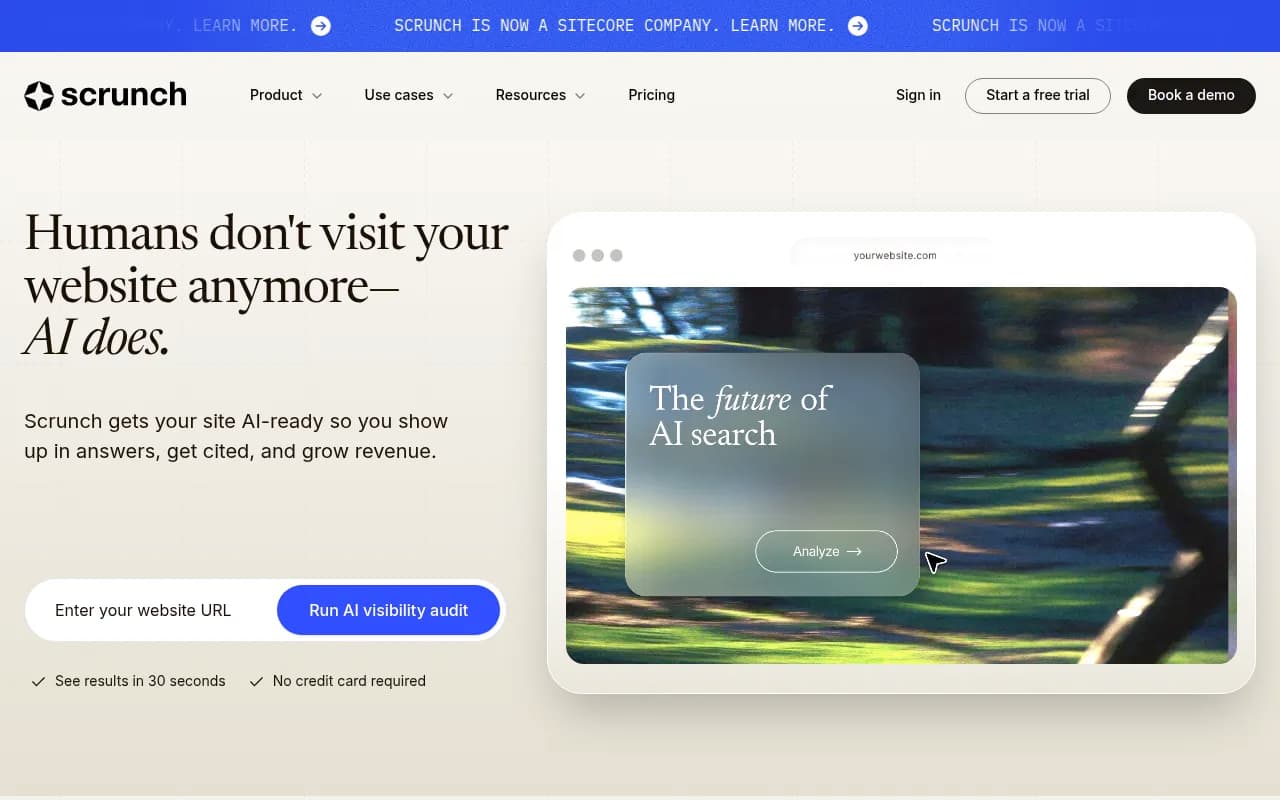
Scrunch is a strong monitoring platform with a real crawler story, but there's a catch: its Agent Experience Platform, which includes agent behavior observability and GA4-integrated bot traffic attribution, is gated to the Enterprise tier. Core plans start at $250/month billed annually, but if crawler visibility is why you're switching, you're back in sales-call territory, which is the exact friction you may be leaving Bluefish to escape.
OtterlyAI
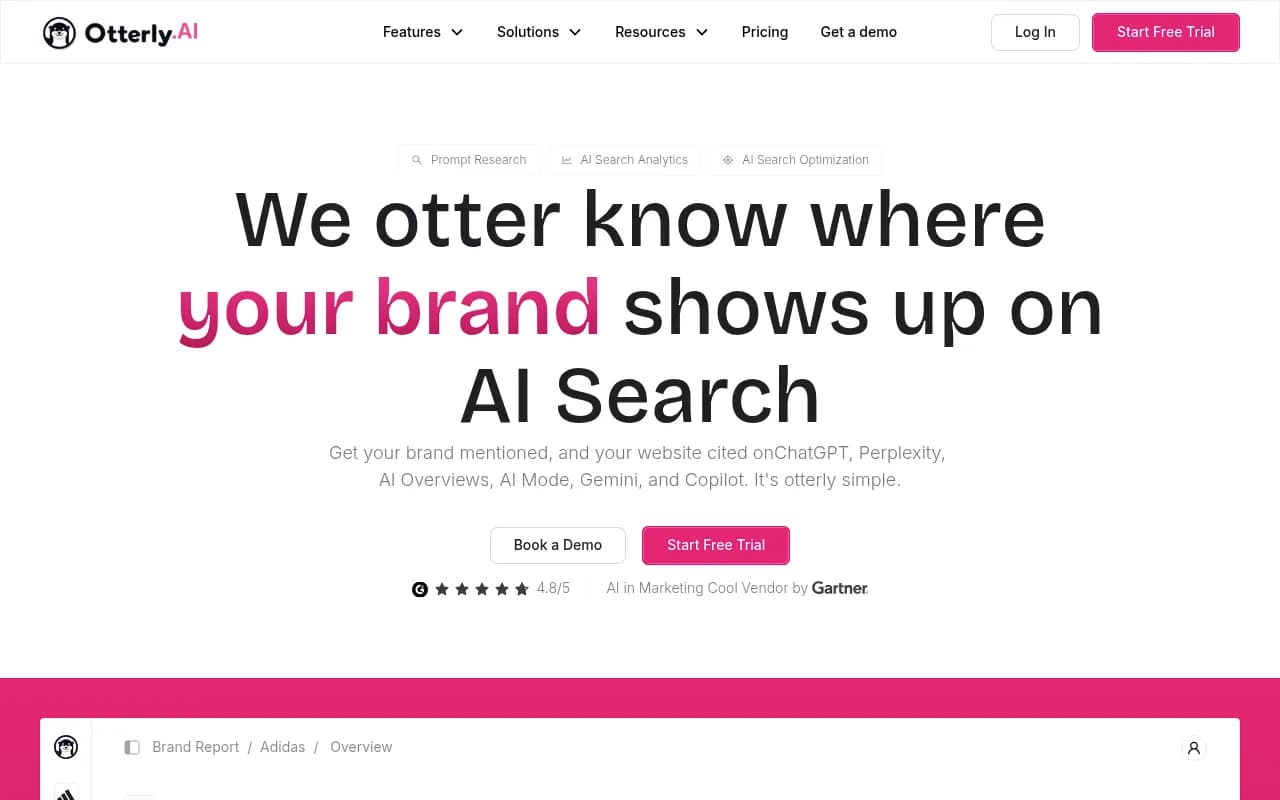
Otterly is the budget-friendly pick at $29/month for its Lite tier, and it does include a crawlability check, content audits, and content briefs. But be clear about what that means: it checks whether your pages are crawlable in principle. It doesn't read your server logs, so it can't tell you that ClaudeBot hit a 403 on your pricing page last Tuesday. One third-party review explicitly classifies Otterly's crawler tracking as output-only. Fine for monitoring on a budget, not a substitute for log analysis.
SEORCE
SEORCE is the low-cost, non-enterprise alternative angle: a free-forever plan with its AI Beacon (real-time monitoring across 7 platforms including Google AI Overviews) in every tier, and paid plans from $79/month. It doesn't do raw log ingestion, so it belongs in the "monitoring without logs" camp, but if your Bluefish complaint is mostly price and sales friction, it's worth a look.
The DIY route: Cloudflare and raw logs
If you already sit behind Cloudflare, its free plan includes basic bot analytics showing which AI crawlers hit your site. The catch is that granular AI-bot rules require Bot Management at the Business tier ($200/month) or above. And Cloudflare shows you the visits, not the citation outcomes, so you're back to guessing whether that heavy GPTBot activity is translating into anything.
Screaming Frog's Log File Analyzer (£259/year bundled with the SEO Spider license) parses server logs and handles AI bot user agents, but it's a manual, desktop-based workflow with no citation correlation and no dashboards your CMO can look at.
The fully free option is parsing raw logs yourself with GoAccess or custom scripts. It works, but you're spending engineering time to get a flat file with no alerts, no crawl-to-citation link, and no way to answer "why aren't we visible" rather than just "are bots visiting."
Practical checks before you commit
A few things I'd verify with any vendor claiming crawler visibility:
- Ask to see a live crawl-to-citation report, not a feature list. The number that matters is the citation rate per crawled page. If a vendor can't show which pages get fetched but never cited, their "crawler tracking" is probably just a bot counter.
- Check which tier includes logs. Promptwatch gates Agent Analytics to Professional ($245/month), Scrunch gates its AXP to Enterprise. Make sure the price you were quoted actually includes the feature you're switching for.
- Verify bot identity in your own logs. Studies estimate 5–8% of requests claiming to be GPTBot or ClaudeBot are spoofed. OpenAI, Anthropic, and Perplexity all publish IP-range JSON files for reverse-DNS verification, and any log tool worth using should handle this for you.
- Mind JavaScript rendering. Analysis of over 500 million GPTBot fetches found zero evidence of JS execution. Content behind client-side rendering is invisible to every major AI crawler except Google's. If your logs show bots fetching empty shells, that's why.
- Don't block the wrong bots. Training crawlers (GPTBot, ClaudeBot) and search crawlers (OAI-SearchBot, PerplexityBot) need separate robots.txt decisions, and Perplexity-User reportedly ignores robots.txt entirely and must be blocked at the edge if you want it gone.
Which one should you pick
If crawler log monitoring is the reason you're leaving Bluefish, Promptwatch is the most direct replacement: it's the only option on this list that combines published pricing, CDN log ingestion at a mid-market tier, and per-page crawl-to-citation correlation, plus content generation to close the loop. Scrunch is the runner-up if you're enterprise-budget anyway and want its GA4-integrated attribution, since its AXP is genuinely capable once you can access it. If budget is the constraint, Otterly or SEORCE cover monitoring well, just know you're not getting real log data. And if you only need to know which bots visit your site, Cloudflare's free analytics already tells you that, no new subscription required.
For a broader look at the category, the GEO software directory at bestgeosoftware.com covers the full field of platforms, including many that don't offer log analysis at all.