Key takeaways
- Bluefish AI has moved from a narrow AI-monitoring tool into what it now calls an end-to-end "agentic marketing platform," adding Agentic Campaigns, AI Accuracy, Brand Vault, and even white-label licensing deals like WEATHERvaiNE with Omnicom's MMC agency.
- The expansion tracks a $43M Series B (April 2026) and claims of 10x revenue growth, but it also means Bluefish is now competing with broader marketing-automation tools, not just AI visibility trackers like Profound or Scrunch AI.
- Existing customers get more surface area (campaigns, commerce, brand-fact verification) but lose some of the focus that made the original product sharp, and independent reviews still flag no self-serve prompt control, no URL-level citation data, and SOC 2 still "in progress" as of mid-2026.
- Pricing remains entirely quote-based with no public tiers, and the platform is explicitly built for Fortune 500-scale marketing orgs, not mid-market teams.
- If you need AI visibility tracking without the enterprise campaign layer, there are leaner alternatives worth comparing before you sign a six-figure contract.
What Bluefish AI actually was, and what it's becoming
When Bluefish launched in 2024, the pitch was straightforward: tell Fortune 500 brands how ChatGPT, Gemini, and Meta AI describe them, and flag when a Reddit thread or a critical YouTube review starts shaping that narrative. It was an AI-monitoring tool with some unusually deep transparency into prompts, responses, and cited sources, sold almost entirely to enterprise marketing and PR teams at companies like Adidas, American Express, and Ulta Beauty.
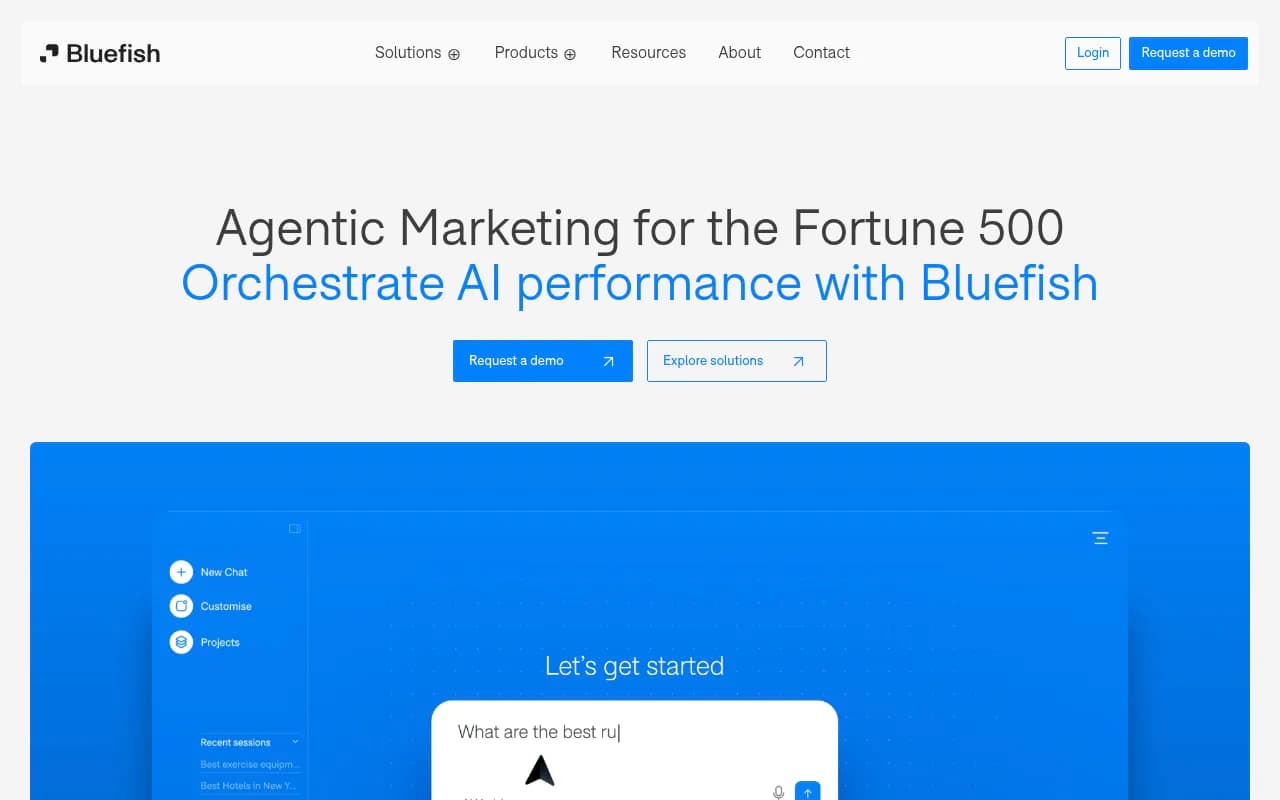
By late 2026 that positioning has changed. The homepage now describes Bluefish as "the only end-to-end agentic marketing platform," organized around three suites: AI Monitoring, AI Activation, and AI Data. That's a meaningfully bigger claim than "we tell you what AI says about your brand."
You can trace the shift through a fairly tight sequence of product launches:
- February 2026: Collections, which groups owned content, earned media, and AI visibility data into a single campaign view
- May 5, 2026: AI Accuracy and Brand Vault, a brand-fact verification layer that checks AI responses against a client's own source-of-truth content
- June 18, 2026: Agentic Campaigns, an automated workflow tool that lets marketers set AI performance targets and have Bluefish's agents diagnose problems and generate content and data tactics against them
- August 4, 2026: WEATHERvaiNE, a white-labeled product built on Bluefish's tech and launched by Omnicom's PR agency MMC during the 2026 FIFA World Cup
Each step on its own looks like a reasonable feature addition. Stacked together, they describe a company that started as a specialized GEO monitoring tool and is now building (and licensing) general-purpose marketing infrastructure for the AI era. Bluefish itself hasn't used the word "pivot" in its own materials, but the scope of what the platform covers now versus what it covered in 2024 is a different product.
Why this is happening now
The underlying market pressure is real, and Bluefish's own messaging leans on some striking numbers: large language models already handle roughly 5.6% of US desktop search traffic per the Wall Street Journal, and McKinsey has estimated traditional search could lose 20% to 50% of its web traffic as AI answer engines take over more of the discovery journey. Bluefish also cites third-party data showing AI-driven traffic to US retail sites surged 12x over an eight-month stretch, with AI-referred visitors staying 41% longer and bouncing 23% less than those from traditional channels, even as overall site traffic falls 15-25% because more queries resolve inside the AI interface itself.
If you believe that story, and the venture money backing Bluefish clearly does, then a pure monitoring dashboard starts to look undersized. Knowing you're being described a certain way in ChatGPT is only useful if you can also do something about it, at scale, across dozens of product lines and regional teams. That's the logic behind Agentic Campaigns: bring the same structure marketers use for paid media or email campaigns to answer engine optimization, and let AI agents handle the diagnosis and tactic generation.
The funding backs this up. Bluefish raised a $43M Series B in April 2026, co-led by Threshold Ventures and NEA, on top of roughly $68M in total funding over two years. CEO Alex Sherman has pegged the broader "agentic marketing" opportunity at around $500 billion, which tells you the company isn't trying to stay a niche AI-monitoring vendor. It's trying to become the marketing system of record for the AI channel, the way a Salesforce or Adobe owns CRM or content workflows today.
What actually changed in the product
Here's a more concrete look at what the current five-pillar structure covers, based on an independent review from mid-2026:
| Pillar | What it does | New or original |
|---|---|---|
| AI Monitoring | Tracks brand visibility, favorability, and safety across ChatGPT, Gemini, Meta AI | Original |
| GEO Optimization | Generates recommendations for site architecture, earned media, and content gaps | Original, but expanded |
| GEO Measurement | Impact Score and Influence Rank for weighting which sources move AI answers | Original |
| AI Commerce | Tracks product discovery and purchase behavior inside AI shopping flows | New emphasis in 2026 |
| AI Accuracy | Verifies factual claims in AI responses against a Brand Vault source of truth | New, May 2026 |
Bluefish says it finds inaccuracies or misleading portrayals in roughly 10% to 20% of the AI responses it tracks for clients, which is the kind of number that makes the Accuracy pillar feel less like a bolt-on and more like a legitimate response to a real problem. If a fifth of what AI says about your brand is wrong, a verification layer is not a nice-to-have.
The Agentic Campaigns launch is the clearest signal of the broader shift. Instead of just surfacing insights, the system now lets a marketer set a target (say, improve favorability for a specific product line across three AI platforms), and Bluefish's agents analyze historical performance, diagnose what's driving the current results, and generate content and data tactics automatically, then track KPI impact once the campaign goes live. That's workflow automation layered on top of monitoring data, which is a different category of software than what Bluefish shipped at launch.
What customers actually gain, and what they don't
For existing Fortune 500 clients already paying six figures a year, the expanded suite is probably a net positive. You get more of the platform without switching vendors, and features like Brand Vault address a genuine gap: most GEO tools will tell you an AI got something wrong, but few give you a structured way to feed correct information back into what gets ingested.
But the broadening comes with tradeoffs that independent reviews keep surfacing, and they haven't gone away just because the suite got bigger:
- No self-serve prompt control. Prompt methodologies still run through Bluefish's professional services team rather than being something a customer can adjust directly, which slows down response to a new product launch or a competitive shift.
- Domain-level citation data only, with no URL-level breakdown, which limits how useful the insights are for a content team trying to figure out which specific page to fix.
- No content generation, drafting, or publishing pipeline. Bluefish gives you a brief on what to write, not the writing itself, which puts the execution burden back on the client or an agency.
- SOC 2 audit still listed as "in progress" as of mid-2026, while several competitors are already SOC 2 Type II certified and HIPAA compliant.
- Pricing remains entirely quote-driven. There's no public tier, and estimates from third-party trackers put enterprise contracts somewhere in the $100K to $500K+ annual range depending on scale. One review mentions entry tiers as low as $99 to $799 a month, but that figure is unverified and doesn't match how the sales-led model actually works in practice.
The pattern across the independent coverage is consistent: Bluefish is sized for organizations with 50-plus marketing headcount, dedicated PR and brand teams, and six-figure AI marketing budgets. If that's not your org, the expanded feature set doesn't change the fundamental fit problem, it just adds more capability to a tool you were probably never going to afford or need in full anyway.
The competitive picture has shifted too
Bluefish's timing matters here. Its most direct competitor, Profound, raised a $180M Series D in September 2026 at a $1.8B valuation, just seven months after its previous round, officially crossing into unicorn territory. Profound's own comparison page (vendor-biased, but specific) claims full self-serve prompt control, URL-level citation tracking, native BI integrations with GA4, Looker, BigQuery, and Tableau, a complete content pipeline from brief to draft to publish, and SOC 2 Type II plus HIPAA certification, positioning itself directly against the gaps reviewers keep finding in Bluefish.
That's the real risk in Bluefish's broadening strategy. Spreading into campaigns, commerce, and licensing products like WEATHERvaiNE means competing on more fronts at once, right as a better-capitalized rival is closing the specific execution gaps (content generation, self-serve prompts, URL-level data) that used to be Bluefish's weakest spots relative to the field.
Where the rest of the market stands on execution
One thing worth grounding in actual data rather than vendor claims: even domain authority doesn't guarantee AI citations the way a lot of enterprise pitches imply. Promptwatch's analysis of citation share by domain rank in August 2026 found that mid-authority domains (DR 46-75) earned almost half of all ChatGPT citations, while the very top tier, DR 91-100, fell from roughly 7% to just 3% of citations by mid-month. In other words, a Fortune 500 brand name alone isn't the lever that gets you cited. Content specificity and freshness matter more than the logo on the door.
That's relevant because it's exactly the gap most AI visibility platforms, Bluefish included, struggle to close on their own: telling you where you stand is one thing, actually producing and publishing the content that moves the needle is another. Promptwatch approaches this differently than most of the field, including Bluefish. It doesn't stop at monitoring; its Content Agents plan, write, and publish GEO-optimized content directly to a client's CMS (Webflow, Framer, WordPress), and Unified Actions turns citation and crawler data into a prioritized to-do list rather than a static report. It also tracks AI crawler logs in real time, something Bluefish and most monitoring-only competitors don't offer at all, so you can see exactly when ChatGPTBot or PerplexityBot hit your pages and whether they errored out before ever reaching the citation stage.

Promptwatch's data set, more than 4.5 billion citations, clicks, and prompts analyzed, also includes things Bluefish's product doesn't track natively, like Reddit and YouTube citation reports. That matters given how fast the Reddit citation picture has changed: Promptwatch's data on Reddit citations shows reddit.com's share of ChatGPT Search citations collapsed from roughly 4% to 0.5% in mid-August 2026, a shift big enough that any brand relying on Reddit sentiment as a visibility lever needs to know about it in near real time, not in a quarterly report.
How to think about this if you're evaluating Bluefish
A few practical questions worth asking before signing anything:
- Do you need campaign automation and commerce tracking, or do you just need to know how AI describes your brand and fix the content gaps? If it's the latter, a broader platform built for Fortune 500 scale is probably overkill, and you'll pay for suites you won't use.
- Can you live with domain-level citation data, or do you need to know exactly which URL on your site got cited and why? If URL-level granularity matters for your content team's workflow, that's a real gap in Bluefish's current offering.
- Who writes and publishes the content the recommendations point to? Bluefish gives you the brief, not the execution. Factor in the cost of a content team or an agency to close that loop, or look at a tool built to close it automatically.
- Does your compliance team require SOC 2 Type II or HIPAA today? If so, verify current certification status directly with Bluefish rather than relying on last year's reviews, since this kind of status changes.
Comparing the options
| Platform | Positioning | Self-serve prompts | Content generation | Crawler log tracking | Pricing model |
|---|---|---|---|---|---|
| Bluefish AI | Enterprise agentic marketing suite | No, via professional services | Briefs only, no drafting | Not offered | Quote-only, enterprise |
| Profound | AI search visibility and analytics | Yes | Full pipeline: brief to publish | Limited | Enterprise, scaled by usage |
| Promptwatch | End-to-end GEO with agentic execution | Yes | Full pipeline with CMS publishing | Yes, real-time with citation rate per page | $95-$579/mo published tiers, plus enterprise |
| Scrunch AI | AI search monitoring | Yes | Limited | No | Quote-based |



The bottom line
Bluefish's expansion isn't really a pivot away from AI visibility, it's a pivot toward owning more of what happens after you find out where you stand. That's a reasonable bet given how fast the AI discovery market is moving, and the Series B funding and named enterprise clients suggest the bet is paying off so far. But for a customer evaluating this in late 2026, the expanded scope doesn't erase the product's original tradeoffs: rigid prompt control, no URL-level data, no native content production, and pricing that only makes sense at genuine Fortune 500 scale.
If you're a large enterprise with existing PR and brand infrastructure and six-figure budget authority, the broader Bluefish suite is worth a serious look, especially the Brand Vault and AI Accuracy features, which address a real accuracy problem few competitors have tackled directly. If you're anywhere below that scale, or if what you actually need is content that gets written, published, and tracked against real citation and crawler data without a services team in the loop, it's worth comparing against platforms built for that from day one. The GEO software directory at bestgeosoftware.com is a reasonable place to see how the rest of the field stacks up before you sign a contract this size.