Key takeaways
- Botify is the heavyweight: crawl, logs, Search Console data and an activation layer for sites with millions of URLs and a team to run it.
- Lumar (formerly Deepcrawl) is strongest at automation and pre-deploy checks, so engineering teams can catch SEO regressions before a release ships.
- Oncrawl is the analyst's pick: log analysis, segmentation and data export for teams that want to model crawl behavior themselves.
- None of the three publishes list pricing. Third-party estimates range from roughly $30K to $400K+ a year for Botify, and the others are quote-based too.
- One widely repeated claim is wrong: Botify did not acquire Oncrawl. BrightEdge did, in February 2022.
Why this comparison is harder than it looks
A Reddit thread on r/TechSEO sums up the enterprise crawler market in one line: DeepCrawl (now Lumar), Oncrawl and Botify are the main three players, they are all pretty similar, and you should get a demo. That is half right. All three crawl large sites in the cloud, all three handle log files, and all three sell through sales calls. But they were built around different ideas of who sits in front of the screen.
Botify assumes a dedicated technical SEO team and a business case tied to crawl budget and revenue. Lumar assumes SEO and engineering will share the tool. Oncrawl assumes someone on the team likes data, SQL-ish thinking and exports.
Pick on that, not on feature checklists. Feature checklists are nearly identical on paper.
A correction before we start
Several comparison pages, including a FAQ on getspike.ai, claim Botify acquired Oncrawl in 2022 and folded it in. That is not what happened. BrightEdge announced it acquired Oncrawl on February 23, 2022, and Oncrawl's own site says it has been part of BrightEdge since then and operates within the group. I could not confirm from the sources I checked whether Oncrawl is still sold as a standalone product, so check that with their sales team before assuming either way.
If your shortlist is driven by a blog saying Oncrawl is dead, re-verify.
Quick comparison
| Botify | Lumar | Oncrawl | |
|---|---|---|---|
| Formerly | n/a | Deepcrawl | n/a (part of BrightEdge since 2022) |
| Core strength | Crawl + logs + activation at huge scale | Automation, QA, pre-deploy monitoring | Log analysis, segmentation, data export |
| Log file analysis | Core capability, a headline differentiator | Present, but not the center of the product | Strong, a main reason people buy it |
| JavaScript rendering | Yes, built around Googlebot-style rendering | Yes, reported as less mature at extreme scale (single-source claim) | Yes |
| Best fit | Millions of URLs, ecommerce, travel, publishers | Enterprise SEO plus engineering workflows, regulated industries | Mid-market and enterprise technical SEOs and data teams |
| Team it assumes | Dedicated technical SEO analyst(s) | SEO and dev together | Data-literate analysts |
| Pricing | Custom quote | Custom quote | Custom quote, crawl quotas |
Treat the JavaScript rendering notes with some caution. The claim that Lumar struggles with complex React sites above 5 million pages comes from a single vendor-comparison blog, and nobody I found verified it against Lumar's own documentation. Test it on your own templates during a trial.
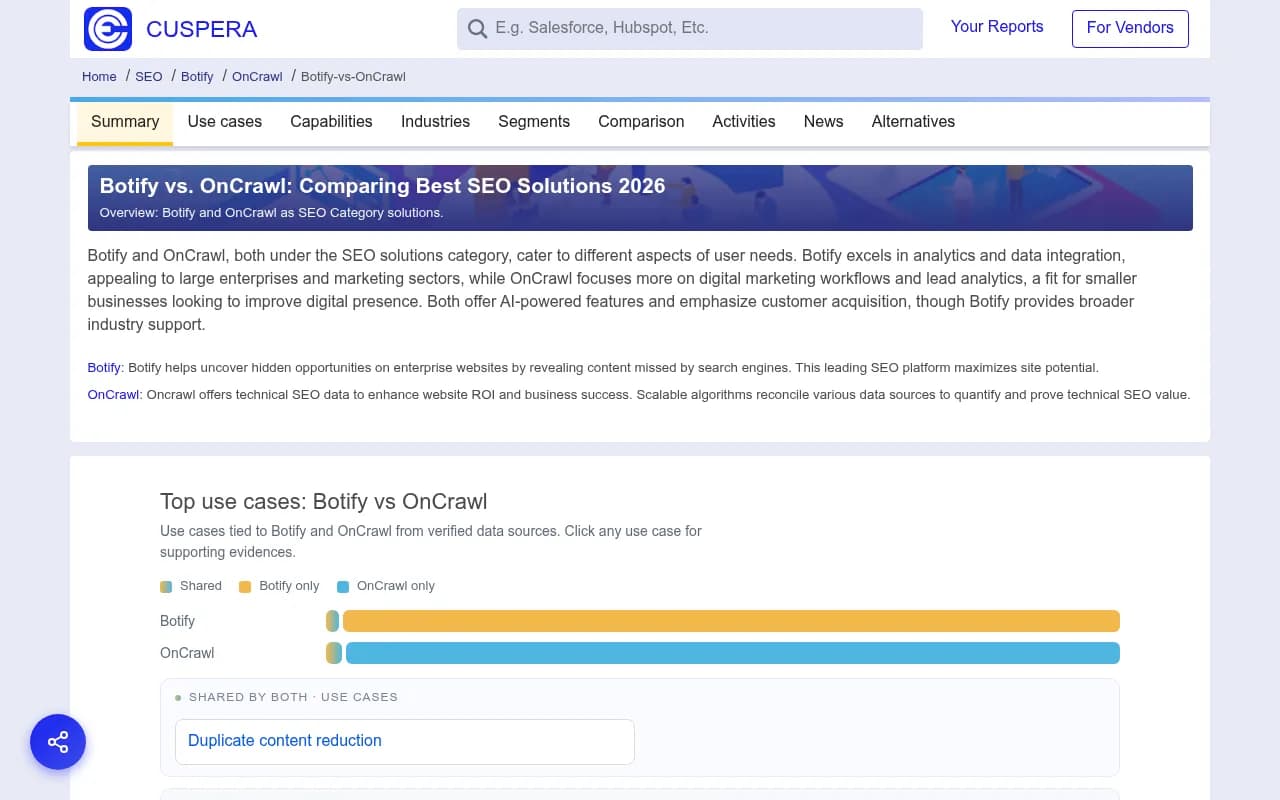
The Cuspera comparison above is a useful sanity check on positioning. It scores Botify as stronger on e-commerce and retail (about 90% of retail mentions) and Oncrawl as more common in insurance, media production and publishing. Treat that as marketing-data signal, not a benchmark, but it matches what practitioners say.
Botify: the platform for true scale
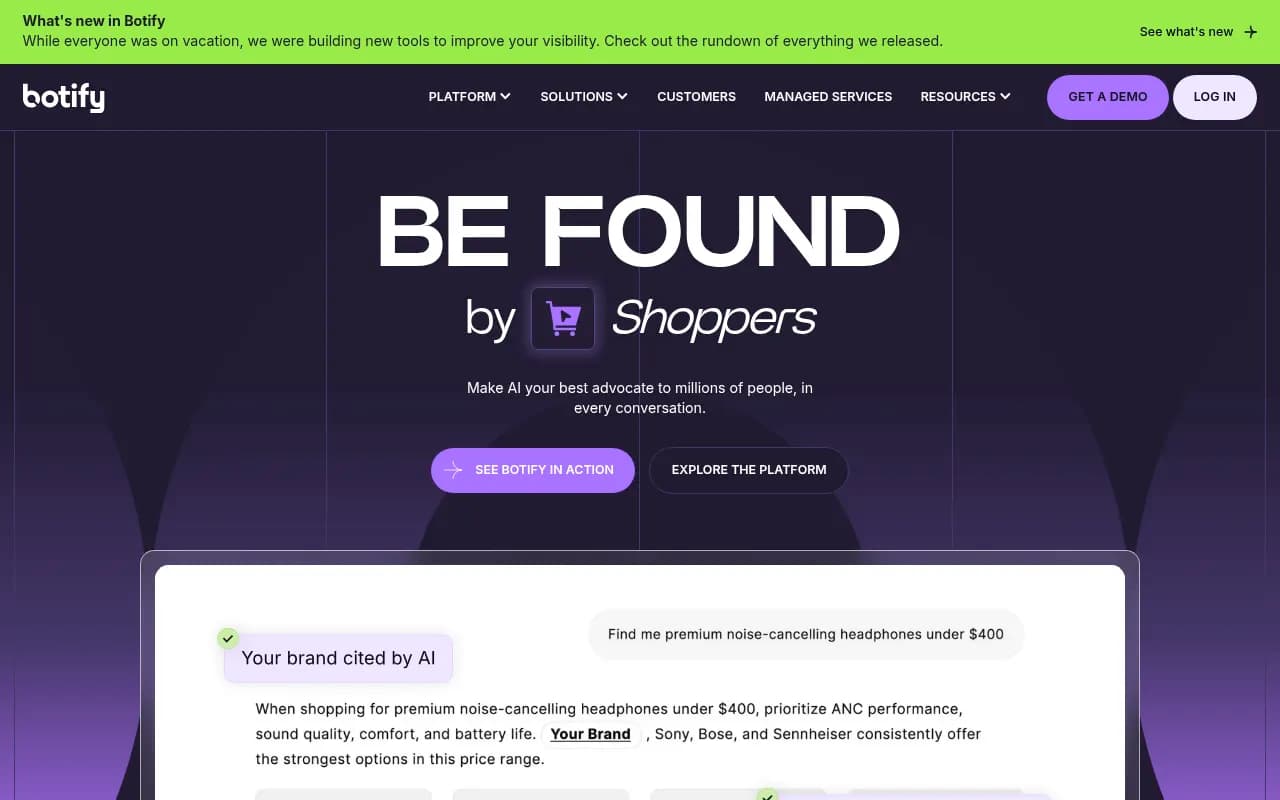
Botify unifies crawl data, log analysis, Search Console data and what it calls Activation, which pushes fixes live instead of leaving them in a ticket queue. It reports serving more than 500 enterprise brands, and Saffron Edge's comparison lists Expedia, Nike and Marriott among them. It was also named a Strong Performer in the Forrester Wave for SEO solutions in Q3 2025, per the same source.
Where Botify wins
- Sites with millions of URLs, where crawl budget waste and indexation gaps are directly tied to revenue.
- Log analysis treated as a core feature rather than an add-on.
- Teams that pipe SEO data into BigQuery, Snowflake or Looker Studio for cross-functional reporting.
- Organizations that want AI-search readiness folded into the same platform as technical SEO.
Where it hurts
Cost and complexity. Vendr's dataset, the only transactional source I found, puts typical annual contracts at about $30K for small deployments and $400K+ for large ones. Pricing is driven by URL count bands, log volume and modules such as Intelligence and Activation. Vendr reports discounts of 15 to 35% off first proposals through multi-year terms, competitive leverage and quarter-end timing. Watch for overage charges on URLs and logs, add-on modules, professional services and renewal increases.
The bigger risk is shelfware. A three-person team on a 2-million-URL site can easily use a third of the platform. If nobody configures the log pipeline, you are paying for it anyway.
Lumar: automation and release-pipeline checks
Lumar is the platform that spent years as Deepcrawl. Its calling card is fitting crawl checks into engineering workflows. The Protect product tests staging or pre-production builds so SEO regressions surface before a deploy, not after rankings drop. Ivris Tech also notes accessibility monitoring and AI-search features added in 2026, and Riff Analytics highlights SOC 2 Type II compliance, which matters in finance and healthcare procurement.
Where Lumar wins
- SEO and engineering teams that want crawl and quality checks wired into CI/CD.
- Migrations, redesigns and site-wide template changes where a staging crawl is worth real money.
- Organizations balancing technical SEO with accessibility compliance.
- Regulated industries with security questionnaires.
Where it hurts
Log file analysis is not the center of the product. Saffron Edge describes it as limited or not core, while another source calls it integrated and powerful. These sources disagree, so ask for a log demo on your own data if logs are your priority. Pricing is also sales-led. Third-party numbers vary wildly: Prerender.io reports about $2,667 a month for Lumar against $5,000 for Botify, and Saffron Edge cites a $89 a month starter plan that I could not verify on Lumar's own site. Do not budget from any of these. Get a quote.
Oncrawl: the analyst's crawler
Oncrawl pairs a crawler with log analysis and leans toward data science: custom segmentation, crawl-over-time comparisons and exports to BigQuery. Riff Analytics describes it as API-first, built for teams that want to push raw SEO data into business intelligence systems and build their own models of crawl behavior against rankings. Pricing scales with monthly crawl quotas, so costs follow usage rather than seats.
Where Oncrawl wins
- Teams with a data analyst or technical SEO who enjoys building segments and models.
- Log-heavy investigations at a price below Botify, though Saffron Edge notes it is less feature-rich.
- Internal linking, migration audits and classifieds-style segmentation, which show up repeatedly in Cuspera's use-case data.
Where it hurts
It gives you less hand-holding than some competitors, and the packaging question above (what exactly is sold, and how, post-BrightEdge) deserves a direct conversation. No official prices are published. An Ivris Tech estimate of about $25K a year is just that, an estimate.
What does each one cost?
All three are quote-only. These are third-party figures, not list prices.
| Vendor | Reported figures | Source and caveat |
|---|---|---|
| Botify | About $30K to $400K+ per year; $30K to $60K for up to 250K URLs | Vendr, Saffron Edge. Ivris Tech estimates $75K to $150K for mid-size deployments |
| Lumar | About $2,667 per month reported; $15K to $30K+ per year for large orgs | Prerender.io, Saffron Edge. The Vendr link behind the second figure points to the wrong vendor, so low confidence |
| Oncrawl | About $25K per year estimate | Ivris Tech. Quote-based with crawl quotas |
The pattern is consistent, though: Botify costs the most, and the other two usually come in below it. Use that for negotiation leverage, since Vendr says competing quotes are one of the better discount levers.
How to choose
Start with site size and rendering
Below roughly a million URLs, an enterprise platform may be overkill. A desktop crawler like Screaming Frog (about GBP 199 a year) or a cloud option like JetOctopus, which Ivris Tech describes as doing most of what Botify and Oncrawl do at a published, much lower price, can cover a lot. Above a few million URLs, or when heavy client-side rendering is involved, Botify is the safest bet on paper. Verify rendering completeness on your real templates for any vendor.
Then look at who will use it
- A dedicated technical SEO team plus a business case around crawl budget points to Botify.
- A shared SEO and engineering workflow with frequent releases points to Lumar.
- A data-oriented analyst who wants to own the model points to Oncrawl.
Then look at logs
If server logs are the reason you are buying, run each vendor against a real sample. Botify treats logs as a core module, Oncrawl is built around log analysis and data export, and Lumar's depth here is disputed in the sources. A good test: ask each one which URLs Googlebot hits that you never meant it to, and how fast you can get from that finding to a fix.
Finally, check procurement fit
SOC 2 Type II (Lumar, per Riff Analytics), data retention, role-based access and API limits all matter more in enterprise buying than a feature grid. Ask for them early.
Cianic's guide lists the evaluation criteria enterprise buyers tend to forget: crawl limits, data retention, role-based access, governance controls and the ability to segment by market, template or directory. Put those on your trial scorecard.
Run a trial that tells you something
Demos are polished. Trials on your site are not. Here is a short plan.
- Pick one section of your site with a known problem, such as faceted navigation or a recent migration.
- Give all vendors the same crawl scope and the same two weeks of log data.
- Time how long it takes to produce a prioritized fix list your developers would accept.
- Test an export into your BI tool.
- Ask each vendor to quote against the others and write down what changes.
The crawler that gets you to a shipped fix fastest is usually the right one, regardless of which has the longest feature list.
Other options worth a look
If none of the three fits, the alternatives that come up most often are JetOctopus (cloud crawling and log analysis at a lower, published price), Screaming Frog and Sitebulb (desktop crawlers for sites that fit on one machine) and Audisto (link-graph analysis on very large crawls). Suite platforms such as BrightEdge and seoClarity cover broader enterprise SEO workflows, and the broader software directory at surferstack.com lists more tools by category.
Do not forget AI search
Technical crawlers tell you how Googlebot sees your site. They do not tell you whether ChatGPT or Perplexity cites you. If that is part of your brief, tools like Promptwatch track AI visibility and IP-verified AI crawler activity, and the GEO software directory at bestgeosoftware.com lists more options. Promptwatch Data also publishes AI crawler research, such as its AI crawler traffic report covering June to September 2026.

Bottom line
Choose Botify if you have millions of URLs, a technical SEO team and revenue tied to crawl efficiency, and you can negotiate hard on price. Choose Lumar if SEO and engineering share ownership and you care about catching regressions before release. Choose Oncrawl if your team wants log data and exports to model things on its own. And before you sign anything, confirm Oncrawl's current packaging directly, get written quotes from all three, and run the same trial against each.