Key takeaways
- A prototype tracker on raw engine APIs takes a few weeks. The expensive part is everything after launch: parsers, metrics, proxies, and re-tuning when engines change behavior.
- API output is not what users see. If you need UI-level answers, citations and shopping results by country, the build gets much harder than most vendor-blog cost estimates assume.
- Build only if you already own adjacent data (site content, hosting or CDN logs, crawler traffic) or need data control that no vendor offers. Otherwise buy, at least for your first 12 months.
- The best enterprise answer is often a hybrid: buy the measurement layer, build the internal reporting and warehouse joins on top of its API.
- Price the workflow, not the dashboard. The question is how quickly you go from a missing citation to a fix that gets published.
Why this question is back on the table
In 2024, building your own tracker meant fighting immature APIs. In 2026 the API layer has matured, AI coding assistants write the dashboard in an afternoon, and open-source trackers exist. So every enterprise engineering lead asks the same thing: why are we paying a vendor for something we could build in a quarter?
I think that is the wrong framing, and the research backs it up. One cloro analysis puts it well: the decision is not whether your team can build a tracker, it is whether maintaining one is the best use of engineering time. Deepak Gupta's 2026 M&A research on the GEO category reaches a similar place from the other direction. His thesis is that the hard part of AI visibility is not the dashboard. It is the measurement infrastructure that turns nondeterministic model outputs into stable signals, plus the per-engine data relationships that have to be maintained as models change without notice. He also notes that every company that built a credible product from scratch already owned an adjacent data position. Nobody has built a competitive product from a standing start.
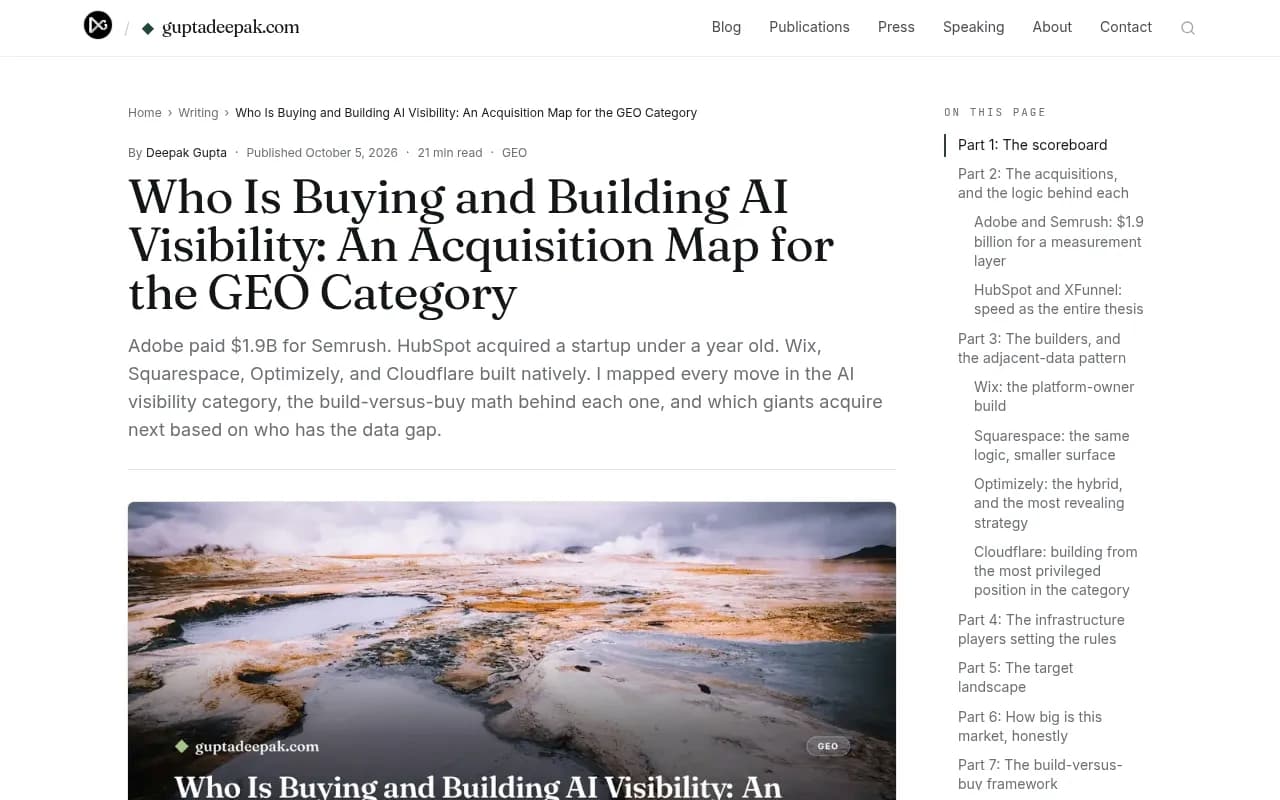
That scoreboard is worth a look. By September 2026 Adobe had bought Semrush, HubSpot had bought XFunnel, and Sitecore had bought Scrunch. Wix, Squarespace, Cloudflare and Optimizely built natively, and each of those already had site, hosting or traffic data. Optimizely partnered with Conductor for the enterprise measurement depth. If large platforms with deep pockets mostly chose to buy or partner, a marketing team building from zero deserves some skepticism about its own timeline.
What you would actually be building
A tracker sounds like one thing. It is at least five.
- A prompt set with intent, personas, topics and country or language variants.
- A collection layer that runs those prompts against ChatGPT, Gemini, Perplexity, Claude, Google AI Overviews, AI Mode, Copilot and others, repeatedly, because answers are nondeterministic.
- A parsing layer that extracts brand mentions, position, sentiment, and cited URLs from free-form answers.
- A metrics layer: visibility score, share of voice, citation share, trend lines that do not jump around because of sampling noise.
- A reporting layer with alerts, dashboards, exports and stakeholder-ready views.
Items 4 and 5 are what AI-assisted development has made cheap. Items 2 and 3 are where the real cost lives.
API collection versus real interface collection
The cheap build calls model APIs directly. It works, and it is useful for seeing what a model believes from training data. But user-facing answers, citations and shopping recommendations can differ from API outputs, because the consumer products add live search, retrieval and ranking behavior on top. Promptwatch Data states that its numbers are collected from the real user interfaces of the engines, not only APIs, and that is a different and much harder build: browser automation, proxies per country, anti-bot handling, session management, and constant breakage.
The cloro cost estimates that circulate in build-vs-buy discussions assume API-only collection. That is fine for a prototype. It is not a fair comparison with a platform that monitors the real interfaces in each country and language.
The cost math, with honest caveats
Here is the number most build advocates quote. A cloro analysis estimates 80 to 120 engineering hours to build dashboards, alerting, share-of-voice computation and competitor tracking, roughly $8K to $12K at $100 per hour. API calls for the same query coverage run about $50 to $150 per month, against $200 to $500 per month for entry and mid-tier platforms. Break-even lands at 18 to 30 months.
Treat those as illustrative vendor-blog estimates, not benchmarks. They are a reasonable shape, but they leave out three things.
The maintenance tail
Reflex's build-vs-buy framework makes the point that a tool costing X to build likely costs two to four times X to keep alive, and that AI reduced X without changing the multiplier. Its worked five-year example shows even a cheap build narrowly beating a purchase only when running costs stay small, and a small build has little scale to spread its tail across. Apply a 2x to 4x multiplier to an $8K to $12K build and your 18-to-30-month break-even quietly becomes never.
Security and ownership
Fast AI-assisted builds also ship faster security debt. Reflex cites researchers who found that AI models generate working endpoints with no access control unless asked. An internal tracker that holds competitive intelligence, customer personas and API keys for six AI vendors is not a throwaway script. Someone owns patching it.
Enterprise scale
The cloro scenario is one team and a modest prompt set. An enterprise typically needs multiple brands, multiple markets, several languages, hundreds or thousands of prompts, SSO, audit logs, and reporting that finance and the CMO will trust. Each of those turns a weekend project into a product with a roadmap.
The maintenance tax: engines change under you
The point that decides most build-vs-buy cases is what happens after launch. Promptwatch Data shows how unstable the thing you are measuring is.
In the ChatGPT query fanouts report, ChatGPT's average fanout was 2.15 web searches per response in early December and eased to about 1.84 by early March. After a gap in the data it returned in April at exactly 1.0 per response. Average query length fell from about 117 characters to the high 80s, then to roughly 53 characters in April. The report describes these shifts as happening in steps tied to behavior changes. If your tracker simulates or analyzes fanouts, you re-tune it every time.
Citation slots move too. According to Promptwatch's average sources per response data, ChatGPT cites about 5 sources per web-search answer, Google AI Overviews about 10, and Perplexity almost exactly 10 every day. Copilot's average swung from under 2 to nearly 17 within a few weeks before settling low. The report notes that averages drift with model and retrieval updates. The ChatGPT citation drop analysis shows average citations per response falling across GPT-5.3, GPT-5.4 and GPT-5-Mini around the March 4, 2026 rollout, and the site: operator shift on August 8, 2026 moved site: queries from about 0.4% to about 17% of fanouts overnight.
None of those changes were announced in advance. Every one of them can break a parser, skew a metric, or make last month's trend line incomparable to this month's. A vendor with a dedicated team absorbs that across thousands of customers. Your team absorbs it alone, and usually finds out when an executive asks why visibility dropped 30% in a week.
Build versus buy: the decision framework
Here is the scorecard I would use. Score each row from 2 (leans buy) to 4 (leans build), as Reflex suggests, then look at the pattern rather than the sum.
| Question | Leans buy | Leans build |
|---|---|---|
| Do you need results in under a quarter? | Yes | No |
| Do you own adjacent data (site content, CDN logs, crawler traffic)? | No | Yes |
| Do you need real-UI answers by country? | Yes | No, API view is enough |
| Is there a data residency or self-hosting mandate? | No | Yes |
| Do you have a platform team with spare capacity for years, not weeks? | No | Yes |
| Do you need to fix gaps (content, publishing), not just measure them? | Yes | No |
| Is your prompt volume very large and stable? | No | Yes, unit economics improve |
If most answers sit in the left column, buy. If compliance forces a self-hosted option, you are not building from scratch anyway: you are choosing between self-hostable products and a custom build.
When building actually makes sense
Build when you already hold something a vendor cannot replicate. A CDN or hosting company sees crawler traffic natively. A CMS vendor owns the content and the publishing step. A product analytics company owns the click-through side. That explains why Cloudflare, Wix and Squarespace could build, and why Amplitude, with its analytics data, shipped its own offering.
Build is also reasonable for a narrow, internal use case: tracking a few hundred prompts for one brand in one market to feed a data warehouse. Open-source starting points reduce the work. Elmo is an open-source, self-hosted tracker, and AI Monitor is an open-source brand mention tracker for AI answers.

For the collection layer, teams that go the custom route usually lean on scraping and browser infrastructure rather than writing it themselves.
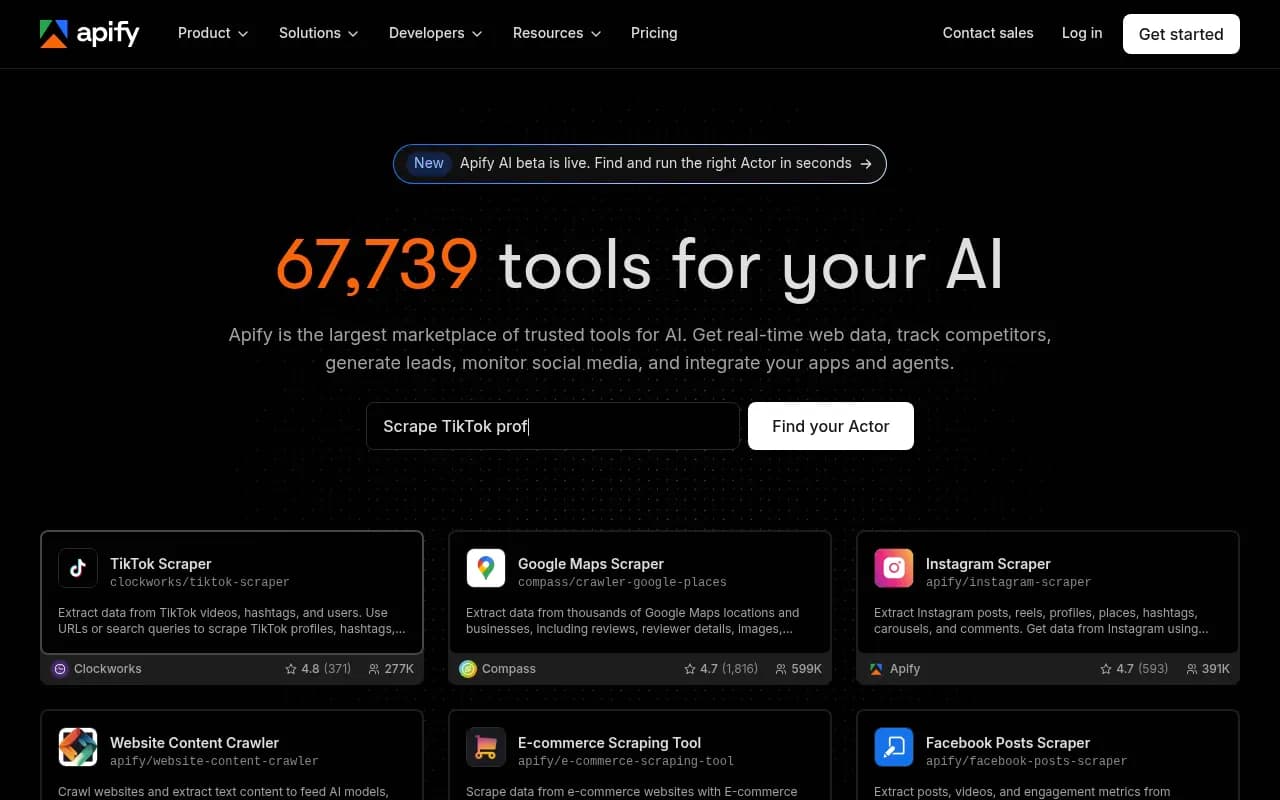


Be aware that these solve getting data, not interpreting it. You still own parsing, metrics and every engine change.
When buying is the better call
Buy when speed matters and you do not own adjacent data, which is most enterprises. Buy when stakeholders need credible numbers fast, when you operate in several countries, or when the goal is changing the result rather than only watching it. As one SearchEye comparison puts it, the right platform shortens the distance between a buyer question, a missing citation, and a credible source that mentions your brand. Treat that as the workflow you are buying.
What to buy: a quick map of the market
The category is barrel-shaped, as cloro notes: a tool at $199 and a tool at $2,000 are different decisions. Check current pricing on each vendor's site before shortlisting, since plans change often.
| Type | Examples | Strength | Watch out for |
|---|---|---|---|
| Monitoring-first trackers | Peec AI, Otterly.AI | Fast setup, low entry price | Often stop at reporting; limited crawler or traffic data |
| Enterprise analytics | Profound, Scrunch | Deep citation analysis, enterprise security | Cost and learning curve |
| SEO suite add-ons | Semrush AI Visibility Toolkit, Ahrefs Brand Radar | One login with existing SEO data | Shallower AI-specific data |
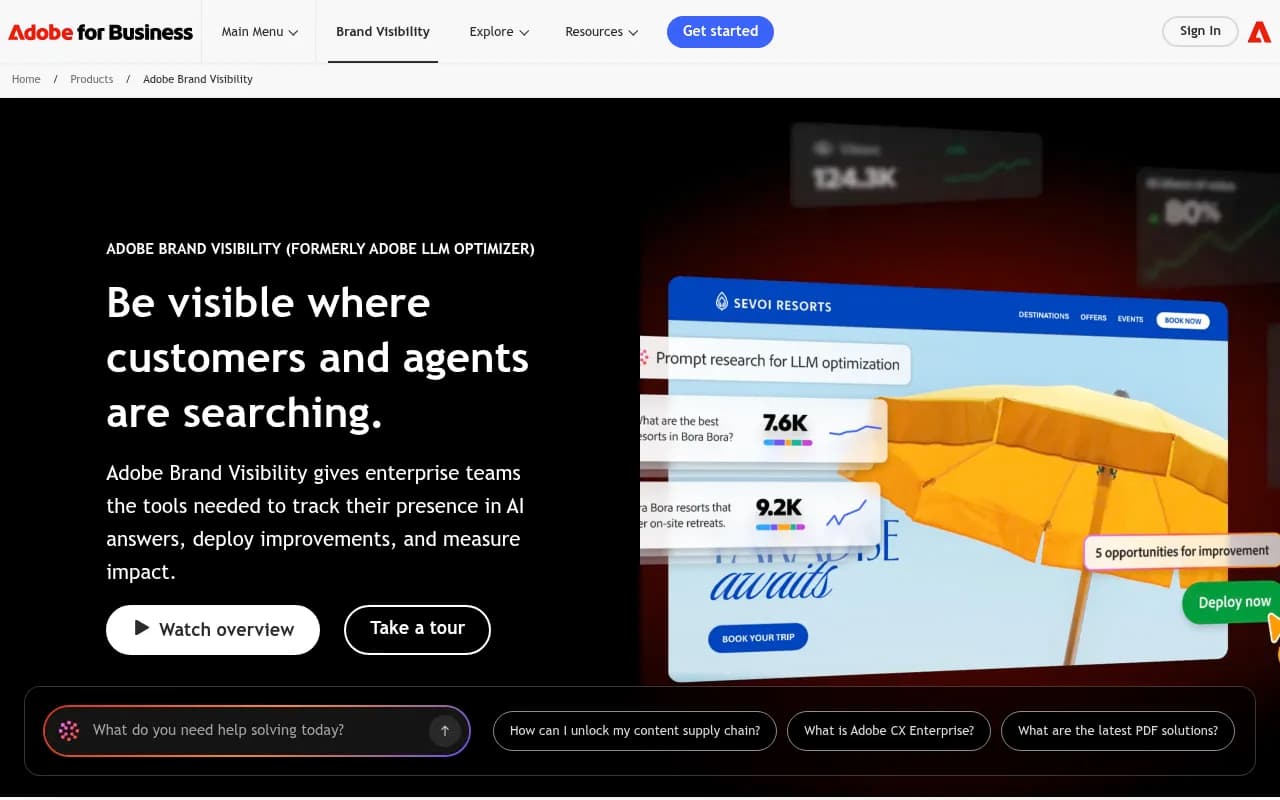
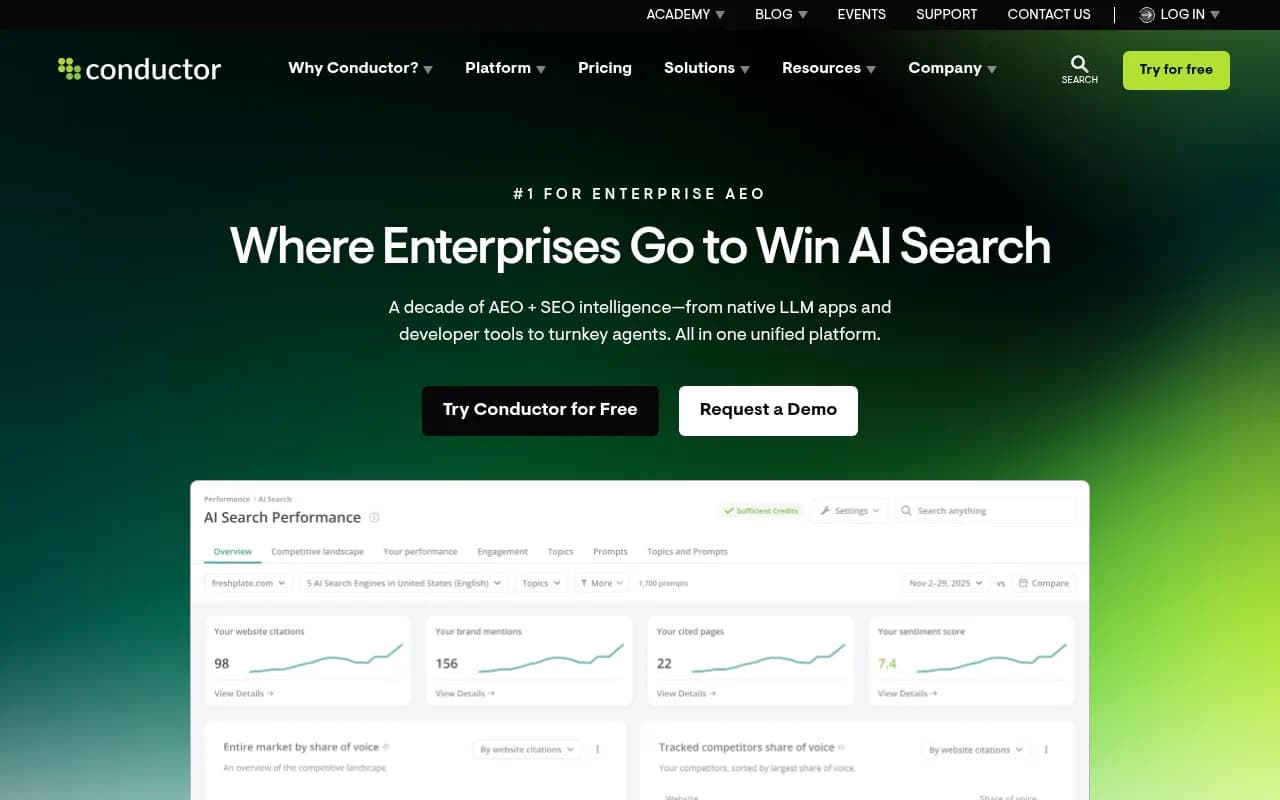
| Enterprise platforms | Conductor, Adobe LLM Optimizer, BrightEdge | Fit into existing enterprise stacks | Contract size, platform lock-in |
| End-to-end optimization | Promptwatch | Monitor, trace, act and measure in one loop | Newer category, so check fit in a trial |
Promptwatch is the one I would put at the top of an enterprise shortlist if the goal is both measuring and fixing. It tracks ChatGPT, Gemini, Claude, Perplexity, Google AI Overviews, AI Mode, Copilot and other engines from the real interfaces in each country and language, then goes further than a dashboard: IP-verified AI crawler logs show whether bots read your pages, a Content Agent writes and publishes the pages AI cites to WordPress, Webflow or Framer, and visitor analytics measure whether the traffic converts. It is ISO/IEC 27001 certified and GDPR compliant, which matters in procurement. Pricing starts at $95 per month for Essential, $245 for Professional and $579 for Business, with the Content Agent first available on Business, so confirm current plans at promptwatch.com/pricing.

If you want to see how it stacks up against specific rivals, the head-to-head pages are Promptwatch vs Profound and Promptwatch vs Peec.



For suite-based teams, the add-ons from Semrush and Adobe are worth a look, mainly if procurement already has those contracts.
To browse more options in this category, the GEO software directory at bestgeosoftware.com lists dozens of platforms by capability.
The hybrid path most enterprises should take
The build-versus-buy binary is mostly a false choice. Optimizely's approach is the model: own what you are uniquely positioned to own, and partner for measurement depth.
In practice, that means:
- Buy the collection and measurement layer from a platform that monitors real interfaces and absorbs engine changes.
- Pull the data through its API or MCP server into your warehouse.
- Build the part that is genuinely yours: joining AI visibility to pipeline, revenue and CRM data, internal dashboards, and executive reporting.
Promptwatch exposes a REST API v2 and a hosted MCP server with 110+ read and write tools, plus a Looker Studio connector, so this pattern does not require scraping a dashboard. Most of the engineering effort then goes into the one thing a vendor cannot know: how AI-driven visits show up in your own revenue numbers. Your team gets custom reporting without carrying the parser maintenance.
A practical 30-day evaluation plan
If you are still torn, run both paths as a time-boxed test rather than a debate.
- Week 1: Define 50 to 100 prompts across your key markets and three or four buyer personas. This is the same input either path needs.
- Week 1 to 2: Start a trial with two or three vendors. Most offer short trials, and Promptwatch has a 7-day free trial on monthly billing plus a free AI visibility report that needs no login.
- Week 2 to 3: Have one engineer spend a bounded few days on a minimal API-based prototype of the same prompts. Do not polish it. The goal is to compare numbers and measure pain.
- Week 3: Compare outputs. Where do API answers and real-interface answers diverge on mentions and citations? That gap tells you how much accuracy you give up by building.
- Week 4: Estimate total cost honestly. Include engineering hours, a 2x to 4x maintenance multiplier, proxies if you add UI collection, security review, and the opportunity cost of what else those engineers would ship.
Then decide. In my experience the prototype is valuable even when you buy, because it teaches the team what the vendor is absorbing for them.
Common mistakes
- Comparing a $100-a-month API bill with a vendor fee and calling the difference savings. It ignores engineering time entirely.
- Building the dashboard first. The dashboard is the easy part; start with collection fidelity and metric stability.
- Ignoring the fix side. Knowing you are invisible in ChatGPT is a start. Someone still has to create and publish the content, repair crawler access, and measure the result. If your build only reports, you will eventually buy something for the rest.
- Treating one week of data as truth. Answers are nondeterministic and engines change, so you need repeated sampling and stable metrics.
- Skipping the buyer conversation. Marketing, SEO and the CMO want credible numbers now. A custom tool that arrives in nine months, maintained by one person, loses the internal argument even if it is technically better.
Bottom line
For most enterprises in 2026, buy the measurement layer and build only the integration work that is truly yours. The exceptions are real but narrow: you own adjacent data, you face a self-hosting mandate, or your needs are small enough that an API-based prototype will do. If you build anyway, budget for the tail, since engines like ChatGPT change fanout behavior, citation counts and query patterns without notice, and each change lands on your team.
A sensible next step is to run the 30-day evaluation above, with a free AI visibility report from Promptwatch as your baseline and a bounded prototype as your control.