Key takeaways
- ChatGPT didn't show a single ad until May 27, 2026. By mid-August, ads appeared in about 32.4% of web-search responses over a trailing 7-day window, per Promptwatch data tracking real ChatGPT interfaces.
- OpenAI killed the $200,000 minimum spend in May 2026, added CPC bidding ($3-$5 recommended starting bid), and opened a self-serve Ads Manager to any US business. The platform now reaches 1.2 billion weekly users.
- Google has pushed ads into AI Overviews and AI Mode in over 200 markets, but only through existing Search, Shopping, Performance Max, and App campaigns, there's no separate "AI Overviews" campaign type.
- Click-through rates on queries that trigger AI Overviews have cratered: organic CTR down 61%, paid CTR down 68% since mid-2024, according to a Seer Interactive study covering 3,119 queries and 25M+ impressions.
- Perplexity walked away from advertising entirely in February 2026, the same month ChatGPT launched it, betting that trust matters more than ad revenue. It's now sitting on roughly $200M in annualized subscription revenue.
Two companies, two very different bets
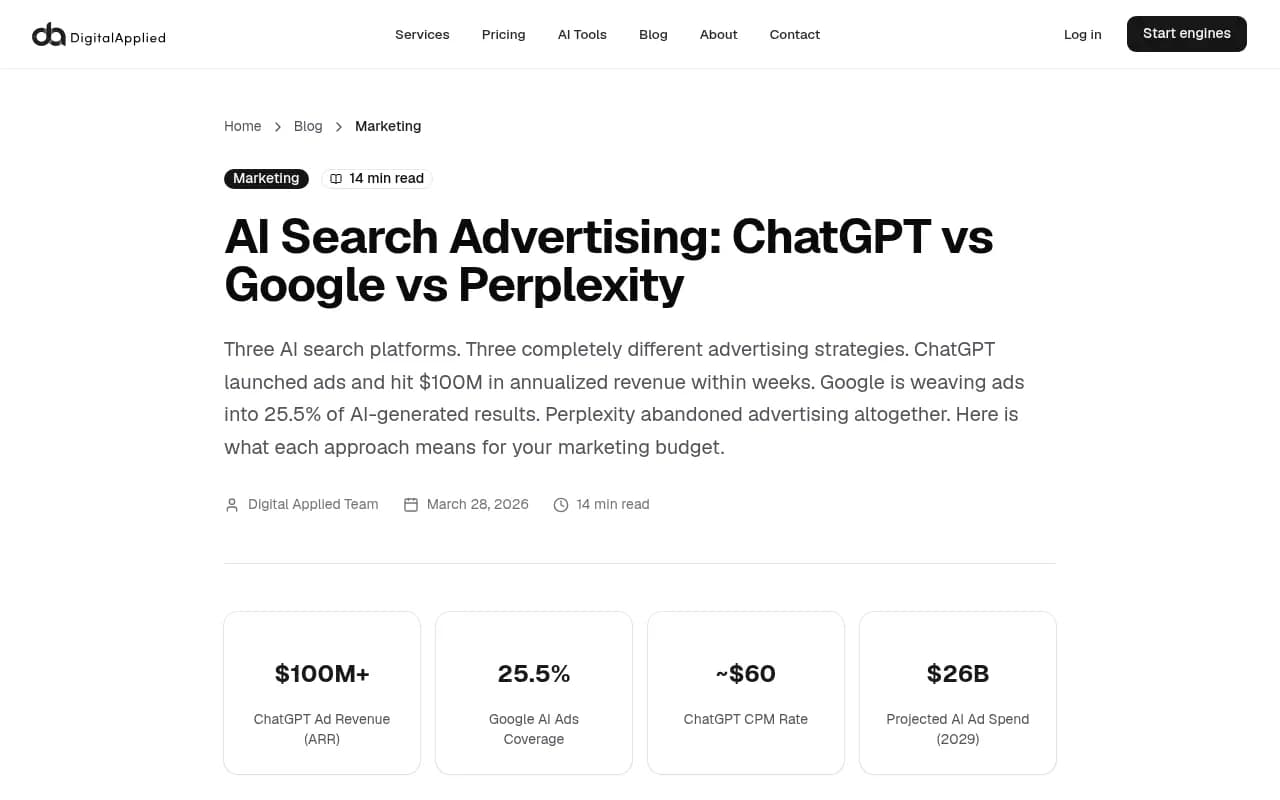
February 2026 was a strange month for anyone watching AI search advertising. OpenAI flipped the switch on ChatGPT ads and hit $100M in annualized revenue within about eight weeks, something close to the fastest ramp any new ad platform has managed. In the same month, Perplexity ripped out its ad tests entirely and told the world it would rather be the ad-free option. Google, meanwhile, had already been quietly stitching paid placements into AI Overviews for a year, and by mid-2026 ads were showing up next to roughly a quarter of all AI-generated answers.
Three companies, three totally different theories about what users will tolerate from AI search. If you run paid media, you don't get to pick just one anymore. You have to understand all three, because they behave nothing like the search ads you grew up with.
What ChatGPT ads actually look like right now
The launch terms were brutal by design. $60 flat CPM, invite-only, $200,000-$250,000 minimum commitment. That's not a test budget, that's an enterprise contract. But OpenAI moved fast: the minimum dropped to $50,000 in April, then disappeared completely on May 5, 2026, when a self-serve Ads Manager opened to any US business. CPC bidding arrived the same day, with a recommended starting bid of $3-$5 per click, and CPM pricing now floats between $25 and $60 depending on category rather than sitting at a fixed rate.
Here's the part that trips up experienced search marketers: there are no keywords. Advertisers set "context hints," natural-language phrases describing the audience and intent, something like "cushioned everyday running shoes for beginners training for their first 5K." OpenAI runs a relevance-weighted auction against that hint, your ad copy, and your landing page. It doesn't guarantee delivery, and there's no quality-score equivalent to benchmark against. David Dugan, OpenAI's head of global ads solutions, said it plainly at Cannes Lions: this "is not a keyword-based buy."
According to Promptwatch's ChatGPT ads tracking over a 90-day window (May 20 to August 17, 2026), ads climbed in bursts rather than a steady ramp. They hit 30% of ad-eligible responses around July 1 and basically stuck there, with a peak daily rate of 43.9%. Organic, non-branded prompts carry about 73% of all ad impressions, meaning most of this inventory is showing up in general research conversations, not in branded or competitor-comparison queries.

One structural catch for B2B advertisers: ads only run on Free and Go ($8/month) tiers. Plus, Pro, Team, and Enterprise users never see an ad. If your buyers are the kind of people who pay $200/month for ChatGPT Pro, this channel structurally can't reach them yet.
Early performance signals
OpenAI's own October 2026 release shared a handful of partner-reported numbers worth treating as early and self-selected, but still informative:
- WeightWatchers reported a CPA 15.3% lower than its blended paid-search benchmark, per DV Rockerbox.
- Wellness brand Dose saw 67% of incremental purchases coming from net-new customers, per WorkMagic.
- 93% of Portland Leather's ChatGPT Ads visitors were new to the brand, per Triple Whale.
That last stat is the interesting one. If ChatGPT traffic is mostly new-to-brand, it's playing a prospecting role, not cannibalizing existing demand the way a lot of branded search traffic does.
What Google is actually doing inside AI Overviews and AI Mode
Google took a more conservative, integration-first approach. There's no dedicated "AI Overviews campaign type." Instead, your existing Search, Shopping, Performance Max, and App campaigns become eligible to surface above, below, or (in a smaller set of markets) within the AI Overview itself. The within-answer placement is currently limited to English, mobile and desktop, in a dozen or so markets including the US, Australia, Canada, and India, and only Text and Shopping ads qualify.
Google's ad-matching logic inside AI Overviews is genuinely different from classic Search. It looks at both the user's query and the content of the generated Overview itself, so a query like "why is my pool green" with zero obvious commercial intent can still trigger pool-vacuum shopping ads because the Overview's own suggested content implies someone is dealing with a maintenance problem. Traditional exact or phrase match keyword campaigns are largely locked out of this inventory. Google's recommended path is broad match, AI Max for Search, Performance Max, Shopping, or Dynamic Search Ads, paired with Smart Bidding.
AI Max for Search rolled out globally as a one-click opt-in, bringing broad-match-style, AI-generated ad customization into existing Search campaigns. Google's own numbers claim +14% conversions at a similar CPA on average, climbing to +27% for accounts that had been running mostly exact or phrase match before switching.
There's also Direct Offers, a newer pilot that lets retail and hotel advertisers surface exclusive discounts directly inside AI Mode answers, not just a separate shopping panel. It's managed through Merchant Center or Hotel Center and layers on top of AI Max or Performance Max campaigns.
The CTR problem nobody can ignore
This is the uncomfortable part. Seer Interactive's analysis of over 3,000 informational queries, spanning 25.1 million organic and 1.1 million paid impressions from mid-2024 through September 2025, found that on queries triggering AI Overviews, organic CTR dropped 61% (from 1.76% to 0.61%) and paid CTR dropped 68% (from 19.7% to 6.34%). Even queries without AI Overviews saw organic CTR fall 41% year over year. Clicks across the board are getting harder to earn.
But there's a silver lining buried in the same study: brands that get cited inside the AI Overview earn 35% more organic clicks and 91% more paid clicks on that same query, compared to brands that go uncited. Citation isn't just an SEO vanity metric anymore, it directly correlates with whether your paid ads even get seen in that moment. That's the core argument for running GEO and paid search as one coordinated effort instead of two separate budgets reporting to two separate teams.
Side-by-side comparison
| Dimension | ChatGPT Ads | Google AI Overviews / AI Mode | Perplexity |
|---|---|---|---|
| Status | Self-serve, no minimum spend since May 2026 | Live in 200+ markets via existing campaign types | Ads shut down Feb 2026, subscription only |
| Pricing model | CPM ($25-$60) or CPC ($3-$5 recommended start) | Standard Search/Shopping/PMax auction | N/A |
| Targeting | Natural-language "context hints," no keywords | Broad match, AI Max, Performance Max, Shopping | N/A |
| Reach | 1.2B weekly users, Free and Go tiers only | All existing Search advertisers | N/A |
| Ad coverage | ~32% of web-search responses (7-day avg, Aug 2026) | ~25% of AI Overview responses | 0% |
| Reporting depth | Impressions, clicks, spend, CTR, CPC/CPM by day | Full Google Ads reporting suite, counted as "Top Ads" | N/A |
Why this is reshaping paid search strategy, not just adding a channel
A few shifts are worth internalizing before you reallocate budget.
First, query fanout behavior on ChatGPT has actually shrunk. Promptwatch's query fanout tracking shows ChatGPT went from roughly 2.15 searches triggered per response in December 2025 down to about 1.0 by April 2026, and query length dropped from around 117 characters to 53, meaning queries are getting more keyword-like and less conversational. That's a smaller window for both organic citations and paid inventory to compete inside each response, which partly explains why ad rates climbed so fast once OpenAI started monetizing: there's less room, so what room exists gets filled quickly.
Second, ChatGPT's citation mix leans heavily toward pages you can actually control. Product pages and landing pages together make up close to 39% of all ChatGPT citations, rising to nearly 70% combined with listicles and comparisons on commercial-intent prompts specifically. That means the same content work that earns you an organic citation, a clean product page, a tight comparison page, a well-structured landing page, also happens to be exactly what a context-hint-targeted ad needs to land well. Paid and GEO are converging on the same content requirements.
Third, don't expect your Google Ads playbook to transfer cleanly. Explore Digital's early-hypothesis testing of the two platforms put it well: Google Ads captures demand that already exists, ChatGPT ads have a shot at influencing demand while it's still forming. A "book now" ad that converts on Google can fall flat on ChatGPT, where the user might still be in the comparing-options phase of a longer conversation.
Fourth, the trust tax is real. An Ipsos survey found 63% of US adults say ads in AI search results make them trust the results less. That's not a reason to avoid AI search ads, but it is a reason to make sure your creative reads as helpful rather than interruptive, since users are primed to be suspicious of anything that feels like a bolt-on.
Budget allocation: a practical framework
Most agencies testing ChatGPT ads recommend a minimum of $2,000-$5,000 per month to get statistically meaningful data, run alongside your existing Google and Meta programs rather than instead of them. A few guardrails worth following:
- Write multiple distinct context hints per ad group. One generic hint per group commoditizes your own bid against everyone else targeting the same broad category.
- Match your landing page to the hint exactly. Mismatches between hint language and page content are one of the most common failure modes agencies report.
- Include competitive framing where it's genuinely relevant, something like "switching from [competitor]" rather than only generic category terms.
- On the Google side, if you're still running mostly exact or phrase match, test AI Max for Search before assuming AI Overview inventory is unreachable. Google's own data shows the lift is biggest for accounts making that exact switch.
- Track citation status separately from paid performance. If your brand is getting cited in AI Overviews or ChatGPT responses on a given query, your paid ads on that same query likely perform meaningfully better, so it's worth knowing which queries already have citation coverage before you bid aggressively on new ones.
For tracking which prompts and queries are triggering ads against your brand or your competitors, and whether you're showing up in the citations next to those ads, tools like Promptwatch can help, since it tracks ChatGPT's Ads Radar and ChatGPT Shopping placements directly against prompt-level citation data, rather than treating ad monitoring and visibility monitoring as separate problems.
If you want a broader view of the AI visibility and GEO tooling landscape beyond Promptwatch, the directory at bestgeosoftware.com breaks down dozens of platforms by feature set and pricing.
What Perplexity's exit tells us
Perplexity's decision to kill ads entirely in February 2026 is worth sitting with for a second, because it's a genuine counter-bet against what OpenAI and Google are doing. The company reported over 100 million users and roughly $200M in annualized revenue by mid-2026, almost entirely from $20-$200/month subscription tiers, and an FT report pegged its valuation at $18B on the strength of that subscription-only model. Whether that holds up against the sheer scale of ChatGPT's 1.2 billion weekly users remains an open question, but it's a real data point that ad-free isn't automatically a losing strategy in AI search.
Where this is headed
A prediction worth taking seriously, floated by Optmyzr's Aaron Levy on a recent webinar: as click volume keeps falling and Google looks for new ways to monetize the SERP, a shift from pure CPC toward CPM or even revenue-share pricing isn't far-fetched, with Local Services Ads as a rough proof of concept already in market. If that happens, the whole notion of "optimizing" a campaign starts to look less like bid management and more like running a good business that answers the phone and treats customers well.
For now, the practical move is simple even if the execution isn't: stop assuming your Google Ads strategy transfers to ChatGPT, start treating citation visibility as a lever that directly affects paid click-through rates, and budget a real test on ChatGPT ads rather than a token spend you'll abandon after two weeks of noisy data.