Key takeaways
- ChatGPT has no ranking position to hold. Tracking means sampling a fixed prompt set on a schedule and recording mentions, citations and shopping cards.
- Brand-level tracking hides the real picture for stores. Shoppers ask about products and categories, so you need prompts and metrics at the SKU and collection level.
- Product pages and landing pages together drew about 39% of ChatGPT citations from Sep 28 to Oct 4, 2026, according to Promptwatch Data.
- Shopping cards appear on a low single-digit share of web-search responses, but they cluster on commercial prompts and the rate moves in steps.
- Run each prompt many times and read trends. A single run tells you almost nothing.
Why brand tracking fails ecommerce teams
Most ChatGPT visibility tools were built around a simple question: was my brand mentioned? That works for a SaaS company with one product. It works badly for a store with 4,000 SKUs.
A shopper doesn't ask ChatGPT about your brand. They ask for "waterproof hiking boots under $150" or "best espresso machine for a small kitchen." ChatGPT answers with specific products, sometimes with cards showing price and merchant. Your brand might be named in one answer for a boot you barely stock, and be absent from the five prompts that drive your revenue. A single brand-level visibility number averages all of that into mush.
So the unit of measurement has to change. You track a product, or a product group, against the prompts that lead to it.
ChatGPT doesn't have a rank
First, drop the word "rank." ChatGPT has no results page and no stable ordered list. The Rework guide to ChatGPT rank tracking tools (updated Oct 2, 2026) puts it plainly: these tools run a fixed set of prompts on a schedule and record whether you were mentioned and whether your page was cited. It also cites SparkToro research finding that the same prompt returns an identical brand list, in the same order, under 0.1% of the time, and reports that 74% of cited domains on ChatGPT Search are new every week.
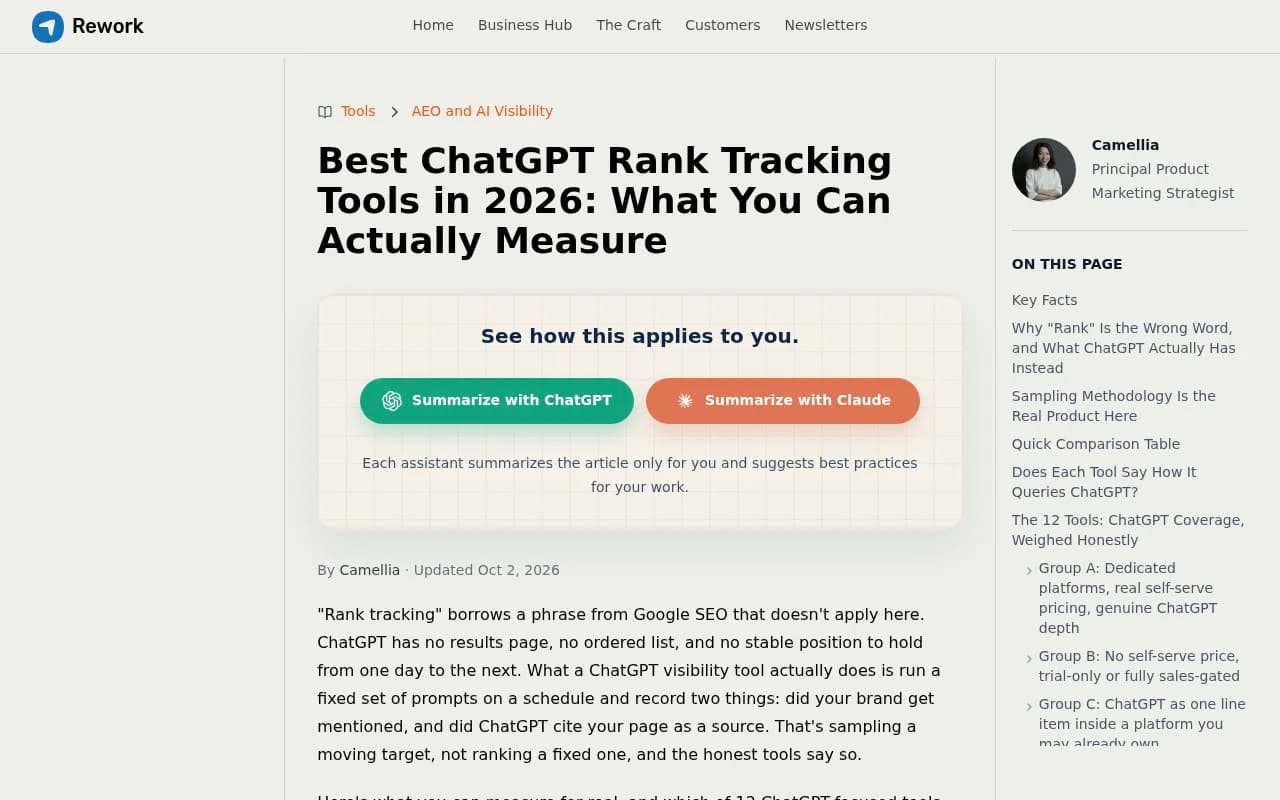
That has a practical consequence. One run of "best running shoes" proves nothing. You need repeated sampling, and you read frequency ("we appeared in 34 of 100 runs") rather than position.
What to track at product level
For each product or collection, I'd track five things.
- Product mention rate: how often a specific product is named in answers to relevant prompts.
- Citation rate: how often a specific URL on your store is listed as a source.
- Shopping card presence: whether product cards appear for that prompt, and which merchants and brands fill them.
- Competitor product share: which rival products show up next to yours.
- Context and sentiment: is your product recommended, or only listed as an alternative with a caveat?
Notice that mention and citation are separate. ChatGPT can name your product while citing a review site, a marketplace or a competitor's comparison page. In that case you have awareness but no traffic, and the fix is different from the case where it cites your own product page.
Which pages ChatGPT actually cites
Promptwatch Data covering Sep 28 to Oct 4, 2026 shows what ChatGPT cites by content type. Product pages led at 22.4% of citations, landing pages followed at 16.8%, and listicles at 13.6%. Together, product and landing pages account for about 39% of citations.
For commercial prompts like "best CRM for small businesses" the skew is stronger. Product pages hit 26.0%, landing pages 20.6%, listicles 15.0% and comparisons 7.9%. Those four types make up almost 70% of commercial citations. For branded prompts, reviews matter more: 5.6% of citations, over three times their share across all prompts.
For a store, this reads as a to-do list:
- Your product and category pages are the main thing ChatGPT wants. Make them comparable, with clear price, specs and who the product is for.
- You also need to appear in third-party "best of" listicles, because that's the third-biggest bucket. Track which ones get cited for your category.
- Reviews matter once a shopper already knows your name, so keep review content crawlable and current.
Content age matters too. Promptwatch's content half-life data shows landing pages and docs staying cited for months, while news loses half its cited pages in about five weeks. Evergreen category pages beat seasonal blog posts.
Shopping cards are real, but small and unstable
ChatGPT's product cards are the closest thing ecommerce has to a SERP feature. Promptwatch's ChatGPT shopping usage data measures the share of web-search responses that include product cards, shopping recommendations or price comparisons. It's a low single-digit percentage overall, but much higher on commercial and transactional prompts.
The interesting part is the shape of the line. The rate moves in steps. In the window Promptwatch charts, it roughly doubled overnight, then fell back weeks later. That looks like OpenAI tuning when cards appear, so a sudden jump in your card appearances may have nothing to do with your work. Annotate your charts, and compare against your category's baseline before celebrating or panicking.
Promptwatch's recommendations for card eligibility are plain: complete Product schema, accurate prices and availability, and a clean merchant feed. Run the commercial prompts your buyers use and record whether cards appear and which brands fill them.
Also watch ads. Promptwatch's ChatGPT ads data shows ads in an average of 20.1% of web-search responses between May 20 and Aug 17, 2026, with a rate above 30% from July 1. If paid placements sit next to your organic mentions, your tracking should separate them.
Build your prompt set around the buying journey
Start with 50 to 100 prompts, not 5,000. Group them by intent:
| Prompt type | Example | What you learn |
|---|---|---|
| Category discovery | best standing desks for home offices | Whether you're in the consideration set |
| Attribute-led | quiet air purifier for a bedroom under $200 | Which specs ChatGPT matches you on |
| Comparison | Brand A vs Brand B vacuum | Which comparison pages get cited |
| Brand-specific | is [your brand] good quality | Sentiment and review sources |
| Problem-led | how to stop sneakers creasing | Top-of-funnel content citations |
Tag each prompt to a product line or collection. That tagging is what turns a pile of results into a product-level report. Add country and language variants if you sell in more than one market, since answers differ.
Then run each prompt repeatedly. Tools handle this on a daily or weekly schedule. Judge by trend lines over several weeks.
Tools that can track products
Most trackers stop at the brand. A few in our catalog lean toward ecommerce.
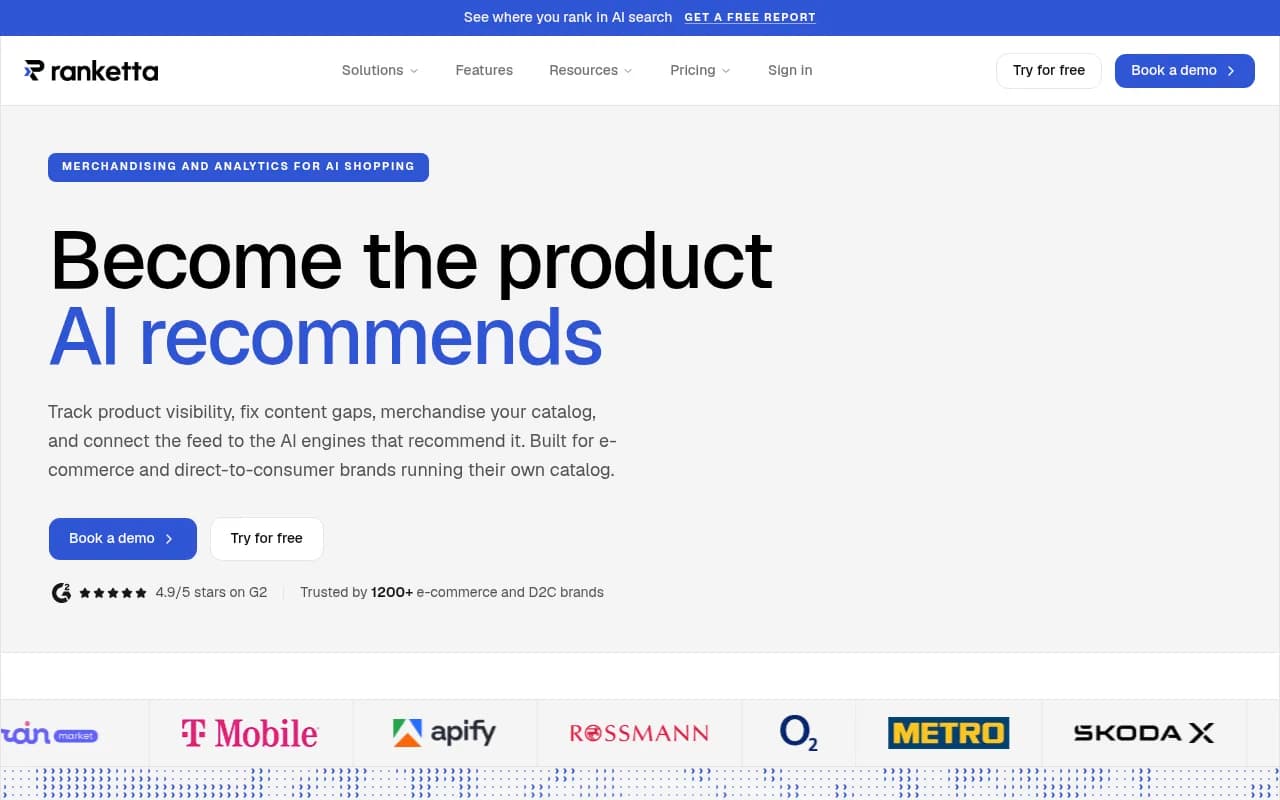
Ranketta is built around product-level visibility for stores.
Alhena AI focuses on ecommerce catalogs.
Yotpo Discover ties AI visibility to catalogs and reviews, which helps given how much weight reviews carry on branded prompts.
Yotpo Discover
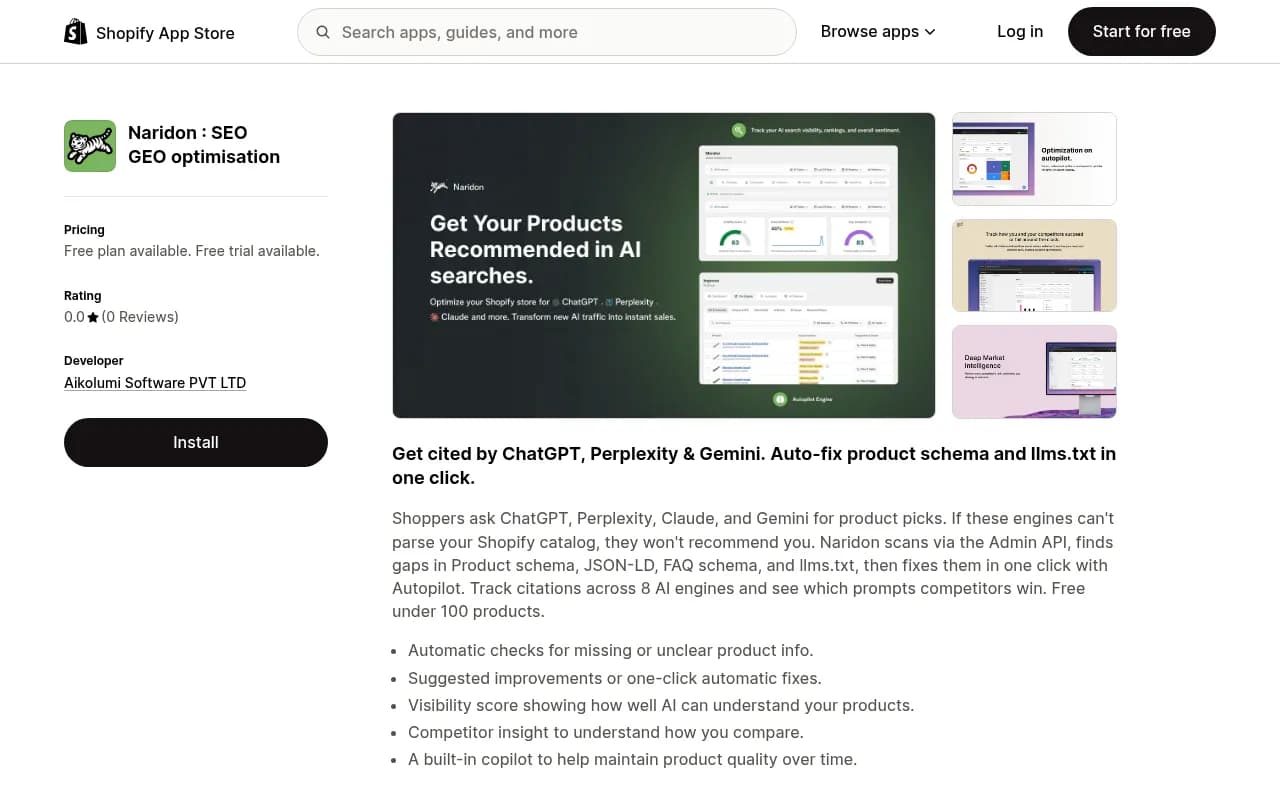
Naridon is Shopify-native, useful if you want monitoring without a separate stack.

Azoma targets agentic commerce, where AI shopping agents buy on a user's behalf.
For tracking plus action, Promptwatch monitors the real ChatGPT interface rather than only API output, which matters because shopping cards and citations can differ between the two. It also covers AI shopping visibility in ChatGPT carousels and Amazon Alexa product results (you can upload your catalog to track your own products), and its crawler logs show whether ChatGPT's bots can read your product pages at all. Content gap analysis then maps your pages against prompts AI answers.

Brand-level trackers still have a place if you want cheap baseline monitoring.



If you want a broader comparison, the GEO software directory lists more options.
Comparison table
| Tool | Product-level focus | Notes |
|---|---|---|
| Ranketta | Yes | Built for ecommerce product tracking |
| Alhena AI | Yes | Catalog-oriented |
| Yotpo Discover | Yes | Catalogs and reviews |
| Naridon | Partial | Shopify-native monitoring |
| Promptwatch | Yes, via shopping tracking and catalog upload | Real-UI tracking, crawler logs, content agent |
| Otterly.AI | No, brand and prompt level | Affordable monitoring |
| Peec AI | No, brand and prompt level | Prompt tracking |
| Profound | Limited | Enterprise monitoring |
Pricing changes often, so confirm on each vendor's site. I haven't verified current pricing for the tools above.
What to check before you buy
Comparison articles like LLM Pulse's roundup are a fair starting point, but run through this list yourself:
- Does it monitor the actual ChatGPT interface, or only the API?
- Can you tag prompts to products or collections?
- Does it record shopping cards, and the merchants inside them?
- Does it show which of your URLs get cited, not just that you were mentioned?
- Does it sample repeatedly and report frequency?
- Can you export data to your BI tool?
Turn tracking into fixes
Tracking without action is a dashboard hobby. Here's a workflow that works.
- Find prompts where competitors' products appear and yours don't.
- Check whether the cause is access (can ChatGPT's crawlers fetch your product pages?), content (thin specs, no comparison), or off-site (you're missing from the listicles that get cited).
- Fix product pages first: full schema, accurate price and stock, clear specs, a feed that matches the page.
- Publish category comparison pages and buying guides for the prompts you lose.
- Pitch inclusion in the roundups ChatGPT already cites.
- Re-measure over several weeks and compare against the category baseline.
For the crawler side, Promptwatch Data also tracks AI crawler traffic, which is useful context when you review your own logs.
Common mistakes
- Tracking only your brand name and calling it product visibility.
- Reading a single run as a ranking.
- Treating a step change in card appearances as your own win.
- Ignoring whether the cited URL is yours or a marketplace's.
- Tracking 1,000 prompts nobody tagged to a product line.
Where to start this week
Pick your 10 best-selling products. Write five prompts for each, across discovery, attribute, comparison and brand intent. Tag them, run them repeatedly for a few weeks, and record mention rate, cited URL and card presence. That small set will show you more than a brand score ever will, and it tells you exactly which product pages to fix first.