Key Takeaways
- Coding agents like Codex, Claude Code, and OpenCode fetch docs, READMEs, and API references directly, so your docs are now read by software before they are read by people.
- Track five things: agent crawl access, citation and recommendation share, recommendation accuracy, AI-referred traffic, and activation of developers who arrive via agents.
- Vanity numbers lie. Adoption rates and request volume can climb while real outcomes stay flat, which is the same trap engineering leaders hit with agent productivity metrics.
- Consumer AI search and developer agent retrieval are separate channels. A strategy that works for ChatGPT citations will not automatically work for Claude Code.
- Start with your server logs and a baseline set of prompts. You can have a useful dashboard within a week.
Why DevRel needs its own agent visibility metrics
DevRel has always measured reach through human behavior: docs pageviews, GitHub stars, conference attendance, Discord activity. Those still matter. But a growing share of developers now ask an agent "which SDK should I use for X" and accept the answer. If the agent never recommends you, the developer never visits your docs, never stars the repo, and never shows up in your funnel. You lose before the funnel starts.
The Temporal State of Development Report 2026 (published August 25, 2026) gives a sense of the scale. It reports a 71% year-over-year jump in AI agent use among surveyed engineers, and 91% say their productivity has "improved" or "revolutionized". One caveat: the report describes its sample inconsistently (500+, 554, and 550 in different places), so treat the exact respondent count loosely. The direction is not in doubt.
A piece from DevRelCon New York 2026 put it well: DevRel is not disappearing, but its audience, interfaces, and measures of success are changing. The interface is now an agent. The measures of success need to follow.
What makes coding agents different from AI search
It is tempting to treat Claude Code the way you treat ChatGPT search. Don't. They retrieve differently.
According to Promptwatch Data on markdown in AI search (last 7 days of citations as of February 2026), HTML accounts for 99.94% of AI search citations, while markdown files are 0.05%. That is roughly 2,000 to 1. Yet the same report notes a large increase in docs crawling by Claude's bot (which powers Claude Code) and OpenAI's bot (which powers Codex). Coding agents fetch specific docs, READMEs, and API references rather than searching the open web the way ChatGPT does.
The practical takeaway from that report is blunt: don't build .md mirrors of marketing pages, but do consider .md endpoints for developer docs, where agents pull them directly. Its crawl-log table shows /docs/**/*.md paths hit thousands of times, with the top path at 3,241 requests, and some paths hit by only one of the two bots.
That last detail matters for metrics. Different agents hit different pages. You need per-agent, per-page numbers, not a single "AI traffic" line.
The five metrics that matter
1. Agent crawl access and error rate
The first question is boring but decisive: can the agents read your docs at all? A page that returns a 403 to ClaudeBot or renders blank without JavaScript is invisible, no matter how good the content is.
Track:
- Requests per agent (GPTBot, OAI-SearchBot, ClaudeBot, Claude-User, PerplexityBot and others) per docs section
- Share of requests that return errors, split by status code
- Pages that no agent has fetched in 30 days
- Whether requests are IP-verified. User agent strings are trivially spoofed.
A useful sanity check comes from Promptwatch's AI crawler traffic report (IP-verified requests, June 8 to September 6, 2026). OpenAI made up 79.8% of verified AI crawler requests in the week of August 31 to September 6, down from 94.8% in the week of June 8 to 14. Its advice is simple: compare your own logs to that mix. If a provider is large in the report but near zero in your logs, you are probably blocked or unreachable for it.
The report is also careful about one thing worth copying: totals mix training crawlers with answer-time fetchers. For DevRel, answer-time fetchers matter more, because they indicate a developer asked a question and an agent went looking for your docs to answer it.
2. Recommendation share on developer prompts
This is the AI-era version of share of voice. Build a prompt set that mirrors real developer questions:
- "Best SDK for sending transactional email in Node"
- "How do I add auth to a Next.js app"
- "[Your category] alternatives to [competitor]"
- "Compare [your tool] and [competitor] for [use case]"
Run them regularly across ChatGPT, Gemini, Perplexity, Claude, and the coding agents, then record whether you are mentioned, in what position, and with what framing. Position matters: being the third of five options is a different outcome from being the default.
Keep two numbers apart. Mention rate tells you whether the model knows you exist. Citation rate tells you whether it points to your pages as the source. A mention without a citation usually means the model is working from training data or someone else's page about you.
3. Which sources the agents trust about you
For software prompts, the sources are fairly predictable. Promptwatch Data on software citations in ChatGPT (organic prompts, September 28 to October 4, 2026) shows github.com at 1.2% of all software citations, learn.microsoft.com at 0.98%, g2.com at 0.73%, docs.aws.amazon.com at 0.41%, and docs.cloud.google.com at 0.35%.
By source type, docs and help centers earned 2.64% of software citations, vendor sites 2.01%, review sites and analysts 1.57%, and GitHub 1.2%. Vendor sites plus docs total 4.65%, about three times review sites and analysts.
The lesson for DevRel: your own docs and your GitHub presence do most of the work. Review profiles on G2 and Capterra still matter, but they are the supporting cast. Track the share of citations that point at your own domain versus third parties. If an outdated Medium post outranks your docs as a source, that is a content problem you can fix.
4. Recommendation accuracy
This is the metric DevRel teams skip and then regret. Agents will confidently tell developers that your API has a feature it doesn't, that your SDK requires a deprecated auth flow, or that your pricing is something it was two versions ago. A wrong recommendation is worse than no recommendation, because it generates support tickets and angry GitHub issues.
Sample the claims agents make about you and mark each as accurate or inaccurate. Then trace inaccurate claims back to the page that taught the model the wrong thing. Often it is an old changelog, a stale tutorial, or a docs page that never got a deprecation banner.
5. AI-referred traffic and activation
The final metric ties visibility to something the business cares about. Track visits arriving from AI platforms, then follow them: do they reach the quickstart, create an API key, make a first call? Compare their activation rate to developers from search and social.
Two cautions. First, attribution is getting messier: ChatGPT stopped sending a referrer on October 8, 2026, so you may need UTM-tagged links or a setting that counts utm_source=chatgpt.com visits as ChatGPT traffic. Second, much agent activity never produces a click at all. A developer's agent reads your docs and writes the integration code directly. For that reason, crawl logs and recommendation share are leading indicators, and traffic is a lagging one.
Metrics that mislead
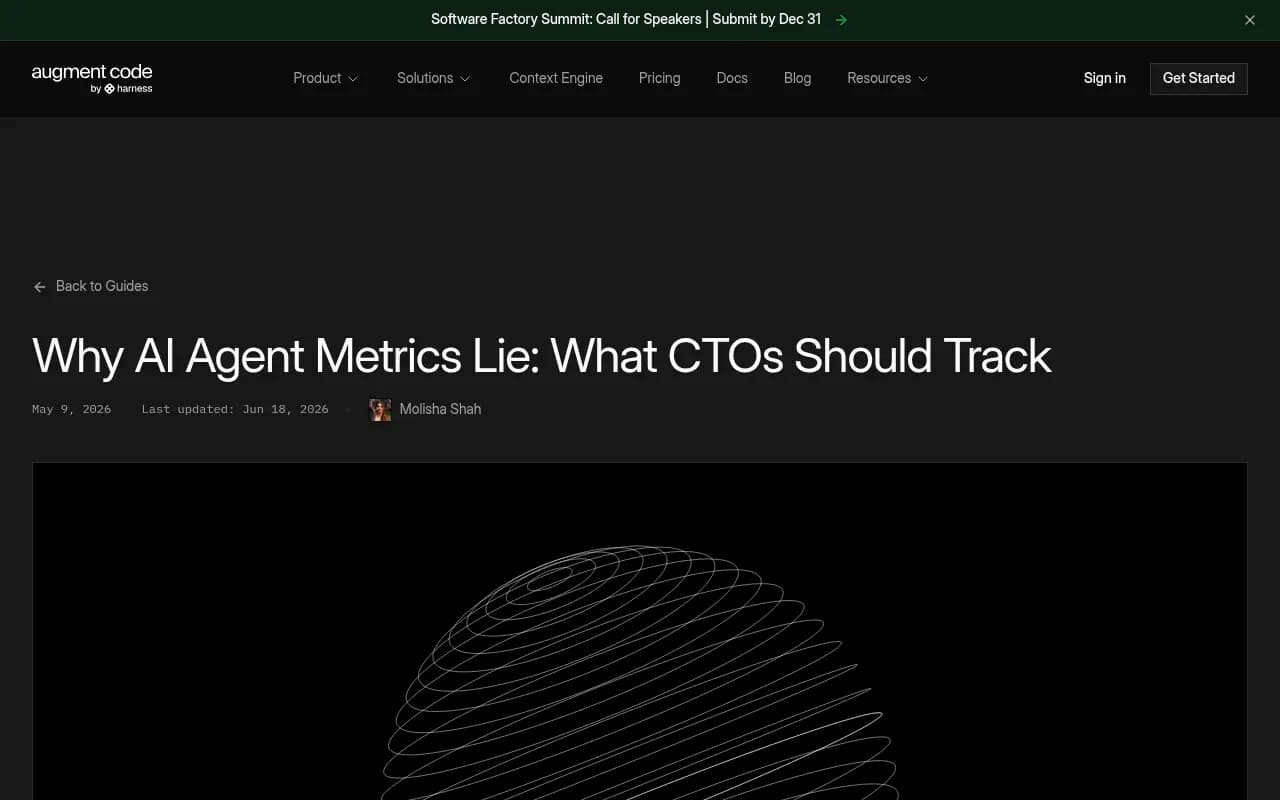
Engineering leaders have been burned by this already. Augment Code's guide on why AI agent metrics lie argues that adoption percentage, PR volume, and lines of generated code can all rise sharply while feature completion rate, change failure rate, and lead time stay flat or get worse. Its advice: measure delivery outcomes, not agent activity.
DevRel has direct equivalents of those traps:
| Vanity metric | Why it misleads | Better replacement |
|---|---|---|
| Total AI crawler requests | Mixes training bots with answer-time fetchers; spikes from one provider can drown the rest | Answer-time fetches per docs page, by agent |
| Raw mention count | Doesn't show position, tone, or accuracy | Recommendation share and position on a fixed prompt set |
| GitHub stars | Humans and bots star repos; not tied to agent recommendations | Citations to your repo and recommendation frequency in coding agents |
| Docs pageviews | Agent reads don't register in client-side analytics | Server or CDN logs with IP verification |
| AI referral sessions alone | Misses zero-click agent usage and missing referrers | Referral traffic plus activation rate plus crawl-to-citation path |
Building the measurement stack
Start with logs you already have
Before buying anything, grep your CDN or server logs for known AI user agents and look at which docs paths they hit. Even a rough count tells you whether agents reach you. Then verify source IPs against each operator's published ranges so you aren't counting spoofed traffic.
Build a stable prompt set
Write 30 to 50 prompts across discovery, comparison, how-to, and troubleshooting intents. Freeze them. Changing the prompt set every month destroys your trend line. Add new prompts, but never silently replace old ones.
Pick tooling that matches the job
You can do much of this by hand at small scale. At larger scale, you want a platform that tracks prompts, citations, crawler logs, and traffic together. Promptwatch covers that loop, and it specifically tracks how Codex, Claude Code, and OpenCode recommend tools, SDKs, and docs, which is the part most monitoring tools skip. Its IP-verified AI crawler logs show which pages agents read and where they hit errors.

Other tools in this space are mostly built around consumer AI search monitoring. They can still cover the ChatGPT, Gemini, and Perplexity half of your prompt set:



For a wider view of the category, the GEO software directory lists many more options.
| Need | What to look for | Example options |
|---|---|---|
| Coding agent recommendation tracking | Coverage of Codex, Claude Code, OpenCode | Promptwatch |
| Crawler logs, IP-verified | CDN or log integration, per-page errors | Promptwatch |
| Consumer AI search mention tracking | Multi-model prompt runs, share of voice | Profound, Peec AI, Otterly.AI, Scrunch AI |
| Traffic and conversion attribution | Script or tag-based AI referral tracking | Promptwatch, Trakkr |
| Delivery and productivity impact (internal) | Links AI usage to DORA-style metrics | Faros |
The last row is a different job. Faros-style tools measure how agents change your own engineering org's output, not how agents see your product. DevRel teams that also support internal developer experience may care about both.
Making your docs easier for agents to use
Metrics are only useful if you act on them. A few moves that follow directly from the data:
- Fix client-side rendering first. If the content isn't in the initial HTML, many fetchers never see it.
- Check robots.txt, CDN, and WAF rules for every major agent. Blocks are often accidental, added during a bot-scraping scare and never reviewed.
- Offer clean markdown endpoints for docs, not for marketing pages. The markdown report is explicit that .md serves agents, not AI search.
- Keep a public GitHub presence with a README that states what the project does, install steps, and a minimal example.
- Mark deprecated pages clearly, and redirect them. Stale pages teach agents wrong answers.
- Check which agent standards you support. Promptwatch's free Agentic Readiness Check reports which AI crawlers can read your site and whether you publish llms.txt and similar files.
A simple reporting cadence
Weekly: crawl errors by agent, new pages with zero fetches, recommendation share on your top 10 prompts.
Monthly: full prompt set run, accuracy review of sampled claims, citation source mix (your docs versus third parties), AI-referred traffic and activation.
Quarterly: compare your agent crawl mix to the industry mix, review which competitors gained share and why, and retire or refresh the pages agents keep misreading.
When you report upward, lead with outcomes. "Claude Code recommended us on 4 of 12 integration prompts, up from 1, after we fixed our quickstart rendering" is a sentence a VP understands. "AI crawler requests rose 38%" is not.
Where the gaps are
I'll be honest about what is still shaky. Coding agent behavior changes fast, so any benchmark is a snapshot, and the crawler mix in particular moves week to week. Zero-click usage is hard to see from any dashboard. And a developer-focused arXiv study on HTTP behavioral signatures of agents in documentation portals suggests agent traffic often looks different from human traffic at the request level, which means your existing analytics may be classifying agent reads wrongly. Treat your first baseline as a rough draft and plan to revise it.
Still, a rough baseline beats none. Pull a week of logs, write your prompt set, and find out whether the agents your developers use can see you.