Key takeaways
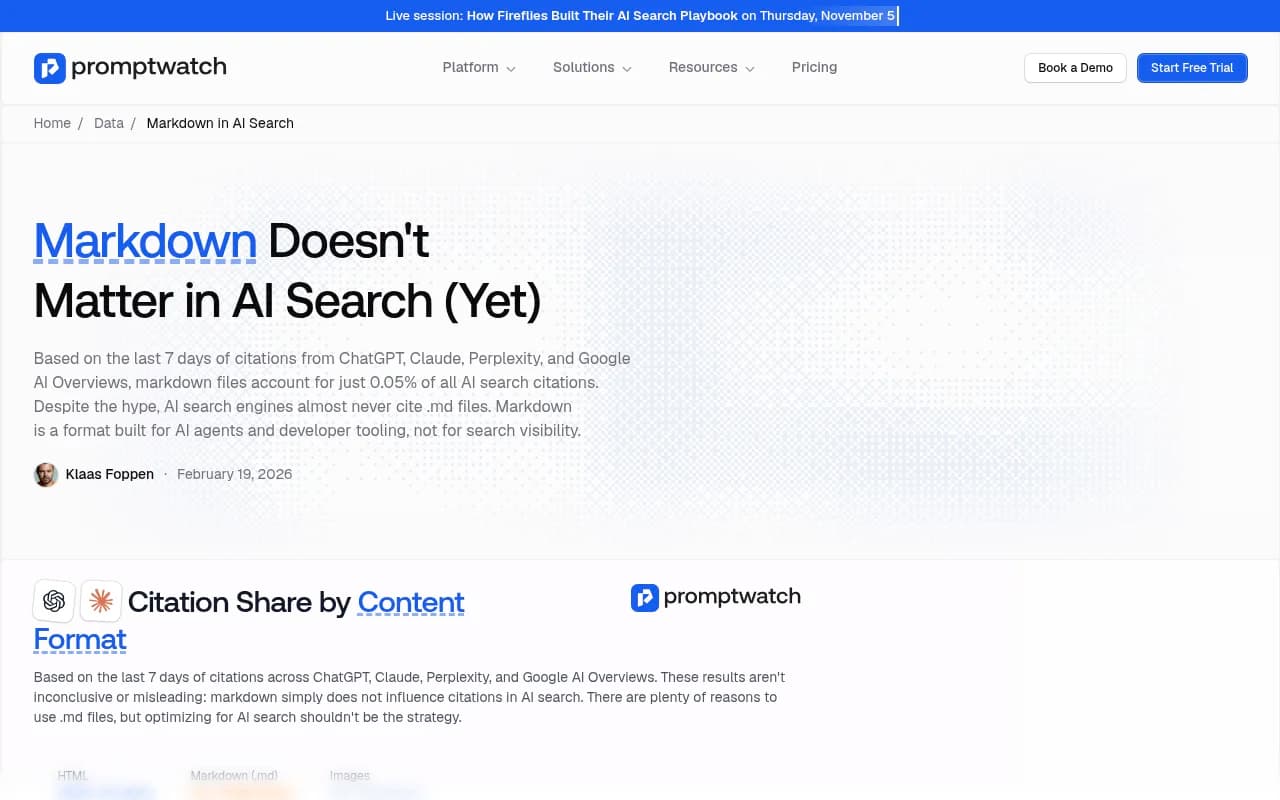
- In Promptwatch Data's report on the last 7 days of citations (published February 19, 2026), HTML pages took 99.94% of AI search citations and markdown (.md) files took 0.05%. That is roughly 2,000 to 1.
- Markdown is a format for AI agents and developer tooling (Claude Code, Codex), not for consumer AI search like ChatGPT or Google AI Overviews.
- Google's John Mueller has said Google's own .md help-doc files are not used for Search or generative AI responses in Search.
- Building .md mirrors of blog and marketing pages for AI visibility is wasted effort. Fix your HTML, rendering and crawler access instead.
- Keep .md endpoints for developer documentation, where coding agents do fetch them.
The claim: publish markdown and the LLMs will love you
If you have spent any time in SEO circles in the last year, you have seen the advice. Serve a clean .md version of every page. Add an llms.txt. Use content negotiation so bots asking for text/markdown get a stripped-down copy. The pitch sounds reasonable: a markdown file has no navigation, no scripts, no inline CSS. Less noise, easier for a model to read, so more citations. Right?
The logic is tidy. The data doesn't back it up.
One WebmasterWorld poster in August 2026 described exactly this setup: a script that caches pages, strips the HTML, and serves markdown to agents that ask for it. Their own summary of what they'd read: it won't help, it won't hurt, and it might be useful someday. They'd also added llms.txt and "nothing happened with that either." Another member replied that three of their sites with llms.txt are cited more often, though they admitted they had also rearranged content at the same time, which makes the cause impossible to separate.
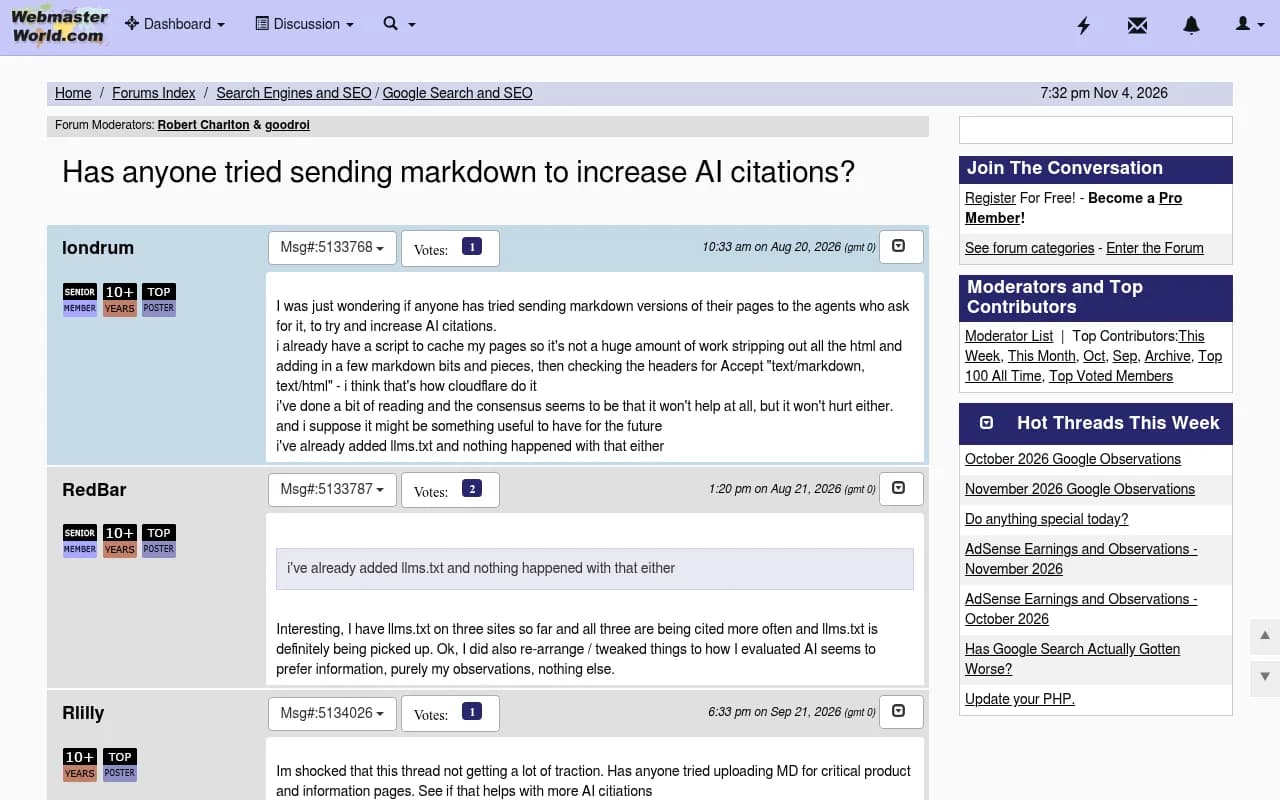
That thread is a fair snapshot of where practitioners are: lots of hope, very little evidence. So let's look at some.
What the data says: 0.05% of citations
Promptwatch Data's Markdown in AI Search report looked at a single week of citations across ChatGPT, Claude, Perplexity and Google AI Overviews. The split by content format:
| Content format | Share of citations |
|---|---|
| HTML pages | 99.94% |
| Markdown (.md) files | 0.050% |
| Images | 0.015% |
That is about two thousand HTML citations for every one markdown citation. A third-party summary from Publii puts the sample at 1,665,674 citations, and Gijs de Groot, Promptwatch's CEO, posted the same figure on LinkedIn with the same conclusion: markdown does not increase citation likelihood, at least for now.
Two honest caveats before anyone over-reads this:
- The data measures which URLs were cited. It doesn't capture every representation of a page a system may have processed before writing an answer. A model could, in theory, ingest a markdown version and still cite the HTML URL.
- The measurement is from February 2026. I could not find a refreshed figure, and the report title itself says "(Yet)". Treat it as a strong signal, not a permanent law.
Still, 0.05% is not a rounding error you can explain away with "early days." Nothing in the data suggests a hidden payoff.
What the platforms themselves say
The vendor side is just as quiet. Per the Publii write-up, Google does not use Markdown files as a ranking signal, and OpenAI, Anthropic and Perplexity do not promise extra search visibility to sites that publish them.
The clearest statement came from Google. When Google added markdown versions to its help docs, Barry Schwartz at Search Engine Roundtable reported that John Mueller said those files are not used for Search or for generative AI responses in Search. So even the company that added the files isn't treating them as a search input.
A Google Search Central community thread asked the same question about parsing by search bots and LLMs. The answers were blunt: no evidence it helps, and from a traditional search view a markdown file is a regression, since a crawler may index it as plain text without knowing that # Header is an H1. Nobody documents how to signal it, either.
One detail from the WebmasterWorld thread is worth noting. Drupal founder Dries Buytaert reportedly said bots found his markdown files through an HTML auto-discovery link pointing to the .md version. So discovery is possible. Discovery is not the same as citation, and the citation numbers above are what matter for visibility.
Why markdown doesn't move AI search citations
There are a few plausible reasons. I'd call these informed reasoning rather than proven mechanisms, since no platform publishes its retrieval stack.
AI search cites pages people can open
When ChatGPT or Perplexity cites a source, it links to something a human will click. A raw .md file renders as unstyled text in a browser. It has no branding, no navigation, no conversion path. Answer engines are built to send users to rendered pages, so that is what they cite.
The retrieval layer already handles HTML
Search-connected models pull from web indexes built around HTML. The parsing problem markdown is supposed to solve (boilerplate, scripts, nav) is already handled upstream. Your clean copy competes with an existing pipeline that works fine.
Ranking and relevance still decide what gets picked
Citation depends on whether your page is relevant, trusted and answers the question. Promptwatch Data shows what gets cited: product pages are the most cited content type in ChatGPT (22.4% of citations, Sep 28 to Oct 4, 2026), followed by landing pages and listicles (ChatGPT citation share by content type). Format of the file isn't on that list. Page type and content are.
Where markdown does matter: AI agents
Here's the part that makes the whole debate confusing. Markdown isn't useless. It's just aimed at a different audience.
Promptwatch's report found a big jump in crawling of documentation .md paths by Anthropic's bot (powering Claude Code) and OpenAI's bot (tied in the report to Codex). The top docs path got 3,241 requests, the second 2,870, the third 1,934 and the fourth 1,512. Some paths were hit only by Claude, others only by OpenAI. The paths in the report are masked and the table is truncated, so treat it as a pattern, not a full census.
The explanation is straightforward. Coding agents don't search the web the way ChatGPT does. They fetch a specific doc, README or API reference to finish a task. Markdown is simpler, cheaper to parse and keeps the context window clean. The report also points to agent-native search engines such as Exa, already integrated into tools like OpenCode, as widening the gap between consumer AI search and developer-facing retrieval.
So the split looks like this:
| Consumer AI search | AI coding agents | |
|---|---|---|
| Examples | ChatGPT Search, Perplexity, AI Overviews | Claude Code, Codex, OpenCode |
| What they fetch | Rendered web pages | Specific docs, READMEs, API references |
| Preferred format | HTML | Markdown works well |
| Does .md help visibility? | No evidence | Yes, for task completion |
| Who should care | Marketers, publishers, ecommerce | Developer-tool and API companies |
If you run a developer-facing product, serving .md docs is sensible. You are optimizing for a bot that wants to read your docs mid-task, not for a search citation.
What to do instead of building .md mirrors
Promptwatch's recommendation lines up with common sense. Put effort into the HTML pages that account for 99.94% of citations.
1. Make sure your pages render for crawlers
If your content depends heavily on client-side JavaScript, fix that first. A page a retrieval system can't parse loses citations because it is unreadable, not because it isn't markdown. View your page with JavaScript disabled, or use a fetch-style inspector, and confirm the main content is in the raw HTML. Promptwatch has a free AI Crawler URL Inspector for this kind of check.
2. Check that AI crawlers can actually reach you
Promptwatch Data's AI Crawler Traffic report (June 8 to Sep 6, 2026, IP-verified requests) shows OpenAI's share of verified AI crawler requests falling from 94.8% to 79.8% as other providers grew. The practical advice: check robots.txt, CDN and WAF rules for every major AI crawler, then compare your own logs to that mix. A provider that is big in the chart but near zero in your logs suggests you're blocking it. That is a far bigger lever than a markdown mirror.
3. Use a clear heading hierarchy and semantic markup
One H1, logical H2s and H3s, real lists and tables, descriptive link text. This is boring and it works because it is what parsers key on. It's also what the markdown advocates actually want (structure), delivered in the format AI search cites.
4. Answer the question directly
Lead sections with the answer, then support it. AI answers are assembled from passages. A page that states a clear answer near the top of a section is easier to lift than one that buries it.
5. Match the content type AI cites
Product pages, landing pages and listicles lead ChatGPT citations. Landing pages and docs stay cited longest, while news lost half its pages within 36 days in the content half-life report. Choose formats with that in mind.
6. Treat llms.txt as optional
The evidence on llms.txt is anecdotal and mixed. One WebmasterWorld poster saw no effect, another saw more citations but changed other things at the same time. It's cheap to add, so do it if you like, but don't expect it to carry your strategy. Promptwatch's free LLMs.txt Generator takes a couple of minutes if you want one.
Should you serve markdown at all?
My take: it depends on who your audience is.
- Marketing site, blog, ecommerce: skip it. Zero measurable payoff in citations, and you take on maintenance and duplicate-content risk for nothing. Maintaining mirrors for another service won't hurt Google visibility either, per the Publii analysis, but "won't hurt" isn't a reason to do the work.
- Developer docs, API references, SDK READMEs: yes. Coding agents fetch these directly, and markdown keeps their context clean.
- Publishers worried about the future: fine to experiment on a small scale, as long as you don't pull time from the HTML basics.
If you do serve both versions, make sure the HTML page stays the canonical, primary version. The goal is for citations to land on pages humans can read and convert on.
How to check what AI actually does with your content
Opinions about markdown are cheap. Your own logs and citation data are better. Two things worth measuring:
- Whether AI crawlers are hitting your site, which pages, and whether they get errors. IP-verified crawler logs separate real bots from spoofed user agents.
- Whether your pages get cited for the prompts you care about, and which format of page wins.
Promptwatch covers both in one place: it tracks how ChatGPT, Gemini, Perplexity, Claude, Google AI Overviews and others mention and cite your brand, and its AI crawler logs show which pages bots read and where they fail. That's the kind of data you would use to test a markdown experiment properly instead of guessing.

Other tools in this space handle parts of the job. Here is a quick orientation, not a ranking:
| Need | Options |
|---|---|
| Track citations and visibility across AI engines | Promptwatch, Profound, Peec AI, Otterly.AI |
| Technical crawl and rendering checks | Botify, Semrush, Ahrefs |
| Clean markdown from web pages for your own agents | Firecrawl |



Firecrawl is worth mentioning for the opposite use case: it turns live web pages into clean, LLM-ready markdown for agents you build yourself. That's markdown doing the job it is good at. For a wider list of tracking options, the GEO software directory is a decent place to browse.
A simple test you can run
If you're still tempted, run a controlled experiment instead of trusting anyone's anecdote, including mine.
- Pick 10 to 20 comparable pages and split them into two groups.
- Add markdown versions (with an HTML discovery link) to one group only.
- Track citations for the relevant prompts in both groups for at least 6 to 8 weeks.
- Watch crawler logs to see whether bots ever request the .md files.
- Compare citation rates, not just crawl counts. Being fetched is not the same as being cited.
Change nothing else on those pages during the test. The WebmasterWorld llms.txt reports are a good example of why: when you tweak content and add a file at the same time, you learn nothing.
FAQ
Do markdown files help AI search?
Not by any measure available. In Promptwatch Data's February 2026 report, .md files were 0.05% of citations across ChatGPT, Claude, Perplexity and Google AI Overviews, against 99.94% for HTML.
Does Google use markdown for AI Overviews?
Google's John Mueller said the .md files on Google's own help docs are not used for Search or generative AI responses in Search.
Will this change?
Possibly. The report title says "(Yet)" for a reason, and the data is from February 2026. If a major engine starts citing markdown directly, the numbers will move. Until you see that in data, don't restructure your site around it.
Is markdown useful for AI at all?
Yes, for agents. Coding agents like Claude Code and Codex fetch markdown docs because it's compact and clean. That is a developer channel, not a search channel.
The bottom line
Markdown is a good format and a bad AI search strategy. The citation data is lopsided enough that spending a sprint on .md mirrors makes little sense for a marketing site. Spend that sprint on rendering, crawler access, structure and content that answers questions. Keep markdown for your developer docs, where agents really do ask for it.