Key takeaways
- ChatGPT is not a domain-authority contest. In August 2026, sites with domain rank 46-75 earned about 46% of citations, while DR 91-100 sites fell to roughly 3 to 5%.
- Startups win by owning narrow prompts (specific use cases, personas, integrations) that incumbents ignore because they're chasing head terms.
- Fresh, proprietary data gives AI something it can't get from a Fortune 500 brand page. Landing pages and docs stay cited longest, so keep them current.
- Product pages, landing pages, listicles and comparisons are about 70% of commercial-prompt citations. Build those first.
- Measure everything: which prompts you appear in, which pages get cited, and whether AI bots can even read your site.
Why the incumbent advantage is smaller than it looks
The usual startup fear is that Salesforce, HubSpot or Bosch will own every answer because they own every backlink. That was roughly true in classic SEO. In AI search it's weaker than people assume.
Promptwatch Data's ChatGPT citation share by domain rank report covers August 2026. Domains in the DR 61-75 bucket took 23.4% of citations, DR 46-60 took 22.6%, and DR 76-90 took 18.9%. The top tier, DR 91-100, averaged just 4.4% for the month, which is below the 6.3% earned by DR 0-15 sites. Around August 14 the top tier slid to about 3% and stayed there.
That doesn't mean authority is irrelevant. It means a mid-authority site with the right content is enough to get cited. You don't need to wait three years for a DR 90 domain.
The other half of the story is behavioral. Large brands show up in AI answers for broad category prompts, and Exposure Ninja's session with Profound's Josh Blyskal explains how Bosch, Expedia and Chanel dominate theirs. But broad prompts are exactly where you shouldn't start. Pick fights you can win.
Watching how incumbents win is useful for one reason: it shows you which prompt territories are already taken, so you can go around them.
Step 1: Find niche prompts the big brands ignore
A head prompt like "best CRM" is crowded. A prompt like "best CRM for a 5-person recruiting agency that uses Slack" is not. Incumbents rarely build pages for that, and AI models increasingly break one question into many narrower searches (query fan-outs), so the long tail is where fan-out queries land.
Where niche prompts come from
- Your sales calls and support tickets. The exact phrasing customers use is the prompt.
- Search Console queries that are already long and specific. Turn them into natural-language questions.
- People Also Ask boxes and Reddit threads in your category.
- The fan-out searches AI runs when you ask a broad question. The free ChatGPT query fan-out generator and the query fan-outs guide show what these look like.
Slice by persona, use case and constraint
A useful framework is to combine three modifiers: who (persona or company size), what (job to be done), and constraint (budget, integration, region, compliance). "Project management tool" becomes "project management for construction subcontractors with offline mobile." Each combination is a prompt, and each prompt is a page you can write.
Orbit Media's Andy Crestodina makes a related point: visibility is not the same as being recommended. Showing up last in a list of five doesn't win the lead. Niche prompts have a second advantage here, because with fewer competing pages you're more likely to be the first recommendation, not the fifth.
Check what AI already says
Before writing anything, ask the models directly. Prompts like "Compare [your brand] and [incumbent] for [niche use case]. Where is each weak?" reveal what the model believes about you. Orbit Media has a good walkthrough of this kind of AI search competitive audit. Do it manually first, then move to a tracker once you have 30 to 50 prompts worth watching.
Step 2: Publish fresh data that only you have
This is the part startups underuse. AI models need facts to cite, and an incumbent's marketing page rarely contains new ones. If you publish original numbers, you become the source.
What counts as fresh data:
- Benchmarks from your own product usage (anonymized, aggregated).
- Pricing comparisons for your category, updated quarterly.
- Survey results from your customers or a niche community.
- Public datasets nobody has cleaned up and summarized.
The TreeHouse team behind Pararius is a good example. By publishing proprietary rental data and fixing crawler access, they grew AI search to roughly 25% of their organic conversions. You can read the details in the TreeHouse case study.
Keep it fresh, because decay is real
Promptwatch Data's content half-life report tracked every page ChatGPT cited on July 6, 2026 for 90 days. The decay differs a lot by format:
| Content type | Still cited after 30 days | Still cited after 60 days | Note |
|---|---|---|---|
| Landing pages | 78% | 69% | Longest-lived |
| Docs | 76% | 67% | 93% cited again after day 0 |
| Comparisons | 72% | 63% | Solid middle |
| Listicles | n/a | 60% | Refresh regularly |
| Product pages, reviews, how-tos | n/a | about 55% | Half-life 74-77 days |
| News | n/a | 41% | Half gone after 36 days |
The practical read: a data study published as a press-style news post will fade fast. The same data published on a durable landing page or docs-style resource, with a visible update date, lasts. Use news and press for short bursts, then fold the findings into pages you maintain.
Step 3: Build the page types AI actually cites
Promptwatch Data's content type report (Sep 28 to Oct 4, 2026) shows what ChatGPT cites overall:
| Content type | Share of all ChatGPT citations |
|---|---|
| Product pages | 22.4% |
| Landing pages | 16.8% |
| Listicles | 13.6% |
| How-tos | 8.7% |
| Docs | 7.5% |
| General articles | 6.1% |
| Comparisons | 5.9% |
| News | 5.7% |
| FAQ | 3.3% |
| Reviews | 1.7% |
For commercial prompts such as "best CRM for small businesses", product pages (26.0%), landing pages (20.6%), listicles (15.0%) and comparisons (7.9%) make up almost 70% of citations. Branded prompts like "is HubSpot good for startups" lean on product and landing pages too, but reviews jump to 5.6%, more than three times their overall share.
That translates into a short build list for a startup:
- Product pages that are easy to compare: clear pricing, specs, and a plain statement of who it's for.
- A landing page per niche use case, each matching one of your niche prompts.
- Your own comparison pages ("[You] vs [Incumbent] for [niche]"). Be honest about where the incumbent wins. Models trust balanced pages more.
- An FAQ page that answers the exact questions in your prompt list.
- Public, crawlable docs. They're 7.5% of citations and among the longest-lived.
- Reviews on trusted third-party sites, which matter more for branded prompts.
You also want a presence in the "best of" roundups. Listicles are 13.6% of citations, and you can't write your way into someone else's list. That's an outreach job.
Step 4: Earn mentions on the sites AI already trusts
From the same domain rank data, DR 61-90 sites held about 42% of citations all month. That's your outreach target range. You don't need a feature in a DR 95 national publication when a respected DR 65 industry blog gets cited more often.
One founder on r/startups described the same pattern: they stopped treating AI visibility like Google SEO and instead built contextual brand mentions in niche blogs, then stayed consistent. That's anecdotal, but it matches the data.
Practical channels:
- Niche industry blogs and newsletters that publish roundups.
- Podcasts and expert quotes where you can supply original numbers.
- Review platforms in your category.
- Community threads where AI engines already cite discussions. Note that ChatGPT's use of Reddit fell sharply in August 2026, so don't build your whole plan on it. Promptwatch's Reddit citations report shows reddit.com's share dropping from about 4% to 0.5% on August 14, while Google's surfaces declined more gradually.
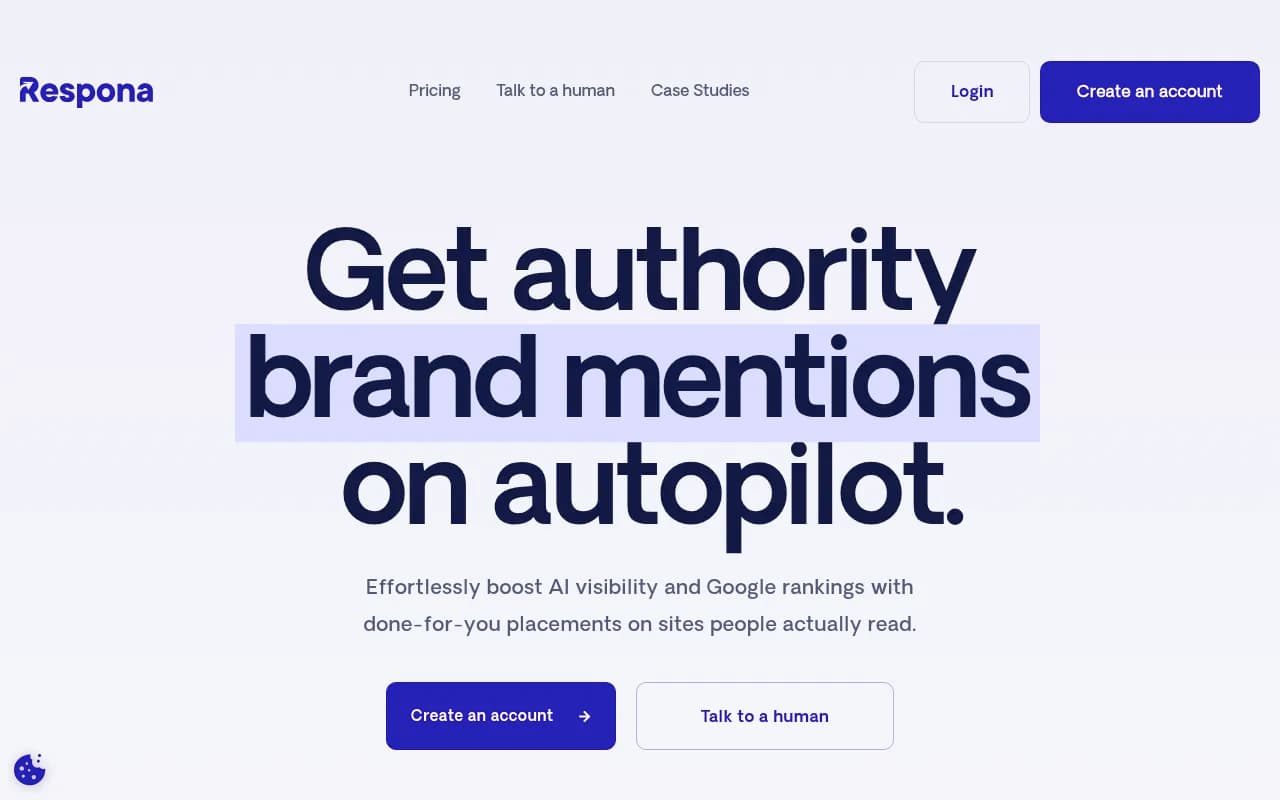
If you'd rather hand outreach to specialists, 1001 SEO Media runs digital PR and generative engine optimization for brands that want citations across ChatGPT, Perplexity and Google AI Overviews. For a small team doing it in-house, tools like Respona and CrowdReply can speed up prospecting.

Step 5: Make sure AI can read your site
Startups often write great pages and then block the bots that would cite them. Check your robots.txt, your CDN rules, and whether pages render without JavaScript. The free Agentic Readiness Check and AI crawler URL inspector are quick starting points, and the AI bots directory lists which crawlers to allow.
One caution on file formats. Promptwatch Data found that markdown files make up just 0.05% of AI search citations. Don't spend a week publishing markdown mirrors of your site hoping for citations. Spend it on the pages above.
Step 6: Measure, then iterate
You can't improve what you can't see. A lean startup measurement stack answers four questions:
- Which niche prompts do we appear in, and at what position?
- Which of our pages get cited?
- Are AI crawlers reaching those pages?
- Does AI traffic convert?
Crisp is the cleanest proof that the last one matters: they saw 2x higher conversion rates from AI traffic compared with traditional channels (Crisp case study).
Tool options by stage
| Tool | Best for | Notes |
|---|---|---|
| Promptwatch | Tracking plus fixing: content gaps, content writing, crawler logs, traffic | Starts at $95/mo (Essential), 7-day free trial on monthly billing |
| Otterly.AI | Cheap, basic monitoring | Tracking only |
| Peec AI | Lightweight prompt tracking with suggestions | No content generation |
| Profound | Enterprise monitoring | Higher price point |
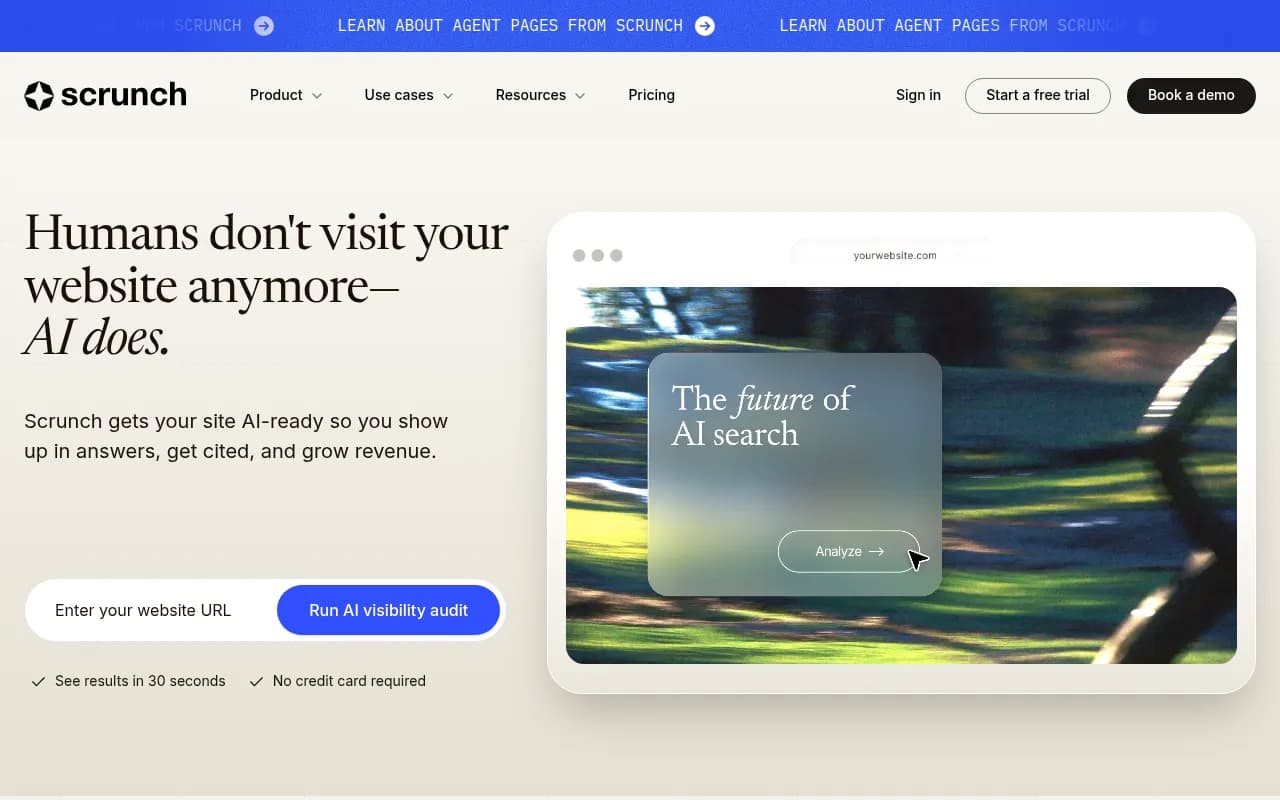
| Scrunch | Monitoring plus agent-ready pages | Mostly aimed at larger teams |
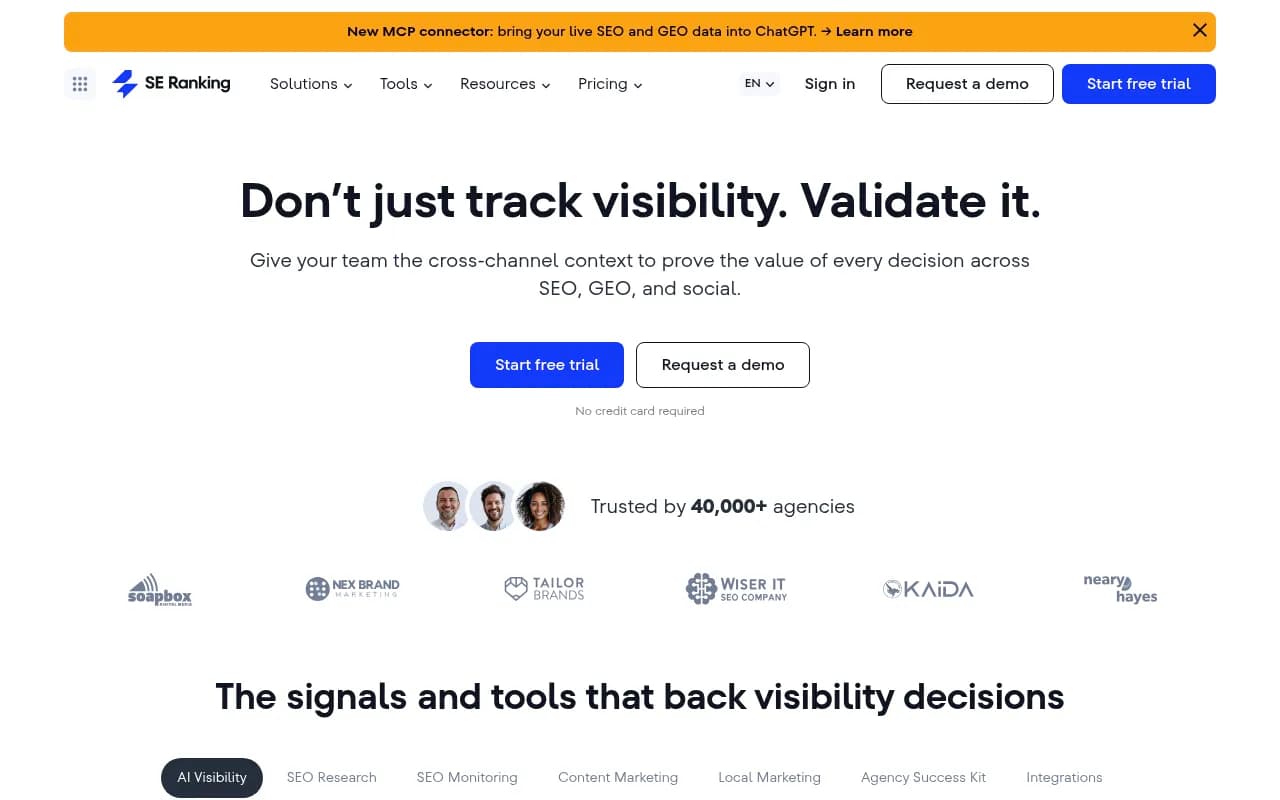
| SE Ranking | Existing SEO users adding AI research | Competitive research built into a broader SEO suite |
Most of these are monitors. They answer "were we mentioned?" That's a fine start, but for a small team the bottleneck is usually execution, not reporting. Promptwatch is built around the full loop: it tracks prompts across ChatGPT, Gemini, Perplexity, Google AI Overviews and others using the real interfaces, shows which pages are cited and where content gaps are, and its Content Agent can write and publish pages for those gaps to WordPress, Webflow or Framer. IP-verified crawler logs then show whether bots read the page, and visitor analytics show whether AI sends traffic. Pricing and plan limits are on promptwatch.com/pricing; note the Content Agent starts on the Business plan.

If you're on a tight budget, start with a cheaper tracker and layer in execution later.



For a wider list, the GEO software directory at bestgeosoftware.com compares dozens of trackers.
Scrunch also published a survey of 600-plus marketing and PR professionals on how teams are equipping themselves for AI search, which is a useful read on what your larger competitors are staffing and buying.
A 30-day plan for a small team
Week 1: research
Write 40 niche prompts from sales calls, Search Console and PAA. Run them manually in ChatGPT, Perplexity and Gemini. Note who appears and which sources are cited. Check crawler access.
Week 2: fix the foundations
Update product and pricing pages so they're comparable at a glance. Add an FAQ. Open up docs. Fix anything blocking AI bots.
Week 3: publish
Ship three to five niche landing pages and one original data piece. Publish one honest comparison page against your biggest incumbent.
Week 4: distribute and track
Pitch the data to five niche blogs in the DR 60-90 range and pursue inclusion in two relevant roundups. Set up tracking for your prompt list and record a baseline.
Then repeat monthly. Refresh landing, pricing and listicle pages on a schedule, since those are the formats that decay if left alone.
Common mistakes
- Chasing head prompts first. You'll lose to brands with a decade of content.
- Treating AI visibility like Google SEO. Keyword density and exact-match titles matter less than being a clear, specific, current answer.
- Publishing data once and forgetting it. Citation decay is measurable.
- Measuring mentions only. Being listed fifth isn't winning. Track position and sentiment, not just presence.
- Ignoring crawl access. No amount of good content helps if the bots can't fetch it.
Bottom line
Incumbents have more links, more budget and more pages. They also have slow content teams and broad pages that don't answer narrow questions. In August 2026, mid-authority sites took nearly half of ChatGPT's citations, and landing pages and docs outlast news by a wide margin. Pick niche prompts, publish numbers nobody else has, keep those pages updated, and check every month whether the models noticed. For more research on what AI engines cite, the Promptwatch Data hub is updated regularly.