Key takeaways
- API tracking and real-interface tracking measure two different systems. The API gives you the model's raw text. The interface adds search behavior, shopping cards, citations and formatting that shoppers actually see.
- For product prompts, the gap matters most. Shopping carousels, product cards and merchant-feed results only exist in the consumer interface.
- Most tools track brands, not products. Product-level or SKU-level tracking is usually a higher-tier feature, so check the pricing page before you buy.
- A prompt budget of 50 to 350 prompts covers categories and comparison queries, not a 12,000-SKU catalog. Plan around that.
- Several claims in this space come from vendors that sell scraping products. Treat any single vendor study as a data point, and test the tools on your own prompts.
Why ecommerce is where this debate matters
If you sell software, an AI answer that names your brand is mostly a text problem. If you sell boots, it is a product problem. A shopper types "waterproof hiking boot under $150" and the answer might include product cards, prices, merchant links and a short list of recommended items. None of that comes out of a plain API call in the same shape.
The commercial stakes are real. The Raccoon AI roundup cites figures of AI-referred shoppers converting at 12.3% versus 3.1% for other traffic, and Rank Prompt's write-up cites Adobe data showing AI traffic to US retail sites up 393% year over year in Q1 2026. I would treat both as vendor-relayed numbers, but the direction is consistent with what most ecommerce teams are seeing: small volume, high intent.
So the question is not whether to track AI visibility. It is whether the number on your dashboard resembles what a shopper saw.
What API tracking actually is
API-based tracking sends your prompts to a model through its developer API and records the response. It is cheap, fast, stable and easy to scale. That is why many early tools started there.
The catch is that the API and the product are different systems. They share a model, but the consumer product wraps it in system instructions, a search layer, a ranking and citation layer, and a UI. A ZipTie FAQ puts it plainly: API tracking records what the model returns, while browser-level tracking records the answer from the interface a person actually uses.
What API output tends to lack for ecommerce:
- Shopping cards and product carousels
- The sources the interface chooses to cite
- Local and country-specific behavior
- Whether a search was triggered at all
- The formatting and ordering of recommendations
API tracking is not useless. It tells you what a model believes from training data, which is a legitimate signal about brand awareness. It just should not be sold as a view of what shoppers see.
What real-interface tracking is
Real-interface tracking (sometimes called UI scraping, browser-level or consumer-product tracking) runs your prompts in the actual ChatGPT, Gemini, Perplexity, Google AI Overviews or Copilot interface, from a chosen country, and records the whole answer: text, brands, citations, shopping results.
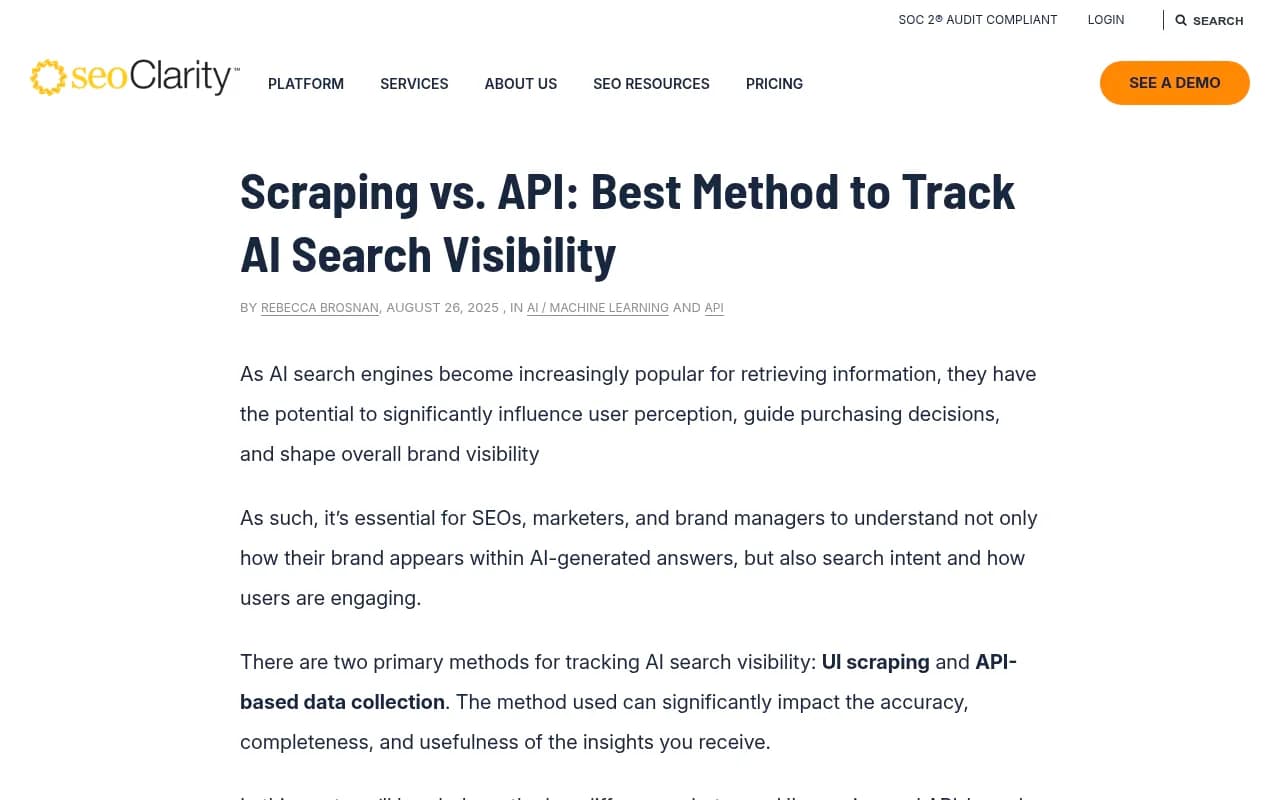
seoClarity's comparison frames the difference as full user-facing output (citations, shopping results, plugins, formatting) versus raw model text only. Its example of the same prompt in the UI shows clickable shopping results and specific products with context, which is exactly what an ecommerce team cares about.
The tradeoffs are real too. Interface tracking costs more to run, is harder to build, and breaks when interfaces change. Vendors that do it well absorb that cost. Vendors that claim to do it and quietly fall back to an API are a risk, so ask directly.
What the data says about the gap
Surfer ran 1,000 prompts across five AI products, once by scraping the interfaces and once through APIs, and compared 13,779 answers. Their summary: the API and the product share a model but behave like different systems, and source overlap per answer stays small. They also found ChatGPT's API searched on 83% of prompts, AI Mode and AI Overviews on 94%, and Gemini on 85%, which means search triggering itself differs by surface.
Two caveats. Surfer sells scraping-based tools, so it has an interest in this result. And I could not find an independent head-to-head study. Still, the direction matches what first-party interface data shows.
Promptwatch Data is a useful example. In ChatGPT Shopping feature usage, shopping features appeared on only a low single-digit percentage of web-search responses, concentrated on commercial and transactional prompts. The rate moved in steps. It roughly doubled overnight in late May, then fell back weeks later, which suggests OpenAI tunes when product cards appear. Likewise, ChatGPT query fanouts shrank from 2.15 searches per response in early December 2025 to about 1.84 by early March 2026, and average query length dropped from about 117 characters to the high 80s, then about 53 from April. On August 8, 2026, ChatGPT began using the site: operator at scale, rising from about 0.4% to about 17% of fanout queries (report).
Those are step changes tied to product updates. A raw API call would not reproduce them. That is my inference from the data, not a measured API comparison, but it is the reason I would not use API-only numbers for product prompts.
What shoppers see versus what you can track
What gets cited for product prompts also tells you where to put effort. Per Promptwatch's ChatGPT citation share by content type (Sep 28 to Oct 4, 2026):
| Content type | All prompts | Commercial prompts |
|---|---|---|
| Product pages | 22.4% | 26.0% |
| Landing pages | 16.8% | 20.6% |
| Listicles | 13.6% | 15.0% |
| Comparisons | 5.9% | 7.9% |
For commercial "best X" prompts, those four types are almost 70% of citations. Branded prompts lean on reviews more than average (5.6%, over three times their overall share). If you only track brand mentions, you miss which of your product pages, landing pages or third-party listicles is doing the work.
Comparison: interface tracking versus API tracking for product prompts
| Factor | Real-interface tracking | API tracking |
|---|---|---|
| What it captures | Full answer, citations, product cards, formatting | Raw model text |
| Shopping carousels and product cards | Visible when the interface shows them | Not reproduced |
| Matches what shoppers see | Closely | Loosely |
| Local and country behavior | Can follow the interface by location | Limited |
| Cost to the vendor | Higher | Lower |
| Stability | Can break when UIs change | Stable |
| Useful for | Visibility, citations, product recommendations | Training-data brand awareness |
Tools to consider for ecommerce
The categories overlap, so here is how I would group them.
Platforms with real-interface data and shopping coverage
Promptwatch monitors the actual interfaces of ChatGPT, Google AI Overviews, Google AI Mode, Gemini, Perplexity, Copilot, Amazon Alexa and Meta AI per country and language, and tracks API models separately so you can see training-data beliefs next to interface results. For ecommerce, it has ChatGPT Shopping tracking: which products AI recommends in ChatGPT shopping carousels and Alexa product results, which competitors it picks instead, and how an uploaded catalog performs. Shopping is on Business ($579/mo) and Enterprise; check promptwatch.com/pricing for current terms. It also covers the part many trackers skip: IP-verified AI crawler logs to see whether bots can read your product pages, visitor analytics to see what AI traffic converts, and a Content Agent to publish what the gap analysis finds.

Profound has a dedicated shopping module covering visibility, attribute accuracy and SKU-level analysis. Per Rank Prompt's research, SKU-level tracking sits at the Enterprise tier. Strong monitoring, higher price.

Goodie is described as strongest for Amazon Rufus and Alexa for Shopping, with product-level tracking on Pro and above (listed at $399/mo and 100 prompts at entry by Rank Prompt).

Ecommerce-specific tools
These focus on catalogs and shopping agents rather than generic brand tracking.
Yotpo Discover

Zoovu is a different animal: it improves on-site product discovery, guided selling and configurators rather than tracking off-site AI visibility. Useful, but not a replacement for tracking.
Budget trackers and suites
Rank Prompt
Rank Prompt is built by the vendor behind the Rank Prompt ecommerce comparison, and it says plainly that it ranks itself first and does not ingest a product feed, which rules it out for pure SKU shelf tracking. Treat its ranking with that in mind.


Otterly is cheap but, per Rank Prompt's review, has no product-level tracking. Peec AI is noted for multi-market retail groups.
Superlines
Superlines positions itself around tracking from real AI interfaces rather than APIs. Semrush's AI toolkit suits teams already living in Semrush, though fixed prompt sets are a limit for ecommerce.
The Raccoon AI roundup also highlights WorkDuo, which uses browser-side tracking and starts at $33 per project per month. I could not independently verify it.

| Tool | Data approach | Product-level tracking | Notes |
|---|---|---|---|
| Promptwatch | Real interfaces plus API models | Shopping tracking on Business and Enterprise | Crawler logs, traffic, content agents |
| Profound | Answer engines | SKU-level, Enterprise | Dedicated shopping module |
| Goodie | Interface-focused | Product-level on Pro and above | Amazon and Alexa strength |
| Azoma | Shopping agents | Yes | Product and prompt level |
| Rank Prompt | Seven engines | No feed ingestion | Category and comparison queries |
| Otterly | General engines | No | Low entry price |
Prices change often. Confirm each vendor's page before buying.
How to choose
Ask how the data is collected
Get a plain answer: interface, API, or both. Ask which surfaces are real-interface and which are API. Run ten of your own product prompts in the ChatGPT interface and compare to the tool's output. If the cards and citations don't match, you have your answer.
Decide brand, category or SKU
Brand tracking tells you whether you are named. Category tracking ("best running shoes for flat feet") tells you whether you win shortlists. SKU tracking tells you whether a specific product appears. Most budgets cover the first two well. Pick a tier that matches your actual question.
Do the prompt math
25 to 350 tracked prompts is normal at entry and mid tiers. That covers your top categories, key attributes and competitor comparisons, not thousands of SKUs. Prioritize the 5 to 10 percent of products that drive most revenue.
Fix what the tracker finds
Visibility data is only useful if you act on it. Check that AI crawlers can read your product pages, keep Product schema, prices and availability accurate, and maintain a clean merchant feed. Adobe, as cited by Rank Prompt, scored US retail product pages at 66% machine readable, the lowest of any page type it measured. Free checks like Promptwatch's Agentic Readiness Check and AI crawler URL inspector are a quick start, and the AI SEO guide covers the wider approach.
Connect to revenue
Look for visitor analytics or attribution. One wrinkle: ChatGPT stopped sending a referrer on October 8, 2026, so tagging links with utm_source=chatgpt.com matters if you want accurate AI traffic numbers. The attribution guide explains the setup.
A practical setup for a mid-size store
- List 30 to 60 prompts across your top five categories: shortlist ("best X under $Y"), attribute ("X for Z use case"), and comparison ("A vs B").
- Run them in the real interfaces for each country you sell in, since locations produce different answers.
- Record which brands fill shopping cards and which sources get cited.
- Compare against API results for the same prompts if your tool offers both. The delta is your blind spot.
- Update product pages, feeds and listicle placements, then re-measure weekly.
If you want to browse more options, the GEO software directory lists tools across the category.
Bottom line
For product prompts, use real-interface tracking as your primary measure, and treat API data as a secondary signal about what models believe. Choose a tool whose product-level coverage matches your catalog size and budget, verify the collection method with your own test prompts, and tie the data to crawler access and AI-referred conversions. A dashboard that tells you a score without telling you what to fix is the wrong purchase.