Key takeaways
- "AI search" means two different jobs for a store: the search box on your site, and whether ChatGPT, Gemini and Google AI Overviews recommend your products. You probably need tools for both.
- On-site search vendors like Klevu, Fast Simon, Searchspring, Algolia and Constructor plug into Shopify and BigCommerce most smoothly. WooCommerce usually needs more setup or a plugin-based option.
- Product pages and landing pages are the most cited content in ChatGPT: 22.4% and 16.8% of citations (Promptwatch Data, Sep 28 to Oct 4, 2026). Your catalog data is your main AI visibility asset.
- Visibility trackers differ a lot. Some track generic brand mentions, others are built around product catalogs. Pick based on catalog size, not hype.
- I did not verify platform-by-platform pricing for most vendors below, so treat price tiers as rough and confirm on each vendor's site.
Two kinds of AI search, and why stores mix them up
When a vendor says "AI search," ask which one they mean. It changes what you buy.
The first is on-site search: the box in your header where a shopper types "gift for dad under 50" and expects something sensible back. The second is external AI search: ChatGPT, Gemini, Perplexity, Google AI Overviews and AI Mode deciding whether your brand shows up when someone asks "best running shoes for flat feet."
They solve different problems. On-site search converts traffic you already paid for. External AI visibility decides whether you get that traffic at all. A few vendors straddle both, and the marketing blurs them. bCloud AI's own comparison table, for instance, scores on-site engines on an "AI visibility (AEO)" column. Take those scores with salt: bCloud is a vendor ranking itself first.

Why the platform matters less than you think (and more than vendors admit)
Shopify, WooCommerce and BigCommerce all expose product data in structured ways. All three can output Product schema, feeds and sitemaps. What differs is how much work it takes to connect a given tool.
- Shopify has the largest app ecosystem, so most search and visibility tools ship a one-click app.
- BigCommerce is well supported by the mid-market search vendors (Fast Simon, Searchspring, Klevu, Constructor) and has open APIs for the rest.
- WooCommerce gives you the most freedom and the most DIY. Many tools work through a plugin, a JavaScript snippet or a feed, but expect to configure more yourself.
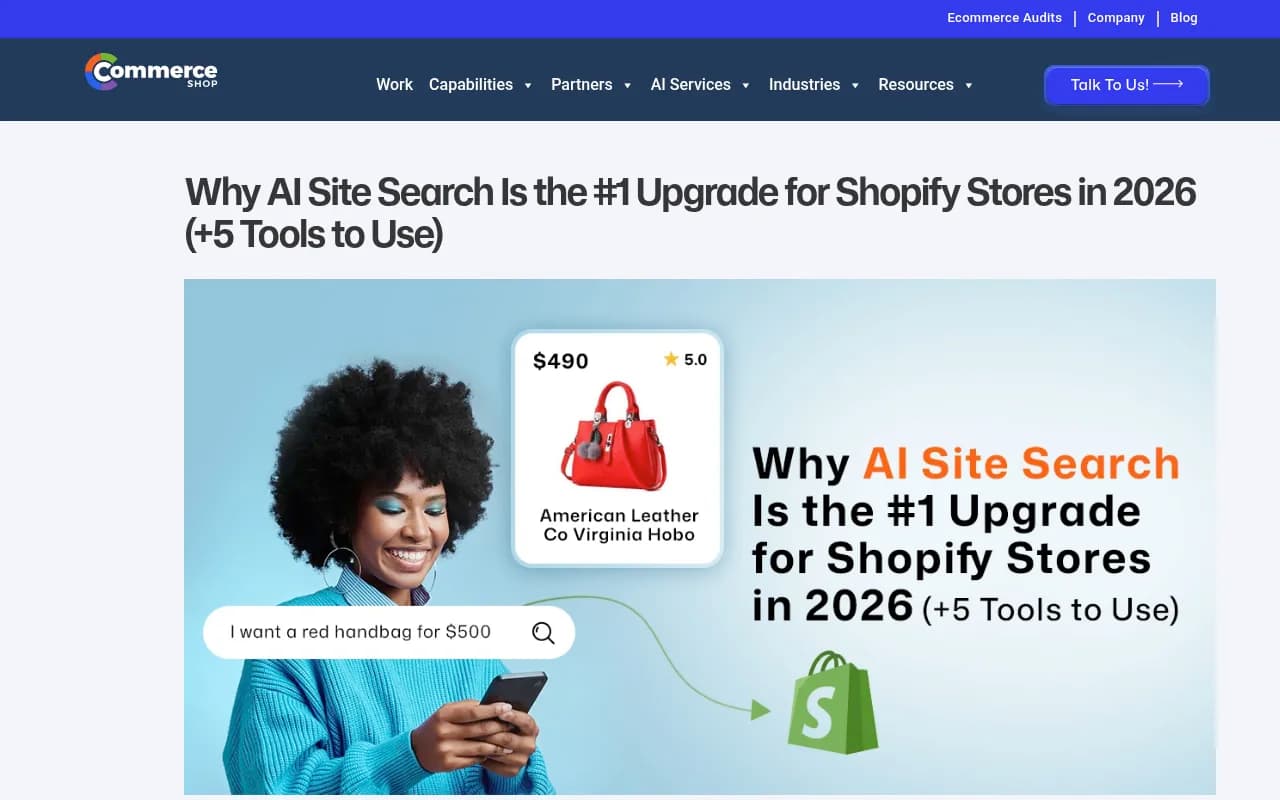
Shopify's native search has improved, but the usual complaints still apply: keyword matching, thin merchandising controls, weak handling of long natural-language queries, and plenty of zero-result searches. The Commerce Shop's guide makes that case for Shopify specifically, and it is a fair summary of why merchants outgrow built-in search.
Part 1: on-site AI search tools
These are the vendors that kept coming up across the comparison articles I read. Pricing is described only in rough tiers, which come from bCloud's table and are not verified.
| Tool | Best fit | Platforms mentioned in sources | Rough tier |
|---|---|---|---|
| Klevu (reported as Athos Commerce by Coursiv, unverified) | SMB and mid-market retailers that outgrew basic search | Shopify, BigCommerce, Magento, WooCommerce | $$ |
| Fast Simon | Shopify and BigCommerce stores wanting search plus personalization and smart collections | Shopify, BigCommerce | $$ |
| Searchspring | Mid-market merchandising teams | Shopify, BigCommerce | $$ |
| Algolia | Developer-led teams that want to build their own experience | Any, via API | $$$ |
| Constructor | Larger catalogs focused on discovery optimization | Any, via API | $$$ |
| Coveo | Large enterprises | Any | $$$$ |
| Doofinder | Larger catalogs, per Vortex IQ | Several, including WooCommerce | Not stated |
| LimeSpot | SMB product discovery and recommendations, from $50/mo per Coursiv | Shopify, BigCommerce | $ |
| Zoovu | Guided on-site product discovery | Enterprise ecommerce | Not stated |
How to choose between them
I would not start with a feature grid. Start with three questions.
- How big is the catalog? Under a few thousand SKUs, a lighter tool like LimeSpot or Klevu's smaller plans is usually enough. Tens of thousands of SKUs with heavy merchandising needs push you toward Searchspring, Constructor or Fast Simon.
- Do you have developers? Algolia is flexible and powerful, but it is a toolkit. If nobody on your team writes front-end code, a packaged app will get you live faster.
- What is your zero-result rate? Check your own search analytics before paying anyone. Bcloud's quiz claims 31% of ecommerce searches return zero results. That is a vendor stat, so measure your own store. If yours is 5%, the case for switching is weaker.
One caveat. Almost every source here is a vendor blog or a listicle written by a vendor, including claims like a 40% conversion lift from AI search. Run a trial against your own traffic before you believe any of them.
Part 2: tools that track whether AI recommends your products
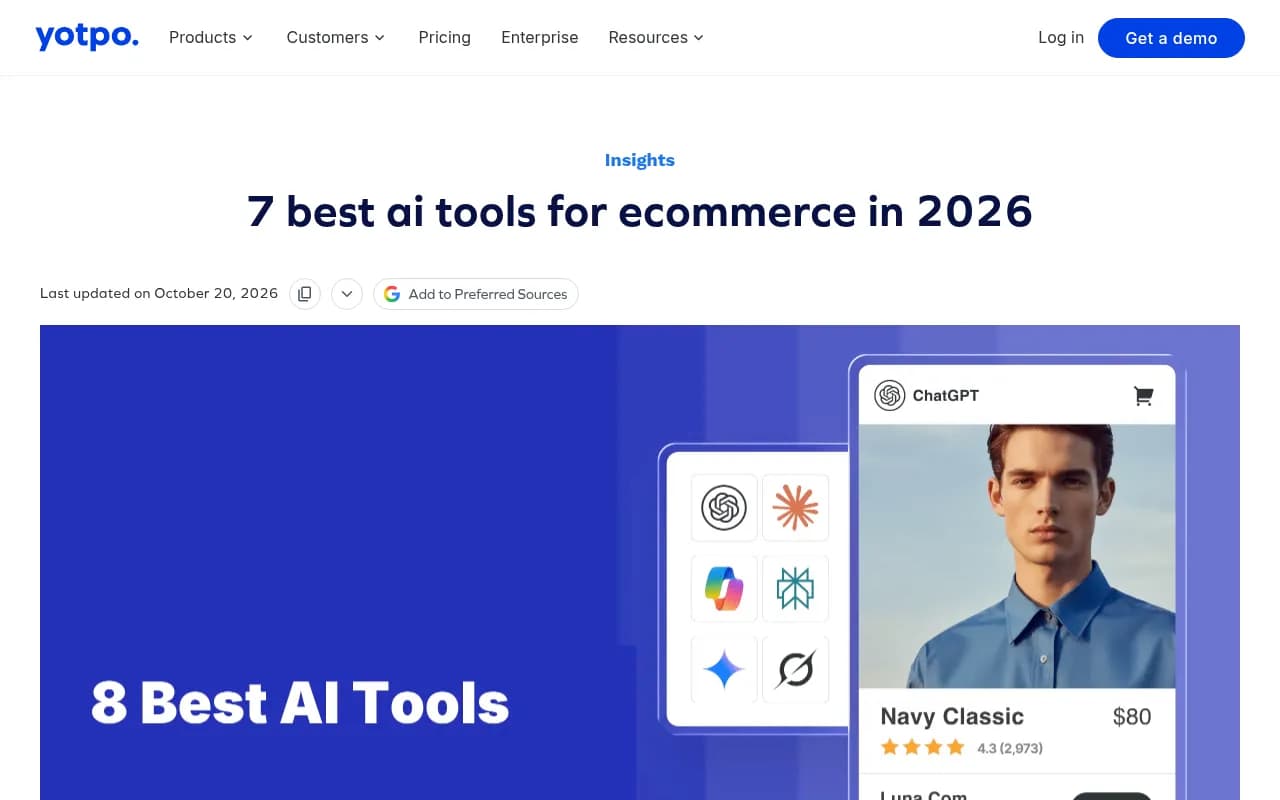
This is the newer category, and it matters because shoppers now ask ChatGPT and Gemini what to buy. Yotpo's guide cites BrightEdge figures that AI Overviews appear on 48% of tracked queries, and that only 16.7% of sources cited in AI Overviews also rank in the organic top ten. Yotpo sells a product in this space, so read that as directional. The second number is still a useful warning: ranking on Google does not guarantee you get cited.
What the citation data says about ecommerce
Promptwatch Data looked at what ChatGPT cites. In its content type report (Sep 28 to Oct 4, 2026), product pages were the most cited type at 22.4% of classified citations, with landing pages next at 16.8%. For commercial prompts like "best X for...", product pages hit 26.0%, landing pages 20.6%, listicles 15.0% and comparisons 7.9%, which together is almost 70% of citations.
For a store, that is good news and a to-do list. Your own product pages are the main citation surface, so thin descriptions, missing specs and broken schema hurt you directly. Listicles and comparisons matter too, so getting into third-party "best of" roundups is worth the outreach. The same report notes reviews are cited at 5.6% on branded prompts, more than three times their overall share, so third-party review profiles help.
Shopping cards are a separate and smaller story. Promptwatch's ChatGPT shopping usage data shows product cards and price comparisons attached to only a low single-digit percentage of web-search responses, with the rate jumping in steps as OpenAI tunes it. Their advice, which I agree with: complete Product schema, accurate price and availability, a clean merchant feed, and treat it like early Google Shopping. Modest traffic today, hard to displace later.
Visibility platforms worth shortlisting
The catalog has more than a hundred AI visibility tools. Most track brand-level mentions and are not built for catalogs. Here is how I would sort the ones relevant to a store.
| Tool | Angle | Good for |
|---|---|---|
| Promptwatch | Tracks, explains and fixes AI visibility, with content agents, crawler logs and AI shopping tracking | Stores that want to act on gaps, not just watch a score |
| Yotpo Discover | Ecommerce AI visibility tied to reviews and catalog | Brands already using Yotpo reviews |
| Alhena AI | Visibility tracking built for ecommerce catalogs | Catalog-heavy stores |
| Ranketta | Product-level visibility tracking | Stores that care about individual SKUs |
| Naridon | Shopify-native GEO monitoring | Shopify merchants wanting an app-store install |
| Azoma | Agentic-commerce GEO for AI shopping agents | Brands preparing for agent-led buying |
| Bluefish AI | Enterprise visibility and agentic commerce | Large retailers |
Promptwatch is the one I would put first for a store that wants more than a dashboard. It monitors ChatGPT, Gemini, Perplexity, Google AI Overviews and AI Mode from real interfaces, then shows which of your pages get cited, and its Content Agent can write and publish to WordPress or Webflow. WordPress covers WooCommerce stores' content side, since the same official plugin also logs AI crawler visits and AI-referred visitors. It also has ChatGPT Shopping tracking and AI crawler logs to check that GPTBot and friends can actually read your product pages. Business is the first plan with shopping insights, at $579/mo; confirm current prices on promptwatch.com/pricing. There is a 7-day free trial, and a no-login free AI visibility report if you want a first look.

Yotpo Discover is the closest ecommerce-native alternative. Its pitch is capturing AI demand for catalogs and reviews, and it names Beekman 1802 and David Protein as users. If your reviews already live in Yotpo, it deserves a look, with the usual caveat that Yotpo wrote the comparison that features it.
Yotpo Discover
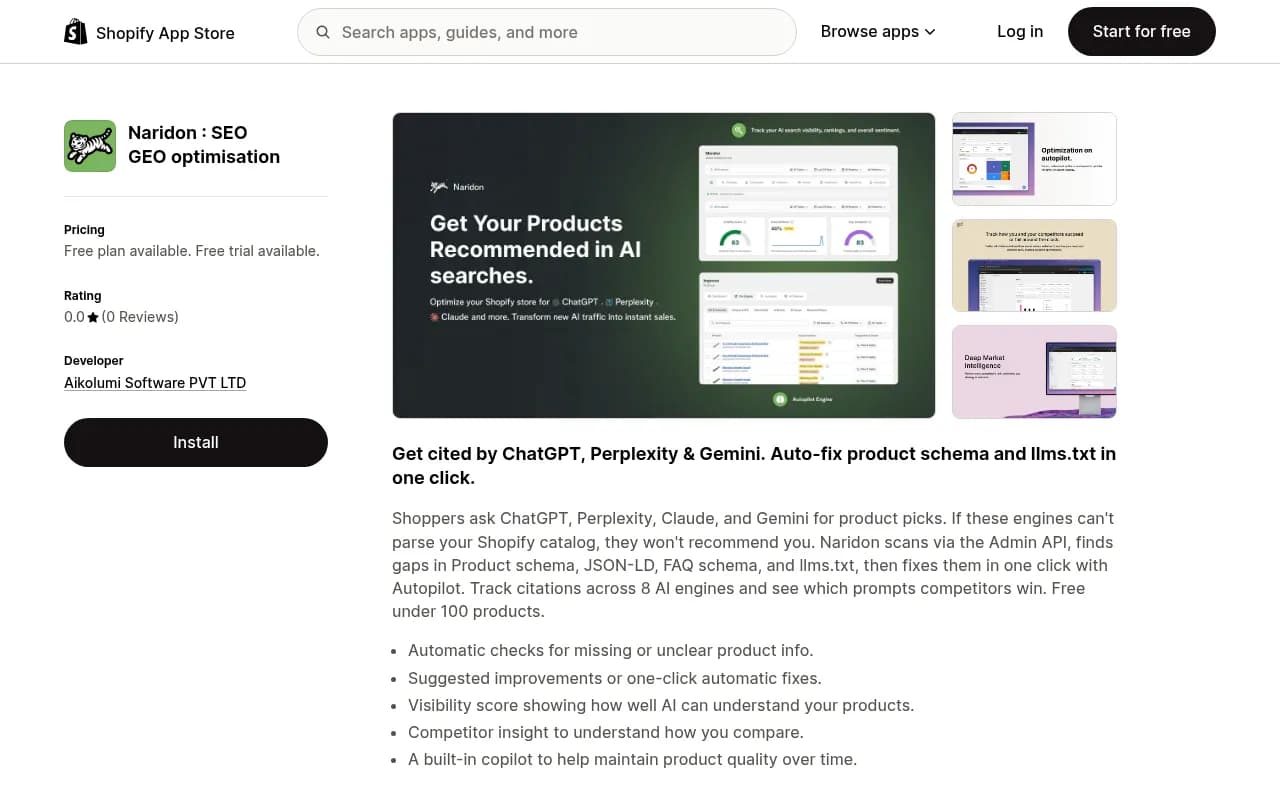
Alhena AI and Ranketta both lean into catalog-level tracking, which is the gap in general-purpose tools. Naridon installs from the Shopify App Store. I have not tested these, so judge them on a trial.

For larger brands that need more breadth, Profound, Scrunch and Semrush's AI toolkit are the names that come up most often. They skew toward monitoring and larger budgets.

If you want to browse more options, the GEO software directory at bestgeosoftware.com lists a wide range.
Part 3: the supporting stack
The Yotpo, Coursiv and TxtCart roundups all recommend more than search. A sensible small-store stack looks like this:
- Support: Gorgias, Tidio or Intercom Fin (Coursiv's picks for Shopify support)
- Email: Omnisend, which Coursiv lists as free to start for SMB Shopify stores
- Pricing: Prisync for competitor price tracking and dynamic pricing
- Content: a writing or optimization tool such as Hypotenuse AI, which is built for ecommerce descriptions at scale
Hypotenuse AI
None of these are AI search tools in the strict sense, but product copy feeds both on-site search and external AI answers, so descriptions are worth the effort.
Platform-by-platform recommendations
Shopify
Easiest path. Start with a packaged search app (Klevu, Fast Simon or LimeSpot depending on budget) and a Shopify-native or app-based visibility tracker. Fix Product schema and your merchant feed first. Check that your theme outputs complete structured data, because many do not.
BigCommerce
Fast Simon, Searchspring, Klevu and Constructor all have good BigCommerce coverage according to the sources. BigCommerce's open APIs also make Algolia a realistic option if you have a developer. For visibility, any tracker that works from your domain and prompts will do, since it does not depend on the cart platform.
WooCommerce
Most flexible, least turnkey. Klevu and bCloud list WooCommerce support, and Doofinder is a common pick for larger catalogs. For AI visibility, a WordPress plugin helps: Promptwatch's official plugin handles publishing and logs AI crawlers and AI-referred visitors. Be careful with caching and CDN layers, which can block bots or hide crawler traffic.
A simple rollout order
- Check your robots.txt and see which AI crawlers can reach your product pages. Free tools like Promptwatch's Agentic Readiness Check do this quickly.
- Clean up Product schema, prices, availability and merchant feed.
- Pull your own search analytics and find your zero-result and no-click queries.
- Trial one on-site search tool for a month against that baseline.
- Set up a visibility tracker with 30 to 50 commercial prompts your buyers actually ask, and record which brands fill the answers.
- Fix gaps: richer product pages, an FAQ, comparison pages, and third-party reviews and roundups.
- Re-measure, using AI referral traffic where your analytics can see it. ChatGPT stopped sending a referrer on October 8, 2026, so tag links with utm_source=chatgpt.com where you can.
What I could not verify
I did not research detailed per-platform pricing or feature lists for Shopify, WooCommerce or BigCommerce integrations. Tier markers like $$ come from one vendor's table. Klevu's reported rebrand to Athos Commerce comes from a single source. Before you buy anything, get a current quote and ask for a live demo on your own catalog.
The short version: spend on on-site search if you have traffic that is bouncing, spend on AI visibility if you have good products nobody is recommending, and fix your product data before either.