Key takeaways
- Google AI Mode has no public API, so every tracker relies on some form of scraping or browser automation. The method matters more than the marketing copy.
- Promptwatch and Finseo both collect from live, real-browser Google AI Mode sessions rather than API shortcuts; Knowatoa and Profound also claim real UI capture, but gate AI Mode and depth differently by plan.
- Industry data cited by Ziptie puts the gap between API-based tracking and what users actually see at a startling 76% mismatch, which is the single biggest accuracy variable in this category.
- AI Mode and AI Overviews only share the same cited URL 13.7% of the time despite reaching similar conclusions, so a tool that treats AI Mode as a clone of AI Overviews will mislead you.
- Profound's FactCheck feature is the only one of the four built specifically to catch false brand claims, not just mentions, which is worth knowing if "accuracy" means factual correctness to you, not just visibility percentages.
Why accuracy is the real question here, not just coverage
Everybody in this space says they "track Google AI Mode." Fine. But tracking isn't the hard part anymore, every vendor in this category can fire a prompt and record a response. The hard part is whether what gets recorded resembles what an actual person sees when they type into the AI Mode tab.
I want to be blunt about why this matters so much for AI Mode specifically. Google AI Mode passed 1 billion monthly active users about a year after launch, and queries have more than doubled every quarter since it rolled out. That's not a niche feature anymore. And somewhere between 92% and 94% of AI Mode sessions never result in a click to an external site, compared to roughly 34-43% zero-click on classic Google Search. If you can't rely on click data to know whether you're showing up, your citation tracking has to be right, because it's often the only signal you get.
There's also a methodology trap specific to this engine. AI Mode and AI Overviews are built on overlapping technology, and a lazy vendor might just reuse Overviews data and relabel it. An Ahrefs study across 540,000 query pairs found AI Mode and AI Overviews cite the exact same URL only 13.7% of the time, even though they land on similar conclusions about 86% of the time. Different sources, similar answers. If a tracker isn't running AI Mode prompts separately from AI Overviews prompts, you're not actually measuring AI Mode.
How each tool actually collects AI Mode data
Promptwatch: real UI sessions, geo-located, with raw answers you can inspect
Promptwatch pulls its Google AI Mode and AI Overviews data from real Google Search results pages, not a provider API. For ChatGPT, Gemini, Perplexity and Copilot it runs automated browser sessions that open the actual product and type prompts the way a person would. It deliberately uses API calls only for models where there's no live-search product to monitor (DeepSeek, Mistral, some coding assistants), and it's upfront that this is a different kind of measurement, not a substitute for live-search tracking.
Two details stood out to me. First, Promptwatch's runs are geo-located, so a monitor set to "DE - German" collects what someone in Germany actually sees, which matters a lot for AI Mode's staggered country rollout. Second, every run stores the full raw answer text and structured extras like shopping carousels, comparison tables and ads, things you can only capture by looking at the real interface. If you've ever been suspicious of a dashboard number, Promptwatch lets you click through to the actual response behind it.

Finseo: daily multi-region prompts with a dedicated AI Mode dashboard
Finseo treats Google AI Mode as its own tracked surface, separate from AI Overviews, with daily prompts run across regions and models. Its public AI Mode tracker shows visibility percentage, monthly mention volume, sentiment, and a competitor ranking table broken out by source type (review sites, comparison pages, Reddit, blogs, news), which is a genuinely useful way to see not just whether you're cited but what kind of content is winning citations.
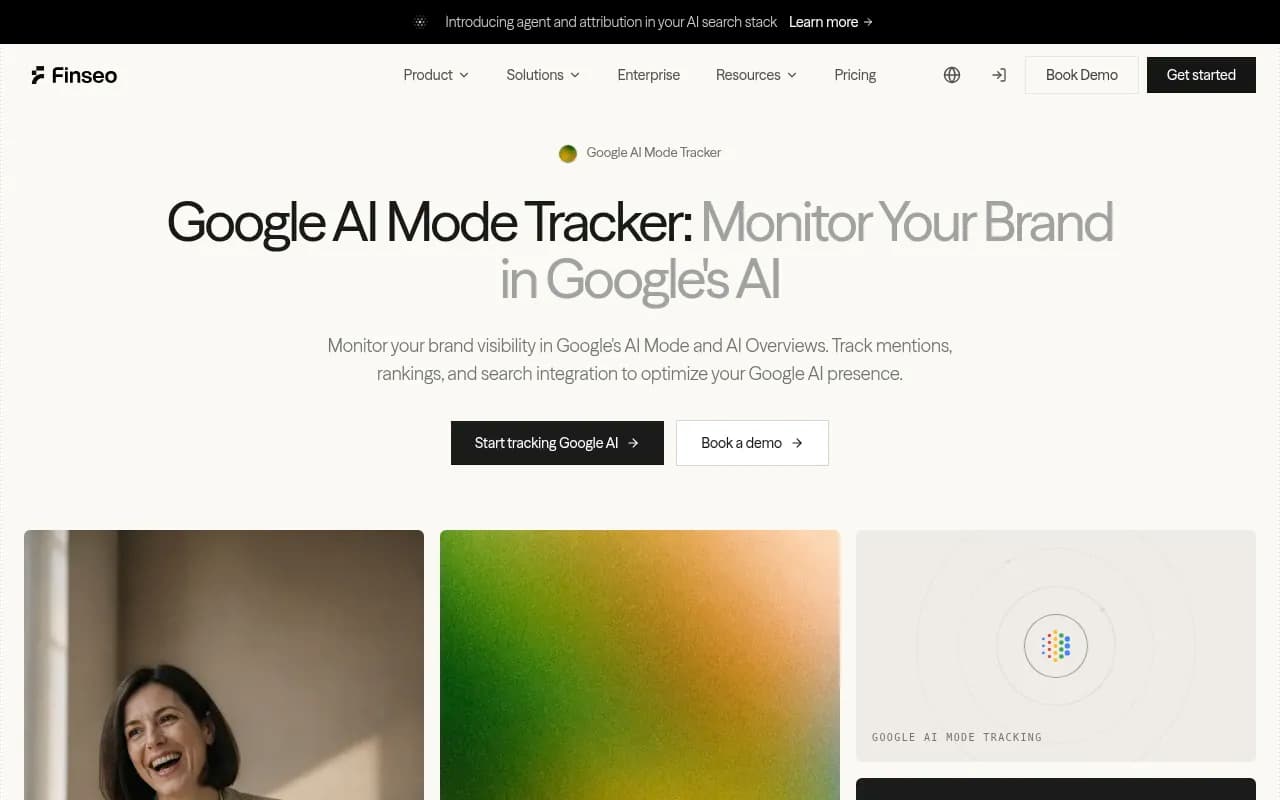
Finseo's pricing scales from a Starter plan around 84 EUR/month up through Growth at roughly 479 EUR/month, with daily tracking available at every tier, which is worth noting since some competitors reserve daily refreshes for upper plans.
Knowatoa: AI Mode on the cheapest plan, but a tight question cap
Knowatoa is the one tool here that puts Google AI Mode on its entry-level $59/month Starter plan alongside ChatGPT and AI Overviews, which is unusual, most competitors gate AI Mode behind a higher tier. The catch is Starter caps you at 30 questions and CSV export only. Jump to Growth at $199/month and you get all seven tracked engines (adding Claude, Gemini, Perplexity and Meta AI) plus 100 questions and API/Looker Studio export.
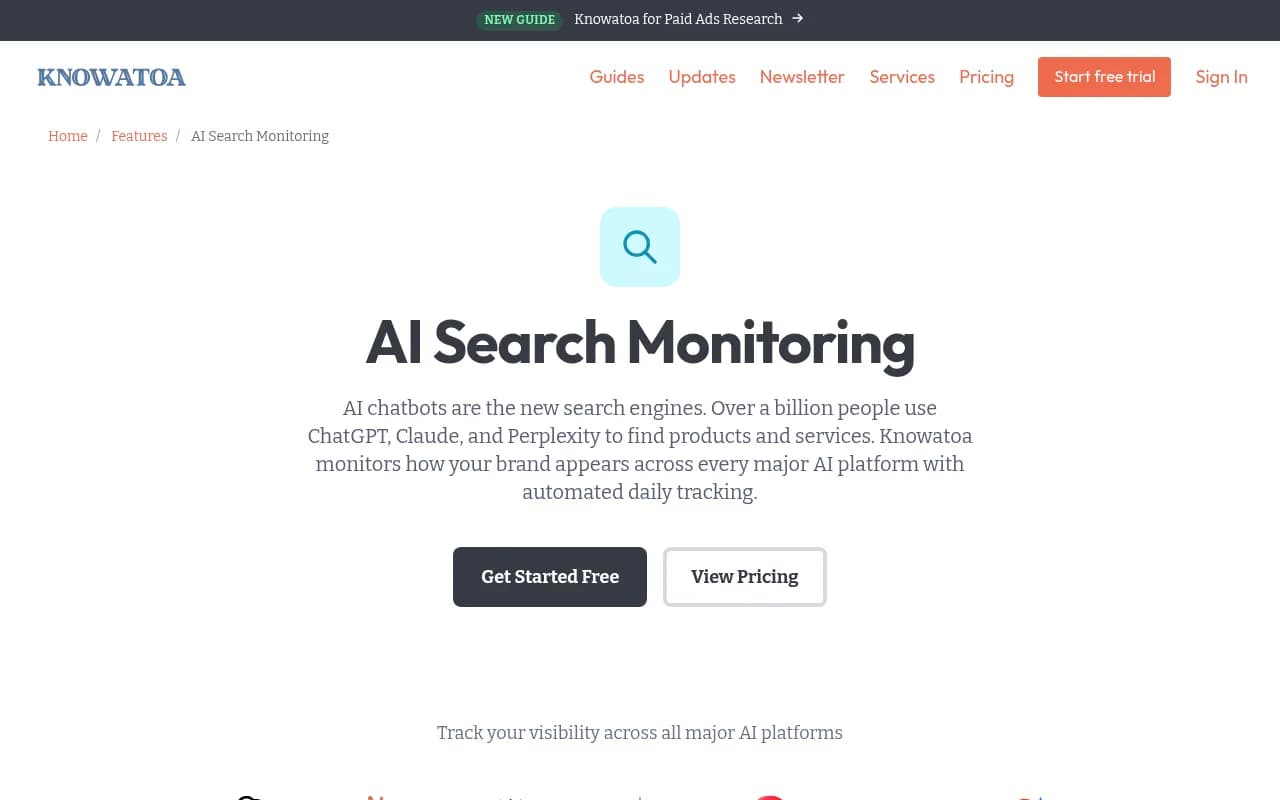

That question cap is the practical accuracy issue with Knowatoa at the entry tier: 30 prompts simply isn't enough sample size to catch the kind of day-to-day variance that probabilistic AI answers produce. More on that below.
Profound: deep but increasingly sales-gated
Profound tracks up to nine answer engines on its Enterprise plan, including Google AI Mode, and layers in CDN-level AI crawler tracking across Akamai, Cloudflare, Fastly and others. Its most interesting recent addition, FactCheck, launched in July 2026 and is built specifically to measure factual accuracy rather than just visibility. You tag prompts with deterministically correct answers (your real pricing, specs, policies), Profound builds a knowledge base from your site and uploaded docs, and a purpose-built claim-detection model (not just an LLM grading another LLM) flags where AI answers about your brand are simply wrong.
The research behind FactCheck is worth knowing on its own: Profound's "Parrot Problem" study of 50,000 LLM responses found roughly 47% of AI answer content is unsolicited editorial commentary the user never asked for, and in one early FactCheck run for a wearable brand, about 11% of claims made about that brand across answer engines were outright false.
The tradeoff: as of around September 2026, Profound dropped its self-serve $99 and $399 plans and now offers only a 7-day trial (which excludes AI Mode) or custom Enterprise pricing. If you want Profound's AI Mode coverage, expect a sales call, not a credit card form.

Comparison table
| Tool | AI Mode collection method | AI Mode available from | Accuracy-specific feature | Starting price |
|---|---|---|---|---|
| Promptwatch | Real browser UI, geo-located | Essential plan | Raw response inspection, Agent Analytics crawler logs | $95/mo |
| Finseo | Daily multi-region live prompts | Starter plan | Source-type breakdown of competitor citations | ~€84/mo |
| Knowatoa | Automated daily querying | Starter plan (30 questions) | None dedicated; relies on sample volume at higher tiers | $59/mo |
| Profound | Real UI plus CDN crawler data | Enterprise only (trial excludes it) | FactCheck claim-verification against a knowledge base | Custom (no public self-serve) |
The accuracy problem nobody wants to admit
Here's the uncomfortable part. AI answers aren't deterministic. The same prompt run twice can return different citations because of vector similarity thresholds, generation temperature, and session context. Ziptie's research frames this well: treating a single AI Mode run as "you rank #3" is the wrong mental model entirely. What you actually want is a citation-frequency distribution across a large enough sample of runs over time.
That's exactly why Knowatoa's 30-question Starter cap bugs me more than its price tag suggests. Thirty prompts a month, run once, doesn't give you a distribution, it gives you a coin flip. Finseo and Promptwatch run prompts daily, which at least builds up a usable sample over a few weeks. Profound does too, but you're paying Enterprise rates to get there.
The other number that should change how you read any "citation share" chart: according to Ziptie's research, API-based tracking tools show only about 24% overlap with what users actually see in the live product, meaning roughly a 76% mismatch. That's the real dividing line in this category, not price, not feature count. If a tool is quietly calling an API instead of opening the actual AI Mode interface, the data underneath its nice dashboard may simply not match reality.
Promptwatch's own data, drawn from its 26-billion-plus citation and response dataset, backs up a related point: different engines behave very differently in how many sources they cite per answer. Google AI Overviews averages around 10 sources per response, roughly double ChatGPT's average of about 5, while Perplexity holds almost exactly 10 with barely any day-to-day variation. Microsoft Copilot, by contrast, swings from under 2 to nearly 17 sources within weeks. None of that is AI Mode specifically, but it illustrates why a one-size-fits-all tracking methodology across engines produces misleading comparisons. Each engine needs to be measured on its own terms.
So which one is actually most accurate for Google AI Mode?
If I had to rank these four purely on methodology and transparency, it goes like this. Promptwatch and Finseo come out ahead because both run genuine live-browser sessions against AI Mode specifically, both let you inspect underlying responses rather than trusting an opaque score, and both include AI Mode from their entry-level plans. Promptwatch edges slightly ahead for me on raw data depth (the 26B+ citation dataset and the ability to drill into crawler logs explaining why you were or weren't cited), while Finseo's AI Mode-specific dashboard with source-type breakdowns by competitor is genuinely handy for quick diagnosis.
Profound would arguably sit at the top on sheer depth, its FactCheck feature solves a problem none of the others even attempt, catching factually wrong claims about your brand rather than just counting mentions. But locking AI Mode behind an Enterprise-only, sales-gated plan with no public pricing makes it hard to recommend unless you're already shopping in that budget range.
Knowatoa is the odd one out: cheapest entry point, AI Mode included from day one, but the 30-question cap on Starter undercuts the statistical reliability you need given how probabilistic these answers are. It's a reasonable way to dip a toe in, not a tool I'd trust for a confident go/no-go decision on AI Mode visibility.
If you're comparing more options beyond these four, the GEO software directory at bestgeosoftware.com is a good place to keep digging, and Promptwatch's own research hub at promptwatch.com/data is worth bookmarking if you want to see how citation behavior across these engines keeps shifting month to month.
A quick gut check before you buy
Before committing budget to any of these, ask the vendor three things directly: does your AI Mode data come from a live browser session or an API call, how many prompts run per day versus per month, and can I see the raw response behind any chart number. If a sales rep can't answer the first question cleanly, that's your answer about how much to trust the dashboard.