Key takeaways
- Most "free" ChatGPT rank trackers are one-shot visibility checks, short trials (2 to 3 days), or tiny prompt allowances. Real free tiers are rare.
- ChatGPT has no rank. These tools sample prompts and record whether your brand is mentioned and whether your page is cited.
- A handful of prompts is a thin signal. Promptwatch Data found 47.6% of cited ChatGPT responses cite 10 or more domains (Sep 28 to Oct 4, 2026), so one answer tells you little.
- Free options are fine for a baseline. Once you need daily runs, competitors, and citation URLs, you are looking at roughly $29 to $95 a month.
- Verify limits on each vendor's pricing page. Most comparison posts online are written by the vendors themselves.
What a ChatGPT rank tracker actually measures
The name is borrowed from Google SEO and it misleads. ChatGPT has no results page and no fixed position. A tracker runs a set of prompts on a schedule and records two things: was your brand mentioned, and did ChatGPT cite one of your pages as a source.
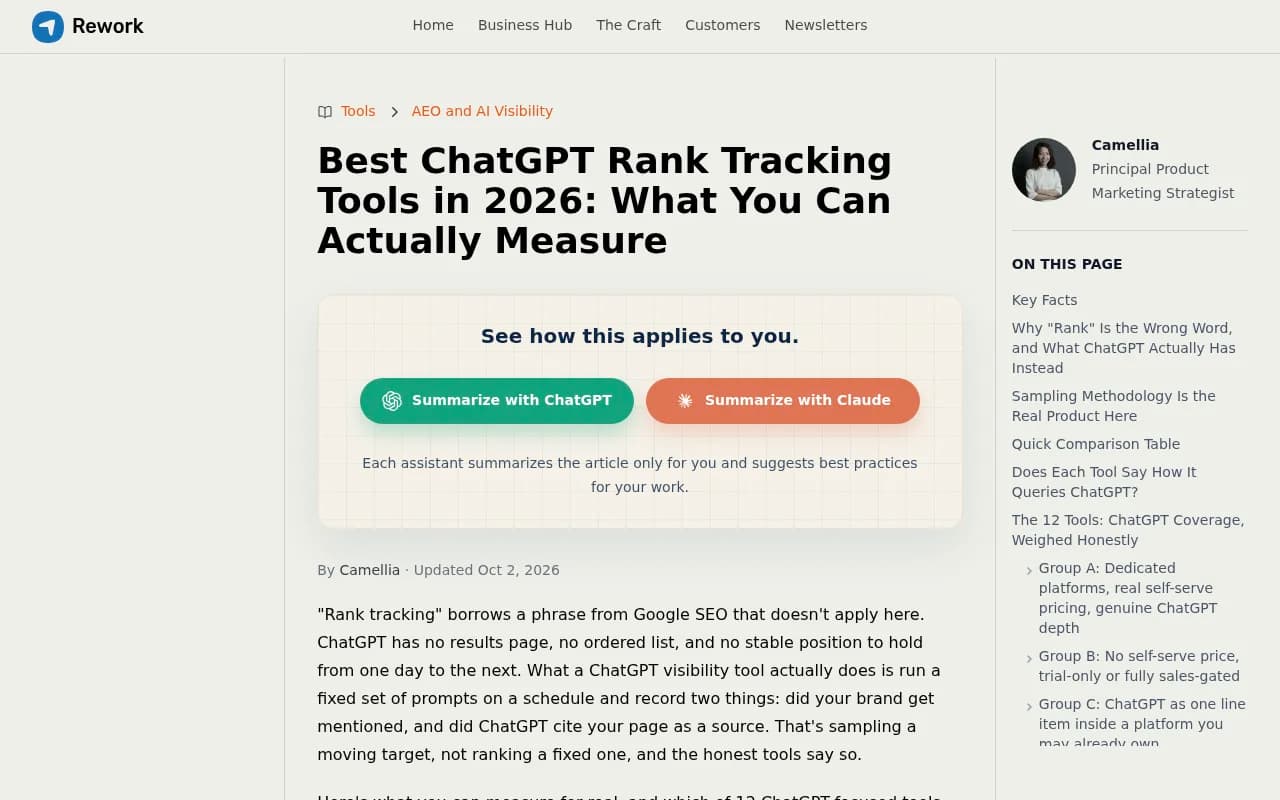
That is sampling, not ranking. Rework's October 2026 review of 12 tools makes the same point, and it cites SparkToro research (via Search Engine Journal) finding that the same prompt almost never returns the identical brand list in the same order twice. Omnia adds that results shift by run, model version, and locale.
So when a free tool tells you "you rank #3 in ChatGPT," treat it as one data point from one run. Useful, but not a position.
The four kinds of free you will run into
I went through the vendor listicles and pricing claims, and "free" falls into four buckets. Knowing which one you are looking at saves a lot of wasted signups.
One-shot visibility checkers
You enter a brand or domain, the tool runs a small set of prompts, and you get a report. No account history, no trend line. LPagery's ChatGPT Rank Tracker is described as completely free, and Honeyb advertises a free AI rank tracker alongside its paid plans from $29. These are the closest thing to a real free option, but they are snapshots.
Free trials
AIclicks offers a 3-day trial: cancel before day 3 and you pay nothing. Leapd's Alex starts at $39 a month with a 2-day trial and covers 50 prompts every 48 hours. These give you the full product briefly. They are not free tiers, and a 2-3 day window barely covers one tracking cycle.
Free tiers with a hard cap
Some platforms give a free plan limited to one project and a few prompts on one engine. Promptwatch's Explore plan is an example: 1 project, 10 prompts, ChatGPT only. Enough to see how monitoring works, not enough to run a program.
Free audits from paid vendors
Tools like Geoptie pair free GEO audit tools with paid tracking. The audit is a lead magnet. It can still be handy for checking technical readiness, but it is not tracking.
Comparison: free entry points and where paid starts
Figures come from vendor-written sources and may have changed. Confirm on each pricing page.
| Tool | Free entry point | Paid entry price | Notes |
|---|---|---|---|
| LPagery AI Rank Tracker | Free analysis | Not stated | Page-level suggestions |
| Honeyb | Free AI rank tracker | From $29/mo | ChatGPT as chosen engine |
| AIclicks | 3-day trial | Not verified | Daily ChatGPT tracking |
| Leapd Alex | 2-day trial | From $39/mo | 50 prompts every 48 hours |
| Searchable | None found | $1.25 per prompt per model per month | Gets pricey as prompts grow |
| Promptwatch | Free Explore plan (10 prompts, ChatGPT) | Essential $95/mo | 7-day trial on monthly paid plans |
Free tools in our catalog worth a look
A few catalog tools are worth checking for free access or open-source options.
Promptwatch has the free Explore plan for ChatGPT, plus no-login tools like the Free AI Visibility Report and the GEO Inspector Chrome extension, which shows ChatGPT's fan-outs and cited sources locally.

Elmo is open source and self-hosted, which suits teams with someone who can run it and want no per-prompt fees.

AI Monitor is another open-source brand mention tracker for AI answers.
Geoptie bundles free GEO audit tools with AI engine tracking.
Otterly.AI is positioned as affordable monitoring and often comes up as the first paid step.

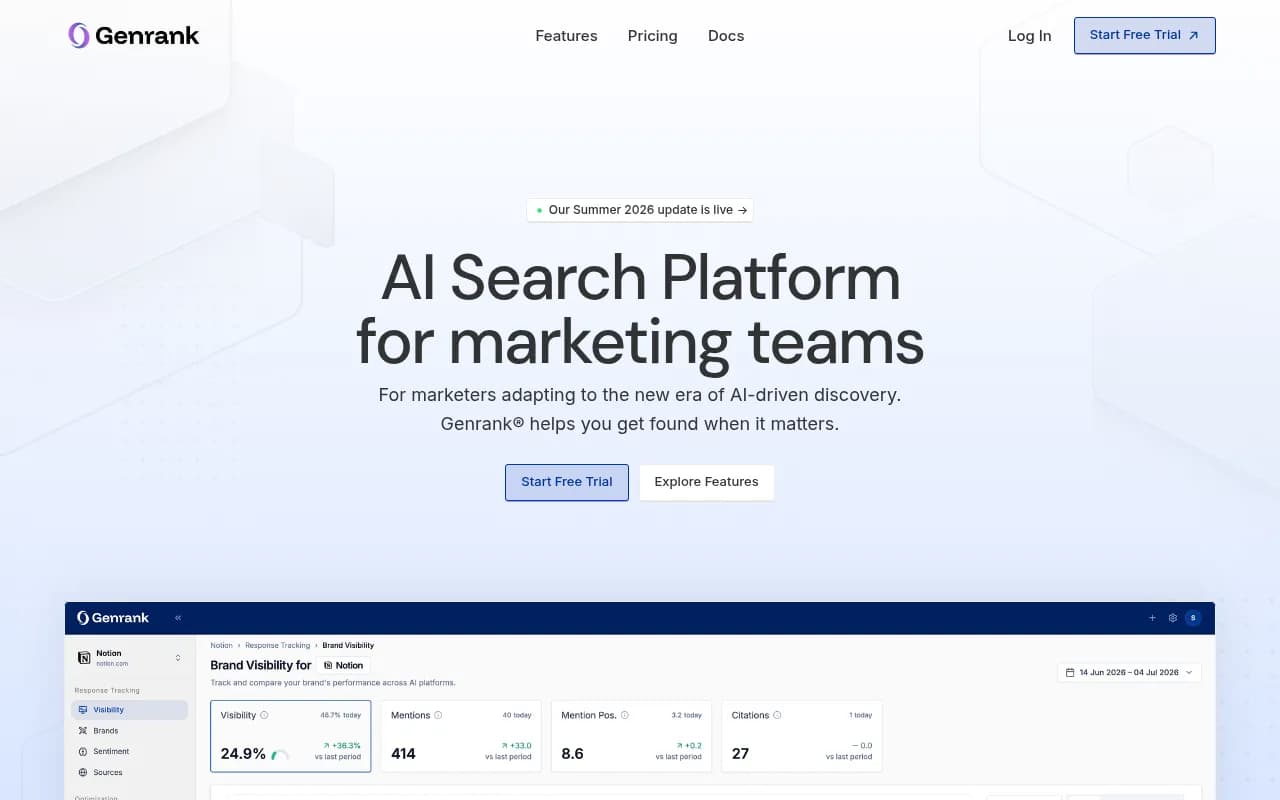
GenRank is aimed specifically at tracking brand mentions in ChatGPT.
KIME made one of the listicles' top-8 ChatGPT lists.
For wider directories, the AI rank tracker directory at ai-rank-tools.com lists many more options.
Why a free check gives you a thin signal
This is the part most free-tool pages skip. Promptwatch Data on unique domains per ChatGPT response (Sep 28 to Oct 4, 2026) found:
- 47.6% of cited responses cite 10 or more domains, and 66.1% cite at least 8.
- For organic prompts with no brand named, 52.5% cite 10 or more.
- Only 6% cite three domains or fewer.
With that many sources per answer, your brand is competing for a spot among a crowd. A free tracker that checks five prompts once cannot tell you whether you are consistently present or you got lucky. The same report advises measuring across many organic prompts and watching how ChatGPT describes you, not just whether you appear.
There is a second wrinkle. ChatGPT searches with short, keyword-style queries behind the scenes. Promptwatch's ChatGPT query fanouts data shows average fan-out query length falling from about 117 characters in December to roughly 53 in April, with about 1 to 2 fan-outs per response on average. If a tracker only tests long conversational prompts, it may not mirror what ChatGPT actually searches. Also worth knowing: ChatGPT began using the site: operator at scale on August 8, 2026, per Promptwatch's data, which changes how some sources get surfaced.
What to test with a free tool
Don't waste your free run on vanity prompts. Use it as a structured experiment.
- Write 10 to 15 prompts a buyer would really ask, with no brand name. "Best CRM for a 10-person sales team" beats "is [Brand] good."
- Add 3 to 5 competitor comparison prompts.
- Run each prompt more than once if the tool allows it, and note the variation.
- Record mention, citation URL, and which competitors appear.
- Look at which third-party pages are cited: listicles, review sites, forums. Those are your outreach targets.
If the tool does not show citation URLs, it is only half useful. Omnia's buyer guide stresses exact citation URLs as a data-integrity test.
Questions to ask before trusting the numbers
- Does it query the real ChatGPT interface or the API? Answers and citations can differ between the two.
- How many runs per prompt, and how often?
- Which country and language does it use?
- Does it show citation URLs, or only a yes/no mention?
- Can you export the raw responses?
If a vendor won't answer these, the free report is a marketing artifact.
When to stop using free and pay
Free is enough if you are validating that AI visibility matters for your category. It stops being enough when:
- You need trends over weeks, not a snapshot.
- You want to track competitors continuously.
- You need to know which pages get cited, and why others don't.
- You want to connect visibility to actual traffic.
At that point the price jump is modest. Entry plans sit around $29 to $95 a month for 50-ish prompts. Per-prompt pricing like Searchable's $1.25 per prompt per model per month adds up quickly: 50 prompts on one model is $62.50, and every extra model multiplies it.
Tracking alone also has a ceiling. Monitoring tells you that you are missing from answers. Platforms such as Promptwatch go further with crawler logs, content gap analysis, and an agent that drafts and publishes content, which matters once you know the problem and need to fix it. For a broader shortlist, the GEO software directory is a decent next stop.
A realistic upgrade path
- Run a free check and a free trial in the same week. Compare how differently they report the same brand. That alone shows you the noise level.
- Pick one paid tool with a 7-day or longer trial and load 30 to 50 prompts.
- Review after four weeks. If you cannot name a content or outreach action that came out of the data, switch tools.
Bottom line
Free ChatGPT rank trackers are good for a first look and bad for decisions. Treat any single result as a sample, load organic buyer prompts instead of brand queries, and check citation URLs. If you still care after the free run, a paid plan around $29 to $95 a month gets you the repeated measurement that makes the data worth acting on. Verify every price on the vendor's own page first, since most of the numbers floating around come from the vendors' own blog posts.