Key takeaways
- GEO and AEO overlap heavily in practice. For ecommerce specifically, GEO is the more useful frame because it originated around product discoverability, while AEO is closer to a B2B/brand-authority concept.
- Product pages are gaining ground fast in AI citations: ChatGPT Search citations to product pages nearly doubled from ~18% in March 2026 to ~32.8% in July 2026, and Google AI Overviews had product pages overtake listicles for the first time in July 2026.
- 45% of top ecommerce product URLs still have no structured data, even though 61% of pages cited in AI Overviews use it. That gap is the single biggest opportunity most stores are ignoring.
- AI-referred shopping traffic converts better and spends more: Adobe found AI visitors convert 31% higher and spend 32% longer on-site than other channels, with AI-driven revenue per visit up 254% during the last holiday season.
- Retailers and marketplaces only capture 2.9% of AI shopping citations overall; brand and DTC sites capture 64.7%. If you sell direct, this favors you more than it favors Amazon.
Why ecommerce teams keep confusing GEO and AEO
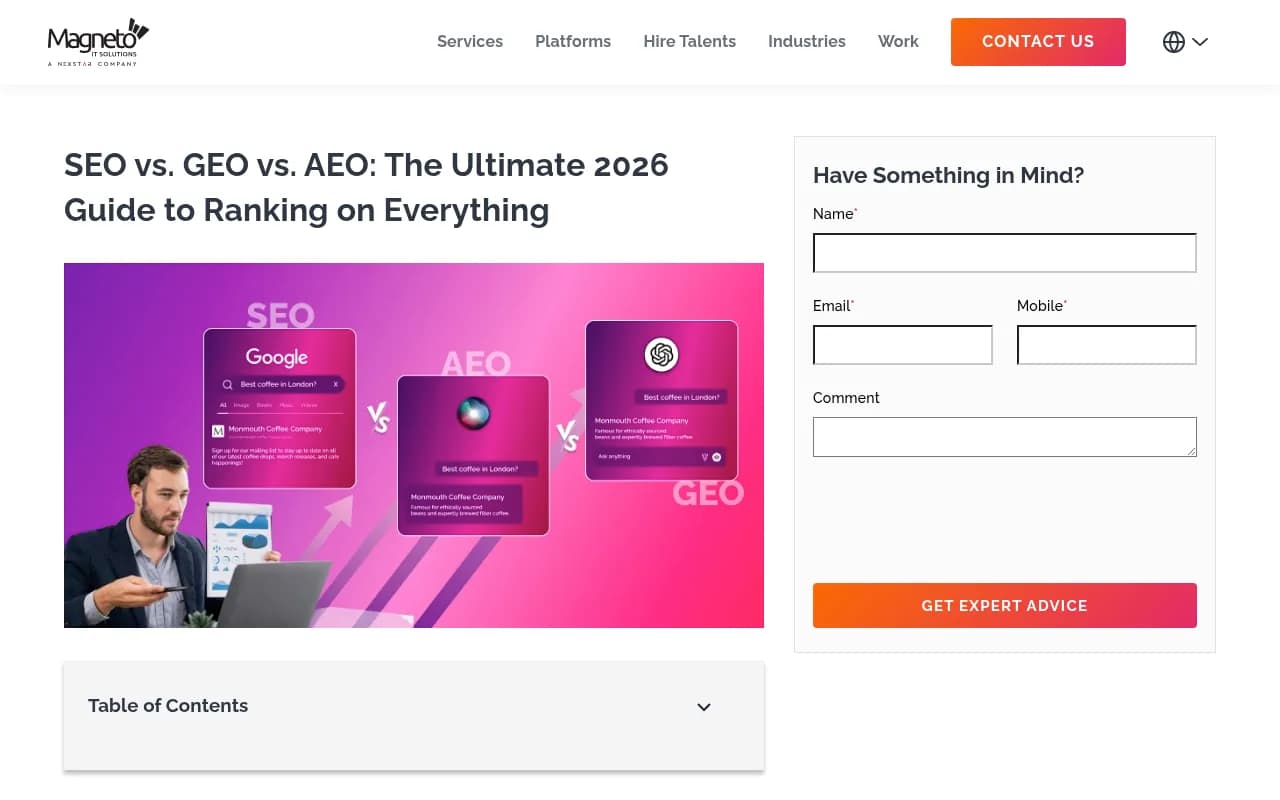
Ask five people to define GEO and AEO and you'll get five overlapping but slightly different answers. That's not because anyone is wrong, it's because the terms grew up in different rooms. GEO (Generative Engine Optimization) traces back to a 2023 Princeton and Georgia Tech research paper and got picked up fastest by ecommerce and AI-shopping circles focused on getting a specific SKU surfaced. AEO (Answer Engine Optimization) grew out of the featured-snippet and voice-search era, and B2B agencies latched onto it because it maps cleanly onto "be the correct answer when someone asks about my category."
Column Five, a B2B content agency, put it plainly: GEO's framing centers on product discoverability, making sure an AI shopping assistant surfaces your SKU. AEO's framing centers on brand authority, making sure an AI research assistant represents your company accurately. For a SaaS company worried about being described correctly when someone asks "who should I hire for content marketing," AEO is the right lens. For a retailer worried about whether ChatGPT recommends their running shoes over a competitor's, GEO is the right lens.
The practical overlap is close to total, though. Most of the technical work, schema, clear headings, citable facts, structured product data, serves both goals simultaneously. The difference is mostly about which outcome you're optimizing for and which content types you prioritize first.
The framework that actually fits ecommerce
For a store selling physical or digital products, I'd argue GEO should lead and AEO should sit underneath it as a supporting layer for category and comparison content. Here's why, based on where the citation data is actually moving.
Product pages are winning the citation game
ChatGPT Search citations to product pages went from roughly 18% in March 2026 to 32.8% in July 2026, according to Promptwatch's ChatGPT citation types data. That's not a small trend, that's a near-doubling in four months.
Google AI Overviews told the same story from a different angle: product pages overtook listicles for the first time in July 2026, ending the month at 17.9% share versus 16.2% for listicles, according to Promptwatch's AI Overviews citation types report for July 2026. Video citation share in AI Overviews also climbed, from about 2.7% in January to 6.3% by the end of July.
That shift matters because it means the classic AEO move, publish a well-structured FAQ or comparison article, isn't automatically the winning play anymore for commercial queries. AI systems are increasingly citing the product page itself. If your product pages read like a bare spec sheet with no context, you're leaving the highest-growth citation format on the table.
Retailers don't dominate the way you'd expect
An LLM Pulse study of 391,073 non-branded shopping citations between April and July 2026 found that major retailers and marketplaces combined captured only 2.9% of citations. Brand and DTC manufacturer sites captured 64.7%. Reddit and YouTube combined captured 10.4%, more than three times what all major retailers got put together.
Amazon's visibility, specifically, turned out to be almost entirely a Google story. ChatGPT cited amazon.com only six times in that entire sample, and Perplexity zero times, while Google AI Mode and AI Overviews drove over a thousand of Amazon's citations. If you're a DTC brand competing against Amazon listings, this is genuinely good news: the AI layer favors your own product pages over marketplace listings in a way traditional Google rankings never did.
The structured data gap is wide open
According to research cited by Nudge, 61% of pages cited in AI Overviews carry structured data, but 45% of top ecommerce product URLs have none at all. That's a huge, unforced error sitting on thousands of storefronts. Schema markup isn't strictly required (Google's own developer guidance says there's no special schema.org markup mandated for generative AI search), but the data shows pages with it get cited roughly 2.3x more often according to Everything-PR's June 2026 Citation Source Index analysis of over 3 million queries.
Where AEO still matters for ecommerce
GEO leading doesn't mean AEO disappears. Two content types where the answer-engine mindset earns its keep:
- Comparison and "X vs Y" content, where shoppers ask an AI assistant to weigh two products or brands against each other before buying.
- Category-level educational content, like buying guides or "how to choose a [product type]" pieces, where the goal is being the cited authority rather than the product itself.
Listicles were the fastest-growing content type inside ChatGPT's July 2026 citation mix, rising from about 8% to over 10% within the month, per Promptwatch's data. So the classic AEO-style roundup post still has a place, it's just not the only lever anymore, and it's growing slower than product-page citations.
How AI shopping assistants actually pick products
Per-platform behavior varies more than most content strategies account for. Research from Nudge, published in April 2026, breaks it down:
| AI platform | How it selects products | Brand mention rate |
|---|---|---|
| ChatGPT | References reviews in 58% of shopping responses; no ad or bid influence on citation | 99.3% |
| Google AI Mode | Pulls from Shopping Graph (50B+ listings, updated 2B times/hour) plus Merchant Center feeds | 81.7% |
| Perplexity | Favors authority review sites and listicles | 85.7% |
| Gemini | Closely mirrors AI Mode signals | Similar to AI Mode |
The practical takeaway: if you're on Google Merchant Center, keeping that feed accurate and current is doing double duty for both traditional Shopping ads and AI Mode citations. If you're chasing ChatGPT specifically, reviews on your own site and on third-party review platforms matter more than schema tricks.
The citation scarcity problem
ChatGPT cites roughly 5 sources per web-search response on average, about half of what Google AI Overviews and Perplexity each cite (around 10 sources per response), according to Promptwatch's average sources per response data. That means every citation slot on ChatGPT is worth roughly twice as much competitive effort as one on AI Overviews or Perplexity. If your team has to pick a primary target for GEO work, Overviews and Perplexity are the more forgiving engines to break into first; ChatGPT is the harder, higher-stakes prize.
Microsoft Copilot's citation behavior swung wildly, from under 2 sources per response to around 17, in the same dataset. I'd treat Copilot as a lower priority until that volatility settles.
Ads are creeping into AI shopping answers
ChatGPT started showing ads in search responses on May 27, 2026, and Promptwatch's 90-day tracking (May 20 to August 17, 2026) put the average at 20.1% of citation-enabled responses carrying ads, spiking as high as 43.9% on individual days and sitting at a 32.4% seven-day average by mid-August, up 12.5% week over week. Of the ad-bearing responses, 73.3% came from organic (non-branded) prompts, meaning ads are increasingly showing up even when a shopper didn't search for a specific brand.
Separately, ChatGPT's shopping features, product cards and price comparisons, appear in only a low single-digit percentage of all web-search responses, but that rate has moved in step changes rather than drifting organically (it roughly doubled overnight in late May 2026, then fell back weeks later), which suggests OpenAI is actively tuning what shows and to whom rather than it being a stable, predictable surface.
Where Reddit and YouTube fit your ecommerce GEO plan
This is where engine-by-engine nuance really pays off. ChatGPT behaves like a Reddit specialist among social platforms, citing Reddit over 20 times more than its next-best social source, per Promptwatch's social media citations data. But that specialty just took a hit: Reddit's share of ChatGPT Search citations collapsed from around 3.8% to under 1% starting August 14, 2026, an 86% relative drop tied to a change in how ChatGPT fans out site-specific searches. Google AI Overviews and AI Mode showed only gradual Reddit declines over the same window, not a cliff.
AI Overviews and Grok, meanwhile, favor YouTube (4.08% and 4.85% citation share respectively), and Perplexity leans YouTube too. Cited YouTube videos skew smaller than you'd expect, about 80% of cited videos have under 100,000 views, and channels with 10,000 to 100,000 subscribers are the largest cited cohort. For an ecommerce brand, that's an argument for a focused product-explainer YouTube channel rather than chasing viral reach you probably won't get anyway.
Tooling: what to use for ecommerce-specific GEO/AEO tracking
General AI-visibility trackers exist, but a handful of tools are built specifically around product catalogs and SKU-level tracking, which matters more for ecommerce than generic prompt monitoring.
| Tool | Ecommerce focus | Notable capability |
|---|---|---|
| Ranketta | SKU-level AI visibility plus feed enrichment | UI-scraping across ChatGPT, AI Overviews, AI Mode, Gemini, Perplexity, Copilot |
| Alhena AI | AI visibility tracking built for catalogs | Designed around catalog-scale monitoring |
| Yotpo Discover | AI visibility tied to catalogs and reviews | Leverages review data already in Yotpo |
| Azoma | Agentic-commerce GEO | Built for AI shopping agents specifically |
| Zoovu | On-site AI product discovery | Focused on the shopping assistant experience itself, not just tracking |
| Naridon | Shopify-native GEO monitoring | Runs on autopilot inside Shopify |
| Promptwatch | Cross-engine visibility plus content execution | Crawler logs, citation trends, Reddit/YouTube tracking, ChatGPT Shopping and Ads Radar, automated content generation |
Yotpo Discover
For teams that need cross-industry monitoring plus the ability to act on gaps, not just report them, Promptwatch adds crawler log analysis (seeing exactly when ChatGPTBot, PerplexityBot, and others hit your product pages), content gap analysis against AI responses, and automated content generation that publishes directly to Webflow, Framer, or WordPress. It also has a dedicated ChatGPT Shopping and Ads Radar module, which is directly relevant given the ad-share numbers above. If you want a broader look at the category, the GEO software directory at bestgeosoftware.com lists dozens of options at different price points.
A practical checklist for ecommerce teams starting this quarter
- Audit your top 50 product pages for structured data. If 45% of ecommerce product URLs have none, there's a good chance yours are in that group.
- Add specific, quotable facts to product pages, not just specs but context: who it's for, how it compares, what reviewers actually say. The original GEO research found that adding citations, quotations, and statistics to content drove up to 40% relative visibility gains in generative engine responses.
- Rewrite page headings to match how shoppers actually phrase queries. Pages with headings closely matching the user's query get cited 41% of the time versus 29% for weak matches.
- Keep your Google Merchant Center feed current if you sell on Google Shopping, since AI Mode pulls straight from that graph.
- Stand up monitoring on your top 25 to 50 commercial product queries across at least ChatGPT and AI Overviews, since Promptwatch's data shows real, fast-moving shifts (like the Reddit citation collapse) that you'd otherwise miss entirely.
- Build a small, focused YouTube presence around product explainers rather than chasing scale, given how citation data skews toward smaller channels.
The bottom line
Don't pick a side in the GEO-versus-AEO debate as if it's a religious question. For ecommerce, the data points toward GEO's product-discoverability framing as the primary lens, because product pages are the fastest-growing citation format across both ChatGPT and Google AI Overviews. Keep an AEO layer for comparison and category content, where being the trusted answer still counts. And close the structured-data gap before your competitors do, because right now nearly half of ecommerce product pages are leaving an easy win on the table.
If your team needs help translating this into an actual content and technical roadmap rather than another framework debate, 1001 SEO Media works on exactly this kind of AI search and GEO strategy for ecommerce and other brands, combining technical SEO with content production built for how AI systems actually cite pages today.