Key takeaways
- ChatGPT accounts for roughly 87% of AI chatbot referral traffic by volume, but generates very few direct clicks -- its impact on pipeline runs through brand recall, not referrals.
- Perplexity converts B2B sign-ups at 11x the rate of traditional organic search, making it the highest-ROI platform per citation despite its smaller traffic share.
- Google AI Overviews (and AI Mode) cut organic CTR by around 35% when triggered, but the traffic that does arrive converts at rates comparable to regular organic.
- Gemini traffic to websites grew roughly 115% between November 2025 and January 2026, while ChatGPT referrals dropped over 22% in the same window.
- Only 11% of domains are cited by both ChatGPT and Perplexity -- optimizing for one doesn't automatically get you the other.
The question sounds simple: which AI platform sends the most traffic? The answer is genuinely complicated, and the "right" answer depends on what you mean by traffic.
Volume? ChatGPT. Conversion quality? Perplexity. Raw reach and search integration? Google. And then there's Gemini quietly doubling its referral share while everyone debates the other three.
This guide breaks down what the 2026 data actually shows, what each platform's traffic behavior looks like in practice, and how to think about prioritizing your efforts.
The state of AI referral traffic in 2026
Let's start with the headline numbers, because they're genuinely surprising.
According to data from AuthorityTech's analysis of B2B AI search behavior, ChatGPT accounts for 87.4% of all AI chatbot referral traffic. That sounds dominant. But here's the catch: most ChatGPT users don't click out to sources. The model summarizes, the user reads, and they move on. Direct referral clicks from ChatGPT are low relative to its massive user base.
Perplexity sits at roughly 15-20% of AI referral volume -- much smaller -- but it's built around inline citations that users actually click. The conversion rate from those clicks is 1.66% for B2B sign-ups, compared to 0.15% from traditional organic search. That's the 11x figure you'll see cited everywhere, and it holds up.
Google AI Overviews is a different beast. It's not really a "referral source" in the traditional sense -- it sits inside Google search and intercepts queries before they ever reach your site. When an AI Overview triggers, organic CTR drops by around 35%. But the users who do click through convert at rates similar to regular organic (around 6.69% for B2B SaaS). So Google AI Mode is less about sending you traffic and more about deciding whether you get any at all.
ChatGPT: massive reach, minimal direct clicks
ChatGPT's traffic story is counterintuitive. It has hundreds of millions of users. It processes an enormous number of queries. And yet, if you look at your referral analytics, ChatGPT probably isn't your top AI traffic source.
The reason is structural. ChatGPT's default behavior -- especially in the standard chat interface -- is to give complete answers without requiring users to click anywhere. Citations exist, but they're often tucked away or not prominently displayed. Users get what they came for and leave.
Where ChatGPT does matter is brand recall. Research from First Page Sage found that when ChatGPT users do click through to a website, they convert at 4.4x the rate of organic visitors. These are high-intent users who've already had a conversation about your product category, heard your brand mentioned, and then sought you out directly. That's a different kind of traffic value -- harder to measure, but real.
The practical implication: don't optimize for ChatGPT referral clicks. Optimize for ChatGPT brand mentions. If your brand name appears in ChatGPT responses to relevant queries, you'll see it show up in direct traffic and branded search, not in your referral report.
Perplexity: smaller audience, much better conversion
Perplexity is the most interesting platform for anyone focused on B2B pipeline. It's built as a research tool, which means its users are actively looking for sources, comparisons, and recommendations -- not just quick answers.
The citation mechanic is different too. Perplexity displays numbered inline citations that link directly to source pages. Users see them, hover over them, and click them. It's much closer to how people use Google than how they use ChatGPT.
The 11x conversion advantage over organic search is striking. Part of it is audience self-selection -- Perplexity users tend to be more technical and research-oriented. Part of it is intent -- if Perplexity cites your product in response to a "best tools for X" query, the person clicking through already knows what you do and is evaluating whether to buy.
The challenge with Perplexity is citation overlap. Analysis of 680 million AI citations found that only 11% of domains are cited by both ChatGPT and Perplexity. The two platforms have very different source preferences. Getting cited by one doesn't mean you're automatically cited by the other, so you need to think about them separately.
Google AI Mode: the traffic thief that also sends traffic
Google AI Overviews (and the newer AI Mode) occupies a weird position. It's simultaneously the biggest threat to your existing traffic and a potential new source of it.
The threat: when Google triggers an AI Overview for a query you rank for, your organic CTR drops by roughly 35%. Users get the answer from Google directly and don't need to visit your site. This is already affecting a significant portion of informational and navigational queries.
The opportunity: Google still cites sources in its AI responses, and those citations carry weight. If your site is cited in an AI Overview, you're getting visibility at the top of the results page -- even if fewer people click. And the users who do click are high-intent.
The key difference from Perplexity and ChatGPT is that Google AI Mode builds directly on traditional SEO signals. Structured data, E-E-A-T, domain authority, and existing ranking positions all influence whether Google's AI cites you. If you've invested in SEO, you have a head start here. The other platforms have their own citation logic that doesn't map cleanly onto Google's ranking factors.
The Gemini wildcard
Here's the number that caught a lot of people off guard: between November 2025 and January 2026, website visits from Gemini grew by roughly 115%. SE Ranking's research tracked this across their dataset and found Gemini growing at about +47% per month while ChatGPT referrals dropped around 8% per month.
By January 2026, Gemini's share of AI-driven website visits reached 0.0242% vs. 0.0172% for Perplexity -- a 41% lead in the U.S. The growth spike coincided with Google's deployment of Gemini 3 models across its ecosystem in late 2025.
This matters because Gemini is integrated into Google's products in ways that could make it a significant traffic driver as adoption grows. If you're already optimizing for Google AI Overviews, you're partially optimizing for Gemini too -- they share infrastructure and source preferences. But Gemini's standalone app and API usage are growing separately, and that's a channel worth watching.
Platform comparison: traffic behavior at a glance
| Platform | Referral volume | Click-through behavior | Conversion quality | Citation mechanism | SEO overlap |
|---|---|---|---|---|---|
| ChatGPT | ~87% of AI referrals | Low direct clicks | Very high (4.4x organic) when clicked | Inline, often not prominent | Low |
| Perplexity | ~15-20% of AI referrals | High click rate | Very high (11x organic sign-ups) | Numbered inline citations | Moderate |
| Google AI Overviews | Reduces organic CTR ~35% | Moderate (intercepts traffic) | Similar to organic (~6.69% B2B SaaS) | Featured snippets / AI answers | High (builds on SEO) |
| Gemini | Growing fast (+115% Nov-Jan) | Increasing | Early data, promising | Inline with source cards | Moderate-High |
| Claude | Growing, absorbed ChatGPT share | Moderate | Limited data | Inline citations | Low |
How citation logic differs across platforms
This is where most "AI SEO" advice goes wrong. People treat all AI platforms as if they work the same way. They don't.
ChatGPT relies heavily on its training data and, for web-connected queries, on Bing's index. It tends to cite well-known domains, frequently linked content, and sources that appear across multiple third-party references. Getting cited in ChatGPT is largely about building the kind of authority that gets you mentioned in other people's content -- Reddit threads, industry roundups, press coverage.
Perplexity does real-time web search for most queries. It's closer to a search engine in its citation behavior. Fresh content, clear answers to specific questions, and pages that directly address the query tend to get cited. Technical SEO matters more here than with ChatGPT.
Google AI Overviews uses Google's own index and ranking signals. Structured data (FAQ schema, HowTo schema, etc.), E-E-A-T signals, and existing ranking positions are the main levers. If you rank in the top 5 for a query, you have a reasonable shot at being cited in the AI Overview.
Gemini follows similar logic to Google AI Overviews for most queries, since it's built on Google's infrastructure. But Gemini's standalone app pulls from a broader set of sources and behaves more like Perplexity for research-oriented queries.
The 11% citation overlap between ChatGPT and Perplexity is the clearest evidence that these platforms don't share a source list. You need a strategy for each.
What this means for your content strategy
The honest answer is that you probably can't optimize for all of these simultaneously with limited resources. Here's a reasonable prioritization framework:
If you're B2B and focused on pipeline quality, start with Perplexity. The conversion data is the best of any AI platform, and the citation mechanism is transparent enough that you can actually work toward it. Create detailed, well-sourced content that directly answers the questions your buyers are researching. Get cited in third-party sources that Perplexity trusts.
If you're focused on reach and brand awareness at scale, ChatGPT is where the volume is. But the strategy is different -- you're not trying to get clicks, you're trying to get mentioned. That means PR, industry coverage, being cited in other people's content, and building the kind of brand presence that shows up in training data and third-party references.
If you have existing SEO investment, Google AI Overviews should be a priority because it builds on what you already have. Add structured data, focus on E-E-A-T, and make sure your best-ranking pages are formatted to be cited in AI answers.
Gemini is worth monitoring closely. It's growing fast and shares infrastructure with Google, so your Google AI Overviews work carries over. But it's not yet at the scale where it needs a dedicated strategy for most brands.
Tracking AI visibility across platforms
One thing that makes this genuinely hard is measurement. Your standard analytics setup will show you ChatGPT.com referrals, but it won't show you how often ChatGPT mentions your brand without a click. It won't show you which Perplexity queries you're being cited for, or whether your Google AI Overview citations are growing.
Promptwatch is built specifically for this -- it tracks how your brand appears across ChatGPT, Perplexity, Google AI Overviews, Gemini, Claude, and several other models, and connects that visibility data to actual traffic and revenue. The platform also includes crawler logs that show when AI agents are visiting your pages, which helps you understand the gap between being crawled and being cited.
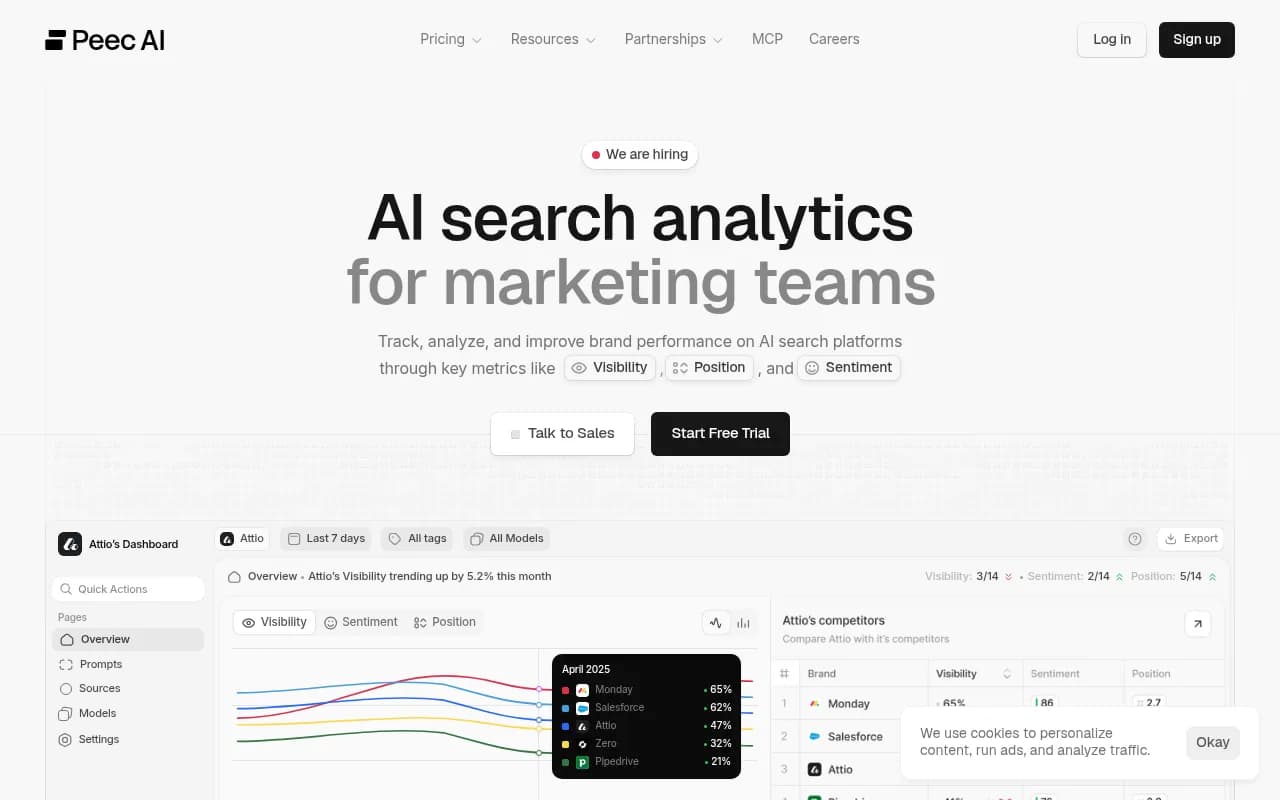
For teams that want to track specific metrics across platforms, a few other tools are worth knowing about:
SE Ranking's research on Gemini vs. ChatGPT traffic trends is some of the most specific public data available on this topic -- their AI visibility tracking is worth exploring if you want to benchmark your own site's AI referral trends.
The bigger picture
The traffic question -- "which platform sends the most?" -- is probably the wrong frame. A better question is: which platform sends the most valuable traffic for your specific goals?
ChatGPT sends volume but not clicks. Perplexity sends fewer visitors but they convert at a remarkable rate. Google AI Mode is quietly reshaping how much organic traffic you get from queries you already rank for. And Gemini is growing fast enough that ignoring it now means catching up later.
The brands that will do well in AI search aren't the ones that pick one platform and go all-in. They're the ones that understand how each platform's citation logic works, create content that earns citations across multiple models, and track the results well enough to know what's actually working.
That last part -- tracking -- is where most teams are still behind. If you don't know which AI platforms are citing you, which pages are getting crawled, and how AI visibility connects to your pipeline, you're optimizing blind.