Key takeaways
- ChatGPT Ads buys context. Google's AI Overviews and AI Mode ads buy existing Search, Shopping and Performance Max inventory and slot it into the generated answer.
- ChatGPT shows almost always one ad per answer (1.06 items on average); Google's AI surfaces behave like a carousel, averaging 3.53 ad items per ad-bearing response.
- ChatGPT blocks Legal, Pharma, Banking and Nonprofit entirely. Google still runs ads in those verticals, with Legal hitting 5.62% ad frequency on Google's AI.
- ChatGPT ad frequency climbed from zero in May 2026 to a 32.4% seven-day average by mid-August, per Promptwatch's tracking of ad-bearing responses.
- Neither platform gives advertisers real competitor visibility yet, which is the actual gap third-party tools are racing to fill.
Two companies, two completely different bets
I want to get one thing out of the way before the comparison starts: these are not the same product wearing different skins. Google took an ad engine it has run for two decades and bolted it onto a new surface. OpenAI built something from nothing, inside a chat window, in about seven months. That history explains almost every behavioral difference below.
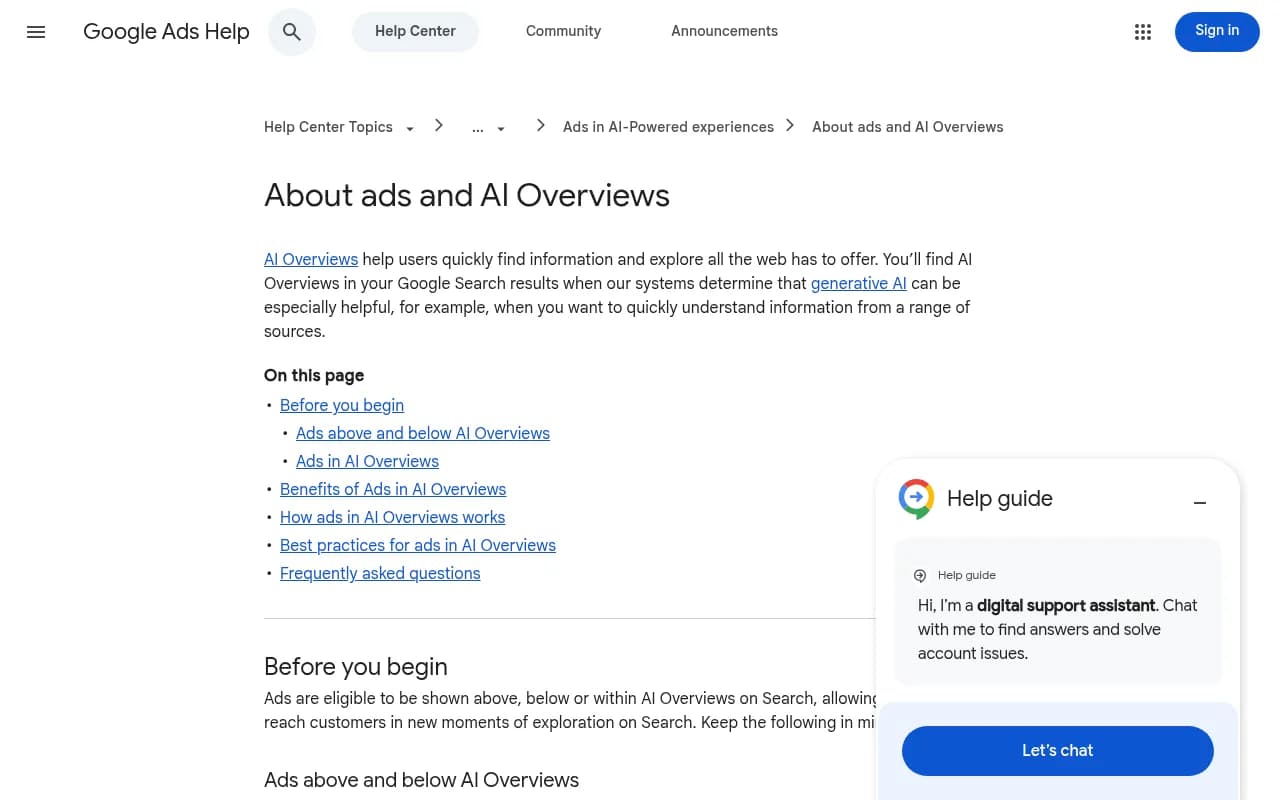
Google's approach to AI Overviews and AI Mode ads is, structurally, boring by design. According to Google's own documentation, ads above and below AI Overviews use your existing Search, Shopping, Performance Max and App campaigns automatically, in all 200+ markets where AI Overviews run. No new campaign type, no new creative format, nothing to opt into. Ads actually inside the AI Overview box are more restricted: currently English-only, mobile and desktop, in twelve countries (Australia, Canada, India, Indonesia, Kenya, Malaysia, New Zealand, Nigeria, Pakistan, Philippines, Singapore, US), and limited to Text and Shopping ads.
ChatGPT Ads, by contrast, started from zero in February 2026 with a test limited to US adults on Free and Go tiers, moved through a handful of expansion rounds, and by August 31 had crossed a $1 billion annualized revenue run rate in under 200 days, across more than 40 countries. That's a genuinely fast ramp for an ad product. Six weeks after launch OpenAI had roughly 600 advertisers; the auction was, by its own account, wide open.
How targeting actually works on each platform
Google still buys and sells keywords, mostly. The twist is that Google's AI considers both the user's query and the generated content of the AI Overview itself when deciding which ad to show, so an informational-sounding question like "why is my pool green and how do I clean it" can surface a pool vacuum ad even though nobody typed "buy pool vacuum." Google explicitly tells advertisers that exact-match-only campaigns underperform in this inventory and recommends broad match, AI Max for Search, Performance Max or Dynamic Search Ads instead. In other words, to show up in AI Overviews you mostly have to let Google's automated matching take the wheel.
ChatGPT skips keywords entirely. Advertisers write "context hints" describing the conversations where their product fits, and OpenAI's system decides whether a sponsored card belongs under the current answer, weighing the live conversation, prior chats and past ad interactions. There's no search-terms report to reverse-engineer. You get aggregated impressions and clicks, not the prompt that triggered the ad. That opacity is probably the single biggest adjustment advertisers coming from Google have to make.
| Dimension | Google AI Overviews / AI Mode ads | ChatGPT Ads |
|---|---|---|
| Matching logic | Keywords plus AI-driven broad match, AI Max, Performance Max | Context hints matched to conversation topic and history |
| Ad density per response | ~3.53 items (carousel-like) | ~1.06 items (single sponsored card) |
| Countries live | 200+ for above/below placements; 12 for in-overview ads | 40+ countries as of late 2026 |
| Regulated verticals | Ads run in Legal (5.62%), low but live in Pharma and Banking | Zero ads in Legal, Pharma, Banking, Nonprofit; Healthcare near-zero |
| Reporting | Shows as "Top Ads"; no AI-Overview-isolated segment | Own dashboard, plus Pixel/Conversions API and third-party attribution partners |
| Pricing model | Existing Search/Shopping/PMax bidding, Smart Bidding | CPM (default max $60) or CPC ($3-5 recommended), second-price auction |
| Who sees ads | Anyone using Google Search | Logged-in adults on Free and Go tiers; paid tiers stay ad-free |
The numbers that actually separate them
Adthena ran roughly 850,000 AI search queries across 20 industries and five markets between March 14 and May 26, 2026, and the resulting data set is probably the cleanest apples-to-apples comparison available. In the US, the only market where both platforms could be measured directly, ad frequency was nearly a tie: ChatGPT at 4.47% of queries, Google's AI surfaces at 4.14%. If you only looked at that number you'd assume the platforms behave the same way. They don't.
The density gap is the real story. ChatGPT almost always shows exactly one ad, averaging 1.06 ad items per ad-bearing answer. Google's AI surfaces average 3.53 items, which functions much more like a Shopping carousel with room for several competing brands in a single response. If you're a smaller advertiser, that distinction matters a lot: on ChatGPT you're fighting for one slot, winner take most; on Google's AI surfaces you can coexist with rivals in the same answer.
Geography skews heavily too. In Adthena's window, roughly 90% of all ChatGPT ad placements sat inside the US. Canada ran at 4.57%, New Zealand at 3.85%, Australia at 1.61%, and the UK returned zero ChatGPT ads in that sample simply because the UK pilot hadn't launched yet (it went live June 6, 2026, with the full UK launch following on August 11 alongside Mexico, Brazil, Japan and South Korea).
Promptwatch's own tracking of ad-bearing ChatGPT responses tells a faster-moving story than any single snapshot can. ChatGPT served zero ads until May 27, 2026, then climbed in bursts, crossing 30% on July 1 and holding there. By mid-August the seven-day average sat at 32.4%, with daily rates spiking as high as 43.9%. That's a roughly 20x increase in ad density inside about three months, which tells you OpenAI is scaling the ad business aggressively rather than cautiously. For anyone tracking this over time, the ChatGPT Ads Over Time report breaks the daily trend down by prompt type, and organic (non-brand) prompts carry 73.3% of ad-bearing responses versus 18% brand-specific and 8.6% competitor-comparison prompts.
Why regulated industries split so sharply
This is the part I find genuinely interesting, because it's a policy choice, not a market gap. Four industries returned zero ChatGPT ads across Adthena's entire dataset: Legal, Pharma, Banking and Nonprofit. Healthcare sat at 0.46%, effectively off. Google's AI did the opposite: Legal ran at 5.62% ad frequency, with Pharma and Banking low but still live.
OpenAI's own documentation confirms this is deliberate, not incidental. At launch, ads were made ineligible near sensitive or regulated topics including health, mental health and politics, and that posture has held as the product expanded. Google, meanwhile, excludes adult content, alcohol, gambling, finance, healthcare and politics from inside AI Overviews specifically, but its broader above/below-overview ad inventory still draws on the same campaigns advertisers already run everywhere else on Search, which is why regulated categories keep showing up there.
The practical upshot: if you're in a regulated vertical, Google's AI surfaces are currently your only paid option inside an AI answer. If OpenAI changes that policy, the first advertisers through the door will have a real head start, the same way early Google Ads adopters built leads that took years for competitors to close.
Where the real blind spot sits
Here's the uncomfortable part that both platforms share: neither one tells you who else is bidding against you. ChatGPT's native ad manager shows your own spend, impressions, clicks, CPC and CTR, and nothing about competitors. Google's reporting folds AI Overview ad performance into a generic "Top Ads" bucket with no segment that isolates it from your regular Search results, so even your own team can struggle to tell whether a given click came from an AI Overview or a standard result page.
Third-party vendors are stepping into that gap. Similarweb added an AI Ads dataset specifically because, as the company put it, advertisers had no visibility into AI ad placements for themselves or competitors, and found that 26% of ChatGPT responses already carried a sponsored ad shown to Free and Go users, with nearly 30% of ad-eligible Google AI Mode queries also showing ads. Adthena built a similar competitive layer on top of its own scraping.
If you're more focused on earning visibility in AI answers organically rather than paying for placement inside them, that's a separate but related discipline. Promptwatch tracks how brands get cited across ChatGPT, Google AI Overviews, AI Mode, Perplexity and the rest, with crawler logs, citation trends and content agents that help close gaps in your organic AI presence. It's not an ad intelligence tool, but Seer Interactive's research is worth noting here: brands cited inside an AI Overview saw 91% higher paid CTR than brands not cited, which means your organic AI visibility and your paid performance on the same surface aren't really separate problems.

Revenue signals and whether AI Overviews are actually cannibalizing search ads
Alphabet's Q2 2026 numbers are the best evidence against the "AI Overviews are killing Google's ad business" narrative. Google Search and other ad revenue hit $63.3B, up 17% year over year, with total Alphabet revenue at $119.8B, up 24%. That's twelve consecutive quarters of double-digit growth. The nuance: this is revenue, not click volume, and other data suggests fewer, pricier clicks rather than more clicks overall. ClickCease's research cites paid CTR on AI-Overview-triggering queries falling from roughly 19.7% to 6.3% between June 2024 and September 2025, even as average CPCs climbed. Google appears to be extracting more dollars per click on a shrinking pool of clicks, which is a very different story than growth through volume.
On OpenAI's side, the comparable signal is advertiser quality rather than raw revenue scale, since $1 billion annualized is still small next to Google's $81.6 billion in quarterly ad revenue. The case studies OpenAI has published are notably strong on net-new customer acquisition: one ecommerce advertiser reported 3x ROAS over 28 days, a tech partner found more than 80% of ad-driven ChatGPT traffic came from new customers, and Portland Leather reported 93% of its ChatGPT Ads visitors were new. That pattern, high new-customer share, modest absolute scale, matches what you'd expect from a channel still in its land-grab phase.
Picking a strategy for each platform
Google Ads and AI Overviews/AI Mode ads reward what you already know: keyword intent, mature Smart Bidding, years of conversion data. If someone has typed a specific, high-intent query, Google remains the stronger bet for direct response. ChatGPT Ads reward a different skill entirely, writing context hints that match a conversation's shape rather than a search term, and they currently work better for awareness and consideration than for bottom-funnel conversion, if only because the reporting is thinner and the audience skews toward free-tier users who may convert differently than paid subscribers.
A few practical notes worth keeping in mind heading into 2026 budget planning:
- Don't assume your Google Ads creative or keyword list transfers to ChatGPT. The targeting unit is a conversation, not a query.
- If you're in Legal, Pharma, Banking or Nonprofit, Google's AI surfaces are your only current option for paid placement inside an AI answer; budget accordingly and watch for policy changes on OpenAI's side.
- Retail and Fashion already punch above their weight on ChatGPT: the category made up 24% of US query volume in Adthena's sample but 39% of all US ad items, at a 6.55% ad frequency versus a roughly 4.5% platform average.
- Track your own ad frequency and density trends rather than relying on a single snapshot. Both platforms are changing their serving rates in step-changes, not gradually, which makes a one-time benchmark unreliable within weeks.
Neither platform is going to settle into a fixed shape anytime soon. Google just started testing promotional offer badges inside AI Mode shopping results in October 2026, and OpenAI is already piloting ads shown during image generation. The comparison you run today won't be the comparison that matters by next spring, so whatever budget split you land on, build in a quarterly re-check rather than treating this as a decision you make once.