Key takeaways
- ChatGPT only surfaces about 5 sources per web-search answer, roughly half of what Google AI Overviews shows, which makes every citation slot more contested for SaaS brands (Promptwatch Data).
- A single ChatGPT check tells you nothing reliable. You need a repeatable prompt library (30-100 prompts), run on a schedule, logged with the same criteria every time.
- Mentions, citations, and recommendations are three different things. Conflating them in a report will get you the wrong conclusions about where to invest.
- GA4 undercounts AI referral traffic badly. One SaaS company found 25% of new users cited ChatGPT in onboarding surveys, far above what GA4's default channel grouping ever showed.
- Manual spreadsheets work as a baseline, but tools like Promptwatch exist specifically because prompt tracking, citation extraction, crawler logs, and content fixes need to happen together, not as three separate side projects.
Why ChatGPT tracking is different from rank tracking
If you're coming from a traditional SEO background, the instinct is to treat ChatGPT like Google: pick some queries, check your position, chart it weekly. That instinct will waste your time.
There's no stable position one or position three in a chat response. The same prompt run twice can produce two different answers, different source lists, even a different tone about your product. That's not a bug you're going to engineer around. It's how retrieval-augmented generation works: the model runs a handful of searches, synthesizes what it finds, and the exact mix shifts with wording, session context, and model updates.
So the goal isn't perfect attribution. It's directional monitoring. You're trying to answer: is my brand becoming more present, more cited, more recommended, over a meaningful stretch of time, not in a single screenshot.
This matters more for SaaS specifically because buyers are already using ChatGPT as a pre-purchase filter. Consumer research cited by Semrush found 57% of US consumers use AI to narrow their choices before deeper research, and B2B buyers ask pointed, pre-qualified questions like "best project management tool for remote teams under 50 people" rather than generic searches. If you're not in that answer, you've lost the deal before the prospect ever opens Google.
Step 1: Define what you're actually measuring
Before building a tracker, agree on vocabulary. Teams that skip this step end up arguing about numbers that were never measuring the same thing.
- Mention: your brand name shows up in the response text, with or without a source shown.
- Citation: ChatGPT references a domain or URL tied to your brand, or a third-party source that supports a claim about you. These are not the same category. A citation of your own pricing page and a citation of a G2 review both count as citations, but they carry different weight in a narrative.
- Recommendation: the answer explicitly puts your brand forward as a viable option for the stated need. Being listed fourth in a comparison is not the same as being recommended.
- Link: a clickable URL in an interface that supports it. Increasingly less common in chat responses, more common when ChatGPT triggers a web search.
Keep these four columns separate in every report you build. Collapsing them into one "visibility score" hides exactly the information you need to decide whether to fix content, chase citations, or manage sentiment.
Step 2: Build a prompt library that matches real buyer questions
Don't reuse your old keyword list. Buyers talk to ChatGPT differently than they type into a search box. Aim for 30 to 100 prompts across four categories:
- Category discovery: "best analytics platform for ecommerce brands"
- Head-to-head comparisons: "Klaviyo vs HubSpot for mid-market companies"
- Problem-solution: "how to reduce churn for SaaS companies"
- Implementation and use-case: "how to onboard new users at scale"
A dozen prompts is a demo, not a measurement program. Below 30, you'll see noise you can't distinguish from signal. Above roughly 30 a week, manual tracking stops being manageable and you need automation.
One detail that matters and gets missed constantly: ChatGPT's own search behavior has changed shape. Promptwatch's fanout data shows average query length dropped from about 117 characters to 53 characters between December 2025 and April 2026, and the average number of separate searches per response dropped from 2.15 to roughly 1.0. ChatGPT now searches more like someone typing keywords than asking a full question. That has a direct implication for your content: write headings that read like short search queries ("Best CRM for small agencies 2026"), not conversational questions.
Step 3: Run the same prompts across platforms and log consistently
A brand that ranks well in Perplexity can be nearly invisible in ChatGPT, and vice versa. No pair of AI platforms shares more than about a quarter of the same cited pages, according to Rankability's analysis, so treating ChatGPT results as a stand-in for your visibility everywhere is a mistake.
Run every prompt at least twice per platform and average the results, since ChatGPT shows meaningfully higher response variance than, say, Perplexity, which grounds more consistently in real-time search. Use logged-out or API-based runs where possible. ChatGPT's memory and personalization features mean two logged-in users asking the identical question can get shaped answers based on their own profile, which is documented in ACM CHI research as a "personalization-conversation tension." That's a genuine confound for benchmarking, not a minor caveat.
Score every response on the same four dimensions: regularity (does it show up consistently), accuracy (is the description correct), prominence (where in the list, how much detail), and sentiment (positive, neutral, critical framing). Crystal Carter at Wix recommends exactly this framework in her work on LLM visibility versus SEO KPIs, and it turns subjective impressions into something you can actually chart.
Step 4: Fix your GA4 setup, because it's probably undercounting AI traffic
Here's where a lot of SaaS teams get a false sense of security. They assume GA4 will just tell them when ChatGPT sends a visitor. It mostly won't, by default.
GA4 dumps AI referral traffic (ChatGPT, Perplexity, Claude) into the generic "Referral" bucket unless you build a custom channel group with a regex match for AI domains, and GA4 caps you at two custom channel groups per property. The new AI channel has to sit above Referral in the ordering or it never fires.
Even after fixing that, you're only seeing part of the picture. Adobe Analytics research from late 2025 found visible, trackable AI referral traffic accounts for only 30-40% of actual AI-driven visits, because a lot of it arrives with stripped referrer data and lands in "Direct" instead. One SaaS company found 25% of new users mentioned ChatGPT in an onboarding survey, far more than GA4 ever reported as AI referral traffic. The fix isn't just technical, it's also a simple "How did you hear about us?" field in your signup flow.
A practical fallback: set up a GTM custom JavaScript variable that checks document.referrer against a list of known AI domains and fires a custom event with the platform name as a parameter. That catches sessions GA4's default grouping would otherwise misclassify.
One thing worth knowing if you're evaluating whether AI traffic is worth chasing: Adobe's research pegs AI referral traffic converting at 4.4x the rate of traditional organic search. If your dashboard shows only a trickle of AI referrals, that's more likely a measurement gap than an actual lack of traffic.
Step 5: Know where ChatGPT actually pulls citations from
Understanding the citation landscape tells you where to spend effort. A few patterns worth building your strategy around:
Product pages became the single most-cited format in ChatGPT by July 2026, at roughly 33% of daily citations, up from about 18% in March, according to Promptwatch's citation-type tracking (see ChatGPT citation types over time - July 2026). That's a real shift for SaaS: your pricing and feature pages aren't just conversion assets anymore, they're citation bait, provided the facts on them are specific and current.
Review platforms matter more than most teams assume. One independent analysis found G2 and Capterra cited in 34.5% of AI Overview responses in the AI-visibility niche, and ChatGPT's most-cited B2B SaaS domains skew toward Reddit, G2, PCMag, and Gartner. If your G2 profile is thin or your reviews are stale, you're handing that citation to a competitor by default.
Don't assume Reddit will always be a reliable channel either. Promptwatch's data shows Reddit's share of ChatGPT citations collapsed from a steady ~3.8% in late July 2026 to just 0.5% by mid-August, an 86% relative drop in a single day, coinciding with ChatGPT rolling out large-scale use of the site: operator in its search fanouts (see Reddit citations are dropping in ChatGPT). Meanwhile Google AI Overviews and AI Mode showed only gradual declines over the same window. If your tracker suddenly shows Reddit citations vanishing, check the date against this event before assuming something is wrong with your own content.
LinkedIn behaves oddly for SaaS teams optimizing purely for thought-leadership articles. ChatGPT treats LinkedIn largely as a company directory, citing company pages (23.8%) and homepages (22.5%) far more than Pulse articles (8.8%), per Promptwatch's LinkedIn citation page types report. Google's AI surfaces are the opposite, favoring Pulse articles at 40%+. If you're chasing ChatGPT citations specifically, a complete, accurate LinkedIn company page and current job listings will move the needle more than another thought-leadership post.
Step 6: Watch out for ads getting mixed into your citation counts
ChatGPT served zero ads until May 27, 2026. Since then, ad frequency ramped fast, averaging 20.1% of web-search responses over a trailing 90-day window and hitting 32.4% in the most recent seven days tracked, per Promptwatch's ChatGPT ads over time data. Most of those ads (73.3%) appear on generic, non-branded prompts rather than head-to-head comparisons. When you're auditing responses manually, separate paid placements from organic citations in your log, or you'll overstate your organic presence.
Manual tracking: the spreadsheet that actually works
You don't need software to start. A spreadsheet with these columns gets you a defensible baseline:
| Column | What to record |
|---|---|
| Prompt text | Exact wording used |
| Platform | ChatGPT, Perplexity, Gemini, Claude, AI Overviews |
| Run date | Date and time |
| Presence status | Absent / mentioned / recommended / cited |
| Cited URL | Specific page, if any |
| Competitors mentioned | Names and order |
| Sentiment | Positive / neutral / critical |
Run each prompt at least twice per platform, weekly at minimum. Calculate a simple AI Share of Voice: brand citations divided by total category citations across all responses, times 100. This is the same formula used across most vendor methodologies, and it's honest about what it can and can't prove: it tells you relative frequency, not actual human exposure.
When manual tracking stops scaling
Somewhere past 30 prompts a week, across multiple platforms, with sentiment scoring and competitor logging, a spreadsheet becomes a part-time job. That's the point where most SaaS teams look at automated platforms.
This is also where the category gets confusing, because plenty of tools only monitor. They tell you whether you were mentioned, maybe extract a citation URL, and stop there. That's useful as a smoke detector, but it doesn't close the loop back to content.
Promptwatch approaches this differently: it tracks prompts with volume and difficulty scoring, pulls citation trends classified into 22 content types, monitors AI crawler logs so you can see exactly when ChatGPTBot, ClaudeBot, and 400+ other bots hit your site and whether they error out, and tracks visitor analytics so you can measure actual traffic and conversions from AI platforms rather than just mention counts. Where it goes further than most competitors is the follow-through: content gap analysis, automated Content Agents that draft and publish GEO-optimized pages to your CMS, and a prioritized Unified Actions list so your team knows what to fix first instead of staring at a dashboard.

For a SaaS team specifically, the crawler logs matter more than they might seem to at first glance. If OpenAI's crawlers can't reach your pricing page because of an overly broad robots.txt rule, no amount of prompt engineering fixes that. Worth noting: OpenAI's share of verified AI crawler requests dropped from 94.8% in early June 2026 to 79.8% by early September, as Anthropic, Google, Perplexity, and Mistral crawlers picked up share, per Promptwatch's crawler traffic data. A rule written a year ago to block one bot might now be quietly blocking several citation sources you didn't know you had.
Comparing the tool landscape
Here's how the main options stack up on price and coverage, based on published self-serve pricing as of late 2026. Watch for mandatory add-ons and quote-only enterprise tiers when comparing headline numbers; several vendors advertise a low entry price that doesn't include full model coverage.
| Tool | Entry price | Platforms covered | Content generation | Crawler logs |
|---|---|---|---|---|
| Promptwatch | $95/mo (Essential) | ChatGPT, Claude, Gemini, Perplexity, AI Overviews, AI Mode, Grok, and more | Yes, automated CMS publishing | Yes, all plans |
| Otterly.AI | $29/mo (Lite) | ChatGPT base; Gemini/Claude are add-ons | No | No |
| Ahrefs Brand Radar | $129/mo, plus a $199 mandatory add-on | ChatGPT, Google AI Overviews | No | No |
| Profound | $99/mo (ChatGPT-only starter) | Full coverage requires Enterprise, $2,000-5,000+/mo | Limited | No |
| Peec AI | ~€80-89/mo | ChatGPT, Perplexity, Gemini | No | No |
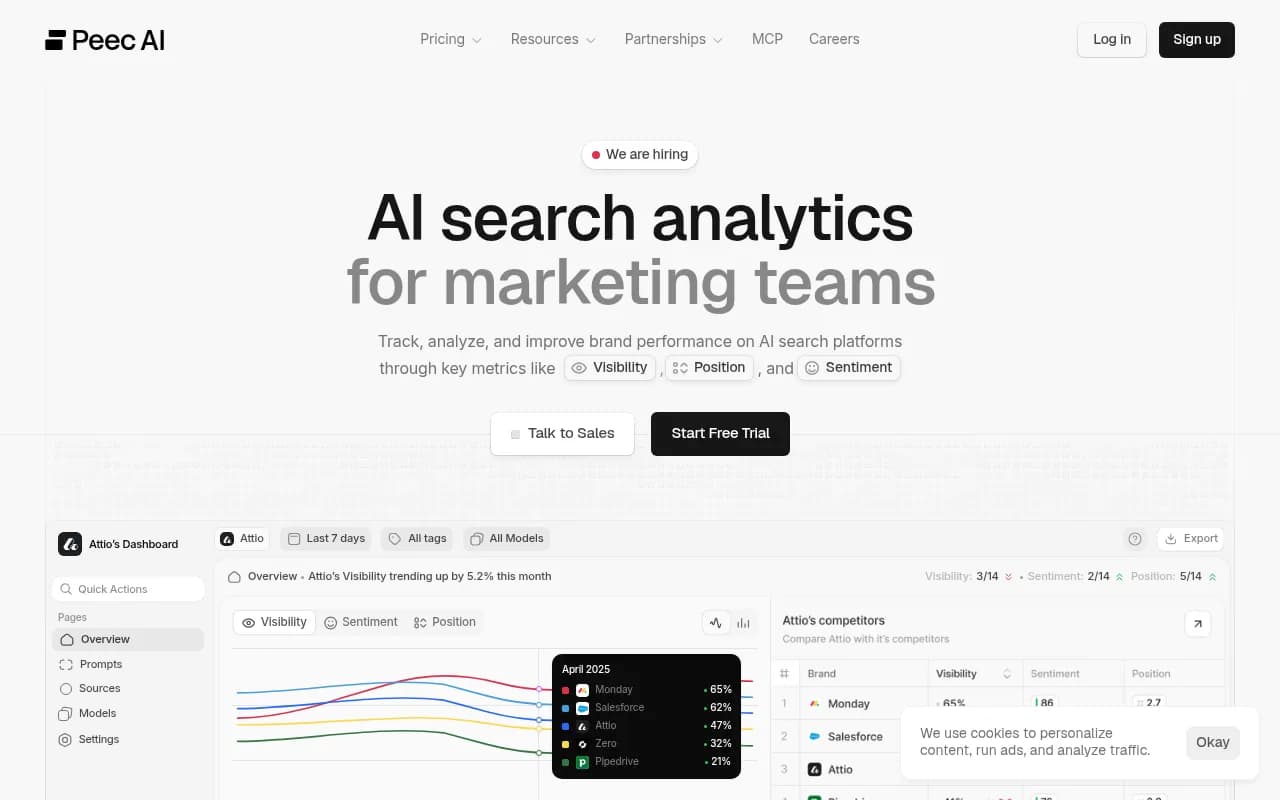
Otterly.AI works well as a cheap pilot if you just want a citation baseline. Profound is built for enterprise citation intelligence but the pricing jump to full multi-platform coverage is steep. Ahrefs Brand Radar is convenient if you're already an Ahrefs customer, but the add-on requirement is easy to miss when budgeting.
Turning tracking into action
A tracking dashboard by itself doesn't fix anything. The teams getting real results treat the data log as a feedback loop:
- Freeze your prompt set and run frequency so month-to-month comparisons mean something.
- Log every material change alongside your visibility data: a product page update, a new G2 review push, a PR placement, a schema change.
- Compare a treated cluster of prompts against a similar untouched cluster before claiming a specific action caused a citation gain.
- Wait for repeated observations. One favorable ChatGPT answer is not proof of anything.
For SaaS brands specifically, the highest-leverage moves right now are keeping product and pricing pages factually current (since they're the most-cited format), building out a complete G2/Capterra presence, and making sure your LinkedIn company page reads like a directory listing rather than a marketing page, since that's how ChatGPT actually uses it.
If you want to go deeper on the broader GEO software category before picking a tool, the directory at bestgeosoftware.com covers a wider set of platforms across pricing tiers and use cases.