Key takeaways
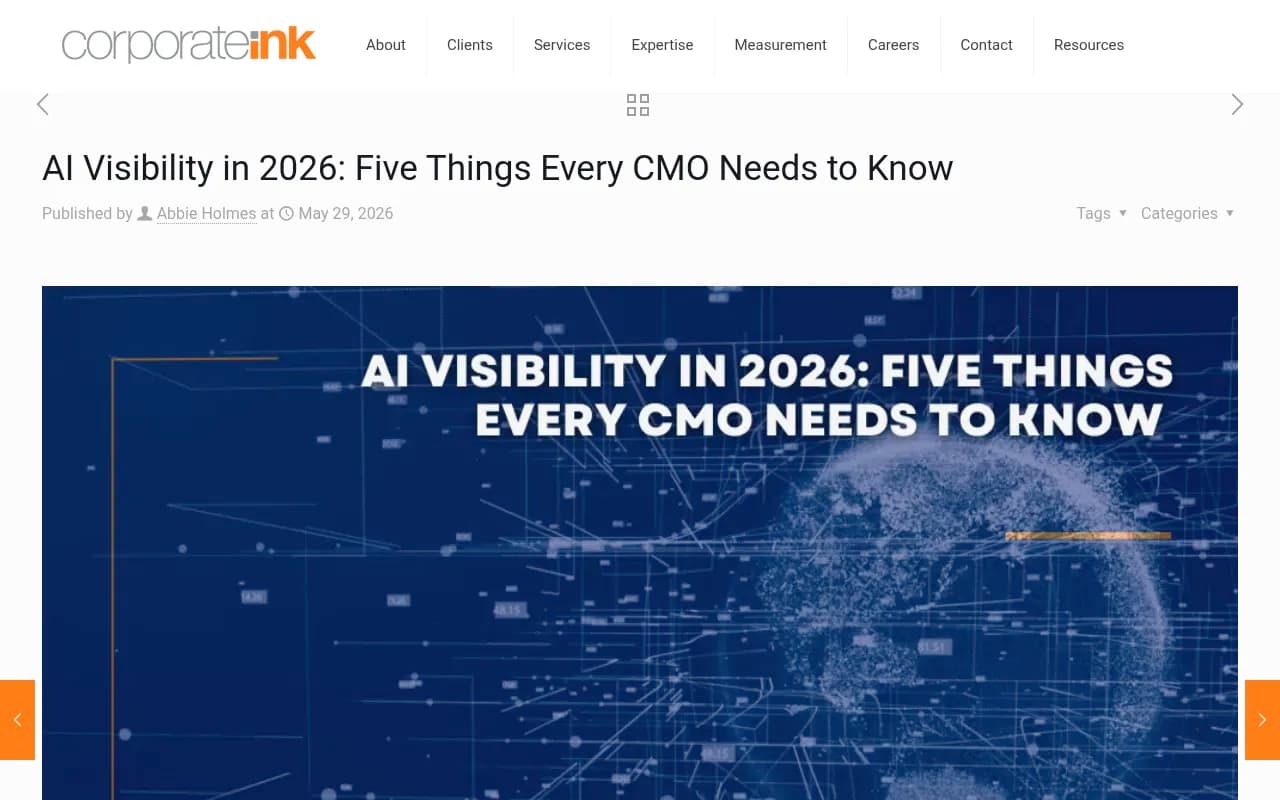
- Leadership is asking. Corporate Ink, a PR agency, surveyed 150 B2B tech marketers and found 88% of CMOs and VP-level marketers are being asked by their boards what they are doing about AI visibility. Treat that as vendor research, but it matches what most teams are hearing.
- Report wins per engine, not as one blended score. ChatGPT, AI Overviews and Perplexity cite very different sources.
- Translate mentions into pipeline, sales conversations and fixed inaccuracies. Executives care about those, not about visibility scores.
- Present drops with context. Citation sources can vanish overnight, and you should check for data-collection issues before explaining one.
- Give sales something to use: a one-page brief with the prompts buyers ask, what AI says about you, and where you beat competitors.
Why this conversation is harder than it looks
Most marketing teams that track AI visibility end up with a dashboard nobody outside marketing understands. A visibility score of 34 means something to you. To a VP of Sales it means nothing, and to a CFO it looks like another vanity metric with a nicer name.
The pressure is real, though. In the Corporate Ink GEO and AI Visibility 2026 Report, 40% of marketers reported a 5-10% increase in qualified inbound pipeline attributed to AI visibility over the past year, and 19% saw more than 10%. That is self-reported, from a PR agency's survey, so don't build a business case on it alone. But it tells you what your leadership has probably read: AI visibility is supposed to produce pipeline.
So your job is not just to measure. It is to translate. This playbook covers who your audiences are, which numbers to lead with, how to handle bad news, and what to hand sales.
Know your two audiences
Sales and the executive team want different things. Mixing them in one deck is the most common mistake.
| Audience | Their question | What to show | Cadence |
|---|---|---|---|
| Sales reps and sales leadership | What do buyers hear about us before they call? | Prompts buyers use, how AI describes you vs. competitors, objections to prep for | Monthly brief, ad hoc alerts |
| CEO, CFO, board | Is this working, and is it worth the money? | Pipeline influence, share of voice trend, competitive position, risks | Quarterly, with a one-page monthly note |
| Product and PR | What is AI getting wrong, and who fixes it? | Inaccuracy log, source list, owners | Monthly |
Sales reps don't need your methodology. They need to know that when a prospect asks ChatGPT for the best vendors in your category, you show up in position two, and a competitor shows up with a wrong claim about your pricing. That is a conversation they can have.
Executives need the opposite: fewer details, a clear trend, a link to money, and an honest read on risk.
Pick metrics leadership will believe
Every AI visibility platform produces a pile of numbers. Pick a small set and explain each in one sentence.
Visibility and share of voice, per engine
Promptwatch Data shows why a single blended number misleads. In its social media citations report (Sep 28 to Oct 4, 2026), ChatGPT drew just 0.46% of its citations from social platforms, while Google AI Overviews drew 12.2%, about 26 times as much. Perplexity sat at 2.7%. If your strategy leans on Reddit threads or YouTube videos, you might be winning in AI Overviews and invisible in ChatGPT, and an average would hide both facts.
See the full breakdown in Promptwatch's social media citations by AI model data. The takeaway for reporting: show a small table with one row per engine.
| Engine | Your share of voice | Change vs. last month | One-line context |
|---|---|---|---|
| ChatGPT | Example: 18% | +3 pts | Product page now cited for pricing prompts |
| Google AI Overviews | Example: 11% | flat | YouTube channel driving most citations |
| Perplexity | Example: 7% | +1 pt | Company page cited, not blog |
Those numbers are placeholders. Use your own, and keep the context column, because that is the part executives actually read.
Position and prominence
Being mentioned fifth in a list of ten is not the same as being the first recommendation. Report average position alongside share of voice. If you are mentioned often but late, that is a prominence problem and a different fix than a coverage problem.
Traffic and conversions from AI referrals
This is the number that gets a CFO's attention. Visits from ChatGPT, Perplexity, Gemini and Claude can be isolated in analytics, and conversion rates compared against other channels. Be careful with volume claims, since AI referral traffic is usually small compared to organic search. Lead with conversion quality when it is strong, and with growth rate when it is not.
I'll be honest: attribution is the weakest link in this whole discipline. Many buyers read an AI answer, then search your brand name later, and the visit gets credited to direct or branded search. A self-reported "how did you hear about us" field on demo forms is a cheap way to catch some of that. Treat it as directional, not exact, and say so.
Accuracy of what AI says about you
This one is underused. Corporate Ink found 72% of marketers had seen AI describe their company, category or value proposition inaccurately, and 29% of those were doing nothing about it. A wrong product description in a buyer's research phase is a pipeline risk you can show in a screenshot. Screenshots of wrong answers move executives faster than any chart.
Build the story around buyer prompts
The strongest way to present a win is to start with a prompt a real buyer would type. Not "our visibility score rose," but:
For the prompt "best [category] software for mid-market teams," we were absent in July. Today we are the second recommendation in ChatGPT, and the cited source is our new comparison page.
That sentence works for sales, for the CEO and for the board. It has a prompt, a before, an after, and a cause. The cause matters because it tells leadership the result came from work, not luck.
A simple structure for each win:
- The prompt and its intent (commercial, informational, branded)
- What AI said before, and what it says now
- The action that caused the change
- The business link: pipeline, sales conversations, or a fixed inaccuracy
The content type matters here too. Promptwatch Data on which content types ChatGPT cites most (Sep 28 to Oct 4, 2026) found product pages are the most cited at 22.4% of classified citations, with landing pages at 16.8%. For commercial prompts, product pages hit 26.0% and landing pages 20.6%. If your win came from a rewritten product page, that is a repeatable story leadership can fund more of.
Be careful with fragile wins
Some wins disappear. Better to say so before someone else does.
Take Reddit. Promptwatch Data showed reddit.com held a steady 3.83% of ChatGPT citations from Jul 18 to Aug 7, 2026, then fell to an average of 0.52% for Aug 14 to 17, an 86.4% relative drop. The slide began on Aug 8, the day ChatGPT changed its query fan-out behavior. Promptwatch itself flagged the size of the drop as provisional because a data-collection issue could not be ruled out. Details are in the Reddit citations report.
If your reporting had celebrated Reddit mentions in ChatGPT in July, you would have been explaining a collapse in September. Two lessons:
- Don't hang a headline metric on a single third-party source.
- When a number drops sharply overnight, check for data-collection problems and platform changes before you build a story around it.
Content also ages at different speeds. According to Promptwatch's content half-life data, news pages cited by ChatGPT on July 6, 2026 lost half their citations within about 36 days, while landing pages and docs stayed cited far longer. When you report a win driven by news coverage, tell leadership to expect decay. When it comes from a landing page, you can say it should last.
What to give the sales team
Sales enablement is where AI visibility work becomes revenue, and most teams skip it. A one-page brief per quarter does more than a dashboard login.
The buyer prompt sheet
List ten to fifteen prompts your buyers use, grouped by stage. Next to each, note whether you appear, in what position, and which competitor beats you. Reps learn what prospects have likely already read.
The "what AI says about us" summary
Paraphrase how the major engines describe you, including mistakes. If ChatGPT says you lack an integration you launched last year, reps should know a prospect may bring it up. Pair every inaccuracy with the correct answer and the owner fixing it.
Competitor comparisons
Show where competitors are recommended and you are not. Sales gets ammunition for objection handling, and marketing gets a content roadmap. These gap lists are also the easiest way to justify new content to leadership.
Win and loss feedback loop
Ask reps to note when a prospect mentions an AI tool during a call. Even ten anecdotes a quarter give you quotes that outweigh a chart. The ValueSelling guide to AI in sales makes a related point: the best-performing teams blend technology with human judgment, and AI insights only help when reps know how to use them in real conversations. The same applies to your visibility data.
Tools that make the reporting easier
You need something that tracks prompts across engines, shows citations, and ties visits back to revenue. The reporting and attribution side is the part most teams under-buy.
Promptwatch covers monitoring across ChatGPT, AI Overviews, Perplexity, Gemini and others, plus visitor analytics and crawler logs that connect visibility to actual traffic, and PDF or scheduled reports you can send straight to leadership.

Other options worth a look, depending on your need:



| Tool | Strongest angle for this playbook | Watch out for |
|---|---|---|
| Promptwatch | Monitoring plus AI traffic analytics, crawler logs and scheduled reports for execs | Broader than a simple tracker, so scope your setup |
| Profound | Enterprise-grade analytics and monitoring | Higher price point |
| Peec AI | Clean prompt tracking with suggestions | Lighter on traffic attribution |
| Otterly.AI | Affordable monitoring for smaller teams | Monitoring-focused |
| Trakkr | Tracing AI visitors to revenue | Check engine coverage |
| Passionfruit | Citation tracking tied to revenue attribution | Verify depth for your use case |
For wider comparisons, the GEO software directory at bestgeosoftware.com lists more options by category.
If you would rather hand parts of this off, an SEO and GEO agency can run the program and the reporting. 1001 SEO Media is one such agency, and it uses Promptwatch for AI visibility work.
A reporting rhythm that works
Consistency beats polish. Here is a cadence I would use:
Weekly (internal, marketing only)
Scan for sharp changes per engine. Check data-quality issues before you explain anything. Log new inaccuracies.
Monthly (sales and marketing leadership)
One page: per-engine share of voice, three notable wins told as prompt stories, one risk, and the top actions for next month. Send the buyer prompt sheet to sales.
Quarterly (executives and board)
Five slides at most:
- Where we stand per engine versus two or three named competitors
- Business impact: AI referral traffic, conversion quality, self-reported attribution, pipeline influence
- Accuracy: what AI gets wrong about us and what we fixed
- Risks: fragile sources, platform changes, content decay
- Plan and ask: what we will do next quarter and what it needs
Common mistakes to avoid
- Leading with the score instead of a prompt and a result
- Reporting one blended number across engines
- Claiming attribution you can't defend. Say "influenced" when that is what you know.
- Hiding drops. Leadership forgives volatility. It doesn't forgive surprises.
- Treating AI visibility as only a marketing project. Corporate Ink found only 17% of marketers credited PR and communications, and 11% content, as owners of the outcome. Authority in the places AI trusts is largely a content and PR result, so bring those teams into the review.
- Reporting on engines your buyers don't use. Ask sales which tools prospects mention.
A sample executive summary
Here is a short template you can adapt:
In Q4 we moved from absent to the second recommendation on four of our twelve priority commercial prompts in ChatGPT, driven by rewritten product and comparison pages. AI Overviews share is flat, and our YouTube content is the main source there. AI referral visits grew 40% quarter over quarter, converting to demos at a higher rate than organic search. ChatGPT still misdescribes our pricing model. A fix is in progress and sales has the correct answer. The main risk is concentration: most of our citations come from two pages, and news-led coverage will decay within weeks.
It is short, specific, and honest about what is working and what is not. That is what builds trust over several quarters.
Final thought
The teams that keep their AI visibility budget are not the ones with the best dashboards. They are the ones who can say, in one sentence a sales rep and a CFO both understand, which buyer question they now win and what it did for the business. Start there, and add the charts afterward.