Key takeaways
- Self-serve platforms measure and diagnose. Managed GEO services (and some hybrid vendors) also do the execution: content, refreshes, and third-party placements.
- Published numbers are thin. Mid-tier self-serve plans typically run $200 to $500 a month, while managed retainers run roughly $5K to $50K a month, per cloro.dev's estimates. Treat those as estimates, not quotes.
- Content decays on a schedule, so execution is ongoing work. The question is who on your side has the capacity to do it.
- Most teams end up with a hybrid: a platform for measurement and an agent, internal team or agency for execution.
- Ask vendors for evidence of outcomes, not just a visibility score.
What the two models actually mean
The labels get blurry fast, because almost every vendor now claims to be "end to end." Here is the plain version.
A self-serve platform gives your team software. You set up prompts, pick the models and countries, read the dashboards, and decide what to do. The vendor is responsible for the product working. Your team is responsible for the results.
A managed GEO service gives you people (and usually their tooling) who do the work. They pick prompts, find the gaps, write or fix content, chase third-party mentions, and report back. You pay for outcomes and labor, not seats.
Then there is the middle ground. Some enterprise vendors sell software plus a managed layer. Meikai, for example, positions itself as software with managed on-site and off-site execution in its enterprise GEO buyer's guide. That is a vendor-written comparison, so read its rankings with that in mind. Its framing is still useful: buy what your team cannot already do.
I should be upfront about one limit. I could not find an independent, neutral head-to-head of managed versus self-serve GEO. Nearly every source is a vendor with something to sell. So this guide leans on first-party data where it exists and flags where numbers are estimates.
Why the answer depends on execution, not measurement
Measurement is the easy half. Plenty of tools will tell you that you are mentioned in 30% of answers and a competitor is in 45%. What changes the number is shipping pages, fixing crawl problems, and earning mentions on sites AI already trusts.
Two findings from Promptwatch Data make that concrete.
First, content does not stay cited. In Promptwatch's ChatGPT content half-life report, which tracked pages ChatGPT cited on July 6, 2026 for 90 days, landing pages and docs held up best: ChatGPT still cited 78% of landing pages and 76% of docs after 30 days. Product pages, reviews and how-tos sat around 55% after 60 days and hit half-life at 74 to 77 days. News was the outlier. Half of news pages were gone after 36 days.
That is a maintenance schedule. Pricing and docs pages need to stay accurate, product pages need refreshing, and comparison pages and listicles need steady investment. A dashboard does none of that.
Second, every answer is crowded. In Promptwatch's unique domains report (Sep 28 to Oct 4, 2026), 47.6% of ChatGPT responses with citations cited 10 or more domains, and only 6% cited three or fewer. For organic prompts the 10-plus share was 52.5%. You will share almost every answer with many other sources, so winning means earning placement on third-party reviews, listicles and forums, and publishing your own comparison pages. That is outreach and content work, not reporting.
So the real question is: who does the weekly work, and do they have the hours?
Side-by-side comparison
| Factor | Self-serve platform | Managed GEO service | Hybrid (software plus managed layer) |
|---|---|---|---|
| Who executes | Your team | The vendor or agency | Split, depends on contract |
| Typical cost (estimates) | $200 to $500/month for mid-tier plans | $5K to $15K/month mid-market; $15K to $50K/month with content production | Platform fee plus services, custom |
| Speed to start | Days | Weeks (onboarding, scoping) | Weeks |
| Control over prompts and data | High | Lower, depends on reporting access | Medium to high |
| Internal skills needed | SEO, content, analytics | Mostly vendor management | Some of both |
| Risk | Insights that never become actions | Paying for activity without clear outcomes | Unclear split of responsibility |
| Best for | Teams with writers and SEOs ready to act | Teams with no capacity | Large orgs with some capacity and many markets |
The cost ranges come from cloro.dev's four-week test of seven services, which are the author's estimates rather than vendor-published prices. Enterprise tiers for most vendors are custom and unpublished.
What self-serve actually gets you
Self-serve pricing varies by how vendors meter usage, and that matters more than the headline number.
AthenaHQ uses credits where one credit is one AI response. Its own comparison page lists a Self-Serve plan at $295 a month for 3,600 credits. That page is AthenaHQ marketing, and other sources list different AthenaHQ price points, so check the vendor's pricing page directly. Peec AI is priced by prompt-volume tiers, with extra AI engines billed on top, which means cost climbs as you add models. Profound's pricing is reported inconsistently across sources, so verify it before you budget.
The practical advice that shows up in several of these sources holds up: model your expected prompt volume, response volume, number of brands and analyst hours, instead of comparing sticker prices. Prefer pricing by brand or volume over per-seat pricing if many people need access.
Some examples of self-serve tools worth a look:





These are mostly monitoring-led products. For a broader list, the GEO software directory at bestgeosoftware.com is a good place to keep browsing.
Where self-serve works well
- You already have content writers, an SEO lead and a developer who can ship changes.
- You want direct access to raw prompts, responses and citations, and to build your own reporting.
- Your budget is closer to software spend than to a services retainer.
- You need to start this month, not after a procurement cycle.
Where self-serve fails
The failure mode is predictable. The dashboard goes live, the first report looks interesting, and then nothing changes because everyone is busy. Three months later the visibility score is flat and someone asks whether GEO works. It does. Nobody did the work.
What managed GEO actually delivers
Cloro.dev's test split GEO offerings into measurement platforms, managed services and agencies. One finding stood out: of the seven services tested, only one managed service (Reporter Outreach) earned the third-party mentions that platforms measure. That fits the data above. Earning placement on other people's pages is slow, relationship-driven work that software cannot do for you.
A good managed engagement should cover:
- Prompt research tied to buyer personas and markets, not a generic list
- Technical fixes, including AI crawler access and page structure
- New content built from the gaps, plus scheduled refreshes
- Third-party placements on reviews, listicles, forums and publications
- Reporting that ties activity to citations, traffic and conversions
If you are weighing agencies, 1001 SEO Media is one option that combines technical SEO, content, digital PR and generative engine optimization, with monthly reporting and no long-term contracts. Interview several, though, and ask each the questions in the checklist below.
Where managed works well
- Lean marketing teams with no spare content or PR capacity
- Large launches or reputation problems with a deadline
- Organizations that want one accountable owner for results
Where managed disappoints
Activity is not outcomes. Some retainers produce a pile of articles and a monthly slide deck. Without a platform you control, you cannot verify whether the work moved citations. Insist on read access to the underlying data.
The hybrid answer, and why most enterprises land there
In practice most teams do not pick one. They run a platform for measurement and use a mix of internal staff, agents and an agency for execution.
This is also where the tooling category has moved. Some platforms now include agents that plan, write and publish content, so the "managed" part is partly automated. Promptwatch is built this way: it monitors AI answers, traces the sources AI cites, and then acts through the Action Board and Content Agent, which can write and publish to WordPress, Webflow or Framer on a schedule you control. It then checks results through IP-verified AI crawler logs, citation tracking and visitor analytics. That closed loop matters for the point above about decay, because refreshes come back as actions instead of being forgotten.

Promptwatch also has an agency path. Agencies can run many client projects on the agency plans, and teams that want the work handled can look at Agentic AI Search Optimization, which Promptwatch describes as AI search fully managed on top of the platform. Pricing details are at promptwatch.com/pricing, which is the place to confirm current numbers.
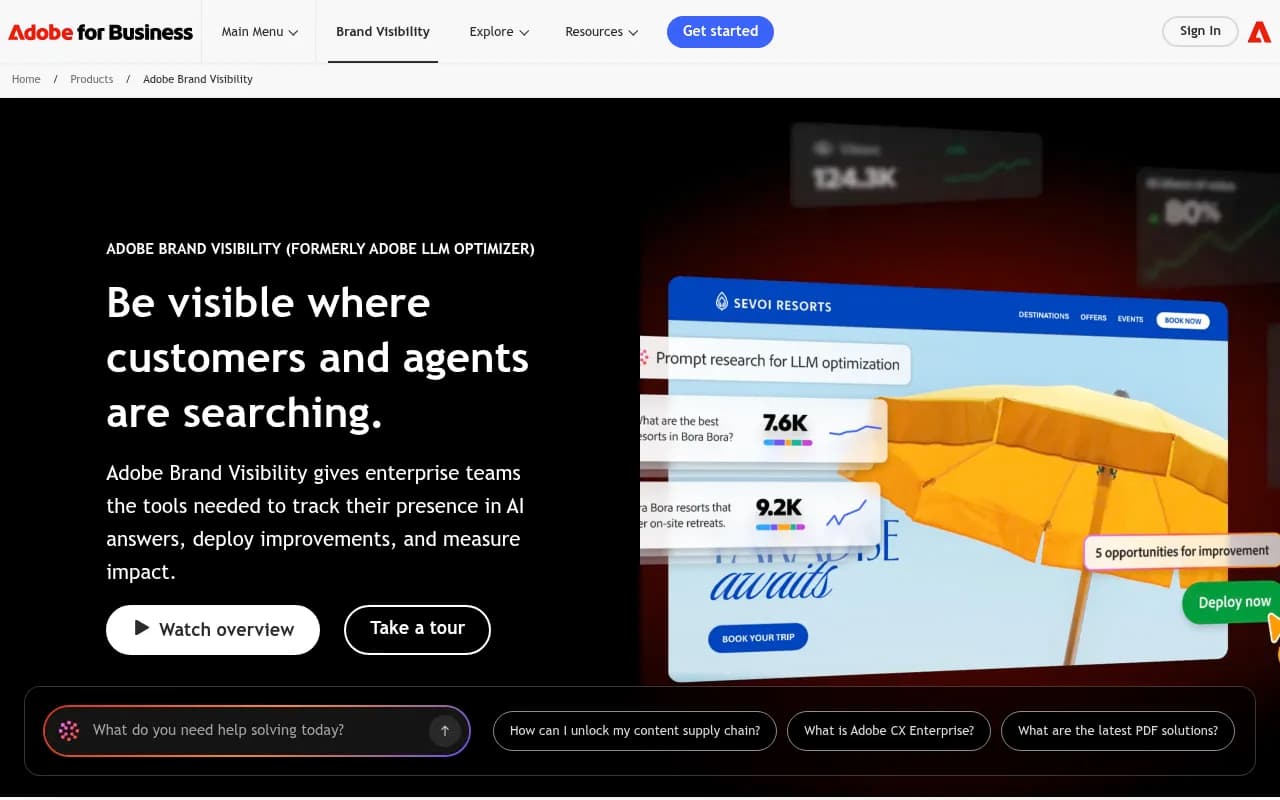
Other enterprise-oriented options with execution layers or suite integrations include:


For related lists, agenticseotools.com tracks tools that automate more of the execution.
A decision framework
Skip the vendor's pitch for a moment and answer these five questions.
1. How many people can act on insights each week?
If the answer is "two writers and a developer with free hours," self-serve or a platform with built-in agents can work. If the answer is "nobody," you need managed help or agentic execution, or the platform will be shelfware.
2. How many brands, markets and languages?
Enterprise scale changes the math. Dozens of brands across many countries need access controls, SSO, audit logs and API access, whichever model you pick. Check monitor structure too: a monitor's country and language should stay fixed so markets never mix in reporting.
3. What is the real bottleneck?
Name it. Is it knowing where you are invisible, producing the content, getting third-party mentions, or fixing the site so AI crawlers can read it? Software handles the first and parts of the second and fourth. People handle the third.
4. How much do you need to own the data?
Regulated industries and large procurement teams ask about ISO 27001, SOC 2, SSO, role-based access and data residency. Those requirements can rule out a vendor before features come up. Check them early.
5. What does success look like in 90 days?
A visibility score is a weak answer. Better ones: more citations on named prompts, fixed crawl errors, new comparison pages live, AI-referred sessions and conversions up. Promptwatch's 90-day GEO program guide is a useful template for setting those milestones.
Quick matching guide
| Your situation | Likely best fit |
|---|---|
| Small SEO team, tight budget, in-house writers | Self-serve platform with content tools |
| Mid-market brand, no content capacity | Platform with agents, or managed retainer |
| Global enterprise, many brands and markets | Enterprise platform plus agency or managed layer |
| Agency serving clients | Agency-tier platform with multi-project support |
| Need third-party placements fast | Managed outreach, measured by a platform you control |
| Local or multi-location brand | Platform with local targeting, plus local SEO support |
Questions to ask any vendor
Use this list in demos. It works for both models.
- Do you collect data from the real AI interfaces or only APIs? User-facing answers and citations can differ from API output.
- Can I export raw prompts, responses and citations?
- Which part of the work do you do, and which stays with my team? Get it in the contract.
- How do you show that a published page was crawled, cited and drove traffic?
- How is pricing metered: prompts, responses, credits, brands, or engines? What happens when I add a model or market?
- What happens to my data and content if I leave?
- Can you show a customer outcome with numbers, not just a visibility chart?
- Which compliance certifications do you hold, and can I see them?
For outcomes, Promptwatch's published case studies are an example of what to ask others for. Crisp reported 2x higher conversion rates from AI traffic than traditional channels, and TreeHouse grew AI search to about 25% of organic conversions. Whatever vendor you consider, ask for the equivalent.
Cost reality check
Rather than comparing a $295 plan to a $10K retainer, compare total cost to get one outcome.
For self-serve, add the platform fee, the hours of your own staff or freelancers who act on it, and any add-ons such as API access, SSO or extra engines. A $300 tool that needs 20 hours a week of senior time is not a $300 program.
For managed, add the retainer, the platform you need to verify their work, and the internal time spent reviewing and approving content.
For hybrid, price the platform tier that includes the agents or execution features, then decide whether you still need an agency for outreach. For reference, Promptwatch lists Professional at $245 a month and Business at $579 a month, with the Content Agent starting on Business. Confirm current figures on the pricing page before you budget.
A note on broader AI buying research
The voice AI comparison from Trillet makes an argument that carries over. It cites the 2025 MIT NANDA report, in which externally purchased tools and partnerships did better than internal builds in that sample. The same page is careful to say this does not prove managed always beats self-serve. I agree. The takeaway is to ask who owns implementation, workflow fit and measurement, not to compare rates alone.
How to run a fair pilot
- Pick 50 to 150 prompts across commercial, comparison and informational intent, in one or two priority markets.
- Record a baseline: mentions, citations, share of voice, crawl errors, AI-referred sessions.
- Run each candidate for 60 to 90 days with a named owner and a fixed weekly task list.
- Track which pages were published or refreshed, and whether they were crawled, cited and clicked.
- Compare cost per outcome, not cost per seat.
If you want a free starting point before committing, Promptwatch offers a free AI visibility report and a 7-day trial, and the free Agentic Readiness Check shows whether AI crawlers can read your site.
Bottom line
Pick self-serve if you have people who will act every week. Pick managed if you do not, and keep access to the data so you can check the work. Pick a hybrid if you operate at enterprise scale, and write the split of responsibility into the contract. In every case, the platform you choose should connect measurement to action, because content decays and the work never ends.