Key takeaways
- In a week of citations across ChatGPT, Claude, Perplexity, and Google AI Overviews, HTML took 99.94% and .md files took 0.05%. That is roughly 2,000 to 1.
- Profound's controlled test (381 pages, 3 weeks) found serving Markdown to bots produced a difference consistent with random noise.
- Markdown does matter for AI agents and coding tools that fetch documentation directly. That is a different channel from AI search.
- Skip .md mirrors of blog and marketing pages. Fix rendering, headings, and crawler access on your HTML pages first.
- If you run developer docs, serving Markdown is cheap and sensible. Cloudflare can do it on the fly.
The claim, and where it came from
For most of 2026 there has been a steady pitch in SEO circles: publish a clean .md copy of every page, and AI will cite you more. It sounds plausible. Markdown is lightweight, LLMs are fluent in it, and stripping out nav bars and scripts seems like a favor to the machine.
The data does not back it up. Promptwatch published a report called Markdown in AI Search (February 2026) looking at the last 7 days of citations from ChatGPT, Claude, Perplexity, and Google AI Overviews. Citation share by content format came out like this:
| Format | Share of citations |
|---|---|
| HTML | 99.94% |
| Markdown (.md) | 0.050% |
| Images | 0.015% |
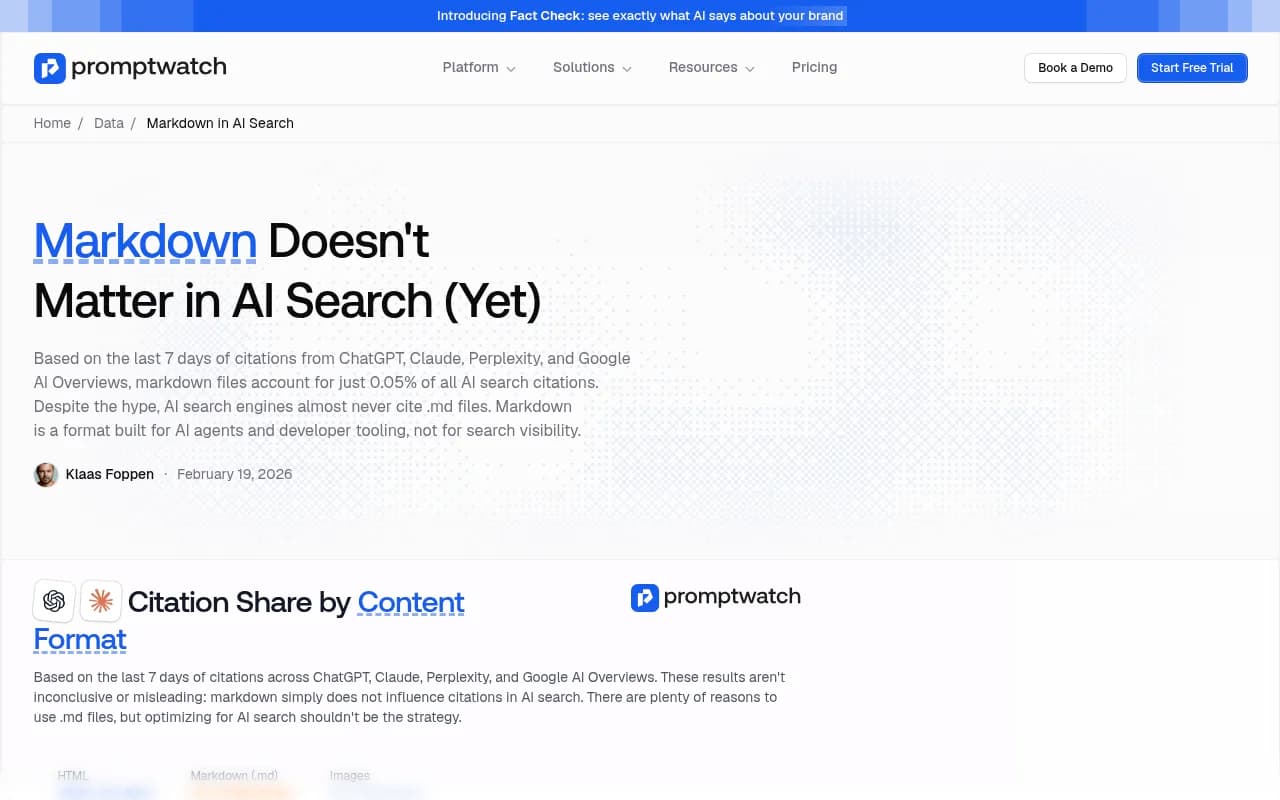
That works out to about two thousand HTML citations for every .md citation. The report's own conclusion is blunt: markdown simply does not influence citations in AI search.

A caveat worth keeping
This is one week of data, and it measures what got cited. It does not tell you every representation a system may have read before it chose a URL to cite. Publii's guide makes the same point. So read the number as strong evidence that .md files are not a citation lever, not as proof that no model ever touches Markdown along the way.
What the controlled experiment found
Citation share is observational. A cleaner test is to change what bots see and measure what happens. Profound did that in early 2026.
The setup: 381 pages across 6 sites, randomly split into a control group (189 pages, bots saw HTML) and a treatment group (192 pages, bots saw Markdown). Humans always saw HTML. The test ran January 19 to February 8, 2026, and tracked bots from OpenAI, Anthropic, Perplexity, Meta, and DuckAssistBot.
The results were underwhelming for the Markdown camp:
- The median Markdown page got about one extra bot visit over three weeks.
- The mean was roughly 16% higher, but that was driven by a few high-traffic pages in the tail. Profound says it is consistent with random noise.
- ChatGPT-User made up about 73 to 74% of bot traffic and was the only bot with a directional Markdown advantage (around +20%), which was not statistically significant.
- Gains of 40% or more would have been detected, so the "slam dunk" scenario is ruled out.
To be fair, Profound plans to re-run the test later in 2026, and this measured bot visits, not citations. But it points the same way as the citation data. Google's John Mueller has said LLMs "have trained on read-and-parsed normal web pages since the beginning," and Bing's Fabrice Canel has made a similar point. There was never a reason to expect models to need a special format for ordinary web content.

AI search is not the same thing as AI agents
This is where most of the confusion lives. Two quite different things get lumped together as "AI reading your site."
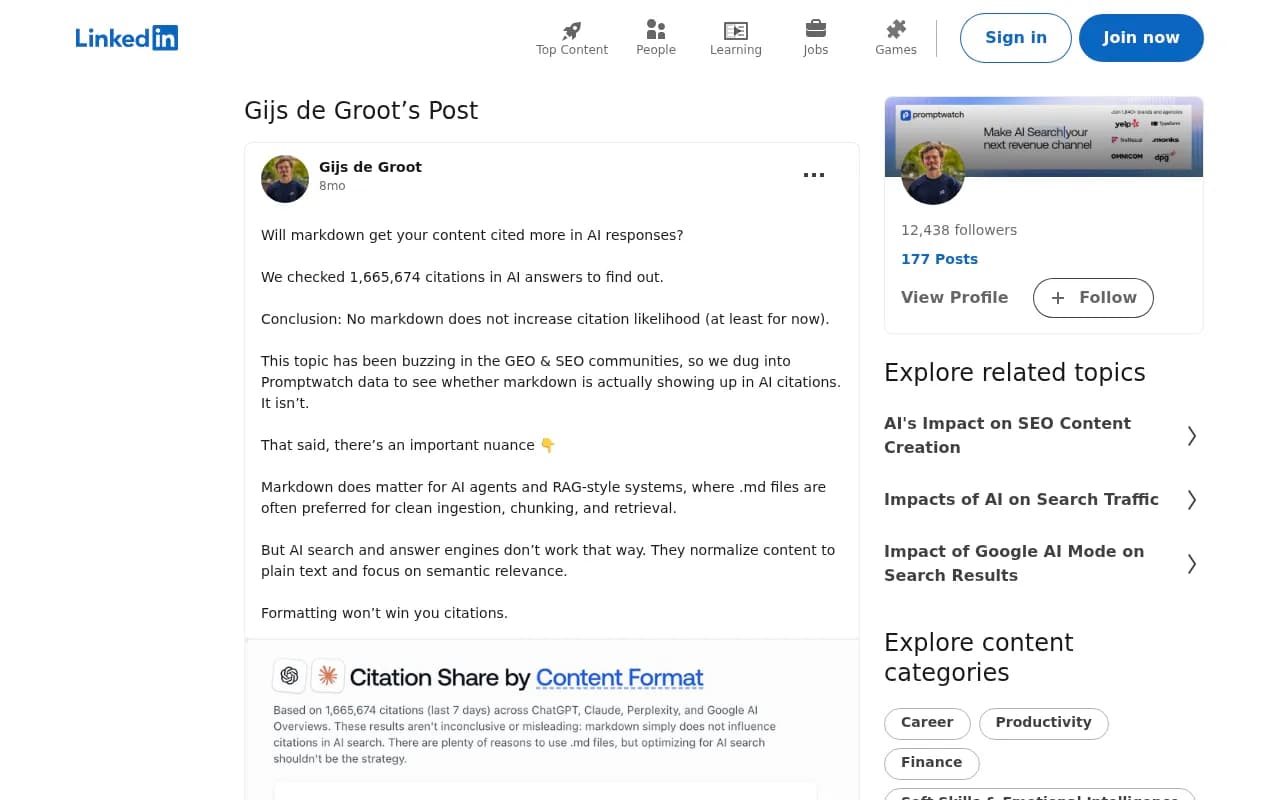
AI search and answer engines (ChatGPT Search, AI Overviews, Perplexity) retrieve rendered web pages, normalize them to text, and pick sources by semantic relevance. Formatting does not win citations. Gijs de Groot, Promptwatch's CEO, put it this way after checking 1,665,674 citations: markdown does not increase citation likelihood, at least for now.
AI agents and RAG-style systems are different. Coding assistants, research agents, and retrieval pipelines often prefer .md for clean ingestion, chunking, and retrieval. Promptwatch's report notes a big uptick in documentation crawling by Claude's bot (which powers Claude Code) and OpenAI's bot (powering Codex), with /docs/.../*.md paths among the most requested in its crawler logs. The top paths there had 3,241, 2,870, 1,934, and 1,512 requests.
So Markdown is not useless. It is just aimed at a different reader than the one most marketers care about. If you want to see which bots actually hit your pages, IP-verified AI crawler logs will show you, and the AI crawler traffic report gives a benchmark of what normal looks like.
What Google says
Google's guidance is the least ambiguous part. Markdown is not a supported file type for indexing, and Google does not use .md files as a ranking signal. You will occasionally see a markdown file surface in an AI Overview, and people read meaning into it. According to Google's John Mueller, that does not mean Google treats .md files any differently from other pages. It is a stray result, not a signal.
OpenAI, Anthropic, and Perplexity have not promised extra visibility for sites that publish Markdown either. Yet OpenAI's own developer docs, Mintlify, and Cloudflare all deliver Markdown for machine workflows. That is the tell: the people shipping it are doing it for tooling, not for rankings. (I did not verify the Google and OpenAI documentation pages directly for this guide, so check the current wording yourself before quoting them.)
When publishing Markdown makes sense
I would not tell anyone to never touch it. The honest answer depends on what kind of content you have.
| Content type | Publish .md? | Why |
|---|---|---|
| Blog posts and marketing pages | No | AI search cites HTML. No measurable payoff. |
| Product and landing pages | No | Product pages are among the most cited types, and they are cited as HTML. |
| Developer docs and API references | Yes | Coding agents fetch them directly and benefit from clean text. |
| Knowledge bases and help centers | Maybe | Worth it if agents or RAG tools consume them. |
| Internal docs and memory systems | Yes, internally | Markdown is a good working format. It is not a delivery layer. |
One analysis from Longato lands in the same place: use Markdown internally, where it is valuable for documentation and workflows, but do not treat it as a delivery layer for AI search.
The cheap way to serve Markdown if you do need it
If you run docs and want to serve agents well, you do not need to hand-maintain a second copy of every page. Content negotiation does it for you.
Cloudflare's Markdown for Agents converts HTML to Markdown on the fly when a client sends an Accept: text/markdown header. The response comes back with headers like these:
content-type: text/markdown
vary: accept
x-markdown-tokens: 725
content-signal: ai-train=yes, search=yes, ai-input=yes
It is available on Pro, Business, and Enterprise plans plus SSL for SaaS at no extra cost, per Cloudflare's documentation. Third-party sites claim token reductions of up to 80%, but I could not verify that from Cloudflare directly, so treat it as marketing until you measure your own pages. One Reddit user found a free-plan workaround using a Transform Rule that rewrites the query string to _fmt=md when the Accept header contains text/markdown. It is a hack, so test it before you rely on it.
The alternative is a static twin, like this:
https://example.com/guides/coffee-brewing/
https://example.com/guides/coffee-brewing.md
If you go that route, put the title, URL, and publish date at the top and keep headings, lists, links, tables, and code blocks intact. Publii's guide walks through this pattern, and static-site generators make it easy to emit.
Two cautions. First, keep the .md version identical in substance to the HTML, because mismatched copies create trust problems and duplicate-content headaches. Second, decide deliberately whether those files should be crawlable. If you do not want .md URLs competing with your canonical pages, point them at the HTML version or restrict them in robots.txt.
What to do instead for AI search visibility
The report's advice on where effort goes is the useful part. Here is how I would order it.
1. Make sure the HTML renders without JavaScript trouble
If your content depends on client-side rendering, retrieval systems may see an empty shell. A page that cannot be parsed loses citations because it is unreadable, not because it is not Markdown. Fix this before anything else.
2. Check that AI crawlers can reach you
Blocked bots, WAF rules, and robots.txt mistakes quietly kill visibility. The free Agentic Readiness Check and robots.txt generator for AI are quick places to start, and the AI bots directory lists 400+ crawlers.
3. Write pages that answer the question directly
Use a clear heading hierarchy, semantic markup, and a direct answer near the top. Promptwatch's data shows what gets cited: product pages lead ChatGPT citations at 22.4% (Sep 28 to Oct 4, 2026), followed by landing pages and listicles. Format on the page matters; file format does not.
4. Watch freshness by content type
According to Promptwatch's content half-life data, landing pages and docs stayed cited longest, while news lost half its pages within 36 days. That is a better use of your editing time than a .md mirror.
5. Look at citations on third-party sites too
Almost half of ChatGPT responses cite 10 or more unique domains (see the unique domains report), so you are competing for a spot among many sources, many of them not yours.
Tools for checking what AI actually does with your site
Opinions about Markdown are cheap. Logs and citation data are not. A few places to look:
| Need | Option |
|---|---|
| End-to-end AI visibility, crawler logs, and content fixes | Promptwatch |
| Enterprise AI visibility analytics | Profound |
| Basic prompt monitoring | Otterly.AI, Peec AI |
| Clean Markdown extraction from the live web | Firecrawl |
| Technical SEO at scale | Botify |
Promptwatch covers the loop that matters here: it shows which AI bots read a page, whether the page then gets cited, and whether it sends visitors. That lets you tell an access problem from a content problem, which is the thing a Markdown mirror would never answer. You can start with the free AI visibility report or the 7-day trial, and confirm current plans at promptwatch.com/pricing.



If you want to compare more options, the GEO software directory at bestgeosoftware.com lists the wider field.
A short decision checklist
- Do you run public developer docs or an API? Serve Markdown, ideally via content negotiation.
- Is your site mostly marketing pages and blog posts? Skip .md mirrors.
- Does your content render only after JavaScript runs? Fix that first.
- Have you checked crawler logs for GPTBot, ClaudeBot, PerplexityBot, and others? Do that before building anything new.
- Are you tempted by an llms.txt file? I did not verify the v2 proposal's specifics for this guide, so treat it as optional and low priority until there is citation evidence behind it.
The bottom line
Markdown is a fine format for machines that ask for it. It is just not a way to get cited in AI search. With HTML at 99.94% of citations, the sensible move is to spend your time making the pages AI already reads clearer, faster to parse, and worth citing, and to keep .md endpoints for the documentation that coding agents genuinely fetch.