Key takeaways
- Nudge, Yotpo Discover, and Anagram all chase the same problem: shoppers now ask ChatGPT, Gemini, and Perplexity for product recommendations before they ever touch Google, and brands need a way to show up and sell inside that conversation.
- Nudge positions itself as a full-funnel platform: AI visibility tracking plus SKU-level catalog optimization plus prompt-aligned shoppable funnels, aimed at enterprise retailers.
- Yotpo Discover leans on Yotpo's existing review and loyalty data (35,000+ commerce brands already run Yotpo) to feed AI agents that rewrite onsite content and activate authentic UGC, reporting a 16% lift in number-one product placements for customers like Aetrex.
- Anagram is the newest and least documented of the three, pitched around agentic commerce and AI shopping agent readiness rather than classic dashboard monitoring, so expect a steeper evaluation process and fewer public case studies.
- None of these tools replace a dedicated AI visibility and GEO platform for your whole brand; if you need cross-channel tracking beyond product catalogs, a tool like Promptwatch covers the broader GEO stack these commerce-specific tools don't touch.
Why this category even exists now
A year ago "AI visibility for ecommerce" meant someone on the SEO team manually typing product queries into ChatGPT and screenshotting the results. That doesn't scale once a catalog has more than a few hundred SKUs, and it definitely doesn't scale once checkout starts happening inside the chat window itself.
That second part matters more than most ecommerce teams realize. ChatGPT's Instant Checkout has been live since September 2025 and already serves 900 million weekly users, built on OpenAI's Agentic Commerce Protocol with Stripe, and adopted by Shopify, Instacart, DoorDash, and Etsy. When an AI assistant can complete a purchase without a product page ever loading, "ranking in AI answers" stops being a vanity metric and starts being a revenue channel. Adobe Analytics data from 2025 found AI-referred traffic converting 31% better than other channels, with 254% higher revenue per visit. That's the number every vendor pitch in this space leads with, and it's the reason three very different tools have all shown up claiming to solve it.
Nudge, Yotpo Discover, and Anagram approach the same opportunity from three different starting points: Nudge from catalog-level optimization infrastructure, Yotpo Discover from an existing reviews-and-loyalty data moat, and Anagram from the agentic commerce angle. Worth understanding before you sign anything.
What each platform actually does
Nudge
Nudge calls itself a full-funnel platform, and the term is doing real work in its marketing: it's drawing a line between tools that only tell you where you appear in AI answers and tools that also fix the underlying catalog data and build the shoppable surfaces those answers point to. Its own comparison research notes that citation volumes for the same brand can vary by as much as 615x across different tracking platforms, which is the argument Nudge uses for why multi-engine, SKU-level tracking has to be table stakes rather than a premium feature.
The stack covers AI engine tracking (ChatGPT, Perplexity, Google AI Overviews, Gemini, Claude, and others), SKU-level catalog optimization including structured data and FAQ schema remediation, and prompt-aligned shoppable funnels that try to convert the traffic once it lands. Nudge's own data point here is worth remembering if you're building a business case internally: pages carrying FAQ schema get cited roughly 2.7x more often, and structured data roughly triples GPT-4's product accuracy. Integrations run through Shopify, PIM, OMS, and CDP systems, which tells you this is built for teams with a real commerce tech stack behind them, not a scrappy DTC brand running everything through one Shopify theme.
Pricing is enterprise and custom-quoted, which fits the target customer: large retailers with catalogs big enough that manual schema fixes and prompt audits aren't realistic.
Yotpo Discover
Yotpo Discover is the newer product built on top of a platform that's been running reviews, loyalty, and SMS for over 35,000 commerce brands for years. That history is the actual pitch here, not a marketing flourish: Discover's agents work off real review text, loyalty program behavior, and UGC that Yotpo already has for any brand already on the platform, rather than starting from zero.
The product has three distinct agent types. An Onsite Agent identifies and acts on catalog-level visibility gaps. A Content Agent develops optimized content aimed at AI citation. An Activation Agent goes further upstream, engaging real reviewers and loyalty communities across Reddit, retail marketplaces, and publisher sites, on the theory that authentic third-party signals carry more weight with AI engines than brand-controlled content ever will. That third piece is the most differentiated part of the product, since most competitors in this space only touch onsite and content, not offsite reputation building.
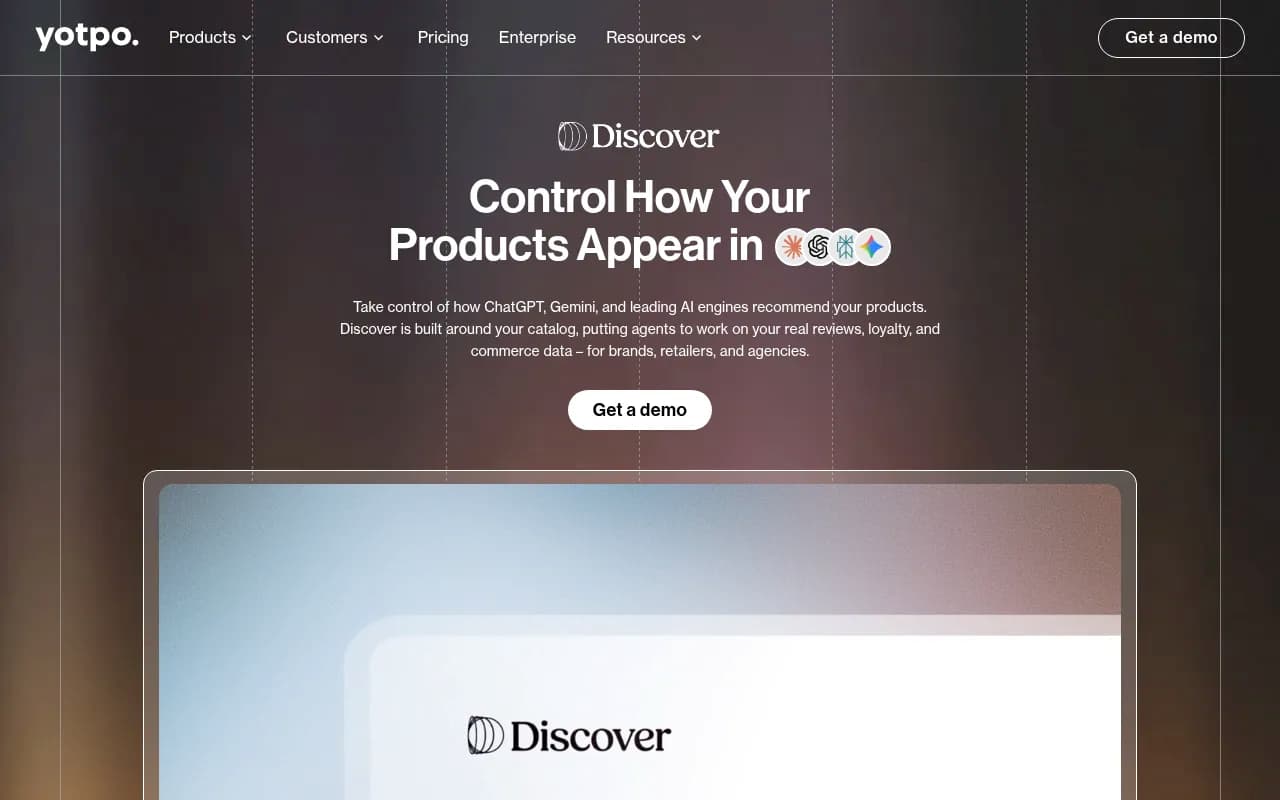
Reported results are specific and brand-named, which is more than most vendors in this category offer: Aetrex saw a 62% increase in number-one product placements in AI answers after rolling out Discover, and Pair Eyewear reported a 33% lift in awareness-stage shopper visibility. Yotpo's own marketing cites an aggregate 16% increase in top-slot placements and 20% awareness-stage visibility gain across its customer base. Discover is explicitly scoped to brands doing $10M+ in annual GMV for its initial release, with smaller brands directed to a waitlist. If you already run Yotpo Reviews, onboarding is near-instant since the catalog and tracking data are already connected.
Yotpo Discover
Anagram
Anagram is the hardest of the three to pin down with hard numbers, which is itself a useful signal if you're evaluating it: it's newer to the category and hasn't published the kind of brand-named case studies that Yotpo and Nudge lean on. Its positioning sits closer to the agentic commerce side of this market, which is a meaningfully different bet than pure visibility tracking. Instead of asking "how do we rank in AI answers," the agentic commerce framing asks "is our catalog structured so an AI shopping agent can transact against it at all," which includes things like feed formatting for the Agentic Commerce Protocol, checkout-ready product data, and machine-readable policies that an autonomous agent needs before it will complete a purchase on a brand's behalf.
That's a real and growing need. It's just one that's much harder to evaluate from the outside right now, since there isn't a deep public comparison dataset the way there is for Nudge and Yotpo Discover. If Anagram is on your shortlist, push hard in the sales process for specific, dated customer results rather than aggregate claims, and ask directly how its data compares against a tool like Nudge or Alhena AI on the same brand.
Head-to-head comparison
| Platform | Core approach | AI engines tracked | Catalog/SKU optimization | Shoppable funnels or agents | Data foundation | Best fit |
|---|---|---|---|---|---|---|
| Nudge | Full-funnel visibility + optimization + conversion | ChatGPT, Perplexity, Google AI Overviews, Gemini, Claude, more | Yes, SKU-level, structured data and schema | Yes, prompt-aligned shoppable funnels | Catalog, PIM, OMS, CDP integrations | Enterprise retailers with complex commerce stacks |
| Yotpo Discover | UGC and loyalty-powered AI agents | ChatGPT, Gemini, Claude, Perplexity | Yes, via Onsite and Content Agents | Partial, via onsite optimization rather than checkout funnels | Existing reviews, loyalty, and UGC data from 35,000+ brands | Brands already on Yotpo, $10M+ GMV, DTC and omnichannel |
| Anagram | Agentic commerce readiness | Not publicly documented in detail | Catalog/feed readiness for AI agents (positioning, not confirmed depth) | Framed around agent-executed transactions rather than funnels | Limited public documentation | Teams specifically preparing for agent-driven checkout, with lower certainty on fit |
If you're also weighing adjacent categories, Alhena AI tracks AI shopping assistant visibility on Shopify and Klaviyo specifically, and Passionfruit syncs AEO and GEO tracking with commerce analytics for mid-market DTC brands. Neither is a direct substitute for the three above, but both show up on the same shortlists.

What actually moves the needle regardless of which tool you pick
The platform comparisons matter less than most vendor decks suggest, because the underlying levers that drive AI citations are mostly the same no matter which tool is pulling them:
- Structured data and schema markup on product pages. Nudge's research cites a roughly 3x improvement in GPT-4's product accuracy when structured data is present, and that's consistent with what most GEO research finds across categories, not just ecommerce.
- FAQ schema specifically. Pages that carry it see about 2.7x more AI citations in Nudge's data, likely because FAQ blocks map almost directly onto how a shopper phrases a question to ChatGPT.
- Product feed accuracy for the platform doing the recommending. Google AI Overviews and Gemini both lean on Google Merchant Center feed quality; a stale or incomplete feed shows up as a worse recommendation regardless of how good your actual product is.
- Authentic third-party signal, not brand copy. This is Yotpo Discover's whole argument, and it's hard to disagree with: AI engines increasingly weight real reviews and community discussion over polished marketing pages when deciding what to cite.
| AI engine | What drives commerce visibility there | Notable behavior |
|---|---|---|
| ChatGPT | Product feed accuracy, Agentic Commerce Protocol integration, structured data | Rarely cites YouTube (under 1% of the time); strongly prioritizes verifiable product data over narrative content |
| Perplexity | Shopping tab with real-time product results, citation strength | Especially important for brands in competitive, comparison-heavy categories |
| Google AI Overviews | Semantic URLs, structured data, Merchant feed quality | Clicks on traditional organic results drop from roughly 15% to 8% once an AI summary appears above them |
| Gemini | Google Merchant Center feed hygiene, product schema | Feed quality has a direct, measurable effect on which products Gemini recommends |
If you want a read on how AI engines are citing content more broadly, not just in commerce, Promptwatch's citation share data for ChatGPT and Google AI Overviews is worth a look since product-page citations have been climbing across both surfaces through mid-2026.

How to choose
Start with what's already true about your business, not the feature list.
If you're a $10M+ GMV brand already running Yotpo Reviews, Discover is close to a free upgrade in terms of setup effort, since the catalog and review data are already wired in. The Activation Agent's offsite reputation work is genuinely different from what Nudge or Anagram offer, and if your brand's biggest gap is a lack of authentic third-party mentions rather than broken schema, that's the deciding factor.
If you're a large retailer with a real PIM, OMS, and CDP stack, and your problem is fragmented catalog data across thousands of SKUs rather than a lack of reviews, Nudge's enterprise positioning and SKU-level remediation tools fit that operational reality better. The custom pricing reflects a longer sales and implementation cycle, so budget accordingly.
If agentic checkout readiness, not visibility tracking, is the actual question keeping you up at night, Anagram's positioning is relevant, but go in demanding specifics. Ask for a named customer, a dated result, and a direct explanation of how its catalog readiness work differs from what Nudge or a feed-optimization tool like Algolia already covers. A vendor with limited public proof isn't automatically a bad choice, it just means you're doing more of the diligence work yourself.
And regardless of which of the three you pick, none of them replace a broader AI visibility layer across your whole brand, including non-commerce content, press mentions, and Reddit or YouTube citations. For that broader picture, a dedicated GEO platform fills the gap these commerce-specific tools leave open. If you're building out that evaluation, the GEO software directory at bestgeosoftware.com is a reasonable place to see how the broader category stacks up against the ecommerce-specific players covered here.