Key takeaways
- Most AI visibility platforms either track your brand mentions OR generate content -- very few do both well in a single workflow
- Promptwatch is the only platform in this comparison rated as a "Leader" across monitoring, content generation, and attribution -- it's the closest thing to a full-stack GEO tool
- AirOps is strong for content workflows but is not a visibility monitoring tool -- it's a content operations platform that happens to care about AI search
- Omnia positions itself as a Promptwatch alternative with tighter diagnostic guidance, but has a narrower feature set overall
- Searchable is a niche player with limited public documentation; it's hard to recommend without clearer pricing and feature transparency
The pitch sounds the same from every vendor right now: "Track your AI visibility and generate content to improve it." But when you actually sit down with these platforms, the gaps become obvious fast. Some are dashboards with a content tab bolted on. Others are content tools that added a monitoring widget. Very few have built the full loop -- find the gap, create the content, track the result.
This guide breaks down four platforms that all claim to sit in that "AI visibility + content generation" category: Omnia, Promptwatch, AirOps, and Searchable. I'll be direct about what each one actually does well, where it falls short, and which type of team should be using it.
What "AI visibility with content generation" actually means
Before comparing tools, it's worth being precise about what we're evaluating. A platform that genuinely combines AI visibility and content generation needs to do three things:
- Show you which prompts your competitors are winning that you're not
- Help you understand why you're not appearing (missing content, wrong framing, no citations)
- Generate content that's specifically designed to close those gaps -- not generic SEO articles
That third point is where most platforms fail. Generating content is easy. Generating content that's grounded in actual prompt data, citation patterns, and competitor analysis is much harder. The difference between the two is whether your new article actually gets cited by ChatGPT or just sits on your blog.
Promptwatch: the full-stack option
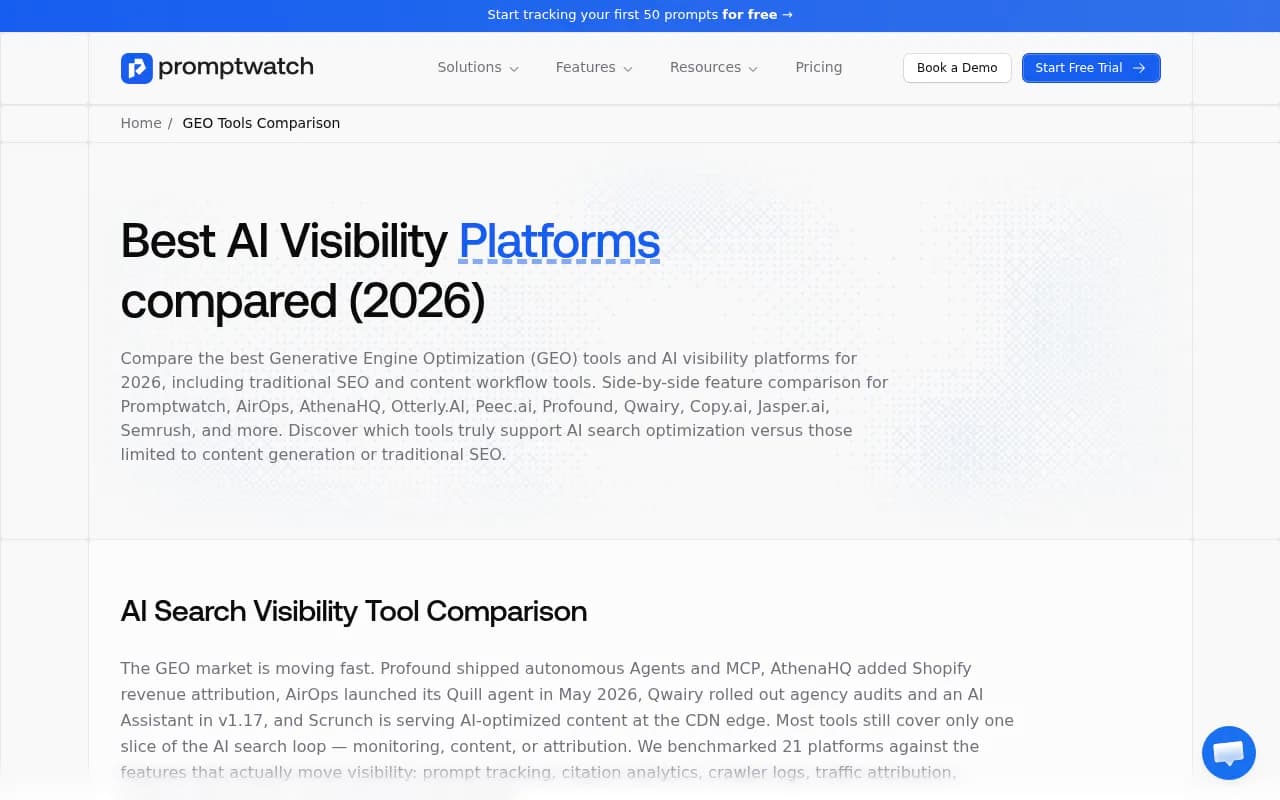
Promptwatch is the most complete platform in this comparison. It monitors 10 AI models (ChatGPT, Perplexity, Claude, Gemini, Google AI Overviews, Google AI Mode, Grok, DeepSeek, Copilot, Mistral), tracks citations at the page level, and has a content generation layer that's actually connected to the monitoring data.
The thing that separates Promptwatch from most competitors is what happens after you see the data. The Answer Gap Analysis shows you exactly which prompts your competitors are appearing for that you're not. That's not unusual -- a few platforms do this. What's unusual is that Promptwatch then lets you generate content directly from those gaps, using real prompt volumes, citation patterns, competitor analysis, and your own brand guidelines as inputs.
The Content Agents produce articles, listicles, and comparisons that are engineered to answer specific AI queries -- not just optimized for keywords. There's a meaningful difference there. An article written to rank in Google is structured around keyword density and backlinks. An article written to be cited by ChatGPT needs to directly answer the question, cite credible sources, and match the framing that AI models already use in their responses.
Promptwatch also has AI Crawler Logs (called Agent Analytics), which show you in real time when ChatGPT, Claude, or Perplexity crawls your pages, what errors they hit, and how long it takes for a crawled page to start getting cited. That's a capability most competitors don't have at all, and it's genuinely useful for diagnosing why content isn't getting picked up.
A few other things worth noting: Reddit and YouTube citation tracking (so you can see which third-party discussions are driving AI recommendations), ChatGPT Shopping tracking, and offsite citation analysis. These aren't features you'd expect to find bundled together at this price point.
Pricing runs from $99/month (Essential, 1 site, 50 prompts) to $579/month (Business, 5 sites, 350 prompts, 30 articles/month). There's a free trial.
Where Promptwatch gets harder to defend is at scale. The prompt caps are real -- 50 prompts on the entry plan is limiting if you're in a competitive category with dozens of relevant queries. Moving from Essential to Professional ($249/month) to Business ($579/month) can happen faster than expected as your prompt list grows. That's a legitimate concern for growth teams.
Omnia: tighter diagnostic guidance, narrower feature set
Omnia markets itself directly as a Promptwatch alternative, and it's honest about what it's trying to fix. The core argument is that Promptwatch shows you data but doesn't always tell you what to do about it -- Omnia claims to provide more prescriptive guidance on why you're losing specific prompts and what actions to take.
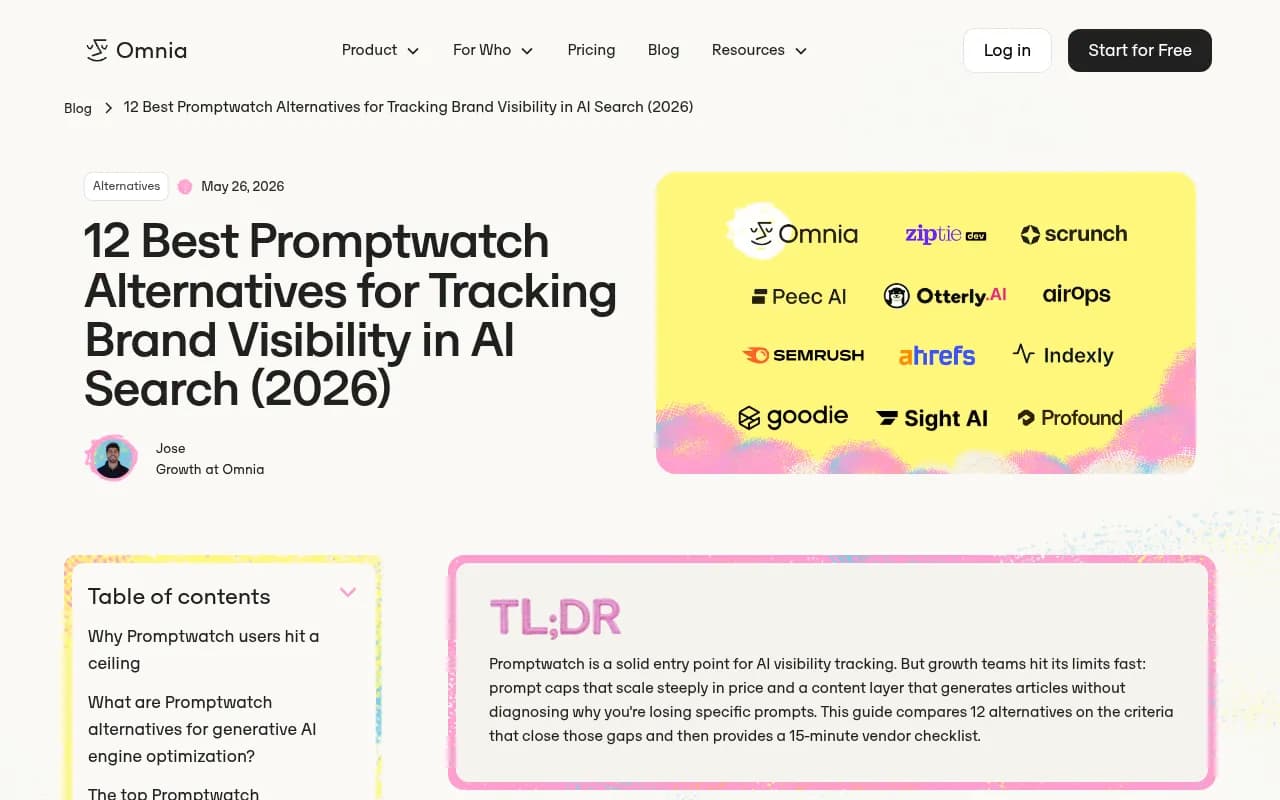
From what's publicly available, Omnia does URL-level citation intelligence, geo-by-country tracking, and prompt-to-outcome mapping. The diagnostic layer is positioned as more actionable than a standard visibility dashboard -- rather than just showing you that a competitor appears for "best project management software," it tries to explain the specific content gap that's causing you to lose that prompt.
That's a compelling pitch, and for teams that find data-heavy dashboards overwhelming, a more prescriptive tool could genuinely be more useful. The question is whether the feature set holds up at scale.
What Omnia doesn't appear to have (based on available information): AI crawler logs, ChatGPT Shopping tracking, Reddit/YouTube citation analysis, or the same breadth of AI model coverage as Promptwatch. It's a narrower tool, which can be a feature if you want simplicity, but becomes a limitation if your use case grows.
For a smaller team or a brand just getting started with GEO, Omnia is worth evaluating. For a team that needs the full stack -- monitoring, content generation, crawler diagnostics, attribution -- it's probably not enough on its own.
AirOps: content operations, not visibility monitoring
AirOps is a different kind of tool, and it's important to understand that before comparing it directly to Promptwatch or Omnia. AirOps is primarily a content workflow platform. It helps teams build AI-powered content pipelines -- automating research, drafting, and publishing at scale.
In May 2026, AirOps launched its Quill agent, which is designed specifically for AI search optimization. Quill can generate content that's intended to rank in AI search results, and AirOps has been building out features that connect content creation to AI visibility outcomes. So it's moving in the right direction.
But AirOps doesn't monitor AI search results. It doesn't show you where your brand appears in ChatGPT or Perplexity responses. It doesn't track citations, crawler activity, or prompt-level visibility. If you want to know whether your content is actually getting cited by AI models, AirOps can't tell you that -- you'd need a separate monitoring tool.
What AirOps does well: content at scale. If you have a clear content strategy and need to execute it efficiently across a large site, AirOps's workflow automation is genuinely powerful. Teams that already know what content they need to create (because they've done the gap analysis elsewhere) can use AirOps to produce it faster.
The practical use case is a combination: use Promptwatch (or another monitoring tool) to identify gaps, then use AirOps to scale content production. That's a reasonable stack, but it means you're paying for two tools and managing two workflows.
For teams that want a single platform that does both monitoring and content generation, AirOps isn't that platform -- at least not yet.
Searchable: limited transparency, hard to evaluate
Searchable is the hardest platform in this comparison to assess fairly, because public information about its features, pricing, and capabilities is sparse. It appears in some roundups of AI visibility tools, but detailed feature breakdowns are difficult to find.
From what's available, Searchable focuses on AI search monitoring with some content optimization features. It's positioned as a niche player rather than a full-stack solution.
The honest answer is: without clearer pricing, feature documentation, and case studies, it's difficult to recommend Searchable over more established platforms. If you're evaluating it, ask specifically about: which AI models it monitors, whether it has crawler log access, what the content generation workflow looks like, and how it attributes AI traffic to revenue. Those questions will quickly reveal whether it's a fit.
Feature comparison: what each platform actually covers
| Feature | Promptwatch | Omnia | AirOps | Searchable |
|---|---|---|---|---|
| AI model monitoring | 10 models | Multiple (exact count unclear) | None | Limited |
| Prompt/citation tracking | Yes | Yes | No | Partial |
| Answer gap analysis | Yes | Yes (more prescriptive) | No | Unknown |
| Content generation | Yes (Content Agents) | Yes | Yes (core feature) | Partial |
| AI crawler logs | Yes | No | No | No |
| Reddit/YouTube tracking | Yes | No | No | No |
| ChatGPT Shopping tracking | Yes | No | No | No |
| Traffic attribution | Yes | Unknown | No | Unknown |
| Page-level visibility | Yes | Unknown | No | Unknown |
| Multi-language/region | Yes | Yes | Partial | Unknown |
| Pricing transparency | Clear | Partial | Clear | Limited |
| Free trial | Yes | Yes | Yes | Unknown |
Who should use which platform
The right answer depends almost entirely on what stage you're at and what problem you're actually trying to solve.
If you want one platform that does everything
Promptwatch is the obvious choice. It's the only platform here that genuinely covers the full loop: monitoring, gap analysis, content generation, crawler diagnostics, and attribution. The prompt caps are a real consideration, but for most marketing teams, the Professional plan ($249/month) covers enough ground to get meaningful results.
If you want more prescriptive guidance and a simpler interface
Omnia is worth a look, particularly if your team finds data-heavy dashboards hard to act on. The diagnostic framing -- "here's exactly why you're losing this prompt and what to do about it" -- is genuinely useful for teams that are newer to GEO. Just go in knowing you'll likely need additional tools as your program matures.
If you already know your content gaps and need to scale production
AirOps makes sense as part of a larger stack. Pair it with a monitoring tool, use AirOps to execute content at volume. The Quill agent is a real step toward AI-search-aware content generation, and the workflow automation is strong. But don't buy AirOps expecting it to replace a visibility monitoring platform.
If you're evaluating Searchable
Ask hard questions before committing. The lack of public documentation is a yellow flag. Request a demo, get specific answers about model coverage and attribution, and compare the output against what you'd get from a more established platform.
The content generation question: does it actually work?
This is the part of every AI visibility platform pitch that deserves the most scrutiny. Generating content is easy. Generating content that gets cited by AI models is not.
The key variables are: whether the content generation is grounded in real prompt data (not just keywords), whether it incorporates citation patterns from actual AI responses, and whether there's a feedback loop that shows you when new content starts getting picked up.
Promptwatch's Content Agents are the most tightly integrated with monitoring data in this comparison. The articles are generated using prompt volumes, citation data, competitor analysis, and brand guidelines -- so there's a reasonable argument that the output is more likely to match what AI models are already looking for. The Agent Analytics feature closes the loop by showing you when a crawled page moves to citation status.
AirOps's Quill agent is newer and more focused on content quality and workflow than on citation-specific optimization. It's a strong content tool, but the connection to actual AI citation behavior is less direct.
Omnia's content generation is positioned around the diagnostic layer -- you understand the gap first, then create content to fill it. That's a sound approach, but the feature set appears less mature than Promptwatch's.
The honest answer is that no platform can guarantee AI citations. What the better platforms can do is give you content that's structurally more likely to be cited -- because it's answering the right questions, in the right format, with the right supporting evidence. That's meaningfully better than generic AI content, but it's not a guarantee.
A practical evaluation checklist
If you're running a vendor evaluation, these are the questions that will separate real capabilities from marketing copy:
- Which specific AI models do you monitor, and how? (API vs. real user interface matters -- API outputs can differ from what users actually see)
- Can you show me page-level citation data for a specific URL?
- Do you have AI crawler logs? Can I see when ChatGPT last crawled my site?
- How does content generation connect to monitoring data? Walk me through the workflow.
- Can I see traffic attribution from AI search to actual conversions?
- What's the prompt cap at each pricing tier, and how does it scale?
- Do you track Reddit, YouTube, or other third-party citation sources?
Any platform that can answer all of those questions with specific, demonstrable features is worth serious consideration. Most will stumble on crawler logs, attribution, or the connection between content generation and monitoring data.
Bottom line
The AI visibility market in 2026 is crowded with tools that do one thing well and call it a full solution. Omnia, AirOps, and Searchable each have genuine strengths -- but none of them cover the full loop that a mature GEO program needs.
Promptwatch is the only platform in this comparison that does. That's not a knock on the others; it's just an accurate description of where the market is. If you're serious about AI search visibility and want monitoring, content generation, crawler diagnostics, and attribution in one place, Promptwatch is the starting point for your evaluation.
If you have specific constraints -- budget, team size, a need for simpler interfaces, or a workflow that's already built around content operations -- then Omnia or AirOps may fit better as part of a broader stack. Just be clear-eyed about what each tool actually covers before you commit.