Key Takeaways
- In ChatGPT, product pages hold the highest peak citation share: about 33% on average in July 2026, slipping to 22.4% by the Sep 28 to Oct 4 window (Promptwatch Data).
- Listicles are the contested format. Promptwatch sees them flat at 10 to 14% in ChatGPT and down from about 26% to 18% in Google AI Overviews. Otterly and Seer report very different numbers because they classify and sample differently.
- How-tos are the rising format: from about 4% in July to roughly 10% at the end of August in ChatGPT, and 15.1% in AI Overviews.
- News has the lowest peak and the shortest life. It sits at 5 to 6% in ChatGPT and loses half its cited pages within 36 days.
- Peak rate and staying power are different questions. Pick a format based on both.
Why "peak citation rate" is the wrong question on its own
Most articles on this topic crown one format and move on. "Listicles win." "Product pages win." Then you open a second study and it says the opposite.
I think the disagreement is the real story. Citation share depends on which engine you measure, which prompts you run, how you label a page as a "listicle," and which month you look at. So this guide uses one primary dataset, Promptwatch Data, for the numbers, and treats the third-party studies as a check on it, not a replacement.

Three things to keep in mind while reading:
- Peak means the highest share a format reached in the period measured, not an all-time record.
- Share means a format's slice of all classified citations, not the chance that one page gets cited.
- Engine matters. ChatGPT and Google AI Overviews rank these formats differently.
The numbers at a glance
Here are the peaks and averages from Promptwatch Data across the 2026 reports, side by side.
| Content type | ChatGPT peak or average (2026) | Google AI Overviews (July 2026) | Trend |
|---|---|---|---|
| Product pages | 32.8% avg in July; 28.7% avg in August; 22.4% Sep 28 to Oct 4 | 16.3% avg, 17.9% at month end | Peaked July in ChatGPT, rising in AIO |
| Listicles | 9.7% avg in July; 10.1% in August; 13.6% Sep 28 to Oct 4 | 18.0% avg (about 26% in Q1) | Flat in ChatGPT, falling in AIO |
| How-tos | 4.1% in July; 6.3% in August; 8.7% Sep 28 to Oct 4 | 15.1% avg | Rising |
| News | 5.2% in July; 5.6% in August; 5.7% Sep 28 to Oct 4 | 13.5% avg | Flat |
Sources: Promptwatch Data on ChatGPT citation types, July 2026, August 2026, ChatGPT citation share by content type, and AI Overviews citation types, July 2026.
Note the second ChatGPT column mixes monthly averages and a one-week window, so don't read it as a perfectly smooth line. The direction is what matters.
Product pages: the highest peak, and it is already fading
Product pages are the biggest single format in ChatGPT. In July 2026 they averaged 32.8% of citations, up from about 18% in March. They held around 30% until August 22, then fell to about 25% late in the month. In the Sep 28 to Oct 4 window they were at 22.4%.
They are still number one, though. Promptwatch's content-type report shows product pages are the top type for all three prompt intents:
- Commercial prompts: 26.0%
- Branded prompts: 23.3%
- Informational prompts: 19.1%
Landing pages sit right behind at 16.8% overall, so about 39% of ChatGPT citations go to pages describing what a company sells. That should change how you read the "listicles dominate" headlines. A lot of the citation volume goes to the vendor's own pages.
In Google AI Overviews, the story runs the other way. Product pages were about 9% in January and have nearly doubled. From July 28 they were the most cited format every day, ending the month at 17.9% against 16.2% for listicles. It was the first time listicles lost the top spot there.
How long product page citations last
Product pages, reviews and how-tos reach their citation half-life after 74 to 77 days. After 60 days, 55% of them are still being cited. That is decent, though landing pages (69% at day 60) and docs (67%) do better.
Pricing pages count as landing or product pages in this data, so a clean pricing page is probably the cheapest thing on this list to fix.
Listicles: everyone's favorite argument
This is where the research collides. Here is what each source says.
| Source | Listicle finding | What it measured |
|---|---|---|
| Promptwatch Data | 10 to 14% of ChatGPT citations; 18% of AIO in July, down from about 26% in Q1 | Citation types across tracked prompts |
| Seer Interactive | 16.6% of 2M ChatGPT citations; down 30% from Dec 2025 to Jan 2026 | URLs containing "best" or "top" |
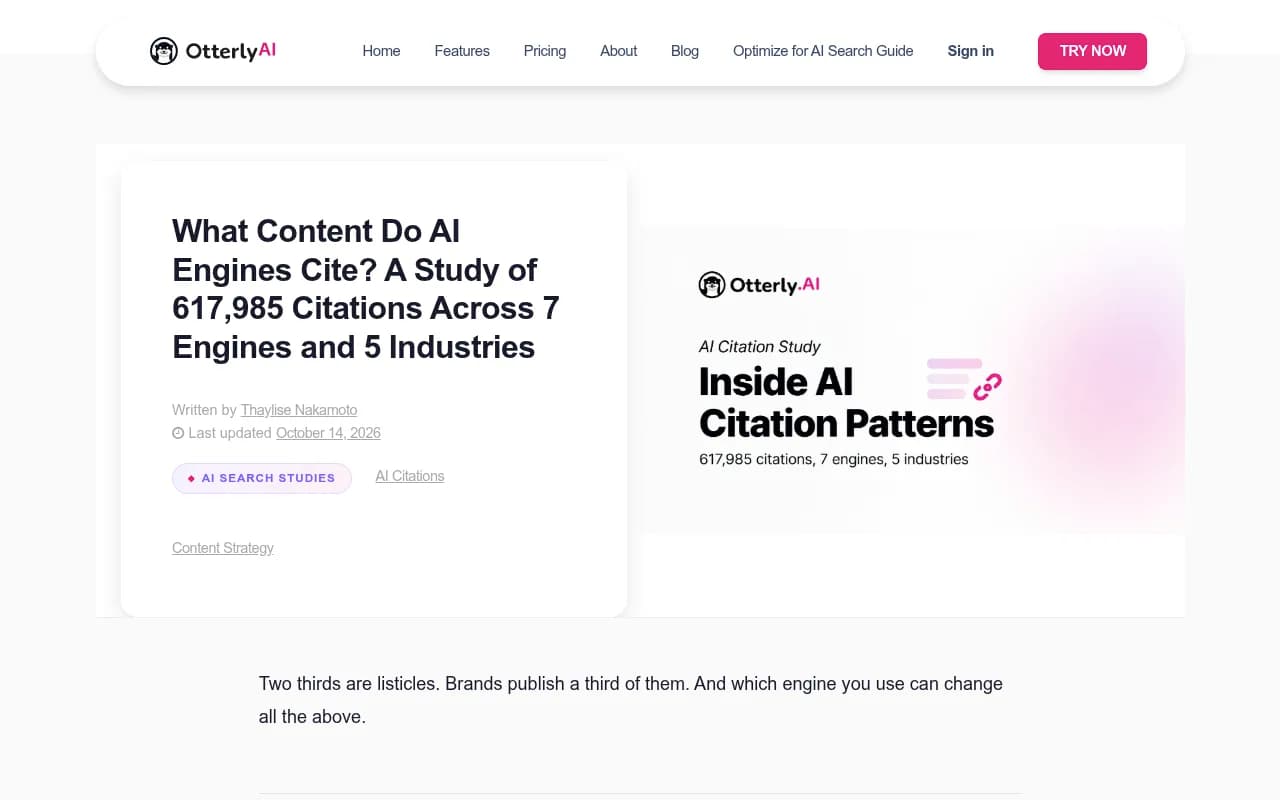
| Otterly | 66.6% of classified citations across seven engines | September 2026, five industries, ranking-style prompts |
| Wix Studio (via HubSpot) | 21.9% of all citations, 40.86% on commercial queries | Cross-engine, 75,000 answers |
| Fractl with Ahrefs Brand Radar | about 20% | Marketing and SEO queries |
That is a spread from 10% to 66%. They cannot all be describing the same thing.
The Otterly study is honest about its own caveat. Its prompt sets are built around buying questions: 295 of 400 prompts contain words like "best", "top" or "cheapest." When the prompt asks for a ranking, 73.2% of cited pages are listicles. For open-ended questions that drops to 55.2%, and how-to guides climb from 3.6% to 11%. So the prompt shape drives the result as much as the engine does.
Seer's method has its own quirk. It labels any URL containing "best" or "top" as a listicle, which is a narrow definition. Its useful finding is directional: 13 of 16 industries saw ChatGPT listicle rates fall, and Wikipedia and Reddit picked up some of the share. Worth remembering that Reddit's share of ChatGPT citations then collapsed on August 14, 2026.
My read: listicles are a format AI uses heavily when someone asks "which should I pick," but they are not the runaway winner in the broad citation mix. If you track a prompt set full of "best X" queries, you will see them everywhere. If you track informational prompts, you won't.
Listicle staying power
Listicles keep 60% of their cited pages at day 60 in ChatGPT, and Promptwatch estimates their half-life sits near or beyond 90 days. Profound's separate analysis of cross-engine citations puts comparisons, listicles and reviews in a "choose" family with a 29-day median half-life, the longest of its four families. The two numbers measure different things, but both say listicles outlast news.
How-tos: the quiet climber
How-to pages are the format I would watch. In ChatGPT they rose from 3.3% to 4.3% during July, then from 4.3% to 9.1% over the last nine days of August, reaching about 10% at month end, level with listicles. In the Sep 28 to Oct 4 window they were at 8.7% of all citations and 10.7% of informational citations.
Documentation moved in the same direction: from 3.3% to 8.2% in late August. Both rose as landing pages fell from about 20% to under 12% in the same period. It looks like ChatGPT shifted some weight from sales pages toward explanatory ones.
In Google AI Overviews, how-tos were already strong at 15.1% in July. Fractl's Ahrefs Brand Radar analysis shows how-to and explainer guides at about 33% of citations on marketing and SEO queries, the largest format there. Again, the prompt mix is doing the work: that is a topic where people ask how to do things.
How-tos reach half-life at 74 to 77 days in ChatGPT, the same as product pages. They are not especially durable, but they are not fragile either.
News: lowest peak, shortest life
News is the format with the least upside in ChatGPT. It stayed flat at about 5 to 6% across July, August and the early October window. In AI Overviews it does better at 13.5%.
The real issue is decay. From Promptwatch's content half-life report, which tracked every page ChatGPT cited on July 6, 2026 for 90 days:
- Almost a quarter of news pages are never cited again after day 0.
- Half of news pages are gone after 36 days.
- 41% are still cited at day 60.
- 77% of news pages get cited again after day 0, versus 93% of docs.
Profound's data tells a matching story across engines: reporting content (news, announcements, research reports) had the lowest share still above half its peak at day 56, at 7.0%. Pages tied to a date or event fade first.
News is worth publishing if you want a burst of citations around an event. It is a poor bet as a durable citation asset.
Peak rate versus staying power
Putting the two views together:
| Format | Peak share in ChatGPT | Share of pages still cited at day 60 | Verdict |
|---|---|---|---|
| Product pages | Highest (about 33% in July) | 55% | Biggest volume, medium durability |
| Landing pages | 16.8% overall, about 20% earlier in August | 69% | Most durable of the sales formats |
| Listicles | 10 to 14% | 60% | Middle on both |
| How-tos | Up to about 10% | 55% | Growing, medium durability |
| News | 5 to 6% | 41% | Low peak, fast decay |
The day-60 figures are from Promptwatch's half-life report. Docs (67%) and comparisons (63%) round out the durable end.
What to do with this
If you sell something
Fix your product and pricing pages first. They are the most cited format and the one AI uses for branded and commercial prompts alike. Keep them current, since freshness and structure show up as a pattern in the listicles that do grow, per Seer, and the same logic applies to any page type.
If you publish listicles
Stop treating them as a volume play. Otterly found 35.6% of cited listicles come from companies that sell in the category, so self-published lists work, but Seer's data suggests the self-serving, thin version is losing ground. Original evidence helps: the Masset guide argues that real customer quotes and scored data are what make a list worth citing.
If you want a format with momentum
Build how-to and docs content tied to the questions your buyers ask. The rise from about 4% to about 10% of ChatGPT citations in two months is the fastest move in the data.
If you do news or PR
Plan for a short window. Publish into events, then pair the news with an evergreen page that will hold citations after day 36.
Why your own numbers will differ
The shares above are averages across large prompt sets. Your category will look different. Promptwatch's industry reports show it: healthcare citations skew to government sites, travel to booking and search sites, and automotive to marketplaces like Autotrader and Cars.com over any car brand. Check the software report if you sell software, where documentation and help centers earn the largest share.
Also keep ChatGPT's own behavior in mind. Average citations per response dropped around the GPT-5.3 rollout on March 4, 2026, and on August 8 ChatGPT started using the site: operator at scale. Format shares can shift when the engine changes how it searches.
How to track citation rate by type for your own site
You can do this by hand for a few prompts, but it gets old fast. Promptwatch's Citation Trends view classifies every citation into 22 content types and shows citation rate by type over time, so you can see whether your landing pages, product pages, listicles, news and how-tos are rising or fading in the engines you care about. Other tools in this space include Profound, Peec AI and Otterly.AI, which are mostly monitoring-focused. For a broader list, the GEO software directory at bestgeosoftware.com is a good place to compare.



My suggested routine is simple: pull citation share by content type monthly, note which of your pages are cited and which are not, and check the half-life of anything you publish for a launch. If a format drops for two months in a row, change what you produce.
Bottom line
Product pages have the highest peak in ChatGPT, but they peaked in July 2026 and have been sliding since. Listicles are steady, not dominant, in Promptwatch's data, even though other studies put them far higher. How-tos are the format gaining ground, and news is a short-lived burst. Build your durable base on product, landing and docs pages, add how-tos where buyers ask questions, and treat news as an event tool.