Key takeaways
- Earned media feeds AI answers, but it decays quickly. In Promptwatch Data, news pages lost half their ChatGPT citations within 36 days, while landing pages and docs lasted far longer.
- A PR agency is strongest at placements, roundups and reviews. A GEO agency is strongest at page rebuilds, crawler fixes and measurement. An in-house team is strongest at owned pages, product facts and speed.
- Most companies get the best result from a split: in-house owns the durable owned pages, an agency owns the third-party sources, and a tool measures both.
- Almost all agency pricing and results you will find online are vendor-authored. Treat them as claims to verify, not benchmarks.
- Run a 30-day tool baseline before hiring anyone. It shows which gaps your own team cannot close.
Why this question is suddenly a budget fight
For years, earned media belonged to PR, owned content belonged to SEO or content marketing, and nobody argued much about the border. AI search blurred it. When ChatGPT answers "what is the best tool for X", it pulls from your product pages, but also from listicles, reviews, news coverage and comparison pages written by other people.
So who owns that second group of sources? PR says it is theirs, because they pitch journalists. SEO says it is theirs, because it is a citation problem. A new class of GEO agencies says it is theirs, because they measure it. The CMO just wants to know who to pay.
I will say upfront that the honest answer is "it depends on what is actually missing", which is annoying but true. The rest of this guide tries to make that dependency concrete.
A note on sources. Most of what is published about this comparison comes from agencies selling the answer. One PR firm's "best agencies for AI visibility" list says its own order reflects editorial judgment, not measured performance. Its own testing found that half of the lists it could open were written by an agency that ranked itself first. Keep that in mind as you read any agency comparison, including the ones I quote below.
What AI actually cites, and what that means for ownership
Before deciding who owns what, look at which kinds of pages AI engines cite. Promptwatch Data covered ChatGPT citations from Sep 28 to Oct 4, 2026:
- Product pages were 22.4% of classified citations and landing pages 16.8%. That is about 39% going to pages describing what a company sells.
- Listicles were 13.6%, how-tos 8.7%, general articles 6.1%, comparisons 5.9% and news 5.7%.
- Documentation was 7.5%, FAQ pages 3.3% and reviews 1.7%.
Listicles, how-tos and comparisons together earn about 28%. Those are the formats that third-party roundups and earned media tend to supply. For commercial prompts, product pages, landing pages, listicles and comparisons add up to almost 70% of citations, and the report's advice is to get listed in the "best of" roundups ChatGPT cites for your category.
For branded prompts, reviews climb to 5.6%, more than three times their share across all prompts.
Read that as two buckets:
- Pages you control: product pages, landing pages, docs, FAQs, your own comparisons.
- Pages other people control: listicles, reviews, news, third-party how-tos.
The first bucket is a good fit for an in-house team. The second is where agencies earn their fee, if they earn it at all.
Earned news is a short burst
Here is the part that changes the budget math. In Promptwatch's content half-life study, pages ChatGPT cited on July 6, 2026 were tracked until October 4, 2026:
- News decays fastest. Almost a quarter of news pages were never cited again after day 0, half were gone after 36 days, and 41% were still cited at day 60.
- Landing pages and docs last longest. At 30 days, 78% of landing pages and 76% of docs were still cited. At 60 days, the figures were 69% and 67%.
- Comparisons held 72% after 30 days and 63% after 60.
- Product pages, reviews and how-tos sat at about 55% after 60 days, with half-lives of 74 to 77 days. Listicles were at 60% after 60 days.
So a press hit is a burst, not an asset. A placement in a durable roundup or a steady stream of reviews is worth more per dollar than a one-off news story, at least for AI citations. A PR agency measured purely on coverage volume can look great on a report and do little for AI answers three months later.
Social is a different story depending on the engine. Promptwatch's November 2026 social citations report (Oct 11 to Nov 9) found social platforms were 13.16% of AI Overviews citations, 1.94% of Perplexity's and 0.64% of ChatGPT's. YouTube alone was 6.71% of AI Overviews citations. Do not count on social posts to reach ChatGPT, but video and community work can matter for Google surfaces.
The three options, honestly described
Traditional PR agency
A PR agency earns coverage, rankings, expert quotes and research mentions. That is exactly the raw material AI tools read. Crackle PR, for example, argues that earned media is the primary signal and owned content plays a supporting role. It cites a figure that 89% of AI citations come from earned media (attributed to Muck Rack, 2025). I could not verify that number and it does not match the content-type data above, where owned-type pages dominate ChatGPT citations. Treat it as a pitch, not a fact.
What PR agencies do well: media relationships, narrative, getting named in third-party lists, reputation. What they often do not do: rewrite your pages, fix crawler access, or measure AI citations at the prompt level. Some have added those services, others have added a label.
Pricing varies widely. Crackle PR publishes a GEO plus PR retainer floor of $12K a month with a six-month minimum. 5W prices GEO programs at $15K to $75K a month, depending on scope. Both are the vendors' own figures.
GEO agency
A GEO agency changes the pages and the sources behind them: page rebuilds, structured content, crawler fixes, citation tracking, reporting. One comparison from 5W summarizes it as: agencies change the pages and the third-party sources, tools only report. A piece from Authority Tech frames the split differently, saying a traditional PR agency earns coverage for human readers while a GEO agency changes a company's own content so generative engines can retrieve it.
The quality range is huge. Nearly every SEO and content agency now lists AEO or GEO. Red flags from one agency guide are worth repeating: a site that added "GEO" this year with no published AI outcomes, and a pitch that leads with an "AI visibility score" that cannot be tied to pipeline. A score is an input. Ask what happened to demos or revenue.
Some GEO agencies, like Hamster Garage and Siege Media, lean on earned and partner coverage as well, so the line between GEO agency and PR agency is blurrier than the labels suggest.
In-house team
An in-house team knows the product, can fix pages the same day, and owns the facts AI should repeat. The weakness is reps. One agency guide made the point that the discipline is too new and moves too fast for a single in-house hire to have meaningful experience. That is a self-interested source, but the logic holds for a team of one.
Their other weakness is reach. A content marketer cannot call a journalist at a trade publication and get a feature. That is relationship work, and it takes years.
Decision table: who should own what
| Job | In-house team | PR agency | GEO agency |
|---|---|---|---|
| Product, landing and docs pages | Best fit | Rarely | Strong for rebuilds and briefs |
| Comparison pages on your own site | Best fit | No | Good for structure and gaps |
| Placement in third-party listicles and roundups | Slow | Strong | Varies, some do outreach |
| News coverage and expert quotes | Weak | Best fit | Weak |
| Reviews on trusted sites | Strong if disciplined | Some | Some |
| Crawler access and technical fixes | Good with dev support | No | Strong |
| Prompt-level tracking and reporting | Needs a tool | Often weak | Strong, if proven |
| Fact correction across sources | Owns the facts | Owns outreach | Maps where the wrong claim comes from |
| Speed on a product launch | Best | Medium | Medium |
What the split usually looks like
If you pushed me for a default, it would be this.
In-house owns the durable owned pages, because they last longest and depend on product knowledge. Someone senior on that team also owns the measurement, so the agency is accountable to numbers they cannot edit.
A PR agency owns third-party sources: roundups, reviews, expert commentary, research placements. Brief them on AI citations specifically, not just coverage count. Ask them to prioritize durable formats over news bursts.
A GEO agency, if you hire one, owns the gap analysis, the technical fixes and the page production that your team cannot staff. Ideally you hire this agency for a defined stretch and bring the maintenance in-house. The buyers who get the most from agencies, according to one guide, are the ones who can execute internally from an agency roadmap.
Plenty of companies will not need all three. A small SaaS company with a decent site and no media presence needs PR help more than GEO help. A large brand with strong press but broken product pages needs the opposite.
Which one for which situation
You have strong press coverage but AI barely mentions you
Check your owned pages and crawler access first. This is an in-house or GEO agency problem. A PR agency will add more press you already have.
AI mentions you but ranks competitors first in every listicle
You have a third-party source gap. Most of the value here is outreach to the roundups and review sites AI already cites in your category. PR agency, or a GEO agency with real outreach capability.
AI says wrong things about you
Find where the claim comes from. Sometimes it is your own old page, sometimes a stale third-party article. The fix is split: your team corrects owned pages, the agency requests updates elsewhere. Tools that track the individual claims AI makes help here.
You are early stage with one marketer
Do not sign a $12K to $75K a month retainer to find out you needed a better pricing page. Fix owned pages, collect reviews, and run a baseline. Then decide.
Enterprise with many markets
You probably need all three, plus governance. Decide a single owner for the measurement layer, or the agencies will each report their own numbers.
Measure first, hire second
The cheapest way to avoid hiring the wrong team is to find out where you actually stand. The 5W guide recommends a 30-day tool baseline, then hiring an agency only for the gaps your own team cannot close. It is the same company selling agency retainers, and it is still sensible advice.
What the baseline should answer:
- Which prompts do buyers ask, and do you appear?
- Which pages and domains does AI cite instead of you?
- Are those cited sources owned, third-party editorial, reviews or news?
- Can AI crawlers read your key pages?
- Does any of it send traffic and conversions?
Tools I would look at for the monitoring layer: Promptwatch covers prompt tracking across real AI interfaces, citation analysis, AI crawler logs and visitor analytics, and its Action Board and Content Agent help close the gaps your team can fix itself. Its free AI visibility report is a no-login way to get a first read.

Other monitoring options include Peec AI for lighter prompt tracking and Profound for enterprise analytics.


For outreach-heavy work, tools such as Respona handle link and mention outreach, and Otter PR is a PR agency in the catalog that sells guaranteed placements, which is a different model from retainer PR.

For more options, the GEO software directory lists tools by category.
Comparison of the measurement layer
| Option | Best for | What it will not do |
|---|---|---|
| Monitoring-only tracker | Cheap baseline, mention checks | Fix pages or publish content |
| End-to-end platform | Gap analysis, content, crawler data, traffic in one place | Replace media relationships |
| PR agency report | Coverage and placements | Show prompt-level AI citations |
| GEO agency report | Strategy and execution narrative | Be independent of the agency's own work |
How to vet any agency
Whatever you hire, ask the same questions.
- Who does the work? 5W points out that outsourced pieces add cost and delay. Ask who writes, who pitches and who builds pages.
- Show me AI-specific results from a client in my category, with the prompts tested and the dates. A case study with "39 of 40 answers" style claims is only useful if the method is stated, and those numbers are self-reported.
- How does the plan treat news versus durable formats? If everything is a press release, be wary.
- How will you tie visibility to leads or revenue? Visibility scores alone are not enough.
- What do I own at the end? You want the roadmap, briefs and data, not a black box.
- Who has access to the reporting? You should see raw prompts and citations, not a dashboard curated by the agency.
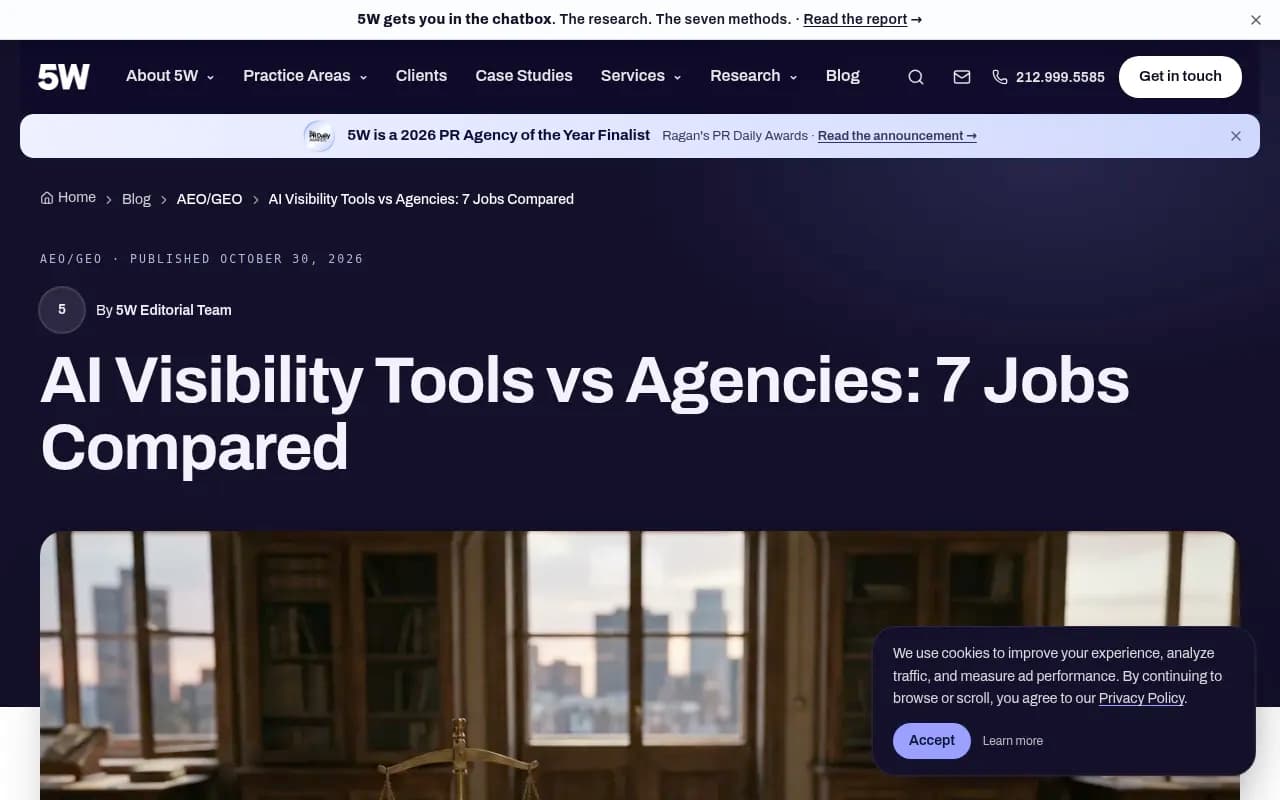
The 5W comparison above is vendor-authored, but its job-by-job framing is a handy checklist for scoping any engagement.
A practical 90-day plan
Days 1 to 30: baseline
Run a tracked prompt set across the AI engines your buyers use. Log which domains get cited, classify them as owned, editorial, review or news, and check crawler access. Do not hire yet.
Days 31 to 60: fix what is yours
Rewrite the product, landing and docs pages that should be cited and are not. Build comparison pages. Fix crawler blocks. This is in-house work, or a short GEO agency sprint if you lack capacity.
Days 61 to 90: go after third-party sources
With the citing domains identified, brief a PR agency or run outreach yourself to get into the roundups and review sites AI already uses. Prefer formats that decay slowly. Re-measure on the same prompts and compare.
At day 90, decide what to keep in-house, what to retain agencies for, and what to drop. If you want a structured outline, Promptwatch's 90-day GEO program guide lays out a similar sequence.
If you want a partner who covers the SEO and GEO side
Some teams want one SEO and GEO partner rather than a PR firm plus a tool. 1001 SEO Media is an SEO agency that combines technical SEO, content, digital PR and generative engine optimization, and it uses Promptwatch for AI visibility measurement. It is the publisher of this site, so weigh that accordingly, and compare it against the other options the same way you would any agency.
Bottom line
Owned pages last longest in AI citations and belong to the people who know the product. Third-party sources are where outside help pays off, and news coverage is the shortest-lived part of it. Measure for 30 days, fix your own pages, then hire for the specific gaps your data shows. If an agency cannot tell you which of those gaps it is closing, keep your money.