Key takeaways
- Scrunch's only published brand price is Core at $250/month: 125 prompts, 5,000 responses, 4 engines. That works out to $2.00 per tracked prompt and about $0.05 per response.
- Profound's live pricing page no longer shows the $99 Starter or $399 Growth tiers that many 2026 blog posts still quote. It lists a free 7-day Trial and a custom Enterprise plan. Any Profound cost per prompt is an estimate built from a sales quote.
- A "prompt" is not a fixed unit. Engine count, run frequency and response limits change what you get for the same price.
- Claude, Gemini, Google AI Mode, Meta AI and Grok sit behind Enterprise quotes at Scrunch. Most multi-engine Profound coverage does too.
- Ask both vendors for overage rates in writing. Neither publishes them.
Why this comparison is harder than it looks
If you search for Profound vs Scrunch pricing, you'll find a pile of articles that disagree with each other. One says Profound starts at $99. Another says $399 for multi-engine. A third says $499. Scrunch shows up at $100, $250, $300 or $500 depending on the post and the month.
They aren't all lying. Both vendors have reshuffled their plans repeatedly, and a lot of comparison content was written against older pricing pages. The live pages (checked while researching this guide) tell a simpler and slightly annoying story: Scrunch has one public self-serve brand price, and Profound has none.
So the honest question for a mid-market team is not "which is cheaper?" It's "what can I actually compare, and what do I need to ask a sales rep?"
Treat vendor-written comparisons like this one as positioning, not neutral pricing data. Profound's article, for example, is clear that it considers the two products to be in different categories.
What each vendor publishes right now
Scrunch: one self-serve price
Scrunch lists a self-serve Core plan and a custom Enterprise tier. Core at $250/month includes:
- 125 unique prompts and 5,000 responses per month
- 4 engines: ChatGPT, Perplexity, Google AI Overviews and Copilot
- 1 country, 1 persona, 1 language and 5 competitors
- 5 site audits a month, a 25-page site map and 1 page optimization a month
- 1 brand workspace and 5 user licenses
- Google SSO only, email support, a 7-day free trial
Not included in Core: API access, Looker Studio, MCP and the Agent Experience Platform (AXP). Enterprise unlocks nine engines (adding Claude, Gemini, Meta AI, Google AI Mode and Grok), full audits, API, SAML/OIDC SSO and a dedicated team.

One context point worth knowing: Sitecore acquired Scrunch in June 2026. It still sells standalone with public pricing, but the roadmap now belongs to Sitecore. If you don't run Sitecore, ask where product investment is headed.
Profound: a trial and a quote
Profound's pricing page currently shows two brand plans:
- Trial (free): 50 prompts run daily for 7 days across ChatGPT, Gemini and Google AI Overviews, with 1 language, 1 region, 5 Prompt Volumes searches, no history, no exports and no API. The prompt set is recommended by industry and can't be customized.
- Enterprise (custom): tailored prompt count at daily frequency, up to 9 engines (ChatGPT, Perplexity, Google AI Mode, Gemini, Copilot, DeepSeek, Claude, Google AI Overviews, Exa), ChatGPT Shopping, custom languages and regions, all-time history, CSV/JSON export, API, SSO/SAML, SOC 2 and unlimited seats.
Agents run on credits, and overage can be set to bill or pause. The self-serve Agency Growth plan is for agencies rather than brands and includes 400 credits per month per client workspace.

That $99 Starter you keep reading about? It was ChatGPT-only with 50 prompts and 1,500 responses a month, and it's gone from the brand page. One third-party review says outright that Profound no longer sells a self-serve brand tier. Profound's own June comparison content still quoted roughly $499 for Growth, which tells you how fast this moves. Verify against the live page before you quote any figure in a budget memo.
The per-prompt math, with the caveats
Here is what you can calculate from published numbers.
| Metric | Scrunch Core | Profound Trial | Profound Enterprise |
|---|---|---|---|
| Monthly price | $250 | Free (7 days) | Custom quote |
| Prompts | 125 | 50 | Custom |
| Engines | 4 | 3 | Up to 9 |
| Cost per prompt per month | $2.00 | n/a | Unknown |
| Responses per month | 5,000 | Not stated | Custom |
| Cost per response | about $0.05 | n/a | Unknown |
| Run frequency | Not stated on page | Daily | Daily |
| Public overage rate | No | No | No |
A few things about the Scrunch numbers. 5,000 responses across 125 prompts is 40 responses per prompt per month, roughly 10 a week. If those are spread across 4 engines (the page doesn't say so; this is an inference), each prompt-engine pair gets sampled about 10 times a month. That's thin for daily trend lines but fine for weekly directional tracking.
So $2.00 per prompt is the number to remember, with the footnote that it covers four engines and a limited sample rate.
Why "cost per prompt" misleads
A single prompt can mean very different amounts of data. Promptwatch's average sources per response data shows ChatGPT web-search answers cite about 5 sources, while Google AI Overviews and Perplexity cite about 10. A prompt tracked on Perplexity gives you roughly twice as many citation slots to observe as the same prompt on ChatGPT.
Query fan-outs matter too. Promptwatch Data on ChatGPT's site: operator change shows searches per response nearly doubled from August 8, 2026. Each tracked response now touches more of the web than it did a few months ago, which is useful if the tool exposes fan-outs and mostly invisible if it doesn't.
So compare these four units, not one:
- Cost per prompt (what you pay to define a question)
- Cost per engine-prompt pair (what you pay to see it in one place)
- Cost per response (what you pay for sampling depth)
- Cost per useful action (what you pay to change something afterward)
What mid-market teams realistically pay
This is where I'll be careful. Nobody can give you a verified Profound Enterprise price from public sources, and I haven't verified any third-party estimates. What I can lay out is how the decision tends to break down.
Scenario 1: one brand, a few hundred prompts, four engines
Scrunch Core covers 125 prompts for $250. To track 300 prompts you'd be outside Core's limits, so you're either asking Scrunch for a custom plan or running multiple workspaces. Either way the public price stops being the price.
Scenario 2: you need Claude, Gemini or AI Mode
At Scrunch, those are Enterprise-only. At Profound, multi-engine daily tracking means Enterprise as well. Both sides become quote-based, so compare actual quotes line by line: prompt count, engines, countries, languages, history and credits.
Scenario 3: you want to pilot first
Both vendors give you a 7-day trial. Scrunch's is the real Core product. Profound's is a fixed industry prompt set you can't customize, so it tells you how the dashboard feels, not whether your prompts will give you useful data.
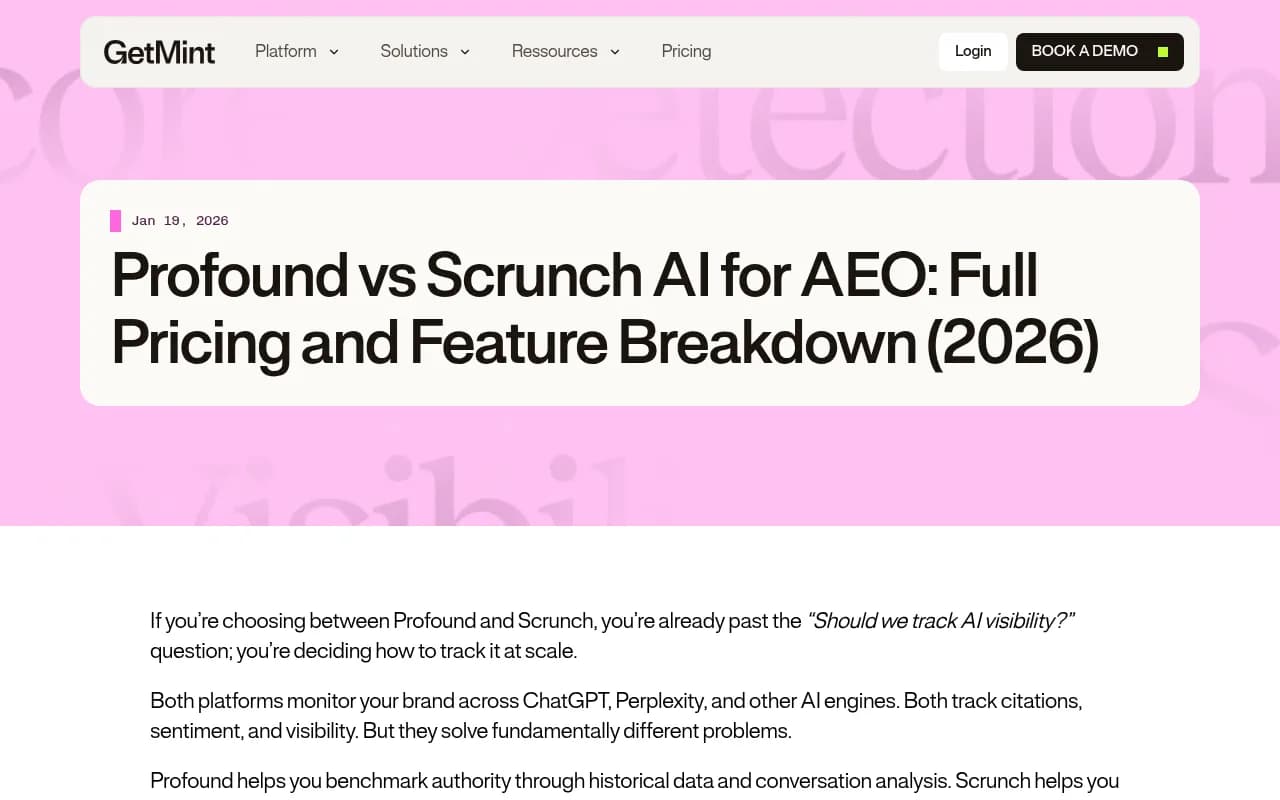
The January 2026 GetMint comparison shows what the market looked like earlier: Profound Starter at $99 (50 prompts, ChatGPT only, all-time history) against a Scrunch entry plan at $100 (100 prompts, ChatGPT only, 90 days of history). Both vendors have moved on since. Useful as history, not as a current price list.
Questions to ask before you sign
Because the real numbers live in sales calls, bring a list. These are the ones that change the total cost most.
- How many prompts, engines, countries and languages does the quote include, and how are they counted?
- What happens when I exceed the prompt or response limit? Ask for the overage rate in writing. Profound's FAQ only says it will notify you and discuss expansion; Scrunch publishes no rate.
- How often do prompts run? Daily, weekly or sampled?
- Is the data from real front-end interfaces or from APIs? Answers can differ between the two.
- How many seats and workspaces are included, and does SSO cost extra?
- For Profound, how many agent credits come with the quote, and what does a typical run consume?
- For Scrunch, is AXP included or a separate line item, and what is the roadmap under Sitecore?
- What's the annual discount? One source claims Scrunch annual billing is about 17% cheaper, but the figure is unverified against the live page.
- What history and exports do I keep if I cancel?
What neither price tells you
A tracked prompt is just a measurement. The bigger cost is what happens after. If nobody on your team has time to turn visibility data into content, fixes and outreach, you're paying for a dashboard. One review in the research put it bluntly: without someone whose job is to act on findings, you're paying enterprise SaaS prices for something you check once a month.
That's the real test for mid-market teams with two or three people on SEO. Look at whether the plan gives you:
- Crawler visibility, so you can see whether AI bots can reach your pages
- Traffic attribution from AI referrals
- Content gap analysis tied to your prompts
- A way to produce and publish the fix
Profound leans toward agents and an orchestrator. Scrunch leans toward audits and agent-ready page delivery. Compare those against how you actually work, not the feature grid.
Alternatives worth pricing alongside them
If neither quote works, it's worth pricing a couple of others before you decide. Public price lists are one reason to look beyond the two big names.
Promptwatch is the one I'd put on the shortlist for teams that want the monitoring and the fixing in one place. Promptwatch publishes its prices: Essential is $95/month for 50 prompts and 6,000 responses across all tracked models, Professional is $245/month for 150 prompts and 18,000 responses, and Business is $579/month for 350 prompts and 42,000 responses. Compared with Scrunch Core's 125 prompts and 5,000 responses at $250, the Professional tier gives you more of both for a similar price, and every paid plan unlocks all active models rather than a four-engine cap. It also includes IP-verified AI crawler logs, visitor analytics, a site audit and content gap analysis, and the Business plan adds the Content Agent that writes and publishes to your CMS. Confirm current rates on promptwatch.com/pricing, since plans change.

Other trackers with lower entry prices include Otterly.AI (from $29/month for basic monitoring) and Peec AI. They're lighter on execution, so they suit teams who only need to know where they stand.


If you want to browse more options, the GEO software directory lists a wider set of trackers with pricing context.
| Option | Published price | Prompts | Engine coverage | Action layer |
|---|---|---|---|---|
| Scrunch Core | $250/mo | 125 | 4 | Audits, basic content generation |
| Profound Enterprise | Quote only | Custom | Up to 9 | Agents on credits |
| Promptwatch Professional | $245/mo | 150 | All active models | Crawler logs, content gap analysis, Knowledge Base, 5 AEO articles |
| Promptwatch Business | $579/mo | 350 | All active models | Content Agent, CMS publishing, local targeting |
| Otterly.AI | From $29/mo | Varies by plan | Varies by plan | Monitoring |
Promptwatch also has a free Explore plan, ChatGPT only with 10 prompts, which is a quick way to see what your own prompts return before you talk to anyone.
How to run a fair comparison in a week
Here is the process I'd use.
- Write down your 50 to 150 most important prompts, grouped by topic and intent.
- List the engines you actually need. If your buyers use Claude or Gemini, price those in from day one.
- Start the Scrunch Core trial with your own prompts.
- Request a written Profound Enterprise quote using the same prompt count and engine list.
- Normalize everything into cost per prompt, cost per engine-prompt pair and cost per response.
- Add the cost of the people and tools needed to act on the data.
- Re-check the live pricing pages on the day you decide, since both vendors have changed plans several times this year.
The short version
On published numbers, Scrunch is the only one of the two you can actually price: $2.00 per prompt per month on Core, with an Enterprise jump for the rest of its engines. Profound is a conversation with sales. For a mid-market team, that means the real comparison happens in a spreadsheet you build from two quotes, and the cheapest-looking line is rarely the cheapest outcome. Price the whole workflow, not just the prompt count.