Key takeaways
- AI-referred traffic to ecommerce sites grew 393% year over year in Q1 2026, and visitors from AI search convert 42% better than paid search traffic (Adobe).
- Most AI visibility tools only monitor -- they show you where you're invisible but don't help you fix it. The best tools close that loop.
- ChatGPT Shopping, Google AI Overviews, and Perplexity are now the three most important channels for product discovery that traditional SEO tools can't track.
- For brands that want to both monitor and act on AI shopping visibility, Promptwatch is the most complete option in 2026.
- If budget is tight, tools like Peec AI and Otterly.AI give you solid monitoring at lower price points -- just don't expect them to help you fix what they find.
AI search has quietly become one of the most important product discovery channels in ecommerce. When someone asks ChatGPT "what's the best standing desk under $500" or asks Perplexity "top moisturizers for combination skin," they get a direct answer -- usually with a short list of recommended products. If your brand isn't in that list, there's no page 2. You're just not there.
Adobe's Q1 2026 data put a number on this: AI-referred ecommerce traffic grew 393% year over year. Visitors from ChatGPT and Perplexity convert 42% better than paid search traffic and spend 37% more per visit. That's not a niche trend you can monitor later -- it's happening now.
The problem is that Google Analytics doesn't tell you any of this. Neither does your traditional rank tracker. You need a different category of tool entirely.
This guide covers the 7 best options for tracking AI shopping visibility in 2026 -- what each one actually does, where it falls short, and which type of brand it fits best.
What "AI shopping visibility" actually means
Before getting into tools, it's worth being precise about what we're tracking. AI shopping visibility is not the same as general AI brand monitoring.
General AI visibility tools track whether your brand name appears in AI-generated answers. That's useful, but it's not enough for ecommerce. What you actually want to know is:
- Does your product appear when someone asks for a recommendation in your category?
- Does it show up with an image, price, and rating -- or just a text mention?
- Which competitors are getting recommended instead of you?
- Which AI models (ChatGPT, Perplexity, Gemini, Google AI Overviews) are driving the most product discovery in your category?
- What content or citations are causing AI models to recommend those competitors?
Some tools in this list track all of that. Others only cover a subset. The difference matters a lot depending on what you're trying to do.
How we evaluated these tools
The tools below were evaluated on five criteria:
- AI model coverage (ChatGPT, Perplexity, Google AI Overviews, Gemini, Claude, etc.)
- Shopping-specific features (product-level tracking, ChatGPT Shopping, image/price rendering)
- Gap analysis and content recommendations
- Traffic and revenue attribution
- Price-to-value ratio
The 7 best tools for AI shopping visibility
1. Promptwatch -- best for brands that want to monitor and fix
Promptwatch is the most complete option for ecommerce brands that want to understand their AI shopping visibility and actually do something about it. Most tools in this category stop at monitoring -- they show you a dashboard of where you're invisible and leave you to figure out the rest. Promptwatch is built around a loop: find the gaps, create content that addresses them, and track whether that content starts getting cited.
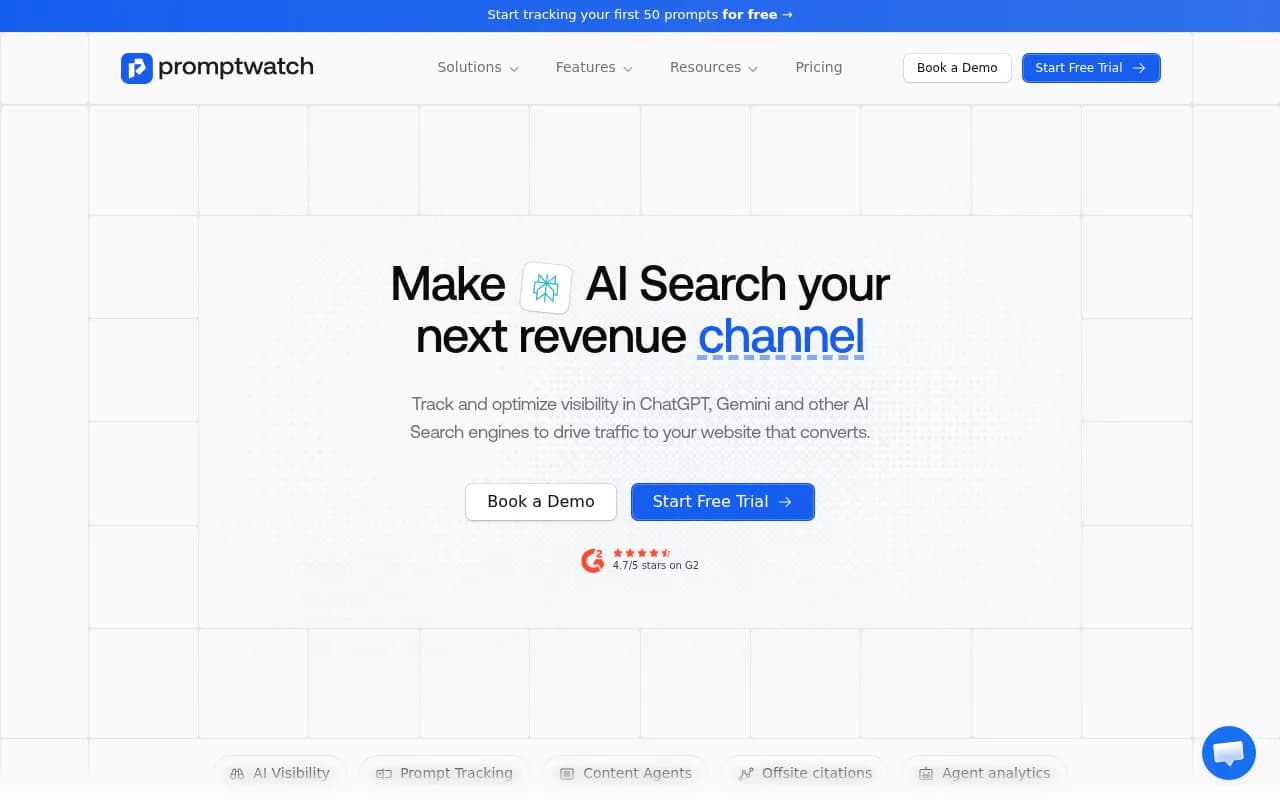
For AI shopping visibility specifically, Promptwatch tracks ChatGPT Shopping recommendations and entity mentions, which is a capability most competitors don't have at all. When ChatGPT surfaces a product carousel or a shopping recommendation, Promptwatch logs whether your brand appeared, what the prompt was, and which competitors showed up instead.
The Answer Gap Analysis feature is particularly useful here. It surfaces the exact prompts where competitors are being recommended and you're not -- not as a vague category observation, but as specific questions with specific gaps. From there, Content Agents can generate product-focused articles, comparison pages, and category briefs grounded in real citation data.
Other features worth knowing about: AI crawler logs that show which of your pages are being read by ChatGPT, Perplexity, and Claude (and which are being ignored), page-level citation tracking, and traffic attribution that connects AI visibility to actual revenue. It covers 10 AI models including Google AI Mode, which is increasingly important for product discovery.
Pricing starts at $99/month for the Essential plan (1 site, 50 prompts). The Professional plan at $249/month adds crawler logs, more prompts, and multi-location tracking. For most ecommerce brands, Professional is the right tier.
The one honest caveat: Promptwatch is strongest for brands with content-driven discovery (think DTC brands, SaaS, or any category where editorial content influences AI recommendations). For pure product catalog tracking at the SKU level across thousands of items, you may want to supplement it with a more catalog-focused tool.
2. Semrush AI Visibility Toolkit -- best for teams already on Semrush
If your team already uses Semrush for SEO, the AI Visibility Toolkit is the most natural extension. It tracks brand mentions across ChatGPT, Perplexity, Google AI Overviews, and Gemini, and surfaces competitor comparisons alongside your existing keyword and backlink data.
The main advantage is consolidation. You get AI visibility data in the same platform where you're already doing keyword research, site audits, and competitive analysis. The main limitation is that Semrush uses fixed prompt sets rather than letting you define custom prompts around your specific product categories. For ecommerce brands with niche products, that matters -- you want to track "best [your specific product type]" prompts, not just generic category terms.
There's also no AI traffic attribution, so you can see where you're mentioned but not what that's doing to your traffic or revenue. Good for monitoring, less useful for optimization.
3. Profound -- best for enterprise ecommerce
Profound is built for larger organizations that need detailed AI analytics across multiple brands, markets, and product lines. It has strong multi-model coverage and good reporting depth, which makes it popular with enterprise marketing teams.
For AI shopping visibility, Profound tracks share of voice across AI platforms and lets you segment by product category, region, and competitor set. The reporting is genuinely good -- better than most tools in this list for stakeholder presentations and executive dashboards.
The downsides are price (it's one of the more expensive options) and the fact that it's primarily a monitoring tool. Like Semrush, it shows you the data but doesn't generate content or help you close the gaps it identifies. For a large brand with a dedicated content team, that's fine. For a smaller team that needs the tool to do more of the work, it's less ideal.
4. Peec AI -- best for budget-conscious monitoring
Peec AI is one of the more affordable options for tracking AI brand and product visibility. It covers the major AI platforms, lets you set up custom prompts, and gives you a clean dashboard for monitoring share of voice and citation trends over time.
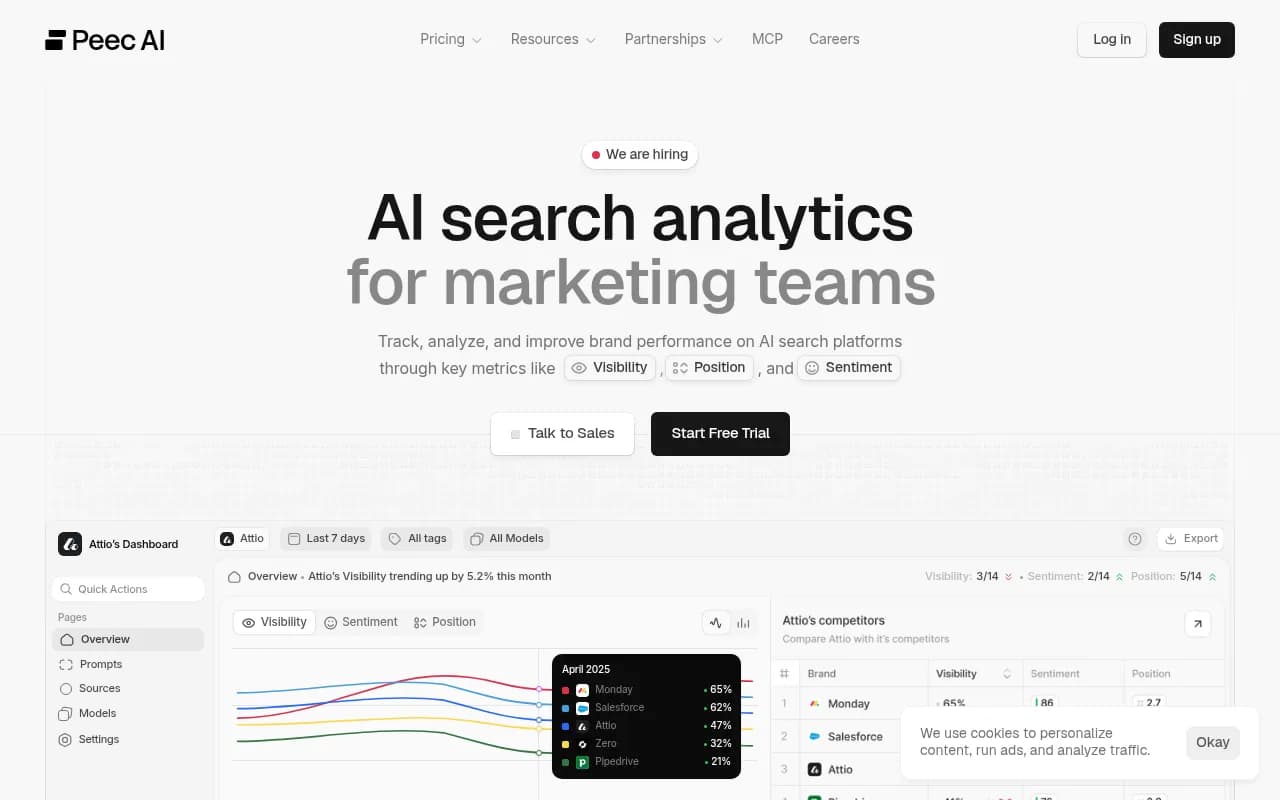
It's a solid choice if you're just getting started with AI visibility tracking and want to understand the landscape before investing in a more comprehensive platform. The interface is straightforward, setup is fast, and the data is reliable.
What it doesn't do: there's no content generation, no gap analysis that tells you what to create, no crawler logs, and no revenue attribution. It's a monitoring tool, full stop. That's not a criticism -- it's just what it is. If you know that's what you need, Peec AI delivers it at a reasonable price.
5. Otterly.AI -- best for agencies managing multiple brands
Otterly.AI is designed for agencies that need to track AI visibility across multiple clients without paying enterprise prices. It handles multi-brand monitoring well, has decent AI model coverage, and produces clean reports you can share with clients.
For ecommerce specifically, it tracks product mentions and brand citations across ChatGPT, Perplexity, and Google AI Overviews. The prompt customization is flexible enough to cover most product categories.
Like Peec AI, it's a monitoring-first tool. There's no content optimization layer, no crawler data, and no attribution. For agencies that handle the strategy and content work separately, that's a reasonable trade-off. For brands that want one platform to do everything, it's not enough.
6. AthenaHQ -- best for deep competitive analysis
AthenaHQ has strong competitive intelligence features for AI search. If your main question is "why is my competitor getting recommended and I'm not," AthenaHQ gives you more detailed answers than most tools in this list.
It tracks which sources AI models are citing for competitor recommendations, how competitor share of voice has changed over time, and which prompts are driving the most visibility in your category. For ecommerce brands in competitive categories (consumer electronics, beauty, apparel), that competitive lens is genuinely useful.
The gap is on the action side. AthenaHQ is monitoring-focused and doesn't have content generation or optimization tools. You'll know exactly what the problem is -- you just have to solve it yourself.
7. Scrunch AI -- best for mid-market brands with agency support
Scrunch AI sits in an interesting middle position: more capable than the pure monitoring tools, but less comprehensive than Promptwatch for content optimization. It's a good fit for mid-market brands that work with an agency and want a tool that gives both sides solid data.
It covers the major AI platforms, has reasonable prompt customization, and includes some content recommendations alongside its monitoring data. The agency-friendly reporting and white-label options make it practical for managed service relationships.
For pure in-house teams, the content optimization features don't go as deep as Promptwatch's Content Agents. But if you have an agency doing the content work and just need a tool to track and report, Scrunch AI is a solid choice.
Side-by-side comparison
| Tool | AI model coverage | ChatGPT Shopping tracking | Content generation | Crawler logs | Revenue attribution | Starting price |
|---|---|---|---|---|---|---|
| Promptwatch | 10 models | Yes | Yes (Content Agents) | Yes | Yes | $99/mo |
| Semrush AI Toolkit | 4 models | No | No | No | No | Bundled with Semrush |
| Profound | 6+ models | No | No | No | No | Custom (enterprise) |
| Peec AI | 4 models | No | No | No | No | ~$49/mo |
| Otterly.AI | 4 models | No | No | No | No | ~$49/mo |
| AthenaHQ | 5 models | No | No | No | No | Custom |
| Scrunch AI | 5 models | No | Limited | No | No | Custom |
How to choose the right tool
The right answer depends on what you're trying to do.
If you want to understand the full picture -- where you're visible, where you're not, why competitors are winning, and what to do about it -- Promptwatch is the most complete option. The combination of ChatGPT Shopping tracking, crawler logs, gap analysis, and content generation in one platform is genuinely hard to replicate by stitching together cheaper tools.
If you're already deep in the Semrush ecosystem and just want to add AI visibility to your existing workflow, the AI Visibility Toolkit is the path of least resistance. Just go in knowing it won't tell you what to do with the data.
If budget is the primary constraint, Peec AI and Otterly.AI both give you reliable monitoring at lower price points. They won't help you fix what they find, but they'll tell you clearly where the problems are.
If you're at an enterprise with multiple brands and markets, Profound has the reporting depth and organizational features to match that scale.
The monitoring-only trap
One thing worth saying directly: a lot of brands buy an AI visibility tool, look at the dashboard, feel vaguely informed, and then don't change anything. The monitoring data is only valuable if it leads to action.
The tools that help you act -- by showing you specific content gaps, generating briefs or articles, and then tracking whether those changes improved your visibility -- are worth paying more for. The tools that just show you a score are only useful if you have the internal capacity to turn that score into a content strategy.
Before choosing a tool, ask yourself: "When I see that a competitor is getting recommended and I'm not, what will I actually do next?" If you have a clear answer and a team to execute it, any monitoring tool will work. If you're not sure, pick a tool that helps you answer that question too.
For most ecommerce marketing teams in 2026, that means starting with Promptwatch and building from there.