Key takeaways
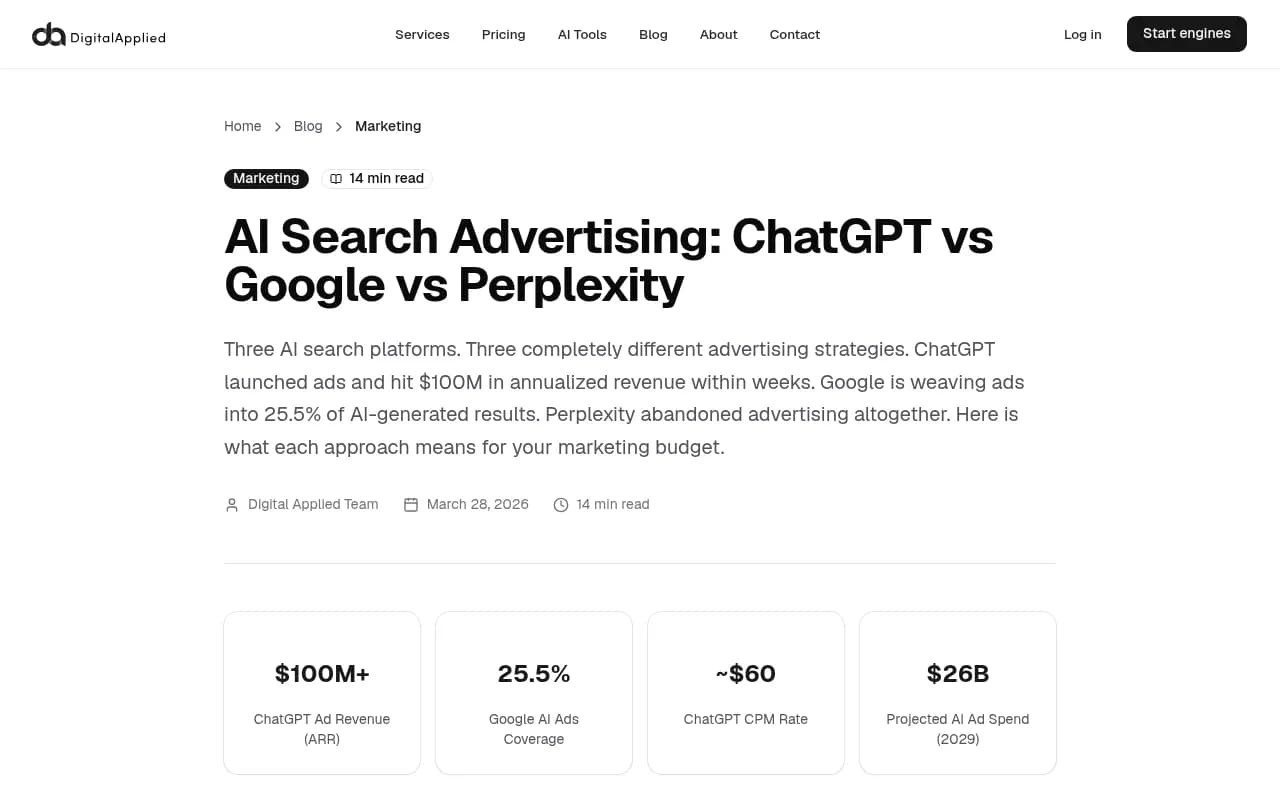
- ChatGPT Ads went from a $250,000-minimum enterprise pilot in February 2026 to a self-serve platform hitting $1 billion in annualized revenue by August 31, 2026, in under 200 days.
- Google AI Mode now shows ads in roughly 25.5% of AI responses, up from about 5% in early 2025, using new formats like Direct Offers and conversational discovery ads.
- Perplexity pulled its sponsored-question ad tests in February 2026 and is instead chasing $500M in subscription revenue as the "ad-free" option.
- US AI search ad spend is projected to climb from roughly $1B in 2025 to $25.9B by 2029, about 13.6% of all search ad spend.
- Nearly two-thirds of US adults (63%, per Ipsos) say ads inside AI answers make them trust the results less, which matters for how brands should show up in these placements.
Three platforms, three completely different bets
Twelve months ago nobody could tell you how AI search engines were going to make money. Now we have three working answers, and they contradict each other, which is honestly the most interesting part of this whole story.
OpenAI decided to build an ad network from scratch and lean hard into scale: 800 million-plus weekly ChatGPT users is an audience Google-sized advertisers can't ignore, so OpenAI priced ads at a premium and let demand sort itself out. Google did the thing Google always does: it took an advertising machine that already prints money in traditional search and bolted it onto AI Mode, so the plumbing (auctions, advertiser relationships, measurement) barely had to change. Perplexity looked at both of those paths and said no thanks, we'll charge users directly instead.
Three different bets, three different outcomes so far, and marketers now have to decide which of these ecosystems is worth a test budget.
ChatGPT Ads: from pilot to $1 billion in six months
This is the fastest-moving story in the bunch, so the timeline matters more than any single stat.
- February 9, 2026: ChatGPT ads launch for US users on Free and Go tiers, through a managed pilot that requires a $250,000 minimum spend. CPMs land around $60.
- May 5, 2026: OpenAI opens self-serve buying through the OpenAI Ads Manager, adds cost-per-click bidding alongside CPM, and ships a measurement pixel plus a Conversions API. The minimum spend drops sharply.
- July 24, 2026: Eight product updates ship in a single week, including conversion-optimized bidding (oCPC), automatic advanced matching, a Bulk API, and richer product cards with price and star ratings.
- August 11, 2026: Ads expand into the UK, Mexico, Brazil, Japan, and South Korea.
- August 31, 2026: OpenAI confirms ChatGPT Ads has reached a $1 billion annualized revenue run rate, less than 200 days after launch.
CPMs have come down a lot as the platform matured, from roughly $60 at launch to around $25 by May, with observed CPCs sitting in the $3-5 range. That's still a premium relative to average display rates, but it's no longer the enterprise-only toy it was in February.
A few mechanics worth knowing before you test it. Ads show up as clearly labeled "Sponsored" blocks underneath the organic answer, not woven into it, and OpenAI says they never influence what ChatGPT actually tells the user. Formats are simple: a 40-character headline, 150-character description, a link, and for product queries a shopping card with price and availability. Targeting is intent-based and contextual, built from the live conversation and chat history rather than third-party identity data; advertisers don't get names, emails, IPs, or precise location. That privacy posture is a real differentiator versus the Google/Meta model, and it changes how you write ad copy: generic retargeting creative performs worse than copy that directly answers the thing the user just asked.
If your paid team hasn't run a test campaign yet, the "let's wait and see" argument is getting weaker every month. This is no longer a pilot channel.
Google AI Mode: the existing machine, pointed at AI answers
Google's advantage here isn't cleverness, it's inertia. AI Mode passed one billion monthly users within a year of launch, and query volume has more than doubled every quarter since, according to Google's own I/O 2026 announcements. Rather than invent a new ad product, Google extended the existing Google Ads auction into AI-generated responses.
The numbers back this up: ads now appear in about 25.5% of AI Mode results, up from roughly 5.17% in early 2025. That's a five-fold jump in less than eighteen months, and it puts AI Mode's ad density close to traditional Google search results. New formats include Direct Offers for shopping queries, conversational discovery ads, highlighted answers, and lead-gen ad units designed specifically for a conversational interface rather than a ten-blue-links page.
The practical implication for marketers: if you already run Google Ads, you're probably already showing up in AI Mode without having built a separate campaign. The catch is that measurement and attribution inside AI Mode are murkier than classic SERP ads, since users interact with these responses conversationally rather than clicking a single link in a predictable spot.
Perplexity: the platform that walked away
This is the genuinely surprising part of 2026. Perplexity spent 2024 and 2025 experimenting with sponsored follow-up questions, the kind of native-feeling ad unit that seemed like a natural fit for a citation-first answer engine. Then in February 2026, it pulled all of it.
The stated reason is user trust. Perplexity is now explicitly positioning itself as the ad-free alternative to ChatGPT and Google, targeting around $500 million in annualized subscription revenue instead of ad revenue. Whether that math works long-term is an open question, but it's a coherent bet: if ads erode trust in AI answers (and the Ipsos data below suggests they do), a subscription-only model becomes a legitimate differentiator rather than just a fallback plan.
For marketers, this means there's currently no paid placement to buy on Perplexity. Your only path to visibility there is earning citations organically, which is a content and authority problem, not a media-buying one.
Comparing the three models
| Platform | Ad model | Current scale | Ad density / revenue | Targeting data |
|---|---|---|---|---|
| ChatGPT | Self-serve CPM/CPC ads, sponsored blocks below answers | 800M+ weekly users, live in US, UK, Mexico, Brazil, Japan, South Korea | $1B annualized revenue run rate (Aug 2026) | Conversation context only, no PII shared with advertisers |
| Google AI Mode | Existing Google Ads auction extended into AI responses | 1B+ monthly AI Mode users | Ads in ~25.5% of AI responses (up from ~5% in early 2025) | Full existing Google Ads targeting stack |
| Perplexity | None (abandoned Feb 2026) | N/A for ads | $0 ad revenue, targeting ~$500M subscription ARR | N/A, subscription-funded |
Why trust is the real constraint here
An Ipsos survey found that 63% of US adults say ads inside AI search results make them trust the results less. That single number explains a lot about why Perplexity bailed and why OpenAI is so insistent that ads never influence what ChatGPT actually says. Both companies are reacting to the same risk: people came to AI answer engines partly because they felt less manipulated than a classic search results page cluttered with sponsored listings. If that perception cracks, usage could shift.
This creates an odd opportunity for brands. If paid placements read as slightly suspect to users, organic citations, the kind you earn by being the source an AI model actually pulls from when it answers a question, carry more credibility by comparison. That's a content and structured-data problem, not a media-buying one, and it's where most of the durable competitive advantage in this space is going to come from over the next couple of years.
What this means for your 2026 budget
A few practical moves, roughly in order of how much certainty we have about them:
- If you sell a product with broad consumer appeal and have budget flexibility, run a small ChatGPT Ads test now. The platform is no longer pilot-only, minimum spends have come down, and the self-serve tooling (Ads Manager, pixel, Conversions API) is mature enough to measure results properly.
- If you already run Google Ads, check whether your existing campaigns are showing in AI Mode and look at the new Direct Offers and conversational discovery formats before assuming nothing has changed.
- Don't build a Perplexity ad strategy, there isn't one to build. Instead, treat Perplexity (and really all AI answer engines) as a visibility target: the goal is to be the page that gets cited, not the ad that gets clicked.
- Track your actual presence inside AI answers separately from your ad spend. Paid placement and organic citation are two different games with two different scoreboards, and conflating them is how budgets get misallocated.
On that last point, tools like Promptwatch are built specifically to track how often your brand gets cited across ChatGPT, Google AI Overviews, AI Mode, Perplexity, Claude, and the rest, separately from any ad spend you're running, along with ChatGPT Shopping placements and sponsored results through its Ads Radar feature.

That combination matters because the two channels interact in ways a simple media-buying spreadsheet won't capture: showing up as a cited source and showing up as a sponsored block are different kinds of visibility, and a brand that only tracks ad performance is flying blind on the larger, and arguably more trusted, half of what's actually happening in these answers.
The road to $26 billion
All of this is still early. US AI search ad spend is projected to go from roughly $1 billion in 2025 to $25.9 billion by 2029, which would put it at about 13.6% of total search ad spending, according to the projections cited by Digital Applied. That's a real market forming in real time, not a speculative side project.
What's genuinely uncertain is whether the current three-way split holds. OpenAI could decide ad density needs to climb to hit growth targets, which risks the exact trust erosion Perplexity is betting against. Google could push ad density in AI Mode even further given how much runway it still has versus traditional search. And Perplexity's subscription bet either validates the idea that ad-free AI search is a durable category, or it quietly adds ads back in a year once $500M in ARR turns out to be a harder number to hit than it looks on paper right now.
For marketers, the practical takeaway isn't "pick a winner." It's building the measurement and tracking muscle now, on both the paid and organic citation side, so that whichever platform ends up dominating AI-driven commerce, you're not starting from zero when it does. If you want to go deeper on how AI platforms are citing and monetizing content more broadly, the research hub at promptwatch.com/data tracks citation share and content-type trends across these same platforms month over month.