Key takeaways
- Earned and editorial coverage still shapes most AI answers. Muck Rack's "What Is AI Reading?" research puts earned media at roughly 84% of AI citations, though the sources inside that slice are shifting.
- There is no single list of trusted outlets. 5WPR argues that model preferences are category-, question- and brand-specific, so a media list should be built per category.
- News is a small slice of the total. In Promptwatch Data, news is under 6% of classified ChatGPT citations, and product pages, landing pages and listicles take far more.
- Coverage decays. News pages lose half their citations in about 36 days, while listicles, comparisons and docs last much longer.
- The practical method: pull your own prompts, collect the cited domains, tier them, then pitch the outlets that already show up for your category.
Why the usual top outlets lists mislead PR teams
Search for "which publications does AI cite most" and you will find a pile of rankings. They disagree. Some put Forbes first, some put Reuters first, and some put Reddit and Wikipedia ahead of every newsroom combined. 5W Research's citation audit, for instance, found Wikipedia at 13.15% and Reddit at 11.97% of U.S. citations, which beats The Wall Street Journal, The Times and Bloomberg together. It also names Reuters and Forbes as the two news survivors in its audit, with Forbes at 1.38% citation share.
Those numbers are not contradictory. They measure different things. An analysis on authoritytech.io points out that wire-service rankings come from studies of the news slice only. In the July 2025 AI Search Arena preprint, 32,865 of 366,087 citations (9.0%) were news outlets, and the wire rankings describe just that 9%. A list built from that slice tells you which newsroom wins among newsrooms, not how much newsrooms matter overall.
So before you build a media list, decide which question you are answering:
- Which news outlets win when AI does cite news? (Reuters, Forbes and similar show up here.)
- Which source types shape answers for my category? (Often reviews, listicles, docs, forums.)
- Which pages will still be cited in 60 days?
The second and third questions usually matter more to a PR team.
What the citation data says so far
The distribution is a long tail
Contently's April 2026 roundup, which pulled from several studies including Peec AI, Semrush, Profound and SE Ranking, cites Evertune's analysis of 200 million prompts: even the top-cited domain on any platform rarely exceeds 5% of citations. The other 95% spreads across thousands of domains. Promptwatch's June 2026 ChatGPT citation share report agrees. Reddit led at 3.71% (down from 6.11% in May), Wikipedia was second at 0.56%, and no domain topped 4%.
That shape matters for PR. You cannot win by landing one mega-placement. You need presence across the cluster of outlets AI draws on for your topic.
News is a minor content type in ChatGPT
Promptwatch's content type report for Sep 28 to Oct 4, 2026 breaks down ChatGPT citations by format. Product pages lead at 22.4%, landing pages follow at 16.8%, listicles get 13.6%, how-tos 8.7%, documentation 7.5%, general articles 6.1%, comparisons 5.9% and news 5.7%. Editorial formats together add up to roughly 43%.
For commercial prompts, the mix tilts further: product pages 26.0%, landing pages 20.6%, listicles 15.0%, comparisons 7.9%. For branded prompts, reviews climb to 5.6% and press releases to 2.1%, both more than their overall share.
The PR takeaway: for "best X for Y" questions, the outlet that matters is the one running the "best of" roundup, not the one running breaking news.
Coverage has a shelf life
Promptwatch's content half-life study tracked every page ChatGPT cited on July 6, 2026 for 90 days. News decayed fastest: almost a quarter of news pages were never cited again after day 0, half were gone after 36 days, and 41% were still cited at day 60. After 30 days ChatGPT still cited 78% of landing pages, 76% of docs and 72% of comparisons. Product pages, reviews and how-tos had half-lives of roughly 74 to 77 days.
My reading of this (it is an inference, not a Promptwatch claim): news coverage buys a short burst of AI visibility. Outlets that publish evergreen roundups, buyer guides and reviews give you a longer tail, and you should plan to refresh or re-pitch them.
Authority is not what you would guess
Promptwatch's domain rank report found that sites with domain rank 46 to 75 earned almost half of ChatGPT citations in August 2026, while DR 91 to 100 fell to about 3%. If your media list is sorted by domain authority, you may be chasing the wrong tier. Mid-size trade and niche publications are doing a lot of the citing work.
Also worth knowing: almost half of ChatGPT responses cite 10 or more unique domains. Answers are assembled from many sources, so breadth of presence beats a single trophy placement.
Social and forum sources swing hard
Reddit's share of ChatGPT citations fell from about 4% to 0.5% on August 14, 2026, per Promptwatch Data. In the Sep 28 to Oct 4 window, ChatGPT drew 0.46% of citations from social platforms while Google AI Overviews drew 12.2%. Any media list that treats "AI" as one thing is already wrong. Each engine has its own diet.
Why you need a category-specific list
5WPR's piece on this topic makes the argument directly: brands should stop asking which publications AI models trust most, and instead identify the media sources that carry authority for the consumer questions that matter to their customers. Promptwatch's sector reports show why:
- Healthcare prompts: NIH, the FDA and the NHS lead, and government and public health sites earn almost half of citations (report).
- Travel prompts: Skyscanner, Going and Tripadvisor lead, and booking and search sites earn more than half (report).
- Software prompts: GitHub, Microsoft's docs and G2 lead, with documentation and help centers taking the biggest share (report).
- Automotive prompts: marketplaces like Autotrader and Cars.com outrank every car brand (report).
A healthtech PR team and a SaaS PR team should not share a media list. In several of these categories, the top cited domains are not news outlets at all.
A tier framework for your media list
Use the citation data to sort targets into tiers. This is a working framework, not a standard.
| Tier | What it covers | Examples from the data | Pitch angle | Refresh cadence |
|---|---|---|---|---|
| 1. Wire and structured editorial | Outlets cited on news-flavored prompts | Reuters, Forbes | Data-led stories, announcements | Per launch |
| 2. Category roundups and reviews | Listicles, comparisons, buyer guides | TechRadar-style "best of" pages, G2 for software | Inclusion in lists, review access | Every 60 days |
| 3. Reference and docs | Wikipedia, documentation, government sites | Wikipedia, NIH, GitHub | Factual accuracy, citable data | Quarterly |
| 4. Community and social | Forums, video, professional networks | Reddit, YouTube, LinkedIn | Genuine participation, not pitching | Ongoing |
| 5. Marketplaces and directories | Category-specific platforms | Autotrader, Tripadvisor, Trustpilot | Profile completeness, reviews | Monthly |
Promptwatch's June report names TechRadar, Reuters and Forbes as trusted publishers worth pitching, which is a useful seed for tiers 1 and 2. Treat it as a starting point and validate against your own prompts.
How to build the list, step by step
Step 1: Write the prompts your buyers actually ask
Start with 30 to 100 prompts: category questions ("best payroll software for small teams"), comparison prompts, and branded prompts. Split them by intent, since commercial and branded prompts cite different content types. Use personas if your buyers differ by role.
Step 2: Run them across engines and record citations
You need the cited URLs and domains, not just whether your brand was named. Run each prompt on ChatGPT, Google AI Overviews, AI Mode, Perplexity and Gemini at minimum. Run them from the countries you sell in, because answers and sources differ by market. Doing this by hand works for a pilot of a dozen prompts. Past that, you need tooling.
Step 3: Aggregate by domain and by content type
Build a sheet with domain, number of citations, engines citing it, content type (listicle, review, news, docs, forum), and the prompts it appeared in. Sort by citation count, then filter by content type. The domains that show up across several engines and many prompts are your priority targets.
Step 4: Find the gaps
For each high-citation page, ask whether your brand or a competitor is on it. Pages that cite competitors but not you are your hit list. Pages that mention you without a link are worth a polite follow-up.
Step 5: Tier, assign, and set refresh dates
Use the tier table above. Give each target an owner and a re-check date based on content type: roughly monthly for news-driven targets, every one to two months for roundups.
Step 6: Re-measure monthly
Promptwatch's own report warns that citation share can halve or double within a month. ChatGPT's citations per response dropped around the GPT-5.3 rollout on March 4, 2026, and the site: operator jumped from about 0.4% to about 17% of fan-out queries on August 8, 2026. A list built in Q1 is stale by Q3. Treat it as a living document.
Tools that can do the heavy lifting
The manual approach breaks down quickly. These are the categories of tool worth knowing, and a few examples from the catalog.
Citation and source tracking platforms
Promptwatch is the one I would start with for this job, because it covers the whole chain from which pages get cited to what to do about it. It tracks citations by domain, classifies them into content types and source types, follows Reddit, YouTube and LinkedIn citations, and finds third-party pages that name your brand without linking. Its Page Tracker lets you watch any URL, yours or a competitor's, and see which prompts cite it. For list building specifically, the content type and source type breakdowns do most of the tiering work for you. See the prompt tracking feature for details, and confirm current plans at promptwatch.com/pricing.

Other platforms that surface cited sources include Peec AI, Profound, Otterly.AI and MentionBird, which is built around seeing which sources AI engines cite.


MentionBird

For a wider survey of this category, the GEO software directory at bestgeosoftware.com lists many more options.
Outreach and placement tools
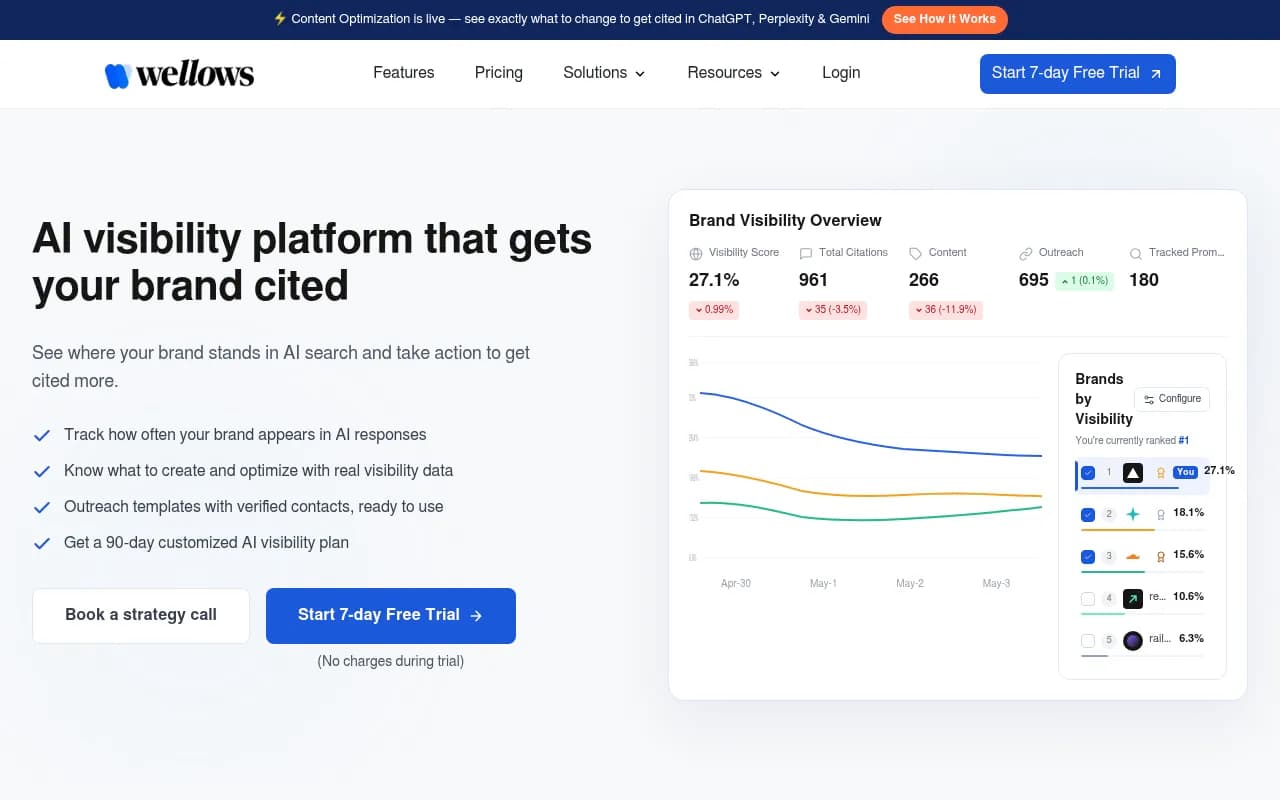
Once you have targets, you need to contact them. Respona handles link building and outreach workflows, and Wellows pairs AI citation tracking with outreach tools. CrowdReply positions itself around getting cited on pages AI already trusts, though anything involving community platforms needs care so you do not violate forum rules.

Comparison of approaches
| Approach | Best for | Weak spot |
|---|---|---|
| Manual prompt runs and a spreadsheet | Pilot of 10 to 20 prompts | Does not scale, no history |
| Citation tracking platform (Promptwatch, Peec AI, Profound) | Ongoing media list maintenance | Needs prompt design up front |
| Outreach tool (Respona, Wellows) | Contacting the targets you found | Does not tell you which targets matter |
| Media database (Muck Rack and similar) | Finding journalist contacts and measuring coverage | Not built around AI citation data |
Common mistakes
Treating one study as the truth
Studies use different prompt sets, engines and time windows. Read the methodology. A list drawn from news-only data should not be used to decide your whole PR budget.
Chasing the biggest domains
With DR 91 to 100 sites at about 3% of ChatGPT citations in August, and mid-authority sites taking almost half, a niche trade publication can beat a household name for your category.
Ignoring decay
A single launch story will fade from AI answers in weeks. Pair news bursts with placements in evergreen roundups and reviews, and keep your own comparison and landing pages current, since those are cited longest.
Skipping the measurement loop
Placements only matter if they change what AI says. Track whether new coverage gets cited, whether your brand appears in more answers afterward, and whether the claims AI makes about you are accurate.
Putting it together
If you only do three things this month: build a prompt set for your top category, pull the cited domains for each engine, and sort them by content type before you open your pitch list. You will probably find that a third or more of your best targets are not the outlets your team has been pitching. If you would rather hand the whole program to specialists, an agency that combines digital PR with GEO, such as 1001 SEO Media, can run it for you.
For a deeper look at how citations differ by engine and category, browse the full Promptwatch Data reports. Rebuild the list every month. The sources AI trusts this quarter are not guaranteed to be the ones it trusts next quarter.