Key takeaways
- I could not find a public source showing a wave of agencies migrating from Slate to Promptwatch. This guide frames the five reasons as reasons agencies choose Promptwatch, not as a documented trend.
- The five reasons: IP-verified crawler logs, AI traffic and revenue attribution, real-UI tracking across many engines, agency-specific plans, and an agentic loop from gap to published page.
- Slate is a legitimate product, and its own blog describes Promptwatch as the pick for teams that link visibility to crawler activity, traffic and revenue.
- Slate is worth a look if your clients are mostly B2B SaaS and content-led, and you want content operations to be the center of the workflow.
- Pricing figures vary between sources. Confirm both vendors' current plans before you sign anything.
A note on the premise
Let me be upfront. The title says agencies are switching, and I went looking for evidence. I found none. The only Slate-versus-Promptwatch comparison I could locate was published by Slate itself, so it leans toward Slate, as you would expect.
What I can do is lay out where the two products differ on things agencies care about, and why Promptwatch tends to win those specific comparisons. If you are an agency lead choosing between the two, that is more useful than a manufactured migration story.
The tools in question:
Slate is an AI-search-first content operations platform. By its own description, it is strongest for B2B SaaS and content-led teams, and it connects visibility tracking to content creation and publishing in one system. Its entry price, per its own blog, is $199 a month.

Promptwatch is an AI search visibility and GEO platform. It tracks brands across ChatGPT, Google AI Overviews, AI Mode, Gemini, Perplexity, Copilot, Claude and more, and then works through gaps with content and action tools.

Reason 1: IP-verified AI crawler logs
This is the clearest technical difference. Most visibility tools tell you what AI said. Few tell you whether AI can actually read your client's site.
Promptwatch's Agent Analytics logs requests from GPTBot, OAI-SearchBot, ChatGPT-User, ClaudeBot, PerplexityBot and others, verified against the operators' published IP ranges, so spoofed user agents are filtered out. You see which pages each bot reads, which errors it hits, and how crawls connect to citations.
Why does this matter for an agency? Because the first question a client asks after "why aren't we cited?" is "is something broken?" Crawler logs answer that in minutes. Promptwatch's own AI crawler traffic report (weekly verified requests, June 8 to September 6, 2026) shows how uneven the mix is: OpenAI accounted for 79.8% of verified AI crawler requests in the week of August 31 to September 6, down from 94.8% in the week of June 8. The report's advice is practical. Compare your own logs against that mix, and if a provider is large in the chart but near zero in your logs, you are probably blocked by robots.txt, a CDN or a WAF rule.
Another data point worth knowing: Meta-WebIndexer grew from roughly 2% to nearly 38% of tracked AI crawler requests between mid-July and August 9, 2026, according to Promptwatch Data. A client whose WAF blocks unfamiliar bots could be invisible to a crawler that most monitoring dashboards do not even list.
Third-party reviewers back this up. Omnia and Analyze AI both list page-level crawler logs as a standout Promptwatch strength. A YouTube comparison against Searchable put it as "deep crawler logs, raw agent analytics, and native API access."
Slate, as far as its public material shows, centers on content engineering and publishing instead. I did not verify whether it offers comparable bot-level logs, so check that directly in a demo.
Reason 2: Traffic and revenue attribution, not only mentions
Agencies get fired when they cannot connect work to outcomes. A visibility score going up is nice. A line in the monthly report showing visits and conversions from ChatGPT is better.
Promptwatch has its own visitor analytics script, so AI-referred traffic is measured directly instead of being inferred from GA4. Its 360 Insights view joins crawls, citations, clicks, and Google Search Console and Bing Webmaster data per page. That lets you ask questions like "which pages rank in Google but never get cited by AI?"
There is a case study angle here too. Crisp reported 2x higher conversion rates from AI traffic compared to traditional channels. TreeHouse, the company behind Pararius, grew AI search to about 25% of organic conversions, almost all of it from ChatGPT, after fixing crawler access and publishing proprietary data. Those are Promptwatch-published results, so weigh them accordingly, but the mechanism (find the crawler problem, fix it, measure the traffic) is exactly what an agency sells.
It is worth noting that Slate's own blog positions Promptwatch as the pick for teams that tie visibility to crawler activity, traffic and revenue. That is a fairly generous concession from a competitor.
Reason 3: Tracking real interfaces across many engines
AI answers shown to users often differ from what you get through an API. Promptwatch monitors the actual interfaces of ChatGPT, Google AI Overviews, Google AI Mode, Gemini, Perplexity, Copilot and Amazon Alexa, by country and language, and tracks API models like Claude, DeepSeek, Mistral and Grok alongside.
For agencies this means two practical things:
- Client reports reflect what real buyers see, which holds up when a client pastes a prompt into ChatGPT and compares.
- Every engine is included on every paid plan. Promptwatch's comparison page makes that point explicitly, and Slate's blog describes Promptwatch as covering 11 AI platforms on every paid plan.
The engines also behave differently, so coverage matters. In Promptwatch's data for Sep 28 to Oct 4, 2026, ChatGPT drew 0.46% of its citations from social platforms while Google AI Overviews drew 12.2% (social media citations by AI model). A strategy tuned to one engine can fail on another. Promptwatch also tracks Reddit, YouTube and LinkedIn citations in dedicated reports, which matters given that reddit.com's share of ChatGPT citations fell from about 4% to 0.5% on August 14, 2026 (Reddit citations are dropping in ChatGPT). Clients who were told to "just post on Reddit" last year deserve an updated answer.
Reason 4: Plans built for multiple clients
Pricing is where you need to be most careful, because the numbers I found conflict. Promptwatch's own pages list Essential at $95, Professional at $245 and Business at $579. Some third-party posts still cite $99 and $249, which are likely stale. Confirm everything at promptwatch.com/pricing.
What matters for agencies is the dedicated agency track:
| Plan | Monthly price | Responses | Notes |
|---|---|---|---|
| Kick-off | $199 | 10,000 | Unlimited projects and prompts, 10 seats |
| Growth | $399 | 25,000 | State/city tracking, Ads Radar |
| Scale | $799 | 65,000 | Most popular agency tier |
All agency plans include all models, crawler logs and visitor analytics, plus pitch projects for prospecting. White-label PDF reports and a white-label client portal are part of the offering. Analyze AI has said Promptwatch's white-labelling is less mature than Scrunch's, so if white-label polish is your top criterion, test it yourself before committing.
Slate's entry price is $199 a month according to its own blog, and I did not verify its agency plan structure. That is a gap to close in a demo: ask about client workspaces, seat limits, and whether prompts are capped per project.
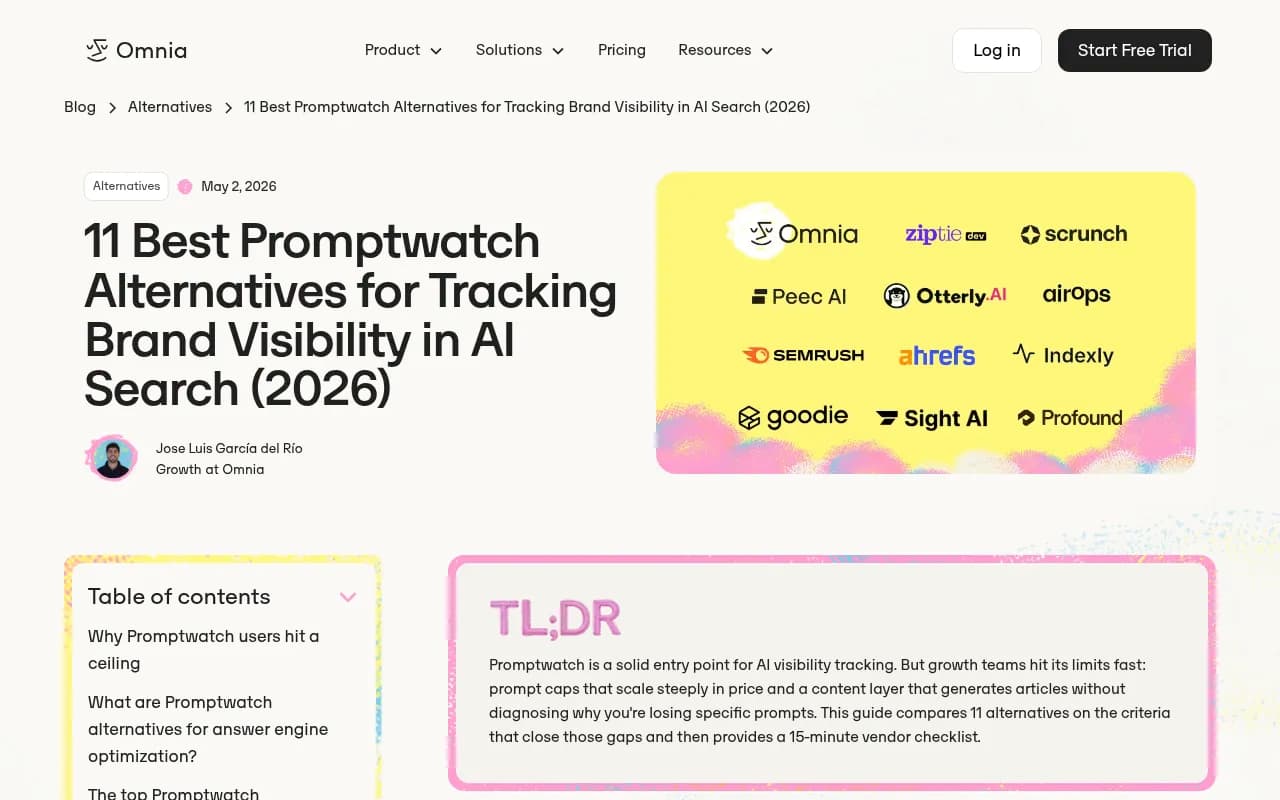
One critique I will repeat because it is fair: Omnia argues that Promptwatch's prompt caps scale steeply on the standard plans, calling the step to Professional a 2.5x price increase for 3x volume. The agency plans, with unlimited projects and prompts, are the way around that, which is one reason agencies should skip the standard ladder.
Reason 5: An agentic loop from gap to published page
Slate's pitch is that it connects tracking to content creation and publishing. That is a real strength, and it is the area where Slate is most competitive. So the question is not whether Promptwatch has an action layer. It does. The question is how much of the loop is automated and measured.
Promptwatch's flow:
- Content gap analysis finds prompts where competitors are cited and you are not.
- The Action Board turns that into a prioritized to-do list, and a Discovery agent investigates your data weekly and suggests up to five evidence-backed actions.
- The Content Agent plans, writes and publishes to WordPress, Webflow or Framer, with a review inbox or fully hands-off.
- Published pages are tracked through crawls, citations and AI traffic, and underperformers return as new actions.
Agent Chat sits on top as an analyst over live data: it builds dashboards and PDF reports on request, which cuts the hours an account manager spends assembling monthly decks. There is also a hosted MCP server and REST API, useful if your agency has its own reporting stack.
One thing I would flag: Omnia says Promptwatch generates content without diagnosing which third-party domains drive a competitor's citations. That is one reviewer's view and Promptwatch has since added Offsite Mentions and citation analytics, but it is a fair thing to test during a trial. Pick a client, pick a lost prompt, and see whether the tool explains why you lost it.
Side-by-side comparison
| Area | Promptwatch | Slate |
|---|---|---|
| Positioning | AI visibility and GEO platform with agentic optimization | AI-search-first content operations platform |
| Crawler logs | IP-verified, page-level | Not verified in public material |
| AI traffic attribution | First-party visitor script plus GSC and Bing data | Verify in demo |
| Content workflow | Content Agent, Content Refresh, CMS publishing | Core strength, tracking tied to content engineering |
| Agency plans | $199 to $799, unlimited projects and prompts | Starts at $199 per Slate's blog, agency details unverified |
| Best fit | Agencies serving mixed industries who need proof of impact | B2B SaaS and content-led teams |
When Slate is the better choice
I would not be honest if I skipped this. Slate makes sense when:
- Your client base is mostly B2B SaaS and the main deliverable is content production.
- You want content operations to be the primary workspace and tracking to be secondary.
- Your team already lives in a content workflow and does not need to debug bot access.
If your clients span e-commerce, finance, travel, publishing and SaaS, or if technical access issues are common, Promptwatch's crawler and attribution depth is more useful.
How to run the comparison yourself
Since no neutral head-to-head exists, build one. Takes a week.
- Pick two clients, one that is doing well in AI search and one that is struggling.
- Load the same 30 to 50 prompts into both tools, across at least three countries if you serve international clients.
- Check whether each tool can tell you why the struggling client is invisible, not just that it is.
- Ask each vendor to show AI-referred visits and conversions for a real site.
- Generate one client-ready report from each and time how long it takes.
- Ask both vendors for agency pricing in writing, including seat counts and prompt limits.
Promptwatch offers a 7-day free trial on its monthly Essential and agency Kick-off and Growth plans, and a free Explore tier, so the test costs little. Its live session on October 22, 2026, "Auditing & Scaling AI Search for Clients," is aimed at exactly this agency workflow. For a broader view of the category, the GEO software directory lists dozens of alternatives to both.
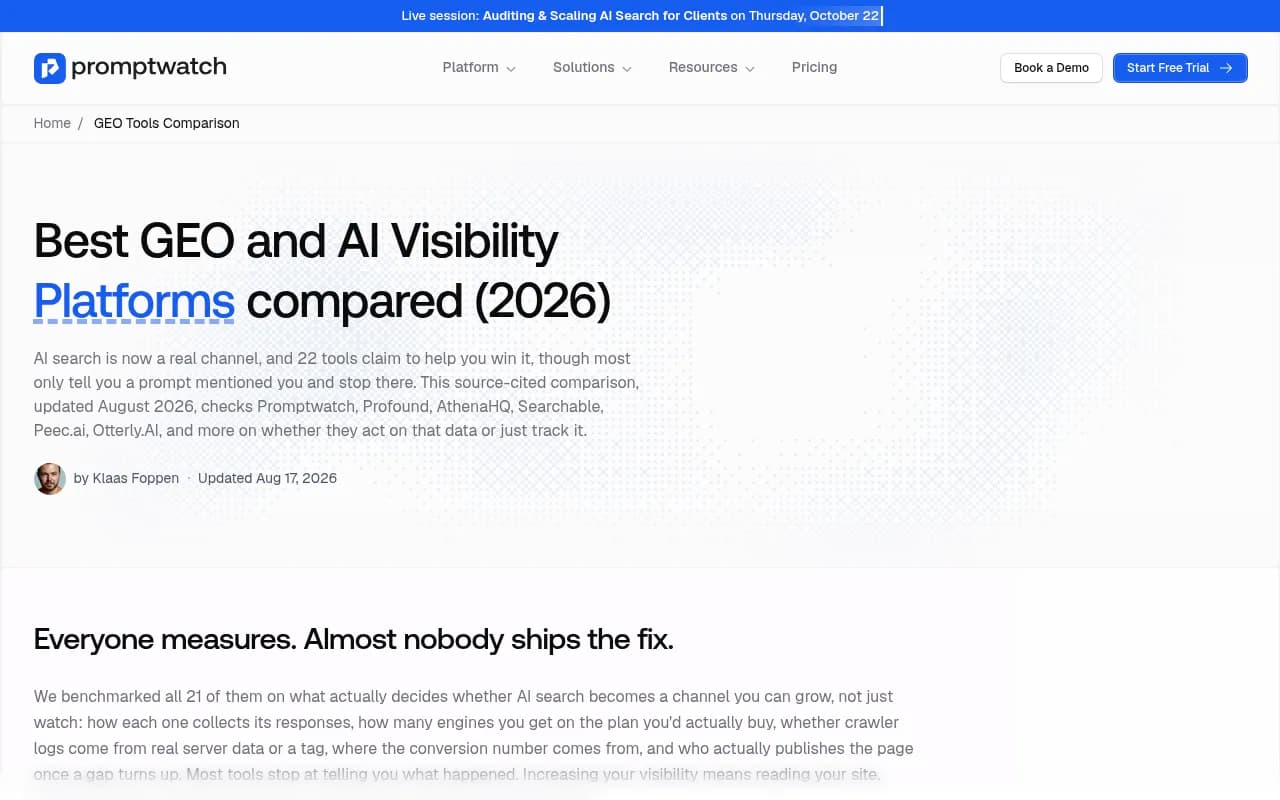
That page is Promptwatch's own comparison, so read it as a vendor claim. For a view from outside, Omnia's critique of Promptwatch is useful for knowing what to stress-test.
The short version
Agencies choose Promptwatch over Slate when they need proof of impact: bot-level crawler logs, first-party AI traffic data, real-interface tracking across many engines, and agency plans without per-project prompt caps. Slate is a credible option when content production is the center of gravity. Run the one-week test above before deciding, because the best answer depends on whether your hardest client problems are about writing or about access and attribution.