Key takeaways
- In Promptwatch Data's report for Sep 28 to Oct 4, 2026, github.com (1.2%), learn.microsoft.com (0.98%) and g2.com (0.73%) lead ChatGPT citations for organic software prompts.
- The market is fragmented. The top domain holds only 1.2% of software citations, and the 23 ranked domains together hold 7.89%.
- Docs and help centers (2.64%) and vendor sites (2.01%) earn about 3 times the share of review sites and analysts (1.57%) when you combine docs and vendor sites.
- Smaller dev tools can compete with crawlable docs, a public GitHub presence, complete G2 and Capterra profiles, and product pages that are easy to compare.
- Treat your own site as your main citation source. Third-party profiles support it, they don't replace it.
What the data says
The numbers come from Promptwatch Data's software citations report, which covers organic software prompts in ChatGPT from Sep 28 to Oct 4, 2026. It ranks 23 domains. Here are the ones with published shares.
| Domain | Share of software citations | Type |
|---|---|---|
| github.com | 1.2% | Code hosting |
| learn.microsoft.com | 0.98% | Docs |
| g2.com | 0.73% | Review site |
| docs.aws.amazon.com | 0.41% | Docs |
| docs.cloud.google.com | 0.35% | Docs |
| gartner.com | 0.34% | Analyst |
| capterra.com | 0.32% | Review site |
| intercom.com | 0.28% | Vendor site |
| zapier.com | 0.24% | Vendor site |
Look at the scale before getting intimidated. The leader has 1.2%. That is not a monopoly. It is a long tail with a few recognisable names at the front.
The report also combines domains by company. Microsoft earns 1.35% across 3 domains, Google 0.98% across 4, AWS 0.69% across 2, and OpenAI 0.42% across 2. Big platform companies win partly by owning several surfaces at once: docs, support, marketing pages, and developer sites.
By source type, the 23 domains split like this:
| Source type | Share |
|---|---|
| Docs and help centers | 2.64% |
| Vendor sites | 2.01% |
| Review sites and analysts (G2, Gartner, Capterra, Software Advice) | 1.57% |
| GitHub | 1.2% |
| App stores | 0.47% |
Vendor sites plus docs come to 4.65%, roughly 3 times what review sites and analysts earn. That ratio matters more than any single logo on the list.
Why these three win
I'd be wary of anyone who claims to know exactly how ChatGPT picks sources. What the data shows is a pattern, and the pattern has plausible explanations. Treat the reasons below as informed reading, not proven mechanics.
GitHub: the source of record for code
Software prompts are often about how to do something with a tool, library or SDK. GitHub hosts READMEs, issues, release notes and examples for a huge share of them. It is public, structured, plain text, and tied directly to the thing being asked about. For a developer tool, a GitHub repo is the closest thing to a canonical primary source.
There is a side story here. GitHub's place inside Microsoft has changed. Runtime reported in August 2025 that Microsoft was folding GitHub into its CoreAI group, ending its semi-independent status after the $7.5 billion 2018 acquisition.
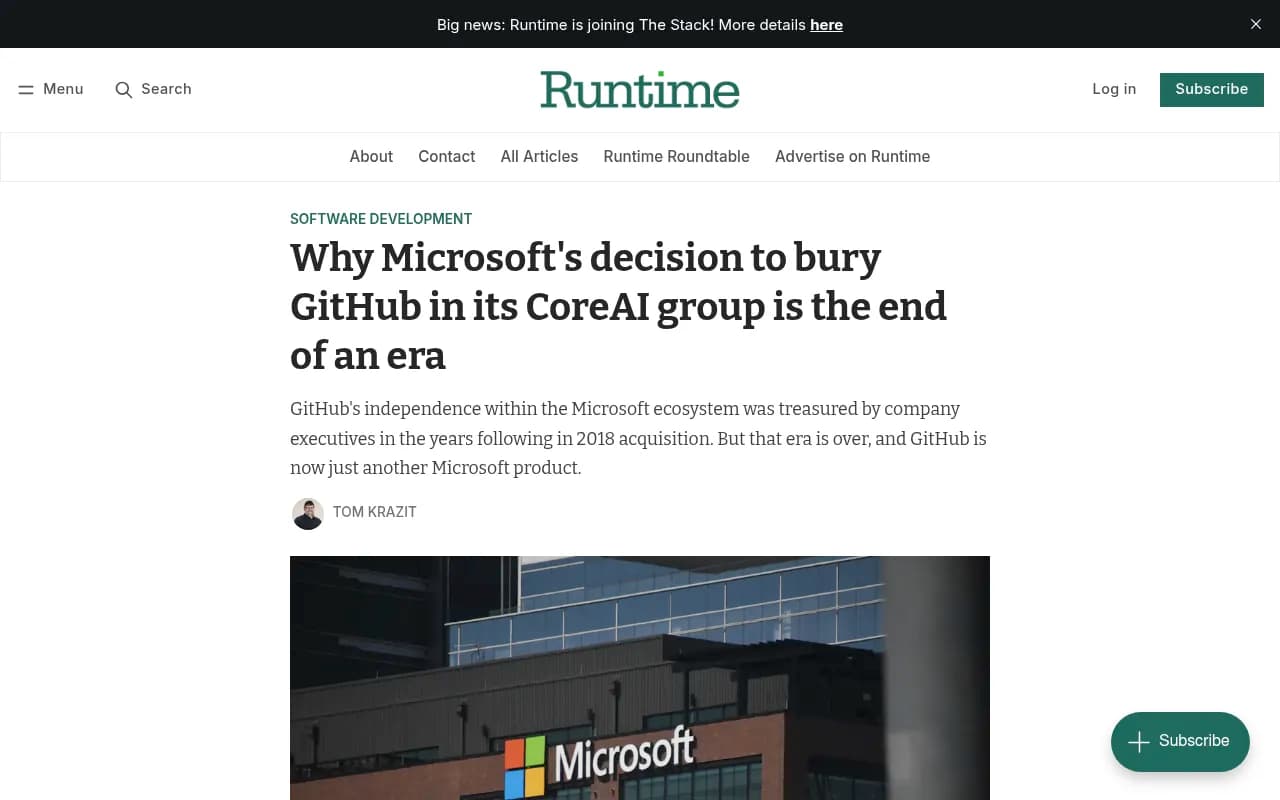
That is corporate context, not an explanation of citation behaviour. Nothing in it tells us why ChatGPT cites GitHub. The reasons are on the page: GitHub is where the code and the docs-in-code live.
learn.microsoft.com: documentation that answers questions
Microsoft's docs are exhaustive, consistently structured, and public. Each page covers a narrow task or concept with headings, code samples and parameter tables. That shape matches how people ask software questions. Add the fact that Microsoft holds 1.35% across three domains and you see a company that has invested in every surface a model might retrieve from.
AWS and Google follow the same recipe. docs.aws.amazon.com (0.41%) and docs.cloud.google.com (0.35%) are both documentation sites. Docs and help centers are the largest source type in the report.
G2: the most cited review site
G2 leads review sites at 0.73%, ahead of Gartner (0.34%) and Capterra (0.32%). Software buyers ask comparison and recommendation questions, and G2 has category pages, ratings and structured profiles for thousands of products. For those prompts it is a ready-made answer source.
Branded prompts lean on reviews too. In Promptwatch Data's content type report, reviews are 5.6% of citations for branded prompts, more than 3 times their 1.7% overall share. When someone asks ChatGPT about your tool by name, review content gets pulled in.
What content types ChatGPT cites
The same period (Sep 28 to Oct 4, 2026) in the content type report shows what kind of page earns citations across all topics:
| Content type | Share of ChatGPT citations |
|---|---|
| Product pages | 22.4% |
| Landing pages | 16.8% |
| Listicles | 13.6% |
| How-to guides | 8.7% |
| Documentation | 7.5% |
| General articles | 6.1% |
| Comparisons | 5.9% |
| News | 5.7% |
| FAQ pages | 3.3% |
| Reviews | 1.7% |
Product and landing pages together are 39%. For commercial prompts like "best CRM for small businesses", product pages take 26.0%, landing pages 20.6%, listicles 15.0% and comparisons 7.9%. Those four make up almost 70% of commercial citations.
For a small dev tool this is good news. Product pages and landing pages are things you fully control. You don't need a billion-dollar docs team to publish them well.
Longevity favours the same assets. According to Promptwatch's content half-life data, landing pages and docs stay cited longest, while news loses half its cited pages within about 36 days. A docs page you maintain keeps earning. A launch announcement fades.
How smaller dev tools can compete
You will not out-cite Microsoft on Azure questions. You can win the prompts about your own category, your own integrations and your own use cases. The report's recommendations point the way, and I'd order them like this.
1. Make your docs public and crawlable
Docs are the largest source type in the report. Put them on a plain URL path, avoid login walls, render the content server-side where you can, and give each page one clear job. If a model cannot fetch it, it cannot cite it.
Check your robots.txt as well. Many sites block AI crawlers by accident. Free tools like Promptwatch's Robots.txt Generator for AI and its AI Crawler URL Inspector let you test access without signing up.
2. Keep a public GitHub presence
Even if your product is closed source, publish something: SDKs, example apps, API clients, an issue tracker, a thorough README. GitHub earns 1.2% on its own, more than any other single domain in the report. A repo with a clear description and working examples gives models a primary source tied to your name.
3. Keep G2 and Capterra profiles complete and current
Fill in every field. Match your product description to your site. Collect fresh reviews, since reviews carry extra weight on branded prompts. G2 is the most cited review site, so start there, then Capterra. Don't treat this as a substitute for your own pages. Review sites and analysts together earn about a third of what vendor sites and docs earn.
4. Make product pages easy to compare
The content type report recommends clear pricing, specs and target audience on product pages. I'd add: say who the tool is not for. Comparison prompts reward pages that state limits plainly. Also publish your own comparison pages, and try to get listed in the "best of" roundups ChatGPT already cites. Listicles hold 13.6% of citations overall.
5. Write step-by-step guides and an FAQ
How-to guides take 8.7% of citations, and 10.7% on informational prompts. FAQ pages take 3.3% overall and 4.8% on branded prompts. Both are cheap to produce and map to real questions. Start from the questions your support team answers most.
6. Treat your own site as the main source
This is the report's bluntest line, and I agree with it. Vendor sites (2.01%) and docs (2.64%) beat third-party profiles. Everything else is amplification of what your own domain says.
A practical 30-day plan
| Week | Task | Why |
|---|---|---|
| 1 | Audit robots.txt, docs rendering and sitemap | Fix access before content |
| 2 | Clean up GitHub README, add examples; complete G2 and Capterra profiles | Primary source and review coverage |
| 3 | Rewrite product and landing pages with pricing, specs and audience | Largest cited content types |
| 4 | Publish a comparison page, one how-to and an FAQ | Fill commercial and informational gaps |
Then measure. You need to know which prompts mention you, which pages get cited, and whether AI crawlers can read the pages you just fixed.
Measuring whether it works
Citation share is small and noisy at this level, so check prompt-level results over time instead of eyeballing a few chats. Promptwatch tracks the prompts you pick across ChatGPT and other AI engines, shows which of your pages get cited, and reads IP-verified crawler logs to separate an access problem from a content problem. Its AI crawler logs are the piece most trackers skip.

Other options exist if you want to compare. Peec AI and Otterly.AI are lighter prompt trackers, and Profound sits at the enterprise end.



For a wider list, the GEO software directory at bestgeosoftware.com is a good place to browse.
What this data does not tell you
A few honest caveats.
- The report covers one week (Sep 28 to Oct 4, 2026). Shares move month to month.
- It covers organic software prompts. Your niche may look different.
- The page text gives figures for only the top nine domains. Others on the list, like Salesforce help, Zendesk and HubSpot's blog, have no published numbers here.
- Correlation is not mechanism. We see which domains get cited, not the ranking logic behind it.
- The GitHub and Copilot productivity studies floating around, and Microsoft's reorganisation, are background. They don't explain ChatGPT's citation behaviour.
The takeaway
GitHub, Microsoft Docs and G2 lead because each is a large, public, well-structured source for a type of question software buyers and developers ask: how do I build it, how does it work, and which tool should I pick. With 1.2% as the top share, there is plenty of room underneath. Fix crawl access, publish real docs, keep a repo, complete your review profiles, and make your own pages the clearest answer to questions about your product.