Key takeaways
- ChatGPT uses LinkedIn mostly to look up companies: in August 2026, company pages were 33.68% of its LinkedIn citations, up from 23.84% (Promptwatch Data).
- Wikipedia is still the runner-up domain in ChatGPT citations (0.56% in June 2026), but notability rules mean many companies cannot and should not have a page.
- Crunchbase matters less as a direct citation and more as a data supplier. It licenses data to LinkedIn and has a partnership putting its funding data inside Perplexity Enterprise Pro.
- The practical job is consistency: the same name, description, founding date, headcount and leadership across every profile AI might read.
- Measure first. Check what AI says about you now, then fix the source that is wrong.
Why a few profile sites decide what AI says about your company
Ask ChatGPT "what does Acme do, and how big is it?" and the answer will not come from your carefully written homepage alone. It gets stitched together from sources the model considers neutral: encyclopedias, databases, professional networks, review sites, news. Your own site is one voice among many, and a self-description is the least trusted of them.
This is good news for smaller companies, because the sources are boring and fixable. You do not need a PR miracle to correct a wrong headcount on a profile. You need to know which profile is wrong and who can edit it.
There is a catch, though. Nobody outside the labs knows the exact weighting, and I would be suspicious of anyone who claims a precise ranking. What we do have is citation data, which shows what AI engines actually link to. That is the evidence this guide leans on.
What the citation data says
Promptwatch Data is the first-party research behind Promptwatch, built on 26.5B+ analysed citations, clicks and prompts. Three of its reports are directly relevant here.

LinkedIn: company pages are the part that gets cited
In Promptwatch's LinkedIn citation page types report for August 2026 (window Aug 1-31), the mix across all engines looked like this:
- Pulse articles: 30.41% of LinkedIn citations
- Posts: 27.75%
- Company pages: 18.05%, up from 13.35% in the May 18 to Jun 17 baseline
- Showcase pages, product pages and LinkedIn Learning: each under 0.5%
The ChatGPT numbers are the interesting ones. Company pages were 33.68% of its LinkedIn citations, up from 23.84%. Job listings (6.51%) and help articles (5.97%) add to that, so roughly half of what ChatGPT cites from LinkedIn is company-profile material. Pulse articles fell from 8.77% to 3.65%. The report's reading is that ChatGPT uses LinkedIn mainly to look up companies, and its advice is to keep the about section, offerings, size and locations complete and current.
Perplexity shows the same direction: company pages rose from 13.09% to 22.03%, the biggest gain of any page type there. Google AI Mode and AI Overviews lean more on articles and posts, with company pages at 13.53% and 14.46%.
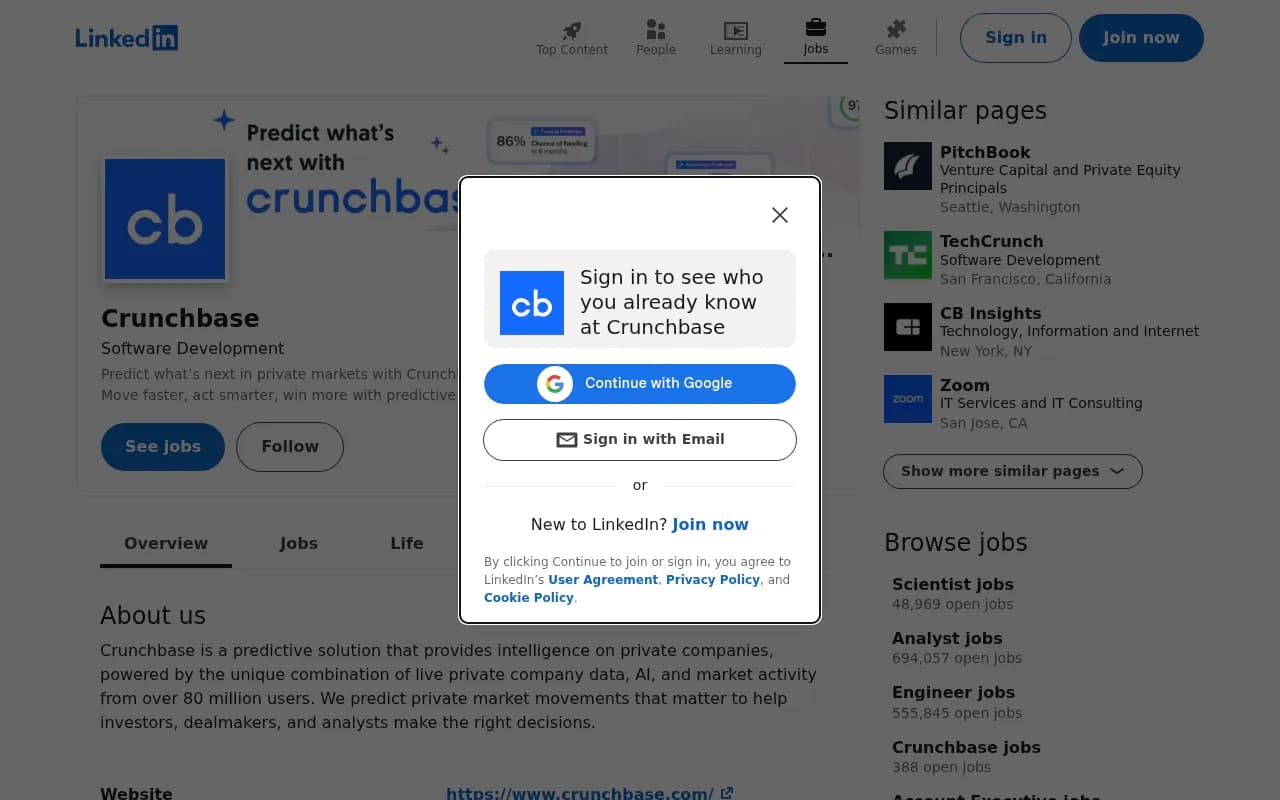
One caveat. LinkedIn is a small slice of total citations. In the Sep 28 to Oct 4, 2026 social citations report, LinkedIn was about 0.3% of ChatGPT citations (still its most cited social platform), 0.86% on Perplexity and 1.55% on AI Overviews. Small, but it is the slice that answers "who is this company" questions, which is the exact job we care about.
Wikipedia: strong but gated
The ChatGPT citation share report for June 2026 puts Reddit at 3.71% and Wikipedia second at 0.56%. No domain holds more than 4%, so the long tail dominates. The report's advice is a well-maintained Wikipedia presence "where notability allows", plus up-to-date review-site profiles.
Treat older figures with care. The live top ChatGPT sources page dates from September 2025 and is internally inconsistent about Wikipedia's share (one blurb says 3-5%, the chart shows 0.7%). I would not quote either number.
Crunchbase: the quiet supplier
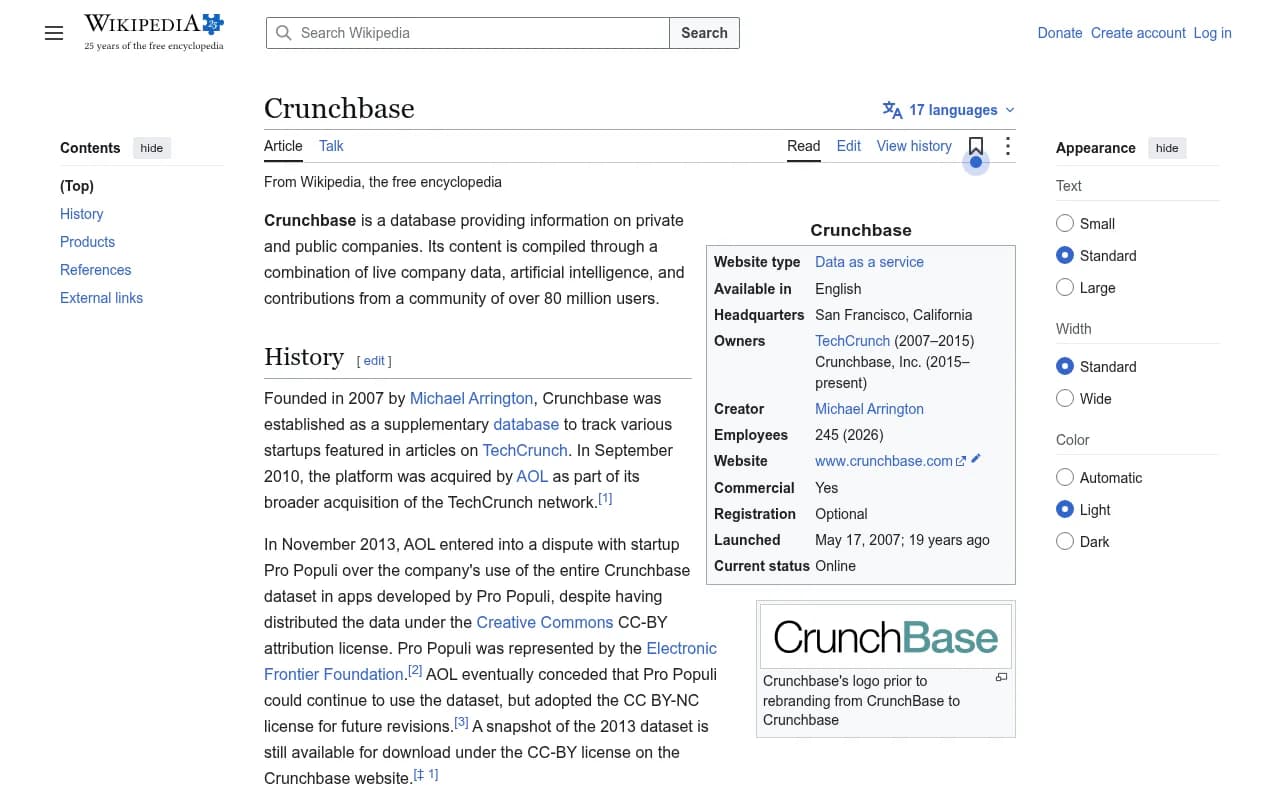
The Promptwatch reports I reviewed do not break out a Crunchbase citation share, so I will not invent one. What is documented is its role as a data source. Per Wikipedia's Crunchbase article, the company licenses its dataset to platforms like LinkedIn, Glassdoor and NASDAQ, and in 2025 partnered with Perplexity to make firmographic and funding data available in Perplexity Enterprise Pro. LinkedIn's own help center says it partnered with Crunchbase to surface an organization's funding information directly on LinkedIn Pages.
That chain is the reason to care. A wrong funding figure on Crunchbase can travel to LinkedIn and into an AI answer without ever appearing on a page you control.
Side-by-side: what each profile does
| Profile | What AI uses it for | Who can edit | Main risk |
|---|---|---|---|
| LinkedIn company page | Company lookups: description, size, locations, offerings | Page admins at your company | Stale headcount, old tagline, missing locations |
| Crunchbase | Funding, firmographics, leadership; feeds other platforms | Claimed profile owners and contributors; paid data partnerships | Wrong funding rounds, outdated founders or status |
| Wikipedia | Neutral background, history, notable facts | Anyone, under strict sourcing and conflict-of-interest norms | Notability, promotional edits getting reverted |
| Wikidata | Structured facts behind many knowledge panels | Anyone, with references | Missing or conflicting properties |
I have not verified the current step-by-step edit flows on each site in this research round, so the sections below describe the approach and point you to each platform's own help pages for the exact buttons. Those interfaces change.
How to update LinkedIn
This is the easiest win and the one the data supports most directly.
- Confirm you are a super admin of the company page. If a former employee holds that role, fix it first.
- Rewrite the about section so the first two sentences state what you do, for whom, and where you are based. Plain language beats slogans because AI summarizes this text almost verbatim.
- Check company size, industry, founding year, website and headquarters. These fields are structured, so they are easy for a system to pull.
- Add every real office location.
- Fill in specialties and offerings with the terms customers actually use.
- Align executive profiles. If the CEO's personal headline says something different from the company description, that is a conflict an AI can pick up on.
A small point worth noting: LinkedIn's own terms mention GenAI features that help hirers find and reach members, which means profile completeness feeds more than outside AI engines. Complete pages pay off twice.
For funding data, LinkedIn's Crunchbase FAQ explains that the information shown comes from Crunchbase, so you correct it at the source rather than on LinkedIn.
How to update Crunchbase
Crunchbase describes its content as a mix of live company data, AI and community contributions, so there are usually several routes to a fix.
- Find your organization profile and claim it if it is unclaimed, using your company email domain.
- Correct the basics: legal and operating name, founding date, headquarters, status, website, short and long description.
- Add funding rounds with a source link, such as a press release or a regulatory filing. Edits with references tend to stick.
- List leadership and board members accurately, and mark departed people as former.
- Re-check after a funding announcement. Press coverage and database entries drift apart quickly.
The point I would stress: keep your Crunchbase description consistent with LinkedIn, word for word if you can. Since the platforms exchange data, divergent descriptions create exactly the contradictions that make AI answers hedge or hallucinate.
Also, be aware Crunchbase suffered a reported cyberattack in January 2026 (allegedly by ShinyHunters, per Wikipedia citing Cybernews). That does not change how you update a profile, but it is a reasonable reason to use unique credentials and review who has edit access to your organization page.
Wikipedia and Wikidata: the careful route
Wikipedia is where companies most often go wrong. The temptation is to write the page yourself. Don't.
Wikipedia has notability requirements and strong norms against editing your own organization's article. I did not verify the current wording of those policies in this round, so read Wikipedia's conflict-of-interest and notability guidance directly before touching anything. The practical rules of thumb:
- If you do not have significant independent coverage (major news outlets, books, analyst reports), you probably do not qualify for an article. Building that coverage is the real project.
- If an article exists and contains an error, use the talk page. State the fix, cite an independent source, and let uninvolved editors apply it.
- Disclose your affiliation every time.
- Never edit to add promotional language. It gets reverted, and the reversion history is itself visible.
The companion is Wikidata, which stores structured facts (founding date, headquarters, official website, CEO) that many systems read. Entries there need references too, but they are far less prose-heavy. If your company is notable enough to have a Wikipedia article, check the Wikidata item behind it for matching facts.
If you cannot qualify for Wikipedia, the Promptwatch report's other advice applies: keep review-site and directory profiles current instead. Trustpilot rose from 0.18% to 0.22% of ChatGPT citations and GitHub from 0.23% to 0.27% in the same June report. Small, rising numbers, but achievable for most brands.
Make the facts agree everywhere
The single most useful exercise is a fact sheet. One document, owned by one person, containing:
- Official company name and any former names
- Founding year and founders
- Headquarters and office list
- Headcount range (decide on a convention, like "51-200")
- One-sentence and one-paragraph descriptions
- Current leadership
- Funding to date, with dates and sources
- Product names and exact spellings
Then audit each profile against it every quarter. Updating after reorganizations, rebrands and funding announcements is where facts rot. LinkedIn's own Wikipedia article is a nice example of the issue: the CEO changed in April 2026 (Daniel Shapero succeeded Ryan Roslansky, per Reuters), and any profile written before that now contains an outdated fact.
Also keep your own site honest. A clear About page and structured data give AI engines something consistent to cross-check against the third-party profiles. Entity-focused tools such as InLinks and schema tools like WordLift help here, and the broader category is covered in the directory at surferstack.com.

Check whether the fixes worked
Updating a profile and hoping is not a process. You want to see what AI says before and after.
Two free manual checks cost nothing: ask ChatGPT, Gemini and Perplexity a handful of questions about your company ("what does X do", "how big is X", "who founded X", "how much has X raised") and write down every wrong claim. Then trace the claim to a source. If ChatGPT says you have 20 employees and LinkedIn says 200, you know where to look.
For ongoing monitoring, a few categories of tool exist:
| Approach | Examples | Best for |
|---|---|---|
| End-to-end AI visibility platform | Promptwatch | Tracking claims AI makes about you, tracing the sources, and acting on gaps |
| Prompt trackers | Otterly.AI, Peec AI | Basic mention tracking |
| Listing and entity management | Yext | Pushing verified business data across directories |
| SEO suites with AI add-ons | Semrush, Ahrefs Brand Radar | Teams already living in those suites |


Promptwatch's Brand Narrative feature pulls the individual claims AI makes about your brand (like "affordable for small teams" or "mobile app lacks features") out of tracked responses, and Fact Check, on Business and higher plans, lets you mark a claim inaccurate and find the pages stating it. Its citation reports show which of your pages and which third-party profiles get cited. You can start with the free AI visibility report before committing to anything, and confirm current plans on the pricing page. More tools in this category are listed at bestgeosoftware.com.

If you would rather have specialists run the entity cleanup and GEO work for you, that is the kind of project an agency like 1001 SEO Media takes on, which also publishes this site.
A 30-day plan
Week 1. Build the fact sheet. Run the manual AI questions and record wrong answers.
Week 2. Fix LinkedIn: admins, about section, size, locations, specialties. Align executive headlines.
Week 3. Claim and correct Crunchbase. Add sourced funding rounds. Match the description to LinkedIn.
Week 4. Review Wikipedia and Wikidata. If an article exists, propose corrections on the talk page with citations. If none exists, note what independent coverage you would need and put that in the PR plan. Rerun the AI questions and compare.
Expect lag. AI answers do not change the moment you save an edit, and some will keep repeating old claims until the underlying sources are recrawled. Re-test monthly and keep the fact sheet current.
What I would not bother with
- LinkedIn showcase and product pages. They are under 0.5% of LinkedIn citations each, and Promptwatch's report says to skip them for GEO.
- Writing your own Wikipedia article. It is the fastest way to get reverted and flagged.
- Chasing a precise "trust ranking" of sites. The citation data moves month to month (Reddit's share in ChatGPT swung from 6.11% to 3.71% between May and June, then collapsed in August), so a diversified, consistent footprint beats betting on any single profile.
Get the facts right in the places AI actually looks, keep them identical, and check the results. That is the whole job.