Key takeaways
- Share of voice across LLMs is now a real marketing metric -- 37% of users start searches in AI instead of traditional search engines, and ChatGPT alone accounts for roughly 56% of AI search referral traffic.
- Most platforms in this space are monitoring-only: they show you where you're invisible but don't help you fix it.
- The tools that matter most in 2026 combine prompt tracking, citation analysis, competitor benchmarking, and some form of content optimization -- not just dashboards.
- Coverage varies wildly: some tools track 4 LLMs, others track 10+. Make sure the models your buyers actually use are included.
- Price ranges from $29/month for basic monitoring to custom enterprise tiers. The right choice depends on whether you need data alone or a full optimization loop.
Why share of voice across LLMs is now a real metric
Not long ago, tracking your brand in AI search meant manually typing prompts into ChatGPT and hoping you showed up. That was 2023. By 2026, AI search has become a genuine channel -- one that influences purchasing decisions, drives referral traffic, and shapes brand perception before a user ever visits your website.
According to Otterly.AI's 2026 research, 15% of all website traffic now originates from AI agents and bots. ChatGPT accounts for 56% of AI search referral traffic, Gemini sits at 18%, and Perplexity at 8%. Search Engine Journal puts the share of users starting searches in AI at 37%. These numbers are big enough that ignoring them is a business risk, not just a missed opportunity.
Share of voice in this context means: when someone asks an AI model a question relevant to your category, how often does your brand appear in the answer -- compared to your competitors? It's the LLM equivalent of rank position, but messier, because different models give different answers, answers change over time, and citations don't always mean recommendations.
Tracking this manually across ChatGPT, Perplexity, Claude, Gemini, Google AI Overviews, DeepSeek, Grok, and Copilot is not realistic. That's the problem these platforms solve.
What to look for in an AI visibility platform
Before getting into specific tools, here's what actually separates useful platforms from expensive dashboards:
LLM coverage. Does the tool track the models your customers actually use? ChatGPT and Perplexity are table stakes. Google AI Overviews matters enormously for consumer brands. Claude is increasingly used in professional contexts. If a tool only covers four models, you may have blind spots.
Prompt quality and volume. Some tools let you define your own prompts; others use fixed templates. Fixed prompts are easier to set up but may miss how your actual buyers search. Volume estimates and difficulty scores help you prioritize which prompts are worth winning.
Competitor benchmarking. Share of voice is relative. Knowing you appear in 40% of responses means nothing without knowing your competitor appears in 70%. Look for tools that show competitor visibility side by side.
Citation and source tracking. Which pages, Reddit threads, or third-party sites is the AI citing when it mentions you? This tells you where to invest -- your own content, PR placements, or community presence.
Actionability. This is where most tools fall short. Monitoring is step one. The harder question is: what do you do when you find a gap? Some platforms stop at the data. Others help you generate content, write briefs, or identify exactly which topics you need to cover.
Crawler and traffic data. Advanced platforms can tell you when AI crawlers visit your site, which pages they read, and whether those pages eventually get cited. This closes the loop between publishing and results.
The platforms worth considering in 2026
Promptwatch
Promptwatch is the platform I'd point most marketing teams to first, because it's one of the few that goes beyond monitoring into actual optimization. It tracks 10 AI models -- ChatGPT, Perplexity, Google AI Overviews, Google AI Mode, Claude, Gemini, Meta/Llama, DeepSeek, Grok, and Mistral -- and it does so by observing real user-facing interfaces, not just API outputs. That distinction matters because what users see in ChatGPT's interface often differs from what the API returns.
The core workflow is built around three steps: finding gaps (which prompts are competitors winning that you're not?), creating content to close those gaps (using AI agents grounded in real citation data), and tracking whether that content actually gets cited. Most competitors handle step one. Promptwatch handles all three.
It also has crawler log analysis -- real-time data on when AI crawlers like ChatGPT's bot or Perplexity's spider visit your pages, which pages they read, and when those pages move from crawled to cited. That's rare in this category. Add Reddit and YouTube tracking, ChatGPT Shopping monitoring, and multi-region/multi-language support, and it's a genuinely comprehensive platform.
Pricing starts at $99/month (Essential: 1 site, 50 prompts, 5 articles), $249/month for Professional (2 sites, 150 prompts, crawler logs), and $579/month for Business (5 sites, 350 prompts). A free trial is available.
Profound
Profound is enterprise-focused and has strong prompt research capabilities. It tracks up to 10 LLMs at the enterprise tier and is well-regarded for teams that need deep analysis of how AI models respond to category-level prompts. Starting at $99/month, it's competitively priced at the entry level, though the full feature set requires higher tiers. It's a solid choice for large brands with dedicated research teams, but it's more of an analytics platform than an optimization one.
Otterly.AI
Otterly.AI is one of the original tools in this category and has built a meaningful dataset over time. It tracks brand mentions and share of voice across ChatGPT, Claude, Gemini, and Perplexity in 67+ countries, and its entry price of $29/month makes it accessible for smaller teams. The monitoring depth is reasonable, but it's primarily a tracking tool -- there's no content generation or crawler log analysis. Good for teams that want affordable visibility data without a lot of complexity.
Peec AI
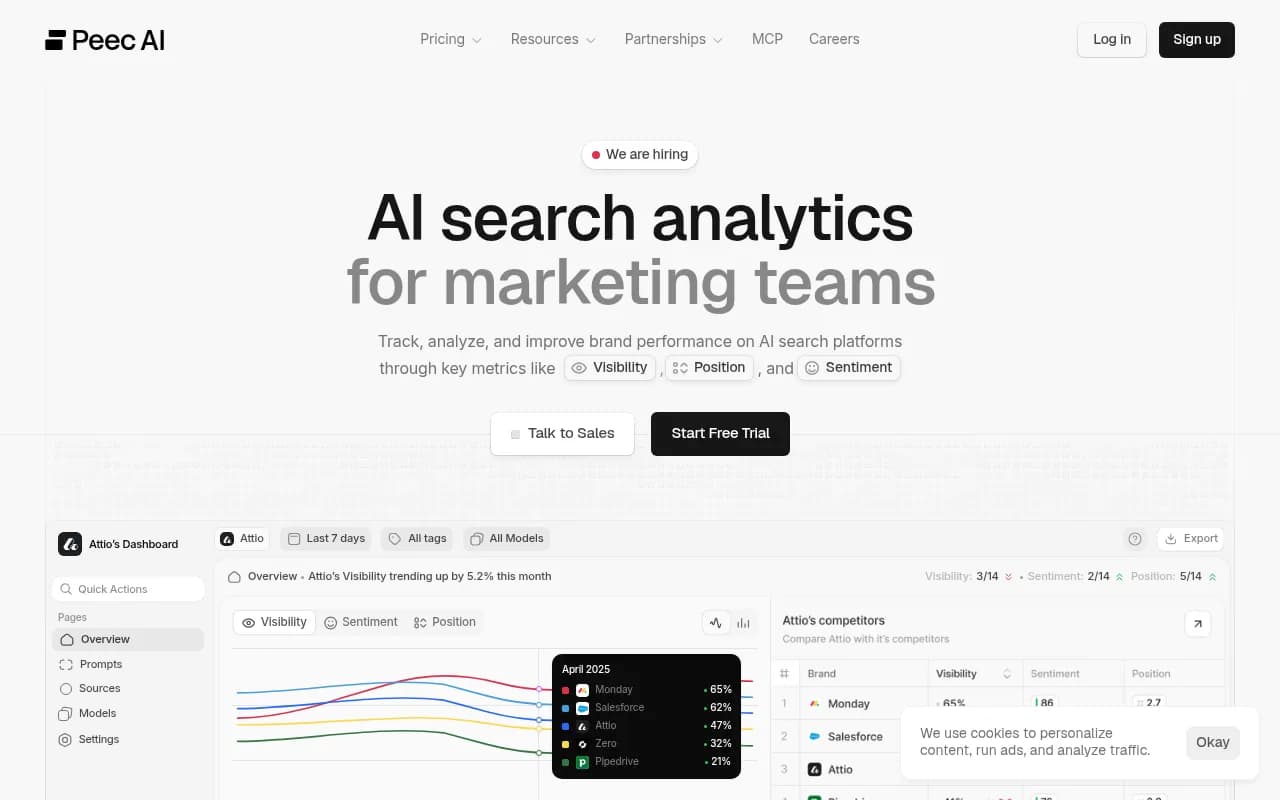
Peec AI offers flexible model selection, letting you choose which LLMs to track rather than locking you into a fixed set. Starting at €85/month, it covers up to 10 models and is a reasonable mid-market option for teams that want some control over their monitoring setup. The platform includes brand mention tracking and competitive benchmarking, though it doesn't have the content optimization capabilities of more full-featured platforms.
KIME
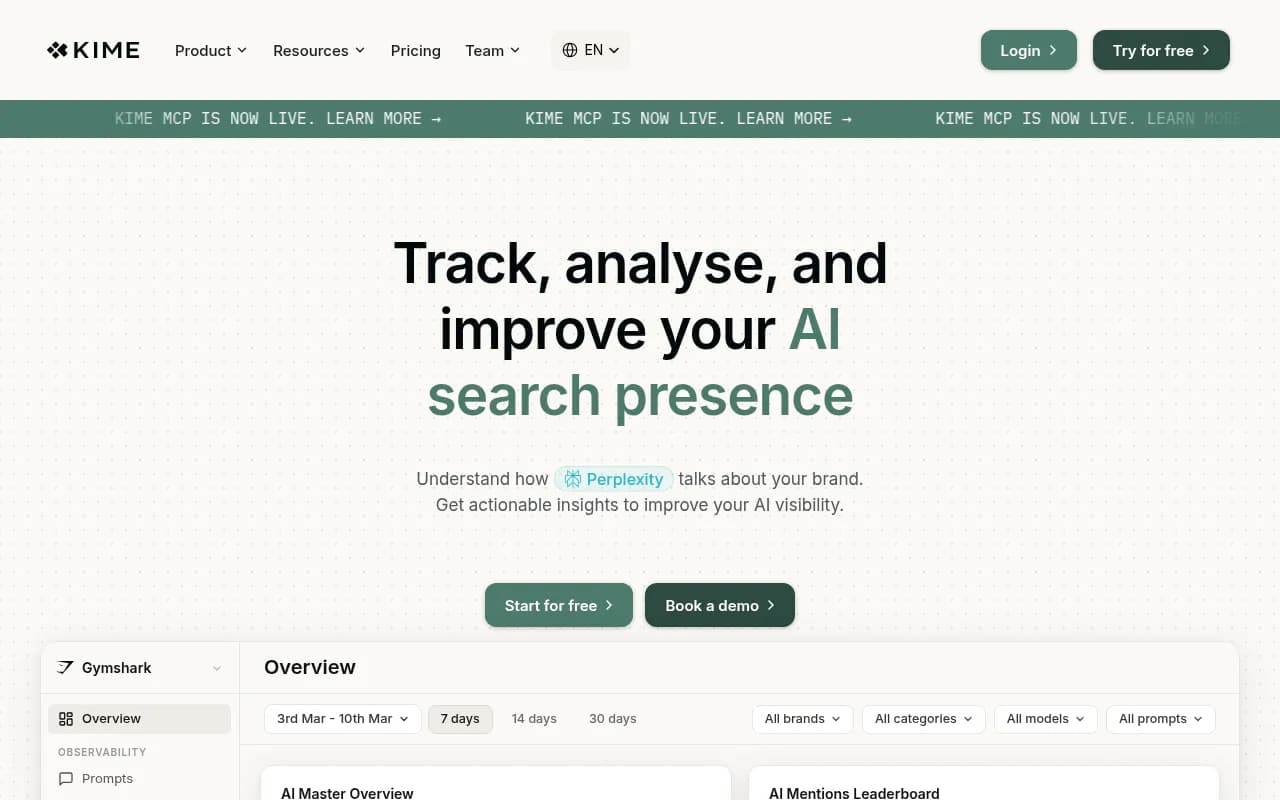
KIME tracks 10 AI models and includes an "Action Centre" for optimization recommendations -- which puts it closer to the optimization end of the spectrum than pure monitoring tools. Starting at €149/month, it supports multi-brand and multi-country setups and is worth considering for agencies managing multiple clients. The Action Centre is a differentiator, though it's more recommendation-based than generative.
Semrush AI Visibility Toolkit
If your team already uses Semrush, the AI Visibility Toolkit is the path of least resistance. It covers 5 LLMs and integrates with the existing Semrush workflow. The limitation is that it uses fixed prompts rather than custom ones, which means you're tracking a predefined set of queries rather than the specific questions your buyers are asking. Useful as a starting point, but not a substitute for a dedicated AI visibility platform if you're serious about the channel.
SE Ranking Visible
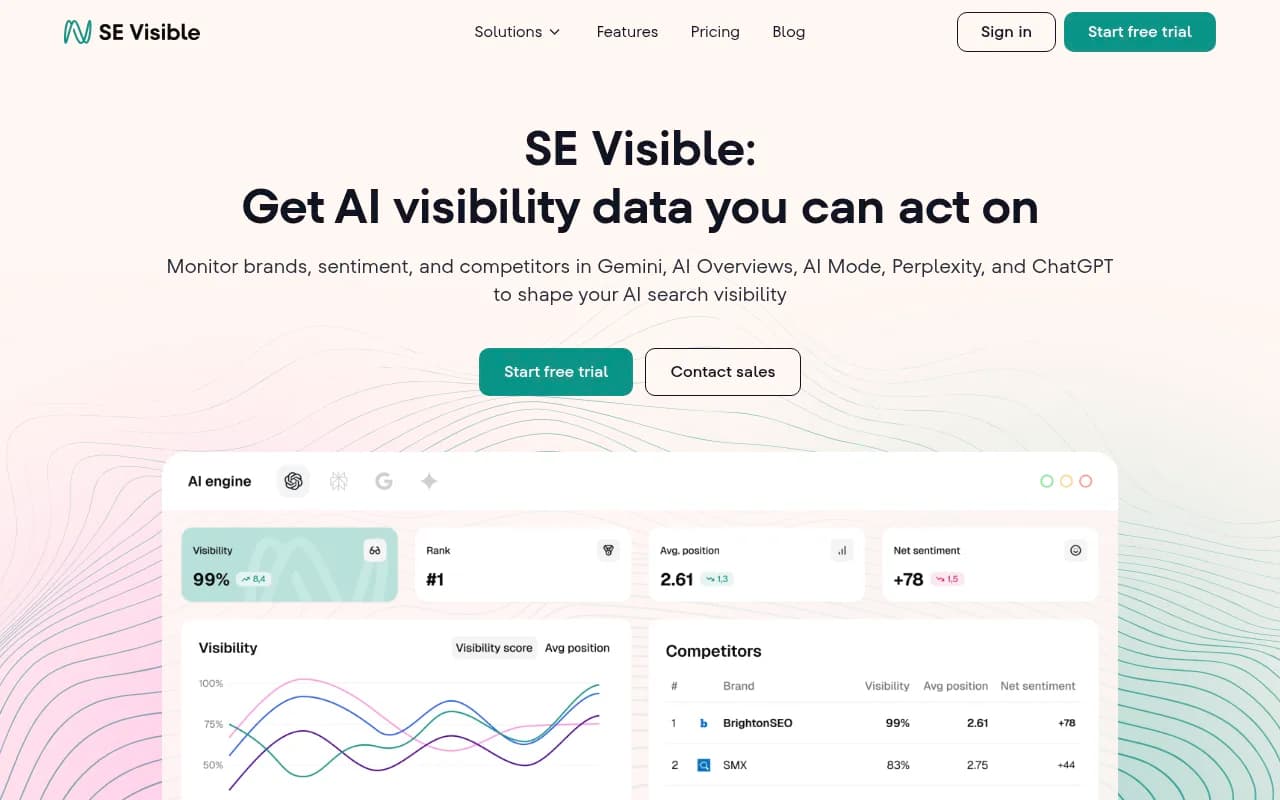
SE Ranking's AI visibility module covers 5 LLMs and is positioned for multi-brand and multi-country use cases at $99/month. It's a reasonable option for teams already in the SE Ranking ecosystem who want to add AI monitoring without switching platforms entirely.
Nightwatch
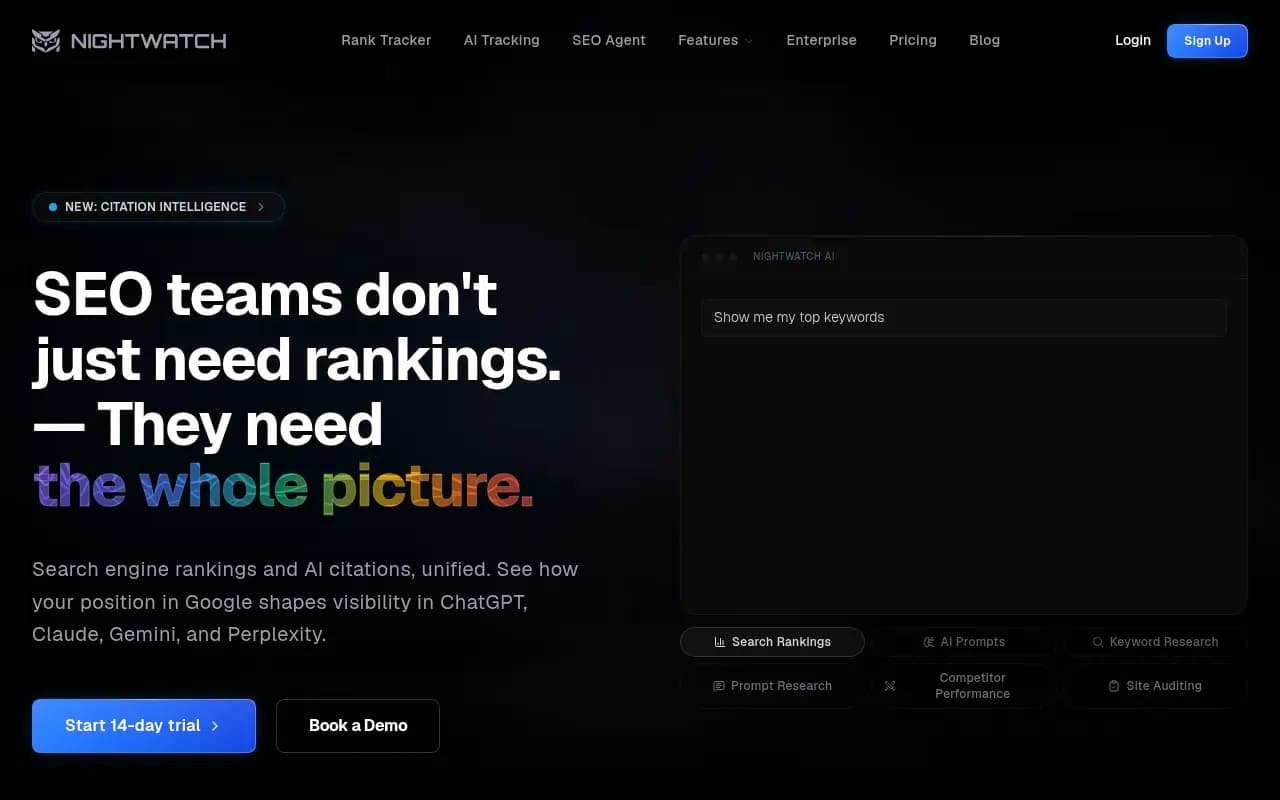
Nightwatch combines traditional rank tracking with AI search monitoring, covering 4 LLMs via a $99/month add-on to its base plan (starting at $32/month). It's a practical choice for SEO-focused teams that want a single tool for both traditional and AI search, though the AI monitoring depth is lighter than dedicated platforms.
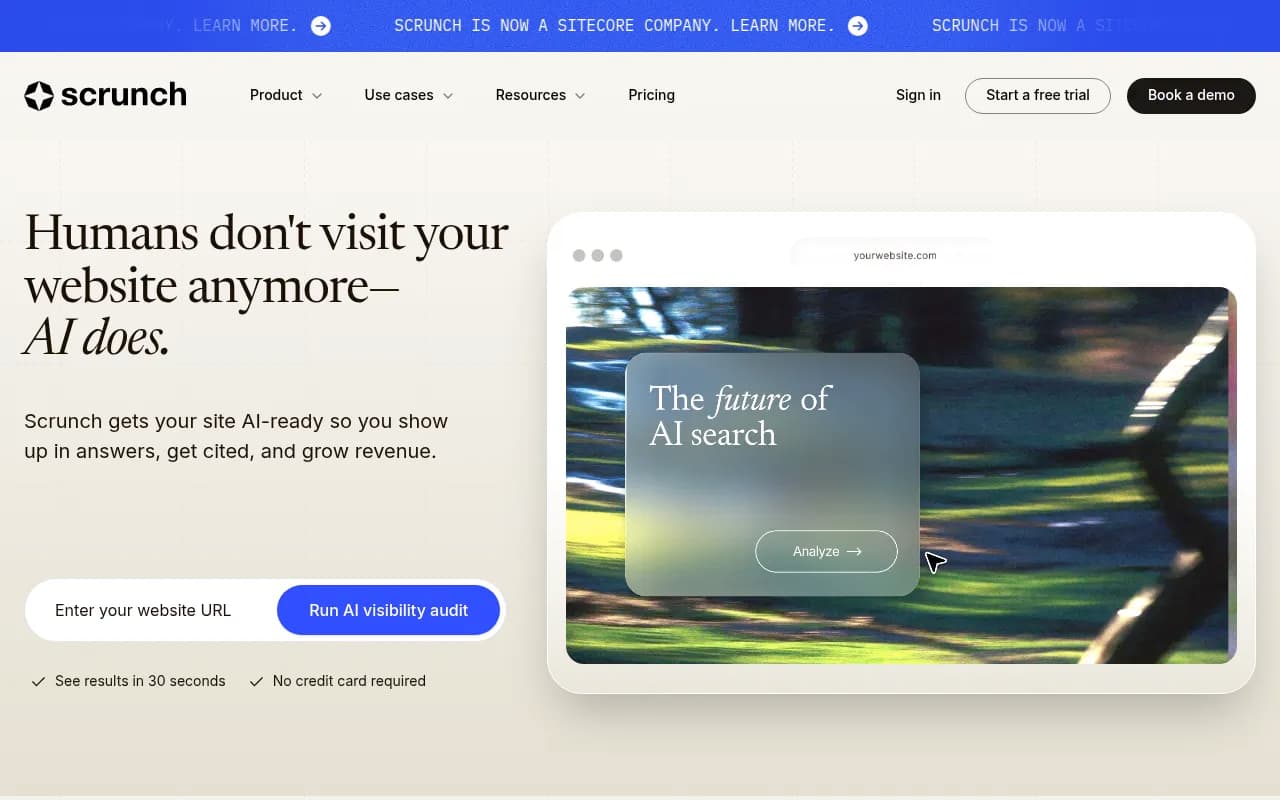
Scrunch AI
Scrunch AI is built for brands and agencies that want monitoring with some competitive intelligence layered in. It tracks brand mentions across major AI platforms and provides share-of-voice comparisons. Worth evaluating if you're an agency managing multiple brands and want a clean reporting interface.
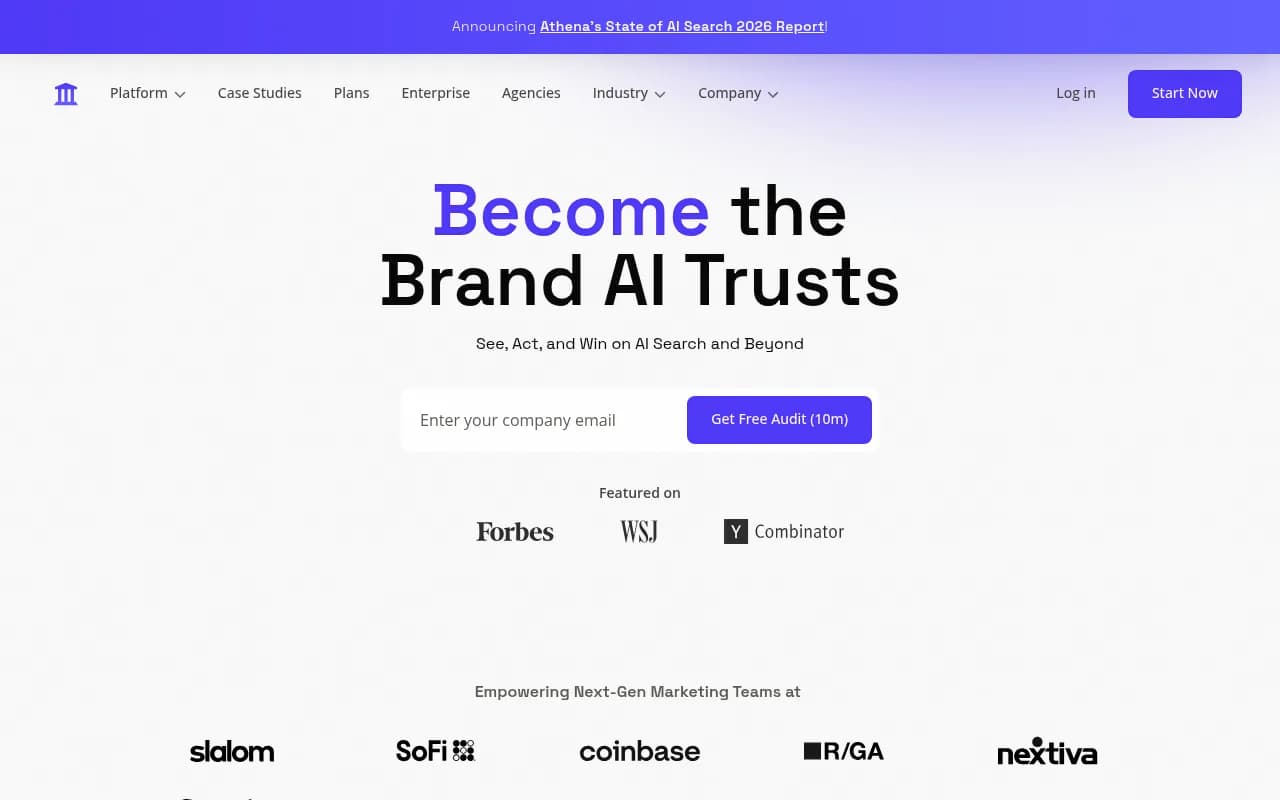
AthenaHQ
AthenaHQ focuses on AI search visibility monitoring with a clean interface and reasonable LLM coverage. It's monitoring-focused -- useful for understanding where you stand, but it doesn't have content generation or crawler analytics built in.
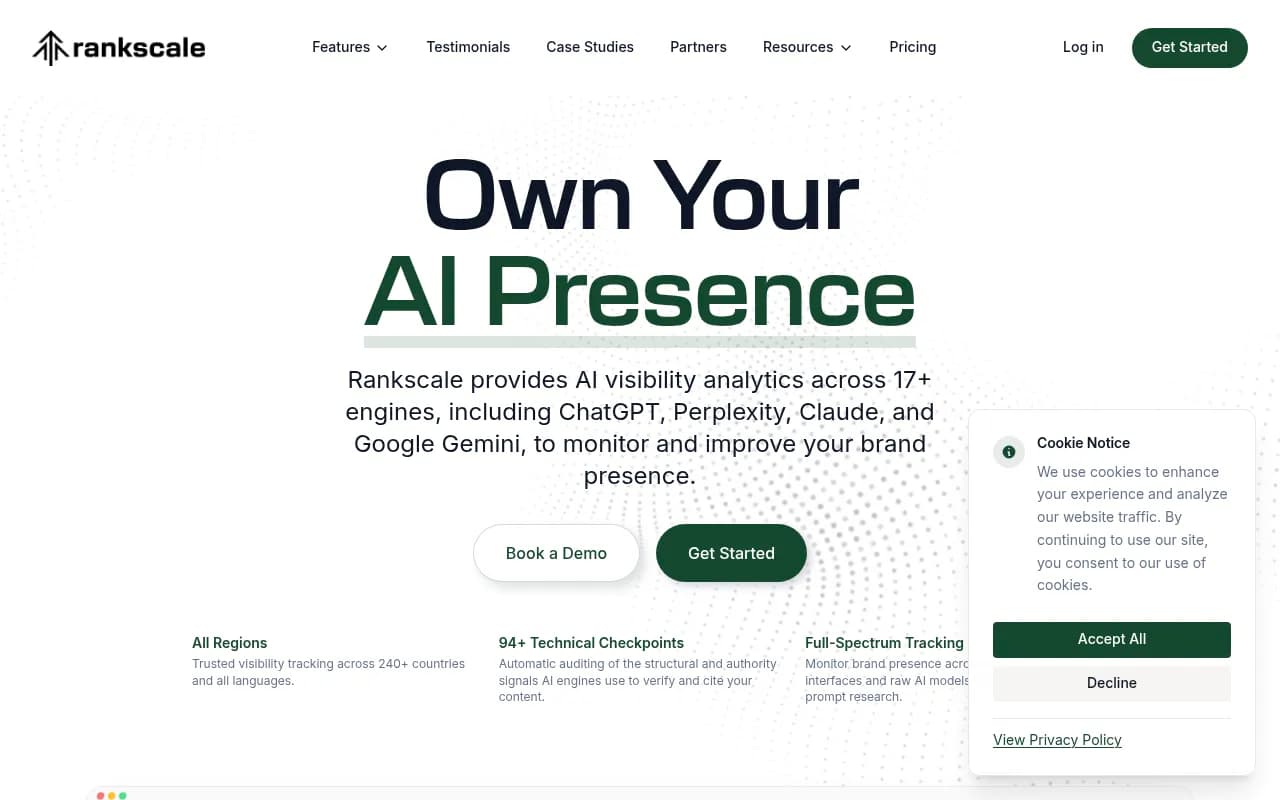
Rankscale
Rankscale is a monitoring-oriented tool with a focus on LLM rank tracking. It's a lighter-weight option for teams that want straightforward visibility data without a lot of configuration overhead.
Search Party
Search Party is built with agencies in mind and covers the major AI search platforms. It's a reasonable choice for agency teams that need multi-client reporting, though prompt metrics and content gap analysis are limited compared to more full-featured platforms.
Comparison table: AI visibility platforms in 2026
| Platform | LLMs tracked | Starting price | Content generation | Crawler logs | Best for |
|---|---|---|---|---|---|
| Promptwatch | 10 | $99/mo | Yes | Yes | Full optimization loop |
| Profound | Up to 10 | $99/mo | No | No | Enterprise analytics |
| KIME | 10 | €149/mo | Recommendations | No | Multi-brand agencies |
| Peec AI | Up to 10 | €85/mo | No | No | Flexible model selection |
| Otterly.AI | 4 (base) | $29/mo | No | No | Budget monitoring |
| Semrush AI Toolkit | 5 | Bundled | No | No | Existing Semrush users |
| SE Ranking Visible | 5 | $99/mo | No | No | SE Ranking users |
| Nightwatch | 4 | $32 + $99/mo | No | No | SEO + AI combo |
| Scrunch AI | 4-6 | Custom | No | No | Agency reporting |
| AthenaHQ | 5+ | Custom | No | No | Monitoring-focused teams |
| Rankscale | 4-5 | Custom | No | No | Lightweight tracking |
| Search Party | 5+ | Custom | No | No | Agency multi-client |
The monitoring-only problem
Here's the honest issue with most of these platforms: they tell you where you're invisible, then leave you to figure out what to do about it.
That's not nothing -- knowing you're missing from 80% of relevant AI responses is valuable information. But it's only useful if you can act on it. And acting on it means understanding which specific topics you're not covering, what content format AI models prefer for those topics, which sources they're already citing, and how to create something that actually gets picked up.
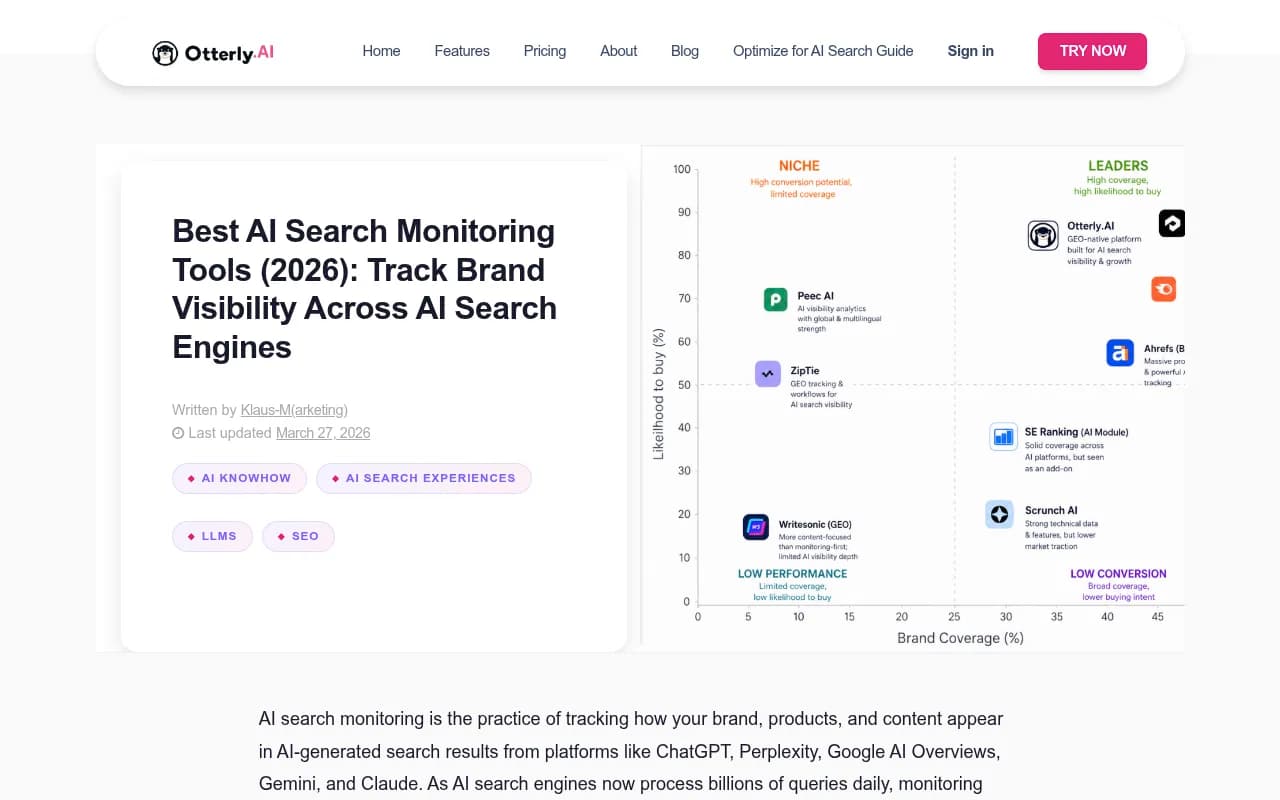
Most monitoring tools hand you a gap report and stop there. The platforms that close that loop -- by connecting gap data to content creation to citation tracking -- are the ones that will matter most as AI search matures. Right now, that's a short list.
How to choose the right platform for your situation
The right tool depends on what stage you're at and what you need to do with the data.
If you're just starting out and want to understand your current AI visibility without a big investment, Otterly.AI at $29/month is a reasonable starting point. You'll get basic share-of-voice data across four major platforms.
If you're at a mid-size company with a content team and you want to actually move the needle -- not just measure it -- you need a platform with content optimization built in. That's where Promptwatch earns its place. The combination of gap analysis, content generation grounded in real prompt data, and crawler log tracking gives you a feedback loop that pure monitoring tools can't match.
If you're an enterprise with a dedicated research team and you need deep prompt analytics, Profound is worth evaluating alongside Promptwatch. The two have different strengths: Profound leans into research depth, Promptwatch leans into the full optimization cycle.
If you're an agency managing multiple clients, KIME and Search Party both have multi-brand setups worth looking at, though Promptwatch also has agency and enterprise pricing.
One thing to check regardless of which tool you evaluate: make sure it tracks the specific LLMs your buyers use. A B2B software company's buyers might skew heavily toward Perplexity and Claude. A consumer brand might care more about ChatGPT Shopping and Google AI Overviews. The models that matter vary by industry and audience.
What the data actually tells you
Share of voice across LLMs is not a vanity metric -- but it can become one if you're not careful about what you're measuring.
A high mention rate in AI responses is meaningless if those mentions are neutral or negative. Citation rate matters more than mention rate in most cases: being cited as a source means the AI model trusts your content enough to point users to it, which is closer to the old "ranking #1" than a passing mention in a list.
Prompt-level data is where things get interesting. Different prompts produce very different visibility outcomes. You might dominate responses to "best project management software for remote teams" but be completely absent from "project management tools with Slack integration." Knowing which prompts you're winning and which you're losing -- and why -- is the real intelligence.
The tools that surface this prompt-level granularity, combined with competitor benchmarks and content recommendations, are the ones worth paying for in 2026. The ones that only show you a single "AI visibility score" are telling you less than they appear to.
Final thought
AI search visibility is not a future problem. It's a present one, and the brands that build systematic tracking and optimization workflows now will have a meaningful head start over those that wait until the channel is fully mature.
The category of tools covered here is still evolving fast -- new platforms launch regularly, existing ones add features, and the LLMs themselves keep changing how they surface and cite content. The best approach is to pick a platform that gives you real data, connects that data to action, and lets you track whether your actions are working. That loop -- measure, act, verify -- is what separates the platforms worth using from the ones that just look good in a demo.