Key takeaways
- Promptwatch is an AI-first platform built around a full optimization loop: find gaps, generate content, track results. Nightwatch is an SEO rank tracker that added AI visibility as a feature layer.
- Promptwatch monitors 10 AI models; Nightwatch covers 5. If you care about Grok, DeepSeek, Mistral, or Meta AI, Nightwatch doesn't track them.
- Nightwatch starts at €79/mo and is meaningfully cheaper at entry level -- but its AI features are limited compared to what Promptwatch offers even on the $99/mo Essential plan.
- Promptwatch includes AI content generation (articles, listicles, comparisons) grounded in real prompt data. Nightwatch has no content generation at any tier.
- Nightwatch's traditional SEO rank tracking -- 107,000+ locations, keyword research, site audit -- is genuinely strong and has no equivalent in Promptwatch.
- If your team needs both traditional SEO and AI visibility, Nightwatch is the more unified option. If AI search is your primary focus and you want to actually improve your visibility (not just measure it), Promptwatch is the stronger choice.
Overview
Promptwatch

Promptwatch is an end-to-end GEO (Generative Engine Optimization) platform built from the ground up for AI search. The core idea is a three-step loop: identify which prompts your competitors appear for but you don't, generate content that fills those gaps, then track whether AI models start citing your new pages. It monitors 10 AI platforms -- ChatGPT, Perplexity, Gemini, Claude, Google AI Overviews, Google AI Mode, Grok, DeepSeek, Meta AI/Llama, Copilot, and Mistral -- and processes real user-facing responses rather than just API outputs. Used by 1,480+ brands and agencies including Booking.com, Duolingo, Typeform, and Yelp, and rated 4.7/5 on G2.
Nightwatch
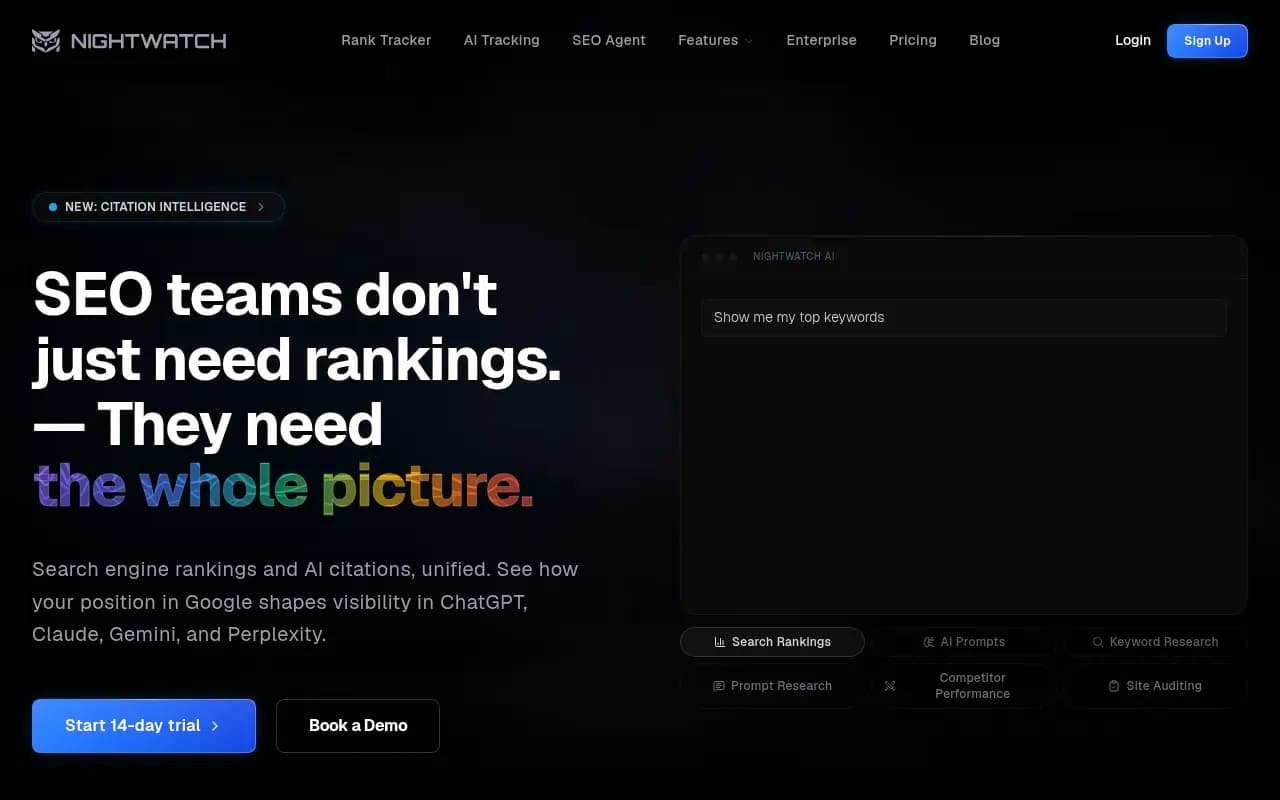
Nightwatch has been an SEO rank tracking platform for 13 years, trusted by 10,000+ SEO teams. In 2024-2025 it expanded into AI search visibility, adding AI tracking, Citation Intelligence, and an SEO Agent alongside its existing rank tracker, keyword research, site audit, and reporting tools. The pitch is "the whole picture" -- traditional rankings and AI citations in one place. It covers ChatGPT, Claude, Gemini, Perplexity, and Google AI Overviews, and tracks rankings across 107,000+ locations.
Side-by-side comparison
| Feature | Promptwatch | Nightwatch |
|---|---|---|
| Primary focus | AI search visibility & GEO | SEO rank tracking + AI add-on |
| AI models tracked | 10 (ChatGPT, Perplexity, Gemini, Claude, Grok, DeepSeek, Copilot, Mistral, Meta AI, Google AI Overviews) | 5 (ChatGPT, Claude, Gemini, Perplexity, Google AI Overviews) |
| Traditional rank tracking | No | Yes, 107,000+ locations |
| Content generation | Yes (AI Content Agents) | No |
| Content gap analysis | Yes (Answer Gap Analysis) | Limited (Citation Intelligence) |
| AI crawler logs | Yes | No |
| Prompt volume & difficulty scores | Yes | No |
| ChatGPT Shopping tracking | Yes | No |
| Reddit & YouTube insights | Yes | No |
| Offsite citation tracking | Yes | Partial (Citation Intelligence) |
| Site audit | No | Yes |
| Keyword research | No | Yes |
| Looker Studio integration | Yes | Yes |
| API access | Yes | Yes |
| Free trial | Yes | Yes (14 days) |
| Starting price | $99/mo | €79/mo (~$85/mo) |
| G2 rating | 4.7/5 | Not listed |
Head-to-head feature deep-dive
AI model coverage
Promptwatch tracks 10 AI platforms: ChatGPT, Perplexity, Gemini, Claude, Google AI Overviews, Google AI Mode, Grok, DeepSeek, Meta AI/Llama, Copilot, and Mistral. Nightwatch covers 5: ChatGPT, Claude, Gemini, Perplexity, and Google AI Overviews.
That gap matters more than it sounds. Grok and DeepSeek have grown significantly in 2025-2026, and Meta AI is embedded across WhatsApp, Instagram, and Facebook -- meaning it reaches a massive audience that most tracking tools ignore. If your brand operates in markets where these models are popular, Nightwatch simply won't show you that data.
Promptwatch also tracks real user-facing responses, not just API outputs. This is a meaningful distinction because what ChatGPT shows a user in its interface can differ from what the API returns -- especially for shopping recommendations and local results.
Verdict: Promptwatch covers substantially more ground. Nightwatch's 5-model coverage is adequate for teams focused on the mainstream AI search engines, but it's not comprehensive.
Content optimization and generation
This is the sharpest difference between the two tools.
Promptwatch's Content Agents generate full articles, listicles, comparisons, and content briefs grounded in real prompt data, citation patterns, prompt volumes, competitor analysis, and brand guidance. You can upload knowledge-base files, include screenshots, and target specific personas. The output is designed to answer the exact questions AI models are already asking but can't find answers to on your site.
Nightwatch has no content generation. Its SEO Agent is a different kind of tool -- it's more of an AI assistant for analyzing rankings and suggesting SEO actions, not a content factory. Citation Intelligence helps you understand which sources AI models cite, which is useful context, but it doesn't help you create content to fill those gaps.
If your goal is to improve your AI visibility (not just measure it), Promptwatch has a clear structural advantage here. Nightwatch tells you where you stand; Promptwatch helps you change where you stand.
Verdict: Promptwatch wins decisively. Nightwatch doesn't compete in this category.
Traditional SEO capabilities
This is where Nightwatch has a real edge.
Nightwatch's rank tracker covers 107,000+ locations and supports Google, Bing, DuckDuckGo, Yahoo, and YouTube. It includes keyword research, site audit, competitor performance tracking, a search simulator, and an SEO MCP (Model Context Protocol) integration. For teams that live in traditional SEO workflows, this is a mature, well-built toolkit.
Promptwatch doesn't do traditional rank tracking. It's not trying to. If you need to track your Google rankings alongside your AI visibility, you'd need to use Promptwatch alongside a separate SEO tool -- or use Nightwatch for both, accepting its more limited AI feature set.
Verdict: Nightwatch wins for traditional SEO. Promptwatch doesn't offer rank tracking at all.
Prompt intelligence and gap analysis
Promptwatch's Answer Gap Analysis shows you the specific prompts where competitors appear in AI responses but you don't. Each prompt comes with volume estimates and difficulty scores, so you can prioritize the gaps that are actually worth closing. Query fan-outs show how one prompt branches into related sub-queries -- useful for understanding how AI models think about a topic.
Nightwatch has Prompt Research as a feature, which helps you find prompts relevant to your niche. Its Citation Intelligence shows which sources AI models cite. But it doesn't offer prompt difficulty scoring, volume estimates, or the kind of structured gap analysis that Promptwatch centers its workflow around.
Verdict: Promptwatch is more developed here. Nightwatch's prompt tools are useful but less actionable.
AI crawler logs and technical insights
Promptwatch's Agent Analytics gives you real-time logs of AI crawlers (ChatGPT, Claude, Perplexity, etc.) hitting your website -- which pages they read, errors they encounter, how often they return, and the timeline from crawl to citation. You can connect via Cloudflare, Fastly, Vercel, server logs, Google Search Console, or a tracking snippet.
Nightwatch has no equivalent. There's no crawler log visibility, no page-level citation tracking, and no way to see which of your pages AI models are actually reading.
For teams doing serious AI SEO work -- diagnosing why certain pages aren't being cited, fixing crawl errors, understanding AI indexing behavior -- this is a significant gap in Nightwatch's offering.
Verdict: Promptwatch only. Nightwatch doesn't offer this.
Offsite and Reddit/YouTube tracking
Promptwatch tracks which external citations are driving AI visibility: Reddit threads, YouTube videos, third-party listicles, brand mentions on other domains. It surfaces Reddit discussions and YouTube content that directly influence AI recommendations -- a channel that most tools ignore.
Nightwatch's Citation Intelligence tracks which sources AI models cite, which overlaps partially. But it doesn't specifically surface Reddit or YouTube as distinct channels, and there's no offsite citation analysis in the same depth.
Verdict: Promptwatch covers more ground here, especially for brands where Reddit and YouTube are meaningful drivers of AI recommendations.
Reporting and integrations
Both tools offer Looker Studio integration and API access. Nightwatch has a more developed reporting suite overall -- it's been building SEO reports for 13 years and has white-label reporting for agencies. Promptwatch has agency-tier reporting and multi-site management, but its reporting is more focused on AI visibility metrics than the broad SEO dashboards Nightwatch offers.
Verdict: Roughly even, with Nightwatch having a slight edge for traditional SEO reporting and Promptwatch better suited for AI-specific reporting.
Pricing comparison
| Plan | Promptwatch | Nightwatch |
|---|---|---|
| Free / trial | Free trial (50 prompts) | 14-day free trial |
| Starter / Essential | $99/mo (1 site, 50 prompts, 5 articles) | €79/mo (~$85/mo) |
| Mid-tier | $249/mo (2 sites, 150 prompts, 15 articles, crawler logs) | €159/mo (~$170/mo) |
| Higher tier | $579/mo (5 sites, 350 prompts, 30 articles) | €399/mo (~$425/mo) |
| Agency / Enterprise | Custom pricing | Custom (Enterprise plan) |
| Annual discount | Yes | Yes |
Nightwatch is cheaper at every comparable tier in raw numbers. But the comparison isn't apples-to-apples: Promptwatch's $99/mo plan includes AI content generation (5 articles/mo), crawler logs on the $249/mo plan, and prompt volume/difficulty data at all tiers -- none of which Nightwatch offers at any price. What you're paying for is different.
If you only need AI citation monitoring and already have an SEO stack, Nightwatch's lower price point is attractive. If you want the full optimization loop -- track, analyze, generate, improve -- Promptwatch's pricing reflects a more complete product.
Pros and cons
Promptwatch
Pros:
- Covers 10 AI models, including Grok, DeepSeek, Meta AI, and Mistral
- The only platform with a full action loop: gap analysis, content generation, and results tracking in one place
- AI crawler logs show exactly which pages AI models are reading and when
- Prompt volume and difficulty scores help prioritize what to work on
- Reddit and YouTube tracking surfaces off-site influence on AI recommendations
- ChatGPT Shopping and entity tracking for e-commerce brands
- Real user-facing response tracking, not just API outputs
Cons:
- No traditional SEO rank tracking -- you'll need a separate tool for Google rankings
- No site audit or keyword research
- More expensive than Nightwatch at comparable tiers
- Newer platform (less legacy data than Nightwatch's 13-year history)
Nightwatch
Pros:
- Strong traditional SEO rank tracking across 107,000+ locations
- Covers Google, Bing, DuckDuckGo, Yahoo, and YouTube for rankings
- Site audit, keyword research, and competitor tracking included
- Cheaper entry price (€79/mo)
- 13 years of ranking data and a mature product
- Looker Studio integration and white-label reporting
- SEO MCP integration for AI-assisted workflows
Cons:
- AI tracking covers only 5 models -- no Grok, DeepSeek, Meta AI, or Mistral
- No content generation or content briefs
- No AI crawler logs or page-level citation tracking
- No prompt volume or difficulty scoring
- Answer gap analysis is less developed than Promptwatch's
- No Reddit or YouTube tracking
- AI features feel like an add-on rather than a core capability
Who should pick which tool
Pick Promptwatch if:
- AI search visibility is your primary goal, not a side project
- You want to actually improve your rankings in AI, not just measure them
- Your team needs content generation grounded in real prompt data
- You care about Grok, DeepSeek, Meta AI, or Mistral coverage
- You want to understand how AI crawlers interact with your site
- You're an agency whose clients are asking specifically about GEO and AI SEO
Pick Nightwatch if:
- You need traditional SEO rank tracking alongside AI visibility in one tool
- Your team is primarily SEO-focused and AI tracking is a secondary need
- You want keyword research, site audit, and rank tracking without paying for a separate SEO tool
- Budget is a constraint and the 5-model AI coverage is sufficient for your market
- You're already a Nightwatch customer and want to add basic AI monitoring without switching platforms
Consider using both if:
- You have a mature SEO operation and want to add serious AI visibility work on top
- Your agency needs traditional SEO reporting for some clients and AI-specific GEO work for others
Final verdict
Nightwatch and Promptwatch are solving different problems. Nightwatch is a well-built SEO platform that has added AI tracking -- useful if you want one tool for both traditional and AI search, and you're okay with shallower AI coverage. Promptwatch is an AI-first platform that helps you not just track your visibility but actually change it, with content generation, crawler logs, and gap analysis that Nightwatch doesn't come close to matching.
If AI search is where your team is investing in 2026, Promptwatch is the more complete tool. If you're primarily an SEO team that wants to keep an eye on AI citations without rebuilding your stack, Nightwatch is a reasonable and cheaper option.
The honest summary: Nightwatch tells you what's happening in AI search. Promptwatch helps you do something about it.