Key takeaways
- Clearscope is the most editorially clean option, with letter-grade scoring that non-SEO writers can act on immediately -- but it's the priciest and doesn't generate content
- Surfer SEO covers the broadest workflow: research, AI drafting, content scoring, audits, and now some AI visibility tracking -- best for teams producing 10+ articles per month
- NeuronWriter is the budget pick at ~$23/month, with NLP optimization and an AI Score that explicitly rates content for AI search compatibility
- None of these tools track how AI engines like ChatGPT or Perplexity actually cite your content -- for that, you need a dedicated GEO platform
- The right choice depends less on which tool has the best features and more on your team size, publishing volume, and how much you care about AI search vs. traditional Google rankings
Content optimization tools have been around long enough that most people have strong opinions about them. Surfer SEO built a loyal following by making SERP analysis feel systematic. Clearscope won over editorial teams with its clean interface and letter grades. NeuronWriter quietly carved out a niche by being genuinely good at a fraction of the price.
But 2026 is a different environment. Google's AI Overviews now answer a huge share of informational queries directly. ChatGPT, Perplexity, and Gemini are routing traffic in ways that traditional content scores don't account for. The question isn't just "will this article rank?" -- it's "will AI engines cite it?"
That shift changes how you should evaluate these tools. Let's go through each one honestly.
Clearscope: still the editorial team's favorite
Clearscope launched in 2017 and has spent the years since refining one thing: helping writers produce content that is semantically complete for a given keyword. It does this well.

The core mechanic is the Content Grade, which runs from F up to A++. It's based on NLP analysis of the top-ranking pages for your target keyword, surfacing the terms and topics those pages cover. Writers see a grade, not a raw number, and that distinction matters more than it sounds. A grade is intuitive. A score of 67 out of 100 requires context to interpret.

What Clearscope does well
The NLP quality is genuinely better than most competitors. Clearscope's term recommendations tend to be semantically meaningful -- they reflect what the topic actually requires, not just what appears frequently in the top 10. That reduces the "keyword stuffing dressed up as NLP" problem that plagues some tools.
It also has unlimited seats on paid plans, which is a real differentiator for editorial teams. You're not paying per user, so content managers, writers, and editors can all work inside the same tool without the per-seat math becoming painful.
Portfolio monitoring is another feature that gets underappreciated. You can track your existing content's grade over time and catch pieces that are slipping before they lose rankings.
Where Clearscope falls short
It doesn't generate content. There's no AI drafting, no brief builder that produces a full outline with an AI-written draft attached. You get recommendations and grades, then you write.
That's a deliberate choice -- Clearscope positions itself as an optimization layer, not a writing tool. But in 2026, when Surfer and NeuronWriter both include AI drafting, paying $129/month for optimization-only feels like a harder sell for smaller teams.
It also has no meaningful AI search visibility features. Clearscope's homepage now mentions "ChatGPT and what's next," but the actual product is still oriented around Google rankings. If your concern is whether Perplexity or ChatGPT will cite your content, Clearscope doesn't answer that question.
Clearscope pricing
- Essentials: $129/month
- Business: $189/month
- Enterprise: custom
Surfer SEO: the workflow tool that keeps expanding
Surfer SEO is the most ambitious of the three. It started as an on-page optimization tool and has steadily expanded to cover research, AI drafting, content audits, and now some AI visibility tracking. Whether that expansion is a strength or a liability depends on what you need.

What Surfer SEO does well
The Content Editor is the core product, and it's genuinely useful. You enter a target keyword, Surfer analyzes the top-ranking pages, and you get a real-time content score (0-100) that updates as you write. The Google Docs integration is smooth -- writers can optimize directly in their existing workflow without switching tools.
The SERP Analyzer goes deeper than most competitors. You can see exactly what the top-ranking pages have in common: word count ranges, heading structures, keyword densities, NLP entities. That data is useful for brief creation even if you don't use Surfer's own brief builder.
For teams producing 10+ articles per month, the workflow coverage is hard to match. Research, brief, draft, optimize, audit -- it's all in one place. That reduces the coordination overhead of running multiple tools.
Where Surfer SEO falls short
The content score can encourage score-chasing. Hit the keyword targets, watch the number climb, publish -- and then wonder why the article isn't ranking. The score measures keyword and structural alignment with top-ranking pages, but it doesn't measure whether your content is actually better or more useful than what's already out there.
Pricing is also a real consideration. At $99/month on the annual plan for the Essential tier, it's not cheap. And the features you actually want -- team collaboration, AI writing credits, content audits -- tend to live in the higher tiers.
The AI visibility features are newer and still relatively thin. Surfer has started tracking some AI search signals, but it's not a dedicated GEO platform.
Surfer SEO pricing
- Essential: $99/month (annual)
- Scale: $182/month (annual)
- Enterprise: custom
NeuronWriter: the budget option that punches above its weight
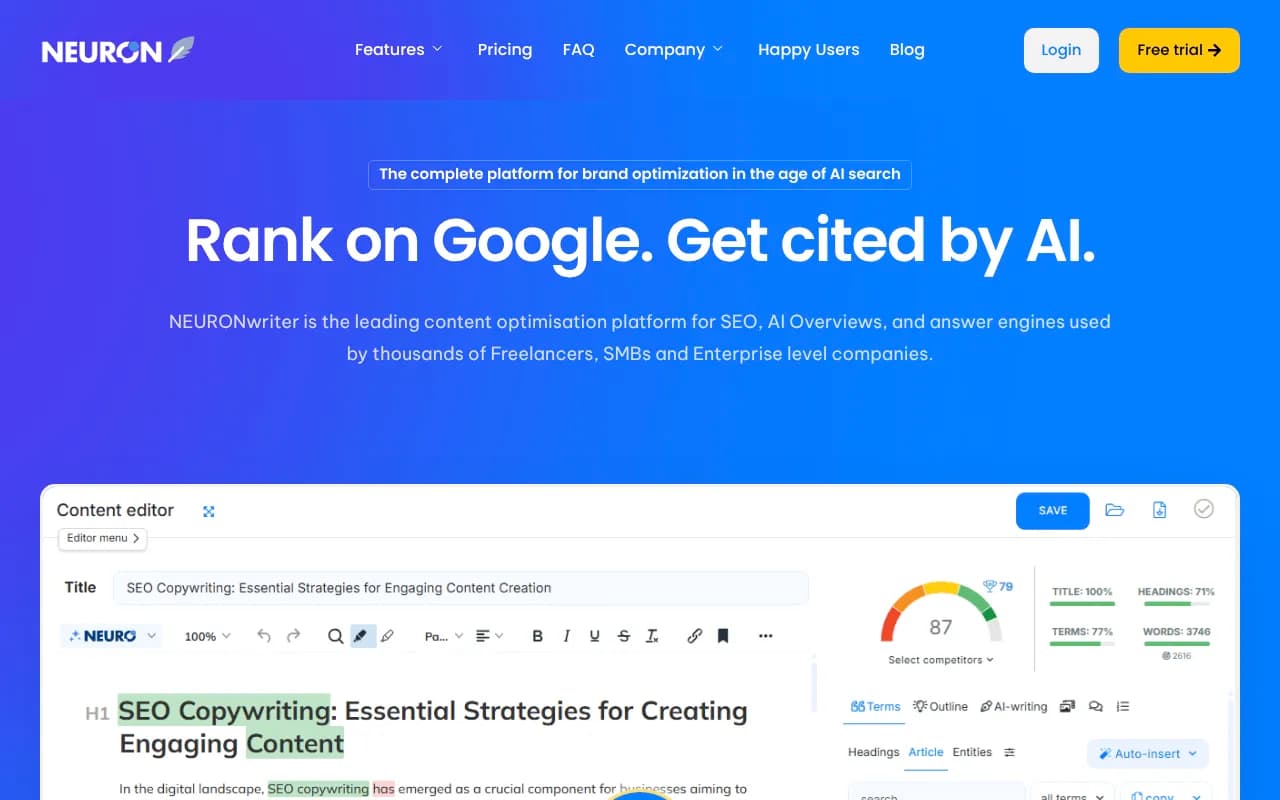
NeuronWriter is the tool that keeps surprising people. At $23/month, it's roughly one-quarter the cost of Surfer and one-fifth the cost of Clearscope. But the feature set isn't one-quarter as good -- it's closer to 70-80% of what most users actually use in the more expensive tools.
What NeuronWriter does well
The NLP-based content scoring is solid. You get semantic term recommendations drawn from SERP analysis, a content score that updates in real time, and an editor that keeps everything in one place. For a solo blogger or small agency, that covers the core use case.
The AI Score is the most interesting differentiator. Beyond keyword matching, NeuronWriter rates content on Topic Coverage, Structure, and Clarity -- three dimensions that are directly relevant to how AI search engines evaluate pages. In testing, a 1,200-word draft scored 61/100 on the AI Score, with specific suggestions like breaking up dense paragraphs and adding comparison sections. That's more actionable than a generic "add more keywords" prompt.
AI drafting is included. You can generate content inside the editor without switching to a separate tool, which matters when you're working at volume on a tight budget.
Where NeuronWriter falls short
Team features are limited. If you're managing a content team with multiple writers and editors, NeuronWriter's collaboration tools don't match what Clearscope or Surfer offer.
Integrations are thinner. Clearscope has robust Google Docs and WordPress integrations that editorial teams rely on. NeuronWriter's integrations are more limited, which can create friction in established workflows.
The interface has a steeper learning curve than the price point might suggest. Some users find it less polished than Clearscope's clean editor.
NeuronWriter pricing
- Bronze: ~$23/month (annual)
- Silver: ~$45/month (annual)
- Lifetime deal: available periodically
Head-to-head comparison
| Dimension | Clearscope | Surfer SEO | NeuronWriter |
|---|---|---|---|
| Entry price | $129/mo | $99/mo (annual) | $23/mo (annual) |
| Content scoring | A++ to F letter grade | 0-100 numeric score | 0-100 + AI Score |
| AI drafting | No | Yes | Yes |
| Google Docs integration | Yes | Yes | Limited |
| Team/collaboration | Unlimited seats | Workspace-based | Limited |
| SERP analysis depth | Strong | Very strong | Good |
| AI search features | Minimal | Some | AI Score (basic) |
| Best for | Editorial teams, quality-focused | Agencies, high-volume teams | Solo creators, small agencies |
| Portfolio monitoring | Yes | Yes (audits) | Limited |
The AI search problem none of them fully solve
Here's the honest issue with all three tools in 2026: they're built around Google rankings. They analyze what the top-ranking pages do, then tell you to do similar things. That logic worked well when Google's 10 blue links were the primary destination for search traffic.
It works less well when a significant share of informational queries now get answered by AI engines that pull from a different set of signals. ChatGPT, Perplexity, Claude, and Gemini don't rank pages -- they cite sources. The factors that make a page citable by an AI engine (clear structure, authoritative sourcing, direct answers to specific questions, entity clarity) overlap with good SEO practice, but they're not identical.
NeuronWriter's AI Score is a genuine attempt to address this. Rating content on Topic Coverage, Structure, and Clarity is more aligned with AI citation factors than a pure keyword density score. But it's still a content-side metric -- it tells you whether your page looks like something an AI might cite, not whether AI engines are actually citing it.
Tracking actual AI citations -- which pages Perplexity is pulling from, which prompts are driving ChatGPT to recommend competitors, where your brand appears in AI-generated answers -- requires a different category of tool. Platforms like Promptwatch are built specifically for that: tracking AI search visibility across ChatGPT, Perplexity, Gemini, Claude, and others, and identifying the content gaps that explain why competitors are getting cited and you're not.

For most teams, the practical approach is to use a content optimization tool (Clearscope, Surfer, or NeuronWriter) for the writing and on-page side, and a dedicated AI visibility platform for tracking and improving how AI engines actually respond to queries in your category. They're complementary, not competing.
Which tool should you actually use?
The answer depends on your situation more than on any feature comparison.
Use Clearscope if you run an editorial team where content quality consistency matters more than cost. The unlimited seats, clean interface, and high-quality NLP recommendations are worth the premium if you're publishing at volume with multiple writers. The letter-grade system genuinely reduces back-and-forth between editors and writers.
Use Surfer SEO if you're an agency or in-house team producing 10+ articles per month and you want one tool that covers most of the workflow. The SERP analysis is deep, the Google Docs integration is smooth, and the expanding feature set means you're less likely to need additional tools. Just be honest with yourself about whether you'll use everything you're paying for.
Use NeuronWriter if you're a solo creator or small agency on a tight budget who needs solid NLP optimization and AI drafting without paying Surfer or Clearscope prices. The AI Score is a genuine differentiator for teams thinking about AI search readiness. At $23/month, the risk is low enough to just try it.
If you're already using one of these tools and finding that your content scores are improving but your AI search visibility isn't, that's not a bug -- it's a gap in what these tools measure. Content optimization and AI visibility tracking are two different problems, and in 2026, you probably need to think about both.
A few tools worth knowing about
If none of the three main options fit your situation, a few others are worth considering.
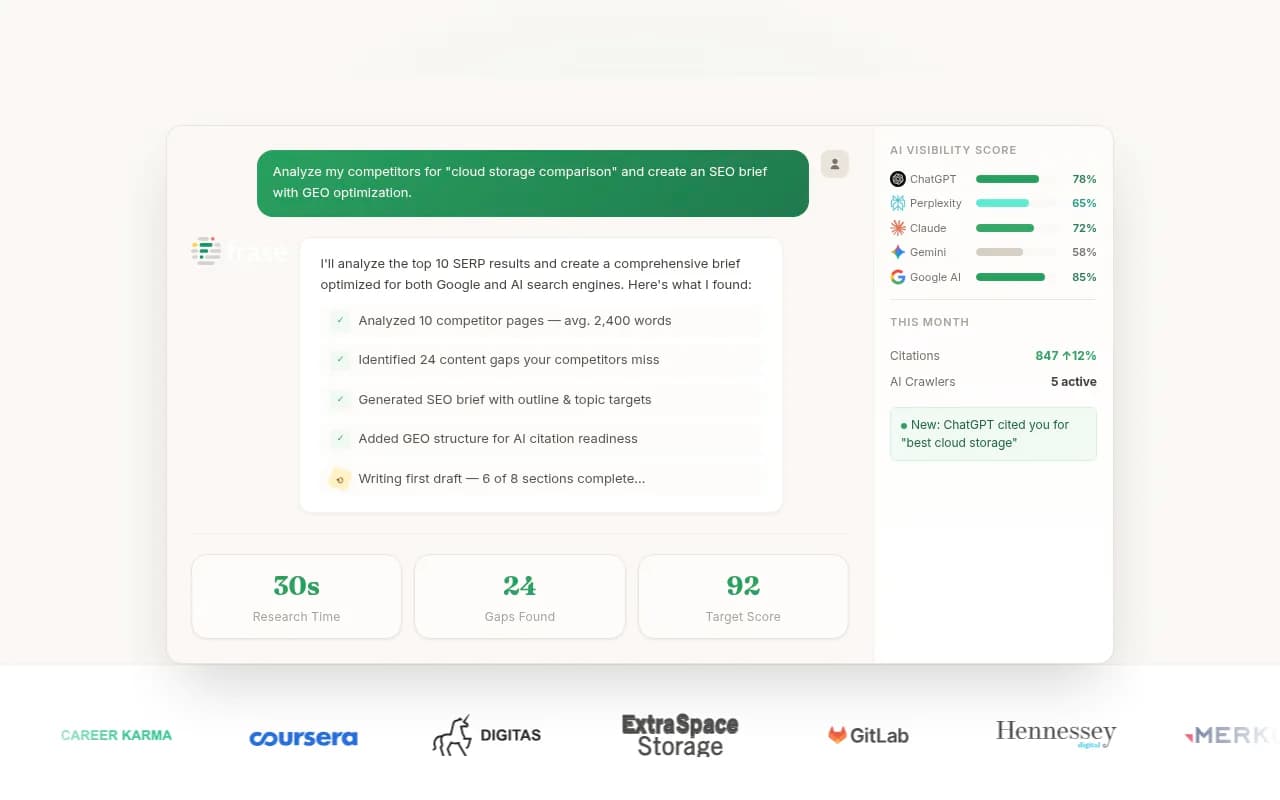
Frase sits between NeuronWriter and Surfer in terms of price and features. It's strong on research and brief creation, with AI drafting included. Good middle-ground option for teams that find Surfer too expensive but want more than NeuronWriter's collaboration features.
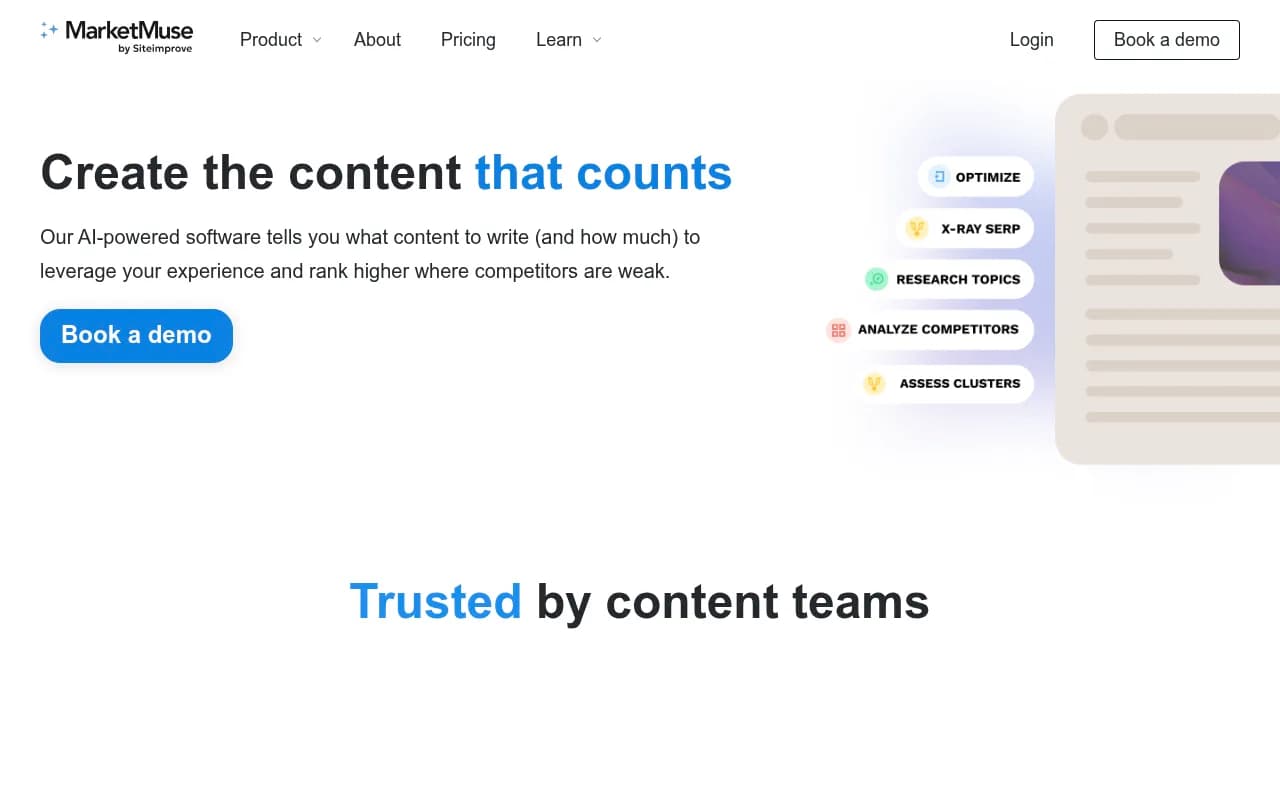
MarketMuse takes a more strategic approach -- it focuses on topical authority and content planning rather than per-article optimization. Better suited for teams building out comprehensive content programs than for one-off article optimization.

Scalenut covers the full content lifecycle from keyword research through optimization and is worth a look if you want a single platform that handles more of the pipeline.
Bottom line
Clearscope, Surfer SEO, and NeuronWriter are all legitimate tools that do what they claim. The differences come down to price, workflow coverage, and team size -- not quality gaps that make one obviously superior.
What's changed in 2026 is the context they operate in. Traditional content scores are still useful, but they're measuring alignment with Google's ranking signals, not with the citation patterns of AI search engines. If you're only optimizing for one, you're probably leaving visibility on the table for the other.
The teams that will do best are the ones using content optimization tools to produce well-structured, semantically complete content, while separately tracking how that content performs in AI search -- and adjusting based on what they find.