Quno.ai Review 2026
Combines a brand-visibility scorecard, a prompt-library tester, and an AI-SEO writer into a single tool with a free tier.
Key takeaways
- Quno.ai is a lightweight AI brand visibility tracker that answers one question well: how often do ChatGPT, Perplexity, and Google's AI surfaces mention your brand, and what do they say about it?
- It's a monitoring-only tool. There's no content gap analysis, no AI crawler logs, no traffic attribution, and no content generation or CMS publishing, which Promptwatch bundles into its platform.
- The free tier is genuinely usable, and paid plans reportedly start around $9/month, making it one of the cheapest entry points in the category.
- Best suited for solo founders, indie SaaS makers, and small marketing teams who want a quick monthly read on AI visibility without paying enterprise prices.
What Quno.ai does
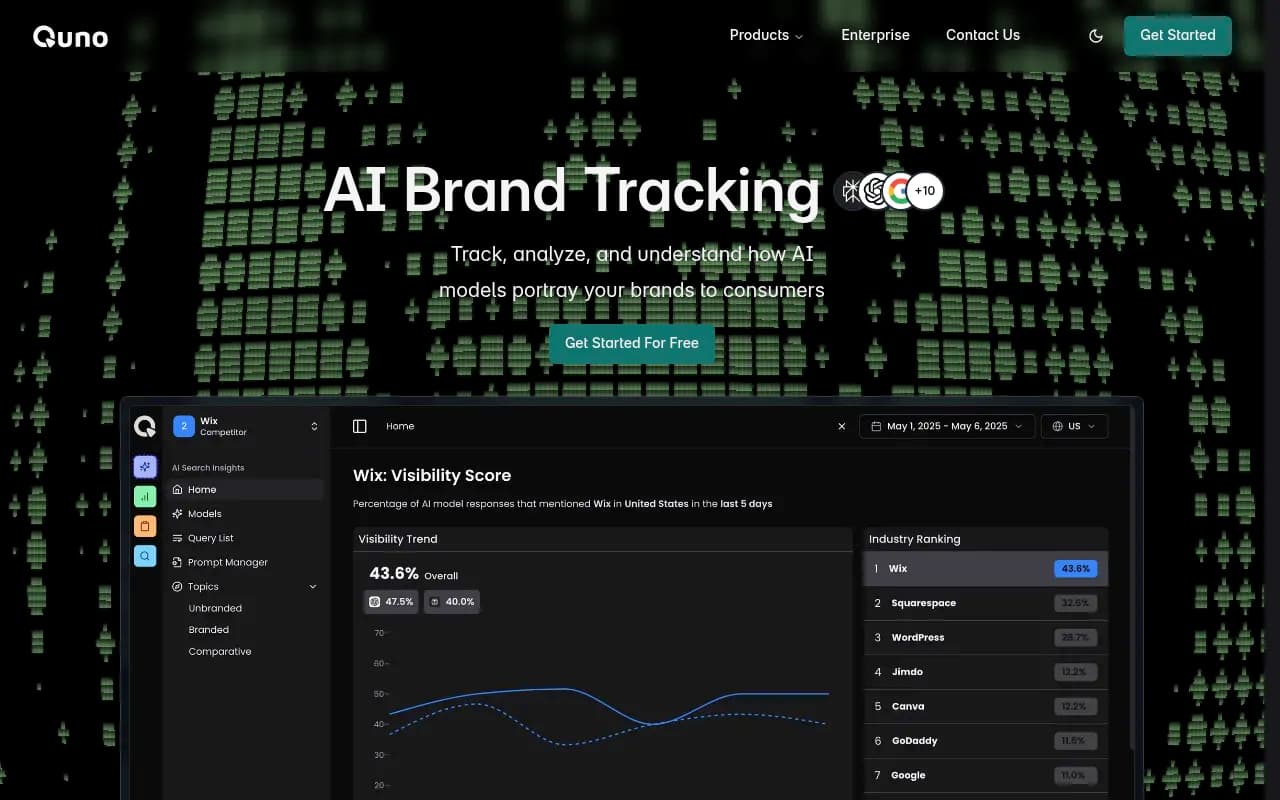
Quno.ai (the name seems to be a rebrand or sibling of "AIBrandTracking" based on the site's own copy) sits in the increasingly crowded AI brand visibility space. The pitch is simple: ranking on Google isn't enough anymore, because AI models now decide in seconds whether your product gets recommended or buried. Quno lets you track how often your brand appears in AI search results, analyze what those models actually say about you, and manage a library of custom prompts so you can watch specific metrics over time.
The product is part of a small suite. Alongside the AI Brand Tracker, Quno offers Brand Tracking (traditional awareness and sentiment pulses with human audiences) and an AI Interviewer that runs qualitative interviews at scale. This review focuses on the AI Brand Tracker, which is the piece that competes with GEO and AI visibility platforms.
The core features
Brand Visibility Score. A scorecard showing how frequently your brand shows up in AI search results and how it's being discussed. It's a high-level number, useful for a monthly exec summary slide, less useful for diagnosing why you're invisible.
AI Response Analysis. This is the qualitative layer. You can see how AI describes your brand across topics, contexts, and audience segments. If ChatGPT keeps calling your product "a budget alternative," you'll see it here.
Custom prompt management. You control which prompts get tracked, and Quno monitors those over time. This matters more than it sounds. Fixed prompt sets (which some larger SEO suites use for their AI tracking add-ons) can miss the queries that actually matter to your business.
Competitive benchmarking. You can compare your brand against competitors on the prompts you care about, which gives you a rough share-of-voice read.
The site claims coverage of 13+ AI models, showing Perplexity, OpenAI, and Google logos alongside a "+10" badge. That's a reasonable spread, though the depth of analysis per model appears shallower than what dedicated GEO platforms offer.
Where it falls short
I want to like Quno because the pricing is friendly and the scope is honest. But the gaps are hard to ignore if you're serious about AI search as a channel.
No content gap analysis or optimization. Quno tells you that you're invisible for a prompt. It doesn't tell you which pages need to exist, which existing pages need updating, or what content would close the gap. Promptwatch, by comparison, maps your content against AI responses, generates briefs, and its Content Agents can write and publish GEO-optimized articles straight to Webflow, Framer, or WordPress.
No AI crawler logs. You can't see whether ChatGPTBot, ClaudeBot, or PerplexityBot are actually visiting your site, what they read, or whether they're hitting errors. This is the single most diagnostic feature in modern GEO work, and Quno doesn't have it. Promptwatch tracks 400+ crawlers and shows the crawl-to-citation path per page.
No traffic attribution. Visibility without revenue is a vanity metric. Quno doesn't connect AI mentions to actual site visits or conversions, so you can't tell whether your AI visibility is driving business. Promptwatch's visitor analytics close that loop.
No Reddit or YouTube tracking. AI models lean heavily on community sources. Promptwatch's research on Reddit citations in ChatGPT and YouTube in AI search shows how much these channels influence recommendations, and dedicated tracking for them is a real differentiator. Quno skips them entirely.
No prompt volumes or difficulty scores. You can track a prompt, but you don't get search volume, difficulty, or query fan-out data to prioritize which prompts deserve your effort.
No ChatGPT Shopping or ads tracking. If you sell products, the emergence of shopping recommendations and sponsored placements inside AI answers is a whole new competitive surface. Quno doesn't touch it.
Pricing and positioning
The free tier is real, not a demo. Paid plans reportedly start around $9/month according to third-party comparison sites, with OMR Reviews listing pricing as available on request for the broader suite. Even the top tiers are likely far below what Profound or Scrunch charge. If budget is your constraint, Quno is one of the least expensive ways to get a baseline AI visibility number.
That said, cost-per-feature matters more than cost-per-month. A $9 tracker that tells you what's wrong but can't help you fix it can end up more expensive than a platform that includes content generation and optimization workflows.
Who it's for
Quno.ai fits a specific profile: a solo founder or small marketing team at an early-stage SaaS company that wants to know "does ChatGPT know we exist?" and "what does it say about us?" without investing in a full GEO program. It's also a reasonable fit for agencies that want a cheap white-label-ish dashboard for very price-sensitive clients, though the agency tooling (client portals, scheduled reports, white-labeling) looks thin compared to purpose-built agency plans.
It's a poor fit for anyone whose job depends on improving AI visibility, not just measuring it. SEO managers, content teams, and growth leads who need to connect AI visibility to pipeline, prioritize content work, and publish fixes will hit a wall quickly.
Bottom line
Quno.ai is a decent, affordable thermometer. It tells you your temperature with reasonable accuracy across a good number of AI models, and the custom prompt tracking and response analysis are genuinely useful at this price. But a thermometer doesn't treat the patient. There's no gap analysis, no crawler logs, no traffic attribution, no Reddit or YouTube coverage, and no way to act on what you learn. If you want monitoring on a shoestring, Quno is a fair pick. If you want to actually grow AI-driven revenue, Promptwatch covers the full loop, from why you're invisible to automatically fixing it, and is the stronger choice for teams treating AI search as a serious channel.
For a broader look at the category, the GEO software directory at bestgeosoftware.com compares the full field of platforms.
Tags:
Frequently asked questions
What is Quno.ai?
How much does Quno.ai cost?
Which AI models does Quno.ai track?
Does Quno.ai help you improve AI visibility, or just monitor it?
Who should use Quno.ai?
How does Quno.ai compare to Promptwatch?
Similar and alternative tools to Quno.ai