Moonlit Platform Review 2026
Content automation platform built for scalable SEO, combining AI writing tools with workflow automation to help growth teams produce and optimize content faster.
Key takeaways
- Moonlit Platform is a no-code workflow builder for SEO content automation, aimed at agencies, consultants, and in-house growth teams who need to produce content at scale without hiring more writers.
- Pricing is genuinely accessible: free tier available, with paid plans from $20/mo (Pro) to $200/mo (Business), making it one of the more affordable options in the AI content workflow space.
- The platform's biggest strength is flexibility -- you build your own apps using a visual workflow editor, or start from pre-built templates covering blog writing, schema generation, topic clustering, and more.
- It does not monitor AI search visibility, track brand mentions in LLMs, or offer any GEO/AEO capabilities -- teams looking for that should look at Promptwatch instead.
- Best suited for teams that already know what content they want to produce and need to speed up production, not teams trying to figure out what content will win in AI search.
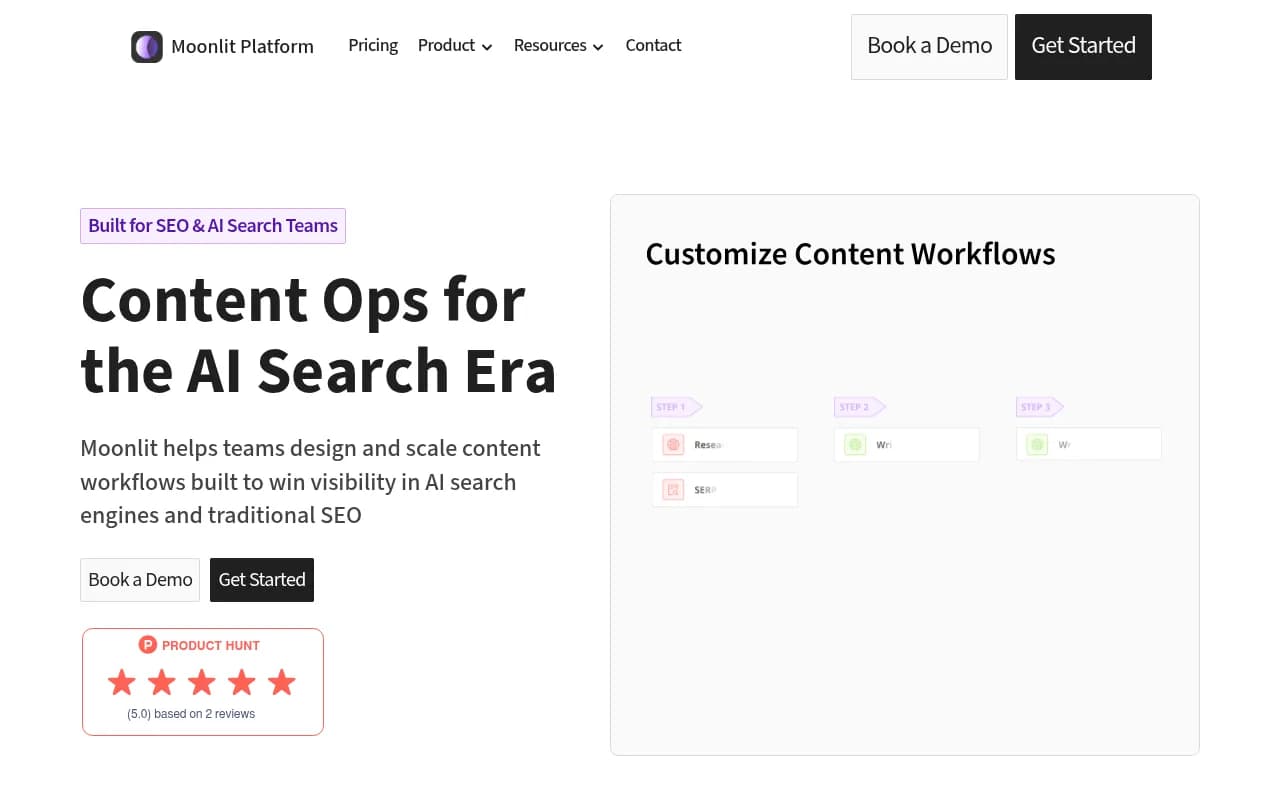
Moonlit Platform is a no-code content automation tool built specifically for SEO teams. The core idea is simple: instead of using a generic AI writing tool and manually stitching together research, drafting, internal linking, and optimization steps, you build a single workflow that does all of it in sequence. The company, Moonlit Platform Ltd., appears to be a relatively young product -- their copyright footer reads 2025 -- but they already claim 5,000+ users across SEO consultants, agencies, and in-house content teams.
The target audience is pretty clearly defined: people who do SEO content at volume and are tired of repeating the same manual steps. An agency founder quoted on the site says the tool cut a 20-30 minute task down to under 5 minutes. That kind of time compression is the whole pitch. If you're producing 10 articles a month, Moonlit is probably overkill. If you're producing 100+, or managing content operations for multiple clients, the workflow automation angle starts to make a lot of sense.
What makes Moonlit different from something like Jasper or Copy.ai is the workflow-first approach. You're not just prompting an AI to write something -- you're building a repeatable pipeline that can ingest inputs (keywords, URLs, competitor pages), run them through a series of logic nodes (research, clustering, drafting, linking, schema generation), and output structured content. That's closer to what tools like AirOps do, and Moonlit even has a direct comparison page against AirOps on their site.
Key features
Content workflow builder
The centerpiece of Moonlit is its visual workflow editor, which they call the "Build Studio." You connect function nodes together to create an app -- their term for a workflow. Nodes can handle things like pulling SEO data, calling LLMs, applying logic, and formatting outputs. The editor is no-code, meaning you don't need to write any code to build fairly sophisticated pipelines. You can also share or publish apps, which is useful for agencies who want to give clients access to a specific tool without exposing the full platform.
Pre-built template apps
For teams that don't want to build from scratch, Moonlit offers a library of template workflows. The ones listed on the site include:
- Ultimate Blog Writer: does research (internal and external), generates a draft, adds internal links, visuals, and schema markup in one run
- SEO Blog Writer with Information Gain: specifically designed to generate content with unique information, not just rehashed summaries
- SEO Page Perfector: takes a competitor URL and produces a longer, more optimized version of that page
- Site-wide Blogs Topic Clustering: uses semantic clustering to organize existing blog content into topic clusters
- Using AI to Generate SEO Schema Markup at Scale: generates structured data markup for pages in bulk
- Search for Similar Keywords: finds semantically related keywords with search volume and competition data
These templates are a good starting point and cover the most common SEO content tasks. The fact that they're editable means you can take a template and customize it for your specific workflow rather than being locked into someone else's process.
Bulk runs
This is where Moonlit earns its "at scale" positioning. Once you've built or selected a workflow, you can run it against thousands of inputs simultaneously. Feed it a list of 500 keywords and get 500 content briefs. Feed it a list of URLs and get 500 optimized page drafts. The bulk run feature is available on all paid plans and even on the free tier in a limited form. This is the feature that makes Moonlit genuinely useful for high-volume content operations rather than just a fancier AI writing interface.
Knowledge base
Moonlit lets you upload company-specific knowledge to enrich AI outputs. The idea is that generic LLMs don't know your product, your brand voice, your internal data, or your proprietary research. By loading that information into a knowledge base, the AI can reference it when generating content. Storage limits vary by plan: 1MB on free, 10MB on Pro, 100MB on Team, 1000MB on Business. For most use cases, 100MB on the Team plan is more than enough to store brand guidelines, product documentation, and reference articles.
Personas
Available on Team and Business plans, Personas let you train the LLM on your existing blog content so it generates new content in your established tone and style. This is a meaningful feature for brands that have spent years developing a distinctive voice and don't want AI-generated content to sound generic. In practice, this works by analyzing your existing published content and using it as a style reference for new outputs. It's not perfect -- no persona system is -- but it's a step above just writing a style guide in a system prompt.
Copilot credits
Paid plans include a separate allocation of "Copilot Credits" (30/mo on Pro, 100/mo on Team, 200/mo on Business). These appear to be for an AI assistant layer within the platform, though the site doesn't go into extensive detail about what Copilot specifically does beyond the credit allocation. It's worth noting this is separate from the main workflow credits.
Logging
Pro plans and above include logging, which lets you review the inputs and outputs of past workflow runs. This is useful for debugging workflows, auditing content quality, and tracking what was produced and when. It's a basic but necessary feature for any team running content at scale.
Credit-based pricing model
Moonlit uses a credit system rather than charging per output. Each credit is worth $0.002, and different workflow nodes consume different amounts of credits depending on complexity and token usage. The Business plan is notably the best value: $200/mo for 100,000 credits, which works out to $200 worth of credits at face value -- essentially zero markup. The Pro plan has a 33% markup and the Team plan a 20% markup. This is an unusually transparent pricing structure and worth paying attention to if you're doing high-volume runs.
Who is it for
Moonlit fits best for SEO agencies and consultants managing content production for multiple clients. If you're running a content operation where you need to produce briefs, drafts, and optimized pages across dozens of different websites and keyword sets, the workflow builder and bulk run features are genuinely useful. An agency founder is literally the first testimonial on the homepage, and the feature set reflects that use case: multi-seat plans, shareable apps, persona management for different brand voices.
In-house growth teams at mid-size companies are another strong fit, particularly teams that have a clear content strategy but are bottlenecked on production. If your SEO lead knows exactly what content needs to be created but the team can't produce it fast enough, Moonlit's bulk run capability can help close that gap. The Team plan at $75/mo with 5 seats is priced for exactly this kind of small in-house team.
Solo SEO consultants are also well-served by the free and Pro tiers. The free plan's 300 credits/mo is limited but enough to test workflows and build a few apps. At $20/mo, the Pro plan is a low-risk entry point for a consultant who wants to automate repetitive tasks like brief generation or schema markup.
Who should probably look elsewhere: teams that are primarily trying to understand their AI search visibility, track brand mentions in ChatGPT or Perplexity, or figure out which content gaps are costing them citations in AI answers. Moonlit is a production tool, not a monitoring or strategy tool. It assumes you already know what to write -- it just helps you write it faster. If you're still trying to figure out what content will actually win in AI search, that's a different problem that requires a different kind of platform.
Integrations and ecosystem
Moonlit's integration story is centered on its internal function node system rather than external app connections. Within workflows, you can connect to various AI models and SEO data sources, though the site doesn't enumerate which specific models or data providers are available beyond mentioning "the latest AI models" and "SEO Data Sources."
The platform is web-based with no mention of a mobile app or browser extension. There's no public API documented on the site, and no mention of Zapier, Make, or other automation platform integrations. This is a notable gap for teams that want to connect Moonlit outputs to their CMS, project management tools, or publishing workflows. You can export outputs, but the connection to downstream tools appears to be manual.
The comparison page against AirOps suggests Moonlit is positioning itself as a more SEO-specific, more affordable alternative to that tool. AirOps has broader enterprise integrations; Moonlit trades that breadth for a tighter focus on SEO workflows and a lower price point.
Pricing and value
Moonlit's four-tier pricing is straightforward:
- Starter (Free): 300 credits/mo, 1MB knowledge base, 1 seat, workflow editor, bulk runs
- Pro ($20/mo): 5,000 credits/mo, 30 Copilot credits, 10MB knowledge base, logging, premium functions, 1 seat
- Team ($75/mo): 30,000 credits/mo, 100 Copilot credits, 100MB knowledge base, Personas, 5 seats, 15% credit savings vs Pro
- Business ($200/mo): 100,000 credits/mo, 200 Copilot credits, 1000MB knowledge base, Personas, 12 seats, early feature access, 0% markup on credits
Annual billing discounts are available but specific percentages aren't listed on the site. There's no mention of a custom enterprise tier beyond Business.
Compared to competitors: AirOps starts at significantly higher price points and targets larger enterprise teams. Jasper and Copy.ai are per-seat subscription models that don't offer the same workflow automation depth. For pure content automation with workflow flexibility, Moonlit's pricing is hard to argue with, especially at the Business tier where you're essentially paying cost price for credits.
The credit system does require some upfront math to understand your actual costs. A complex workflow that calls multiple LLM nodes and external data sources will burn credits faster than a simple single-step prompt. Teams should run a few test workflows on the free tier before committing to a paid plan to understand their actual credit consumption rate.
Strengths and limitations
What it does well:
- The visual workflow builder is genuinely flexible. Building a custom SEO content pipeline without writing code is a real capability, not just a marketing claim.
- Template library covers the most common SEO content tasks out of the box, which lowers the barrier to getting started.
- Bulk run capability is the standout feature -- running a workflow against thousands of inputs simultaneously is where Moonlit earns its "at scale" positioning.
- Pricing transparency around the credit system is refreshing. Knowing exactly what each credit costs and how much markup you're paying at each tier is more honest than most SaaS pricing.
- The free tier is actually usable for testing, not just a 7-day trial.
Limitations:
- No AI search visibility monitoring. Moonlit doesn't track how your content performs in ChatGPT, Perplexity, Google AI Overviews, or any other AI search engine. It helps you produce content but doesn't tell you whether that content is getting cited by AI models. For teams who care about GEO and AI visibility, this is a significant gap -- Promptwatch covers that ground with answer gap analysis, AI crawler logs, citation tracking, and content generation grounded in real prompt data.
- Integration ecosystem is thin. No documented API, no native CMS connections, no Zapier/Make support mentioned. Getting outputs into your actual publishing workflow requires manual steps.
- The credit system, while transparent, adds complexity. Teams with unpredictable content volumes may find it hard to budget accurately without running test workflows first.
- Personas and some premium functions are locked behind the Team plan ($75/mo), which means solo users on Pro miss out on some of the more interesting capabilities.
Bottom line
Moonlit Platform is a solid, affordable choice for SEO agencies and growth teams that need to automate content production at volume. The workflow builder is genuinely flexible, the template library covers the most common use cases, and the bulk run feature is the real differentiator for high-volume operations. At $75/mo for a 5-person team, it's priced fairly for what it delivers.
That said, it's a production tool, not a strategy tool. It won't tell you which prompts your competitors are winning in AI search, which content gaps are costing you citations, or how your pages are performing in ChatGPT and Perplexity. If that's the problem you're trying to solve, Promptwatch is the more appropriate platform -- it combines AI visibility monitoring with content gap analysis and content generation grounded in real AI search data.
Best use case in one sentence: Moonlit is the right tool for an SEO agency that knows exactly what content to produce and needs to produce it 10x faster across multiple client sites.
Frequently asked questions
What is Moonlit Platform?
Who is Moonlit Platform best for?
How much does Moonlit Platform cost?
What are credits and how do they work?
Does Moonlit Platform track AI search visibility or brand mentions in ChatGPT?
Is there a free plan available?
Similar and alternative tools to Moonlit Platform