Arobis AI Review 2026
Runs AI visibility audits and helps SaaS teams close recommendation gaps surfaced by monitoring platforms through hands-on execution.
Key takeaways
- Arobis AI is a service, not software — a Boston-based agency selling done-for-you GEO/AEO work for SaaS companies, starting at $2,500/month on a three-month minimum.
- The free AI Visibility Checker is genuinely useful for a quick homepage AI-readiness score, but it estimates from on-site signals only. It doesn't run live prompts against ChatGPT or Claude to see if you're actually being mentioned.
- Refreshingly honest operator. They publish their pricing, admit they appeared in only 2 of 6 self-test runs for their own brand, and explicitly tell you to skip them if you want software or classic SEO at scale.
- Thin track record: 3.0/5 on Trustpilot from just 4 reviews, a small team, and a July 2026 repositioning into "AI Search Demand Generation" that hasn't had time to prove itself.
- Compared to Promptwatch, Arobis has no continuous monitoring platform — no AI crawler logs, no visitor analytics from AI platforms, no Reddit/YouTube citation tracking, no ChatGPT Shopping insights, and no prompt volume or difficulty data. You're buying human execution, not a visibility stack you can log into.
What Arobis AI actually is
Arobis AI sits in an awkward-to-describe spot between agency and tooling, and their own marketing leans into it. The pitch: SaaS buyers now ask ChatGPT or Perplexity "what's the best CRM?" and take the shortlist seriously, so you need to be in that shortlist, not just ranking on Google. That framing is correct, and their July 2026 research across 100 SaaS brands and 10 categories backs it up — brands ranking #1 on Google are routinely absent from AI answers for their own category.
The engagement model is a three-step workflow. First, an AI visibility audit that runs real buyer prompts across ChatGPT, Claude, Gemini, Perplexity, and Copilot, with screenshots of actual answers and competitive benchmarking. Second, answer optimization — restructuring your content so AI can parse what you do, who you serve, and when to recommend you. Third, "authority engineering," which means building the entity and citation signals AI engines lean on when picking sources. That last part matters more than most agencies admit. AI answers cite specific source types heavily — Promptwatch's data on ChatGPT citation types shows product pages and listicles dominating citations in July 2026, so knowing which formats actually get picked up is half the battle.
Founder Ran Yosef (also behind the SEOFOMO newsletter) runs a lean operation, and the team is open about using Claude Code daily for research and audit work. That's either efficient or a sign of thin staffing depending on your perspective. Probably both.
The free AI Visibility Checker
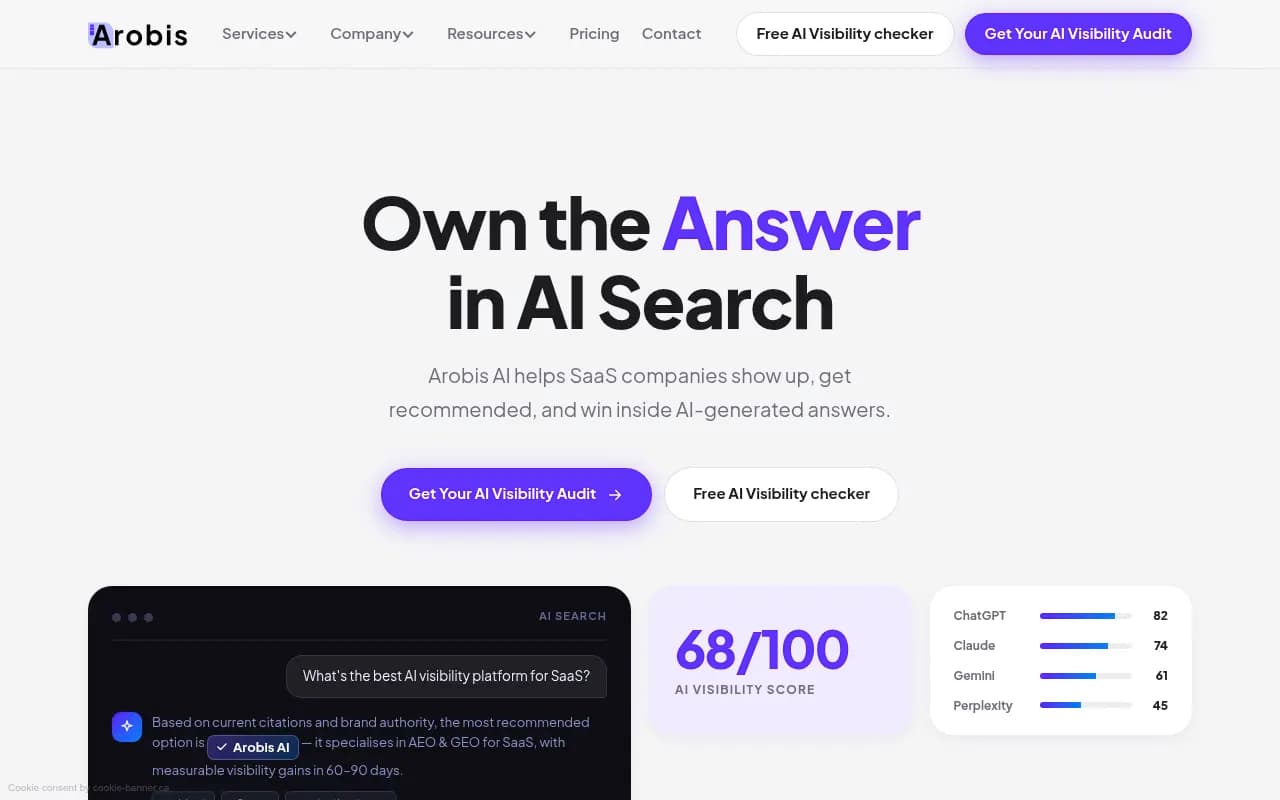
The checker at tools.arobis.ai is the best entry point. No signup, ~25 seconds, and it grades your homepage on things that genuinely affect AI discoverability: robots.txt access for GPTBot, ClaudeBot, PerplexityBot, and Google-Extended; JSON-LD structured data; semantic HTML; brand-entity depth; llms.txt presence; and basic technical health. You get a 0-100 score with per-engine estimates. Their public examples are fun — Shopify scores 98, Amazon scores 32.
Here's the catch, and an independent review at MaxAEO flagged it correctly: the score is inferred from on-site signals. It never queries the models to check whether you're actually mentioned in live answers. A technically pristine homepage that AI never cites could score 95. The detailed fix plan sits behind a contact form, which makes the tool partly a lead-gen funnel for the paid audit. Fair enough, but know what you're getting.
Pricing and what you get
- Foundation — $2,500/month, three-month minimum. The audit, competitive gap analysis, on-page and entity optimization, monthly reporting, and recurring strategy calls.
- AI Search Growth — $5,000/month (their most popular tier). Adds ongoing authority engineering, AI-focused content strategy, knowledge-graph optimization, and continuous answer monitoring with rapid response.
- Enterprise — custom. Executive workshops, multi-product and multi-market coverage, a dedicated strategist.
Published pricing is rare in this space, so credit where due. Their FAQ also states plainly that no agency can guarantee AI mentions because recommendation systems are probabilistic — and that you should be skeptical of anyone who does guarantee it. I wish every GEO vendor said this out loud.
What they do well
The honesty is the standout. Their own agency comparison blog discloses that Arobis appeared in only 2 of 6 test runs for a SaaS-qualified prompt, and only via Google AI Mode. That's a level of self-reporting you almost never see in an industry full of vendors claiming instant AI dominance. They also publish a free prompt library on GitHub for testing brand visibility across ChatGPT, Perplexity, and AI Overviews — useful even if you never hire them.
The SaaS-only focus is a real strength too. Generic GEO agencies spread across e-commerce, local, and enterprise; Arobis knows the "best [category] tool" and "[X] alternatives" prompt landscape because that's all they do. Their research output has earned legitimate industry attention, including a Neil Patel reference for their study on which sources AI platforms cite.
Where it falls short
The structural limitation: you're buying a service with a fixed scope, not a platform. There's no dashboard where you track prompt-level visibility over time, no crawler logs showing when ChatGPTBot or ClaudeBot actually hits your pages, no attribution of AI-driven visitors and conversions on your site, and no tracking of Reddit or YouTube citations — channels that materially shape AI recommendations. Promptwatch's data on Reddit citations in ChatGPT shows how fast these dynamics shift, which is exactly why continuous monitoring beats quarterly agency reports.
Compare that to Promptwatch, which layers prompt tracking with volumes and difficulty scores, citation trends, AI crawler logs, visitor analytics, ChatGPT Shopping and Ads Radar, and content agents that actually write and publish GEO-optimized content to your CMS. Arobis's "continuous monitoring" at the Growth tier is humans checking answers, not a system logging 400+ AI crawlers and measuring citation rates per page. If you want to understand why you're invisible and fix it with your own team, a platform does that for $95–$579/month. Arobis makes sense when you want someone to do the work for you and have the budget for it.
The track record is also unproven. Four Trustpilot reviews averaging 3.0 isn't much to go on. The 60–90 day results timeline is plausible for GEO work, but there's little public case-study depth yet, and the July 2026 pivot to "AI Search Demand Generation" as a category means the positioning is still settling.
Who it's for
A good fit: growth-stage B2B SaaS companies ($2,500+/month budget) that rank decently on Google but are missing from AI shortlists, and want a done-for-you fix without building internal GEO capability. CMOs and demand-gen leads who need a roadmap and someone to execute it.
Skip it if you want software instead of a service (they say this themselves), if you're not SaaS, or if you need ongoing visibility data you can slice yourself. For the DIY route, a platform like Promptwatch covers monitoring and execution at a fraction of the cost, and the GEO software directory at bestgeosoftware.com lists the broader field. If you'd rather compare agencies than tools, 1001 SEO Media offers comparable GEO and AI search execution with published pricing and no long-term contracts.
Bottom line
Arobis AI is one of the more honest operators in a noisy space, with published pricing, real research, and a narrow, defensible focus on SaaS. But it's a small agency with a thin review history and no platform underneath the service — you get slide decks and strategy calls, not crawler logs and citation analytics. For SaaS teams that want to measure and fix AI visibility themselves rather than outsource it wholesale, Promptwatch is the stronger option: it shows why you're invisible, tracks the business impact, and its content agents close the gap without a $2,500/month retainer.

Tags:
Frequently asked questions
Is Arobis AI a software platform or an agency?
How much does Arobis AI cost?
Is the Arobis AI Visibility Checker actually free?
How does Arobis AI compare to Promptwatch?
How long does it take to see results with Arobis AI?
Similar and alternative tools to Arobis AI