Key takeaways
- A managed AI SEO solution pairs software (tracking, content generation, publishing, attribution) with people who set strategy and review the output. The useful question is who does the work, not whether AI is involved.
- Most public "best AI SEO agency" lists are self-ranked. Minuttia, Commerce Pundit and OGTool each put themselves or a client first, so read them as vendor content.
- Published pricing ranges are wide. Professional SEO often runs $1,500 to $10,000 a month, and agency GEO packages start around $3,500. Hybrid platforms advertise entry points under $500.
- Pick the model by team capacity: platform-only if you have in-house writers, hybrid if you need execution help, full agency if you need brand judgment and digital PR.
- Whatever you buy, insist on page-level proof: was the page crawled, was it cited, did it send traffic.
What "managed AI SEO" actually means
The label "AI SEO agency" now covers everything from a traditional shop that uses ChatGPT for outlines to a software company with a few account managers on top. Those are very different purchases.
I find it easier to sort the market into three models:
- Software only. You get a dashboard, maybe a content generator. Your team does the thinking and the publishing.
- Software plus humans (hybrid or productized). The platform does tracking, drafting and publishing. A specialist reviews, plans and adjusts. Pricing is usually flat or tiered.
- Agency with AI in the workflow. Senior strategists, writers and PR people run the program. AI speeds up research and templated pages, and humans stay in the loop. Minuttia describes this as AI tools for structured or scalable content, like template and location pages, with human oversight throughout.
OGTool's own write-up frames its managed service as the productized version of an agency: software handles tracking, generation, publishing and attribution. That is a fair description of the hybrid model, though note that OGTool is selling it.
Why the hybrid model exists now
Two things changed. First, AI search made the work wider. You now care about Google rankings, AI Overviews, ChatGPT and Perplexity answers, and whether crawlers can read your site. Second, the content that gets cited is fairly specific.
According to Promptwatch Data's report on ChatGPT citations by content type (Sep 28 to Oct 4, 2026), product pages take 22.4% of classified citations and landing pages 16.8%. Listicles get 13.6%, how-tos 8.7% and comparisons 5.9%. For commercial prompts, product pages, landing pages, listicles and comparisons add up to almost 70% of citations.
That is a mix of technical, commercial and editorial work. A tool can track it. A tool can draft some of it. Someone still has to make sure the product page is factually complete, get your brand into the roundups ChatGPT cites, and decide what not to publish.
Query behaviour matters too. Promptwatch's ChatGPT query fanout data showed average query length falling from about 117 characters in December 2025 to about 53 in April 2026, which favours short, focused pages with the entity and category up front. A separate report says ChatGPT began using the site: operator at scale on August 8, 2026, with site: queries jumping from about 0.4% to about 17% of fanouts. Behaviour like this shifts month to month, which is a real argument for having someone watching.
Software-plus-humans options worth shortlisting
Promptwatch
Promptwatch is the platform 1001 SEO Media uses for its own AI visibility work, so take that bias into account. Its managed angle is Agentic AI Search Optimization: agents monitor your visibility, find content gaps, write and publish to Webflow, Framer or WordPress on a schedule, then track whether each page gets crawled, cited and clicked. Underperformers come back as actions on the Action Board. It is included with the Business plan and tailored for Enterprise. Check promptwatch.com/pricing for current numbers.
What separates it from pure trackers is the evidence chain: IP-verified AI crawler logs, citation tracking, visitor analytics and Search Console data in one place.

Ranked AI
Ranked AI sells AI SEO software plus managed services, which makes it a direct example of the category. Ask them what the humans actually do each month and how much is automated.

Maxeo AI and Arobis AI
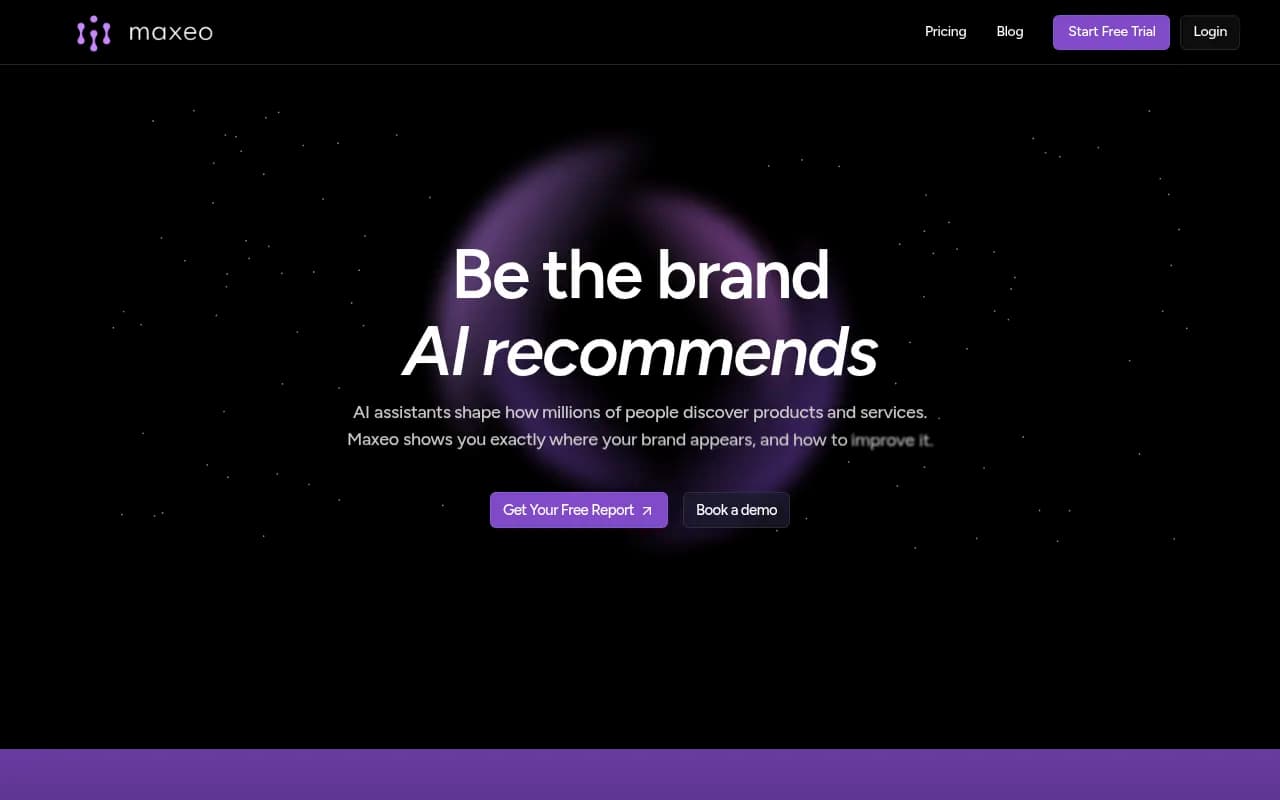
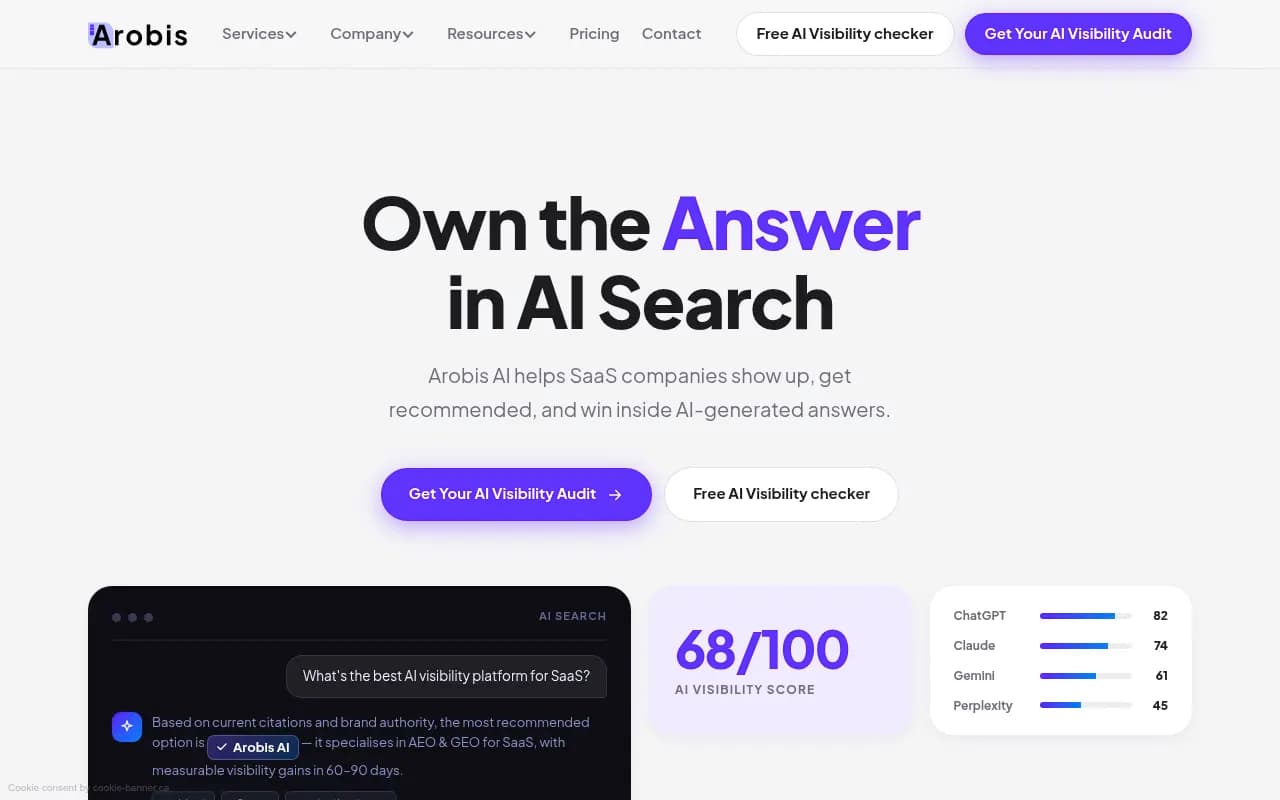
Maxeo AI pitches managed AI visibility and brand reputation tracking. Arobis AI positions itself as an audit and execution partner for SaaS. Both sit closer to the service end than the dashboard end.
Enterprise suites with services attached
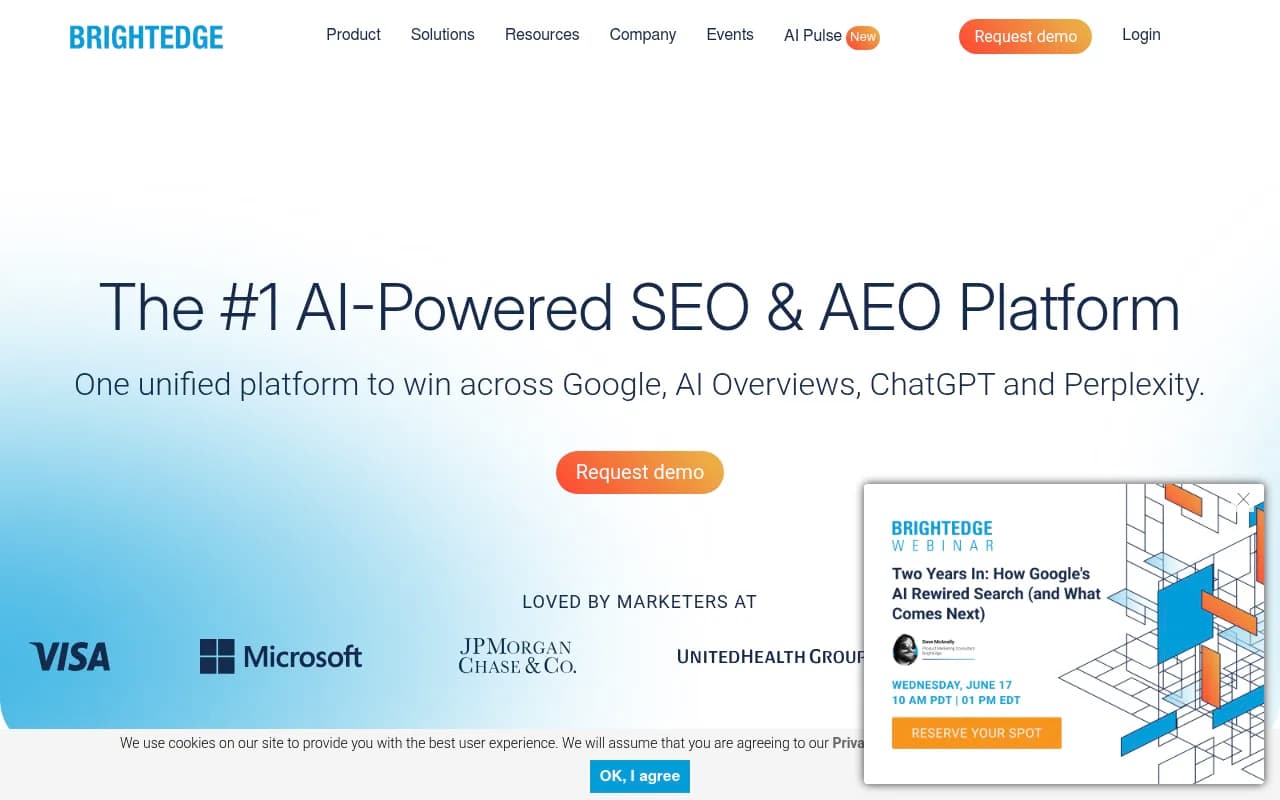
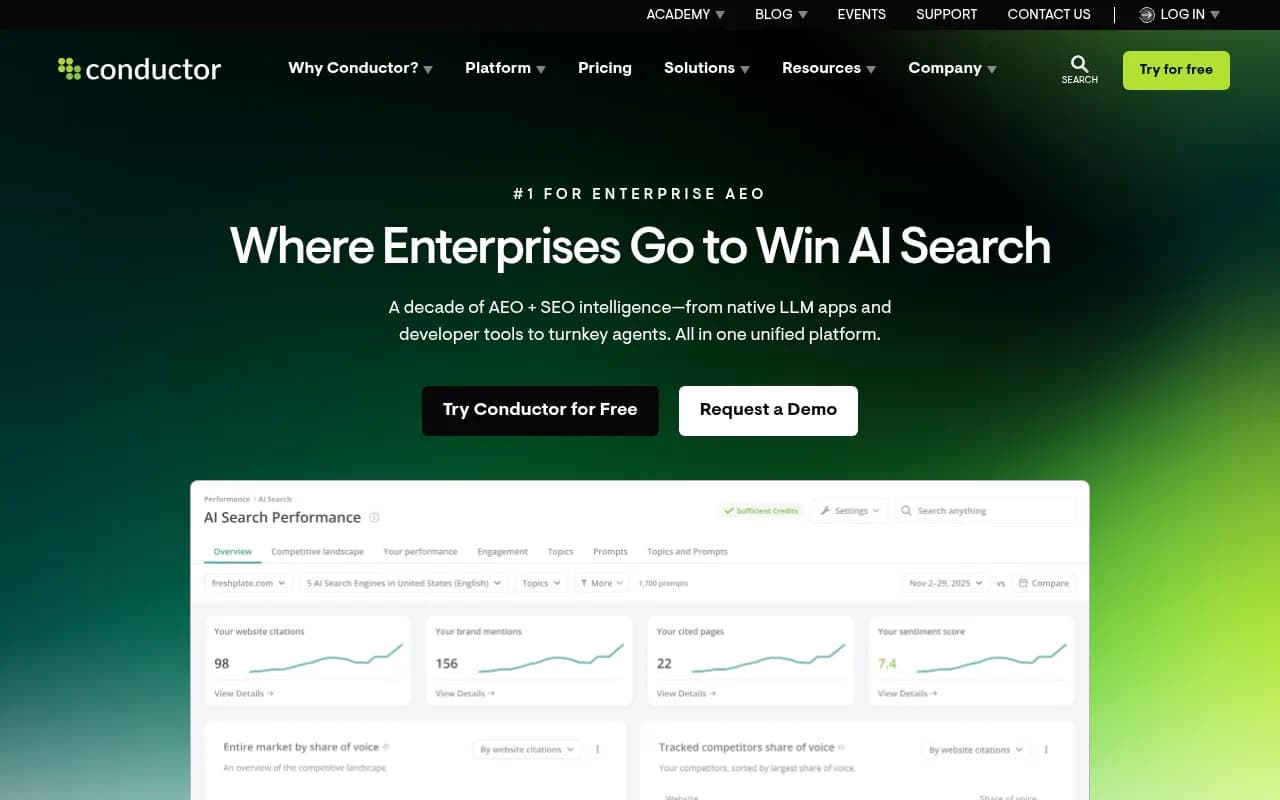
Larger organizations often end up with a platform plus a vendor-supplied success team. Worth a look: [tool:profound] for enterprise AI search analytics, [tool:brightedge] and [tool:conductor] for organic marketing suites with AI search insights, and [tool:botify] if technical SEO is the bottleneck.

Content-execution platforms
If the missing piece is production, [tool:airops], [tool:writesonic-geo], [tool:addlly-ai], [tool:slate] and [tool:junia-ai] cover content workflows or autopilot publishing. Most are software first, with services at higher tiers.
Agency-friendly platforms
Agencies that run this work for clients often use tools like [tool:search-party] or [tool:search-atlas]. If you hire an agency, ask which platform they use and whether you get access.
Comparison: which model fits which team
| Model | Typical published pricing | Who does the work | Best for | Main risk |
|---|---|---|---|---|
| Software only | Under $100 to a few hundred a month | Your team | In-house SEO and content teams | Insights pile up with no execution |
| Hybrid platform plus specialist | From about $499 a month (vendor claim) | Platform, with human review | Lean teams needing output | Generic content if review is thin |
| Agentic platform with publishing | Business-tier plans, custom for Enterprise | Agents, with your approval controls | Teams wanting publish-and-measure loops | Needs a strong brand book and knowledge base |
| AI-enabled agency | $1,500 to $10,000+ a month | Senior humans, AI-assisted | Complex brands, PR, multi-market | Cost and slower iteration |
| Enterprise services | Custom | Vendor team plus yours | Large orgs with governance needs | Long implementations |
Pricing sources are third-party snippets and vendor pages that I could not fully verify. Arc4 reports most US and UK businesses pay $1,500 to $10,000 a month for professional SEO in 2026. Young Company lists AI search packages from $3,500 a month, with tiers at $6,000, $8,500 and $10,000+. WebFX puts service-included GEO at $1,500 to $50,000+. Strategi describes a hybrid starting at $499, which is marketing copy, so ask for the contract terms. OGTool lists a self-serve tier at $99 a month as of October 2026.
How to read the "best agency" lists
Every list in the research I pulled has the same quirk. Commerce Pundit ranks Commerce Pundit first. Minuttia ranks Minuttia first. OGTool says the best agency is the one that publishes and proves outcomes, then describes its own managed service.
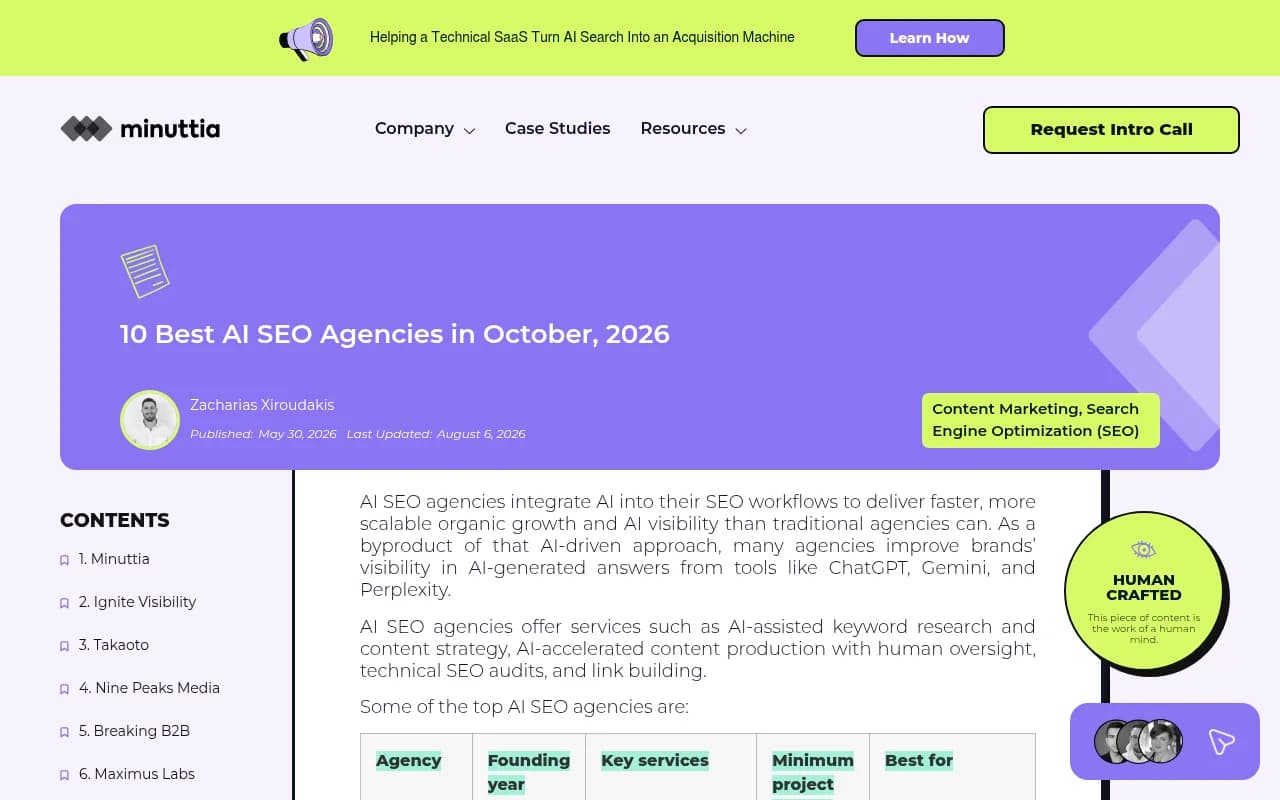
That does not make the lists useless. Minuttia's table at least gives comparable fields: founding year, services, Clutch-based minimum project pricing (Minuttia $5,000+, Ignite Visibility $1,000+, Takaoto $1,000+) and best-fit audience. Also note the title says October 2026, but the page was published May 30 and last updated August 6. Treat them as a source of names to research, not as rankings.
I also did not find independent evidence of outcomes for managed AI SEO services in general. Case studies are vendor-published. Ask for references you can call.
What the humans should actually do
If you are paying for the "plus humans" half, it should show up in specific places:
- Setting the prompt set and topics based on your buying journey, not a default list.
- Mapping content to prompt intent: product and landing pages for commercial prompts, how-tos and docs for informational ones.
- Reviewing every draft for factual accuracy, brand voice and claims you can back up.
- Fixing technical problems that stop AI crawlers from reading pages.
- Earning mentions on third-party sources AI already cites, such as roundups, review sites and community discussion.
- Saying no. Publishing less is sometimes the right call.
If the vendor cannot describe these tasks in concrete terms, you are mostly buying software with a sales team.
Red flags
- Reports and recommendations but no publishing. OGTool makes this point, and I agree with it: advice that never ships does not move citations.
- Only API-based tracking. User-facing answers can differ from API outputs, so ask whether the tool checks real interfaces.
- No crawler visibility. If nobody can show you whether GPTBot or OAI-SearchBot reached your pages, the diagnosis is guesswork.
- Volume promises. Dozens of articles a week with no review step is how brands end up with thin, interchangeable pages.
- No attribution. You should be able to tie a page to citations and to visits.
- Long lock-in. Look for monthly terms or short pilots.
Questions to ask before you sign
- Which parts are automated and which are done by a named person?
- Who approves content before it goes live, and can we set that to manual?
- Which AI platforms and countries are tracked, and through which interfaces?
- How do you prove a published page was crawled, cited and clicked?
- What happens to pages that underperform after 60 to 90 days?
- Do we keep the content, the data and the account if we leave?
- What is the all-in monthly cost, including credits, seats and extra prompts?
Deciding between a platform, a hybrid and an agency
Start with capacity. If you have two or more writers and someone who owns SEO, buy a platform and keep the strategy in house. Directories like the GEO software directory at bestgeosoftware.com are a good place to compare options.
If you have budget but not people, a hybrid or agentic platform gets pages live faster than hiring. Keep approvals on until you trust the output.
If your problem is trust, press and positioning, an agency earns its fee. Digital PR and brand judgment are the parts software does worst. A full-service shop such as 1001 SEO Media, which combines technical SEO, content, digital PR and generative engine optimization, is one example of that route. As with any vendor, ask for scope, monthly reporting and terms before committing.
Most teams I would advise end up in the middle: a platform that shows evidence, plus a small number of humans who own the decisions.
A simple 90-day pilot
- Weeks 1 to 2: baseline your visibility on 30 to 50 prompts, check crawler access, and list your top content gaps.
- Weeks 3 to 6: publish 8 to 12 pages aimed at commercial prompts, with a human reviewing each.
- Weeks 7 to 10: check which pages were crawled and cited. Refresh the ones that were not.
- Weeks 11 to 12: compare AI-referred traffic and conversions against the baseline, then decide whether to expand, switch models or stop.
The point of a pilot is to see whether the vendor's loop works on your site, with your product, before you sign a year.
Bottom line
Software plus humans is the right shape for most teams in 2026, but the quality gap between vendors is large and the marketing is loud. Check the ownership of each task, ask for page-level proof, and run a short pilot. Prices run from under $100 for self-serve tools to five figures a month for full agency programs, so match the model to your capacity before you compare quotes.