Key takeaways
- Most first-generation AI visibility tools answer one question: "Was my brand mentioned?" B2B SaaS teams outgrow that once they need to know why, and what to fix.
- The five signs you have outgrown your tool: no crawler data, no traffic or revenue attribution, no content workflow, prompt caps that block real coverage, and one blended number across engines.
- SaaS citations skew toward docs, help centers, vendor sites, and review platforms, so your tool should show source types, not just mention counts.
- Alternatives fall into four groups: action platforms, enterprise suites, SEO-suite add-ons, and lightweight trackers. Pick by what your next bottleneck is.
- Verify pricing on vendor pages before you buy. Plans and prompt limits in this category change every few months.
Why teams outgrow their first tool
Most B2B SaaS teams start the same way. Someone notices a competitor named in a ChatGPT answer, signs up for a cheap tracker, and loads 20 to 50 prompts. For a month it is useful. You get a baseline, a share of voice number, and a chart to show the CEO.
Then the questions change. The CEO asks why the number is flat. Your content lead asks which pages to rewrite. Your demand gen lead asks whether any of this produces demo requests. A mention-counting dashboard cannot answer any of those.
One roundup from Nathan Ojaokomo put the starting point plainly: most B2B SaaS brands appear in fewer than 15% of relevant AI answers when they first start tracking. Getting from there to something meaningful is an operations problem, not a monitoring problem. Monitoring-only tools are honest about this themselves. Reviewers describe Peec AI as "monitoring-focused; limited guidance on what to fix" and Scrunch as "monitoring-only with limited actionability". That is a fair description of the category's first generation, not a knock on the products. They do what they say.
The five signs you have outgrown your tool
- You cannot see AI crawlers. You have no idea whether GPTBot, ClaudeBot or PerplexityBot are reading your pricing, docs or comparison pages, or hitting errors.
- You cannot connect visibility to pipeline. Mentions go up, and nobody can say whether a single trial came from an AI answer.
- You hit the prompt cap. Fifty prompts is fine for a pilot. It is not enough to cover personas, use cases, competitors and regions.
- Reporting is manual. Someone exports a CSV every Monday and builds slides.
- The tool tells you what is wrong but the fix lives in a spreadsheet. Briefs, drafts, publishing and re-measurement all happen elsewhere.
If three or more of those are true, you are shopping for a different class of tool, not a cheaper version of the same one.
What B2B SaaS needs that generic tracking misses
SaaS buying queries are comparison-heavy. "Best CRM under 50 seats" and "ClickUp vs Asana for product teams" are the prompts that build shortlists, and the answers cite a very specific mix of sources.
Promptwatch Data tracked which sites ChatGPT cited for software prompts from Sep 28 to Oct 4, 2026. The software citation report shows GitHub (1.2%), Microsoft Learn (0.98%) and G2 (0.73%) leading, followed by AWS docs, Google Cloud docs, Gartner and Capterra. By source type, docs and help centers earned the largest share at 2.64%, vendor sites 2.01% and review sites and analysts 1.57%. Vendor sites plus docs together earned about three times what review sites did.
The practical read for a SaaS team: your own docs, help center and product pages are doing more citation work than your blog, and your G2 and Capterra profiles still matter. A tool that only reports "you were mentioned 14 times" hides all of that.
Two more data points shape what to look for:
- ChatGPT's most cited content type is the product page, at 22.4% of citations from Sep 28 to Oct 4, 2026, according to Promptwatch's content type report. Landing pages and docs also stay cited longest, per the content half-life study, while news loses half its pages within 36 days. Evergreen product and docs pages are worth the optimization effort. Timely blog posts decay fast.
- Engines behave differently. Promptwatch's average sources per response report (dated September 2025, so treat the exact figures as dated) found ChatGPT citing about 5 sources per answer, Google AI Overviews and Perplexity about 10. Citations on one engine do not predict another. Your tool must report each engine separately.
Query fan-outs matter too. ChatGPT turns one prompt into several shorter web searches, and Promptwatch's fan-out data shows average fan-out query length shrinking over 2026. Your content has to match those sub-queries, not the prompt a human typed. Tools that show fan-outs give you something concrete to write against.
Evaluation checklist for a second-generation tool
Before comparing vendors, decide which of these you actually need. Do not pay for all of them if you only need two.
- Real interface tracking rather than API calls only. User-facing answers and citations can differ from API output.
- Per-engine reporting across ChatGPT, AI Overviews, AI Mode, Gemini, Perplexity and Copilot at minimum.
- AI crawler logs, ideally IP-verified so spoofed bots are filtered.
- Traffic and conversion attribution from AI platforms.
- Source-type and citation analysis, including Reddit, YouTube and review sites.
- Prompt volumes, difficulty and fan-out data, so you can prioritize.
- A content workflow with briefs, drafts, CMS publishing and re-measurement.
- Agency or multi-brand features if you serve several clients or product lines.
- Integrations: Search Console, Bing Webmaster, Looker Studio, Slack, API or MCP.
- Price per tracked response, not just the headline monthly fee.
Best alternatives by category
The tool catalog here is huge and growing, so I will group by what problem each solves instead of ranking 30 products.
Action platforms: tracking plus fixing
This is the group most teams outgrow into. These tools track, then help you produce and publish the fix.
Promptwatch is the one I would put first on a shortlist for a SaaS team that has already proven AI search matters and now needs to execute. It tracks the real UIs of ChatGPT, AI Overviews, AI Mode, Gemini, Perplexity, Copilot and others, adds IP-verified AI crawler logs, and ties AI visits to conversions through visitor analytics. The Action Board turns gaps into a prioritized to-do list, and the Content Agent can write and publish to WordPress, Webflow or Framer, then track whether the page got crawled, cited and clicked. Crisp reported 2x higher conversion rates from AI traffic than from traditional channels, and TreeHouse (Pararius) grew AI search to about 25% of organic conversions after fixing crawler access. Pricing starts at $95/month for Essential, with Business at $579/month adding the automated Content Agent. Confirm current plans at promptwatch.com/pricing.

The honest tradeoff: it is a bigger product than a simple tracker, so a solo marketer who just wants a weekly chart will use a fraction of it.
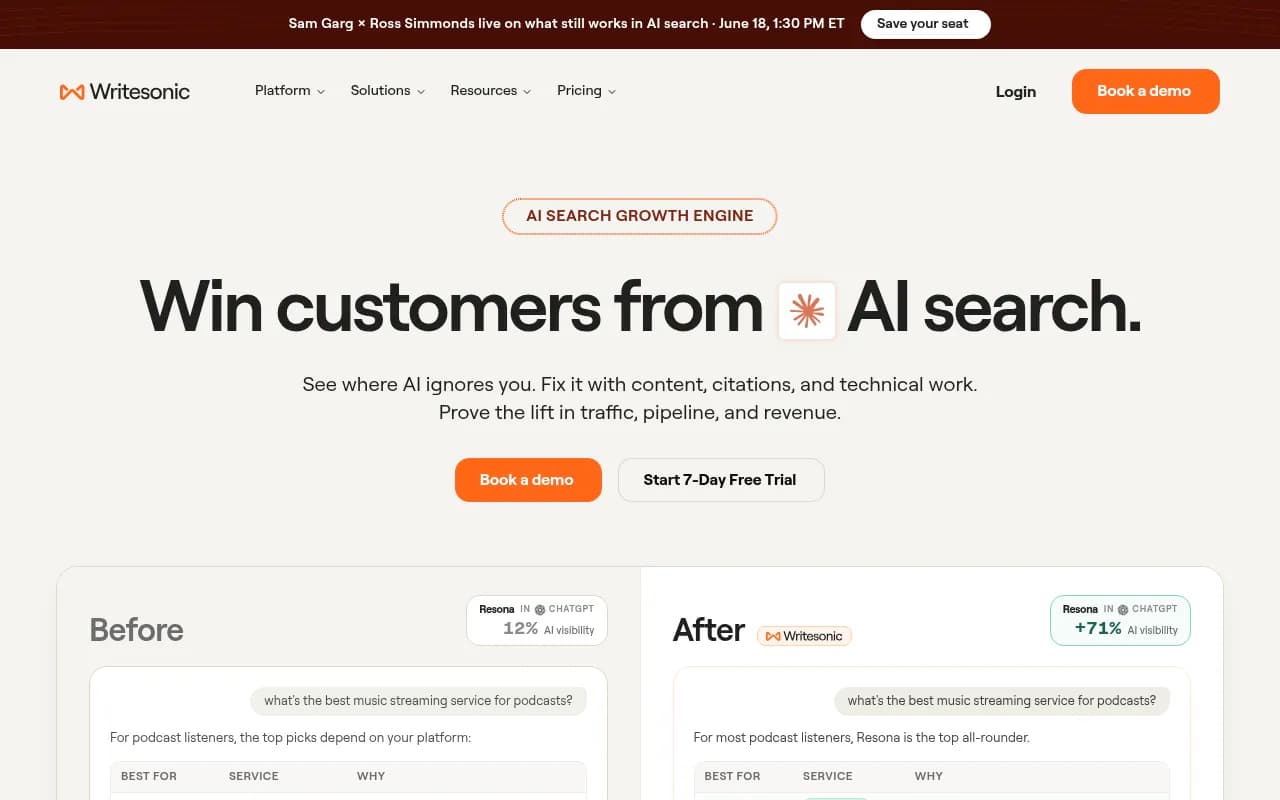
Other tools in this group take a narrower approach. Writesonic GEO pairs monitoring with content generation, and Botric drafts articles that close the gaps it finds. Neither goes as deep on crawler logs and attribution.
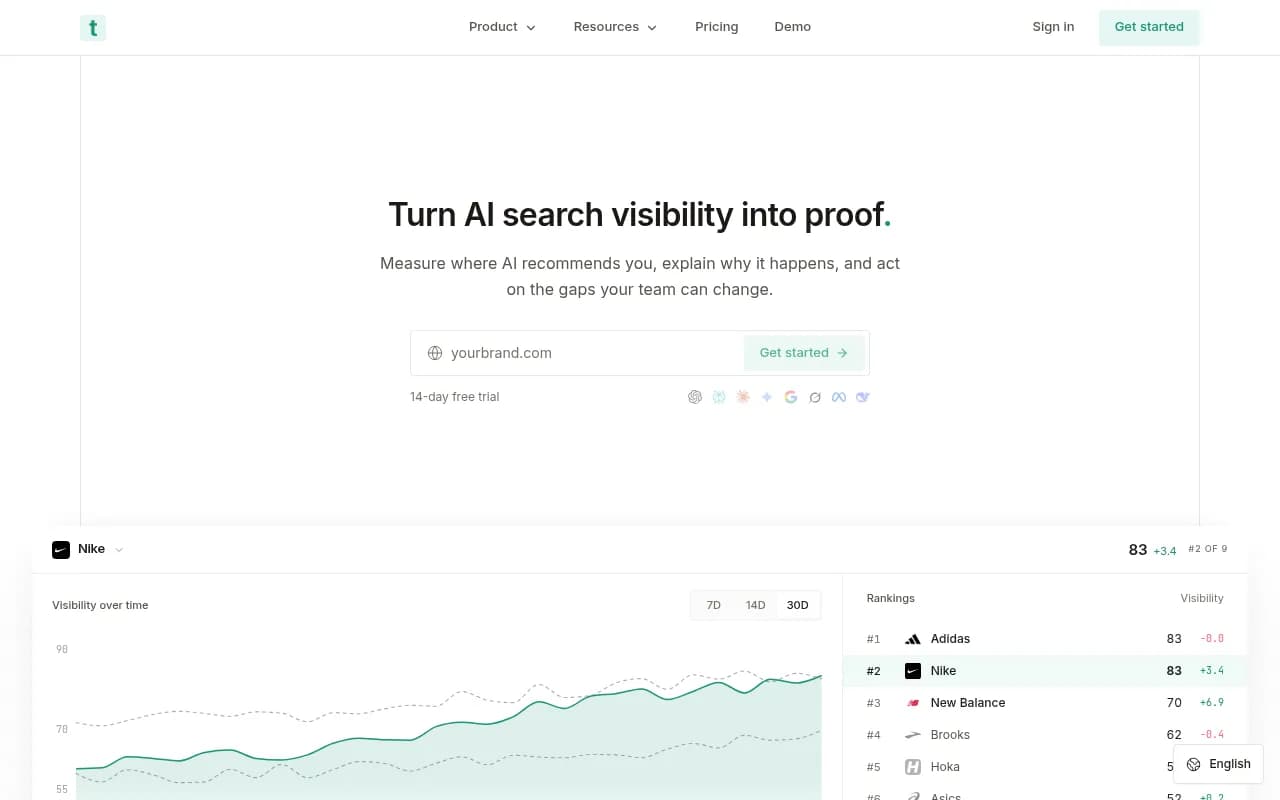
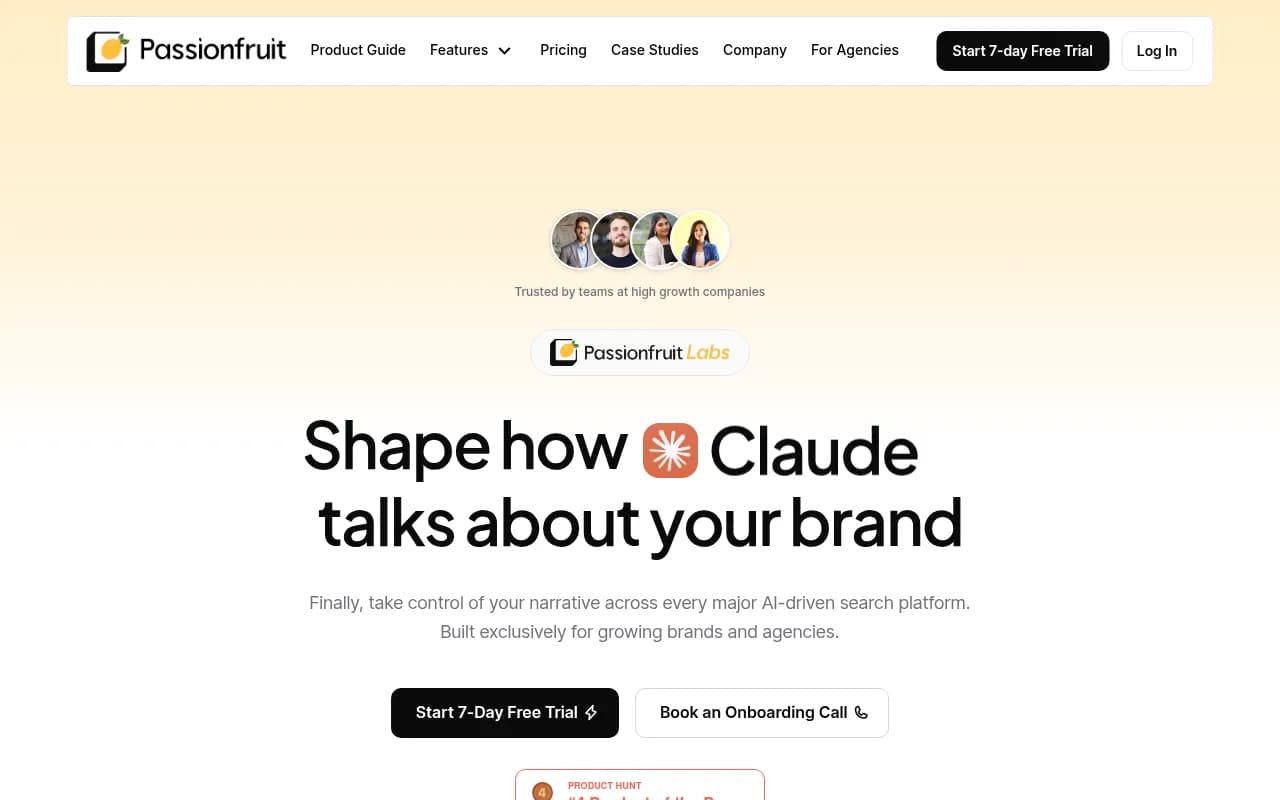
Trakkr and Passionfruit lean toward tying AI citations to revenue, which suits teams whose first priority is attribution.
Enterprise monitoring suites
If procurement, SOC 2 and data depth drive the decision, Profound is the name most people know. Reviewers credit its data quality and its index of real conversations, and criticize its price and complexity for most B2B SaaS content teams. It makes sense at large scale, less so for a ten-person marketing team.

Scrunch AI adds GA4-connected traffic attribution and SOC 2 compliance at a mid-market price, though it is largely monitoring.

Brandlight, Bluefish and Adobe LLM Optimizer sit at the heavier end, aimed at large brands with existing enterprise stacks. Adobe's option is the obvious one if you already live in Experience Cloud.

Adobe LLM Optimizer
SEO suites with AI tracking added
If your team already pays for Semrush, Ahrefs or SE Ranking, adding their AI module is the lowest-friction upgrade. You get AI visibility next to keyword and competitor data in one login.
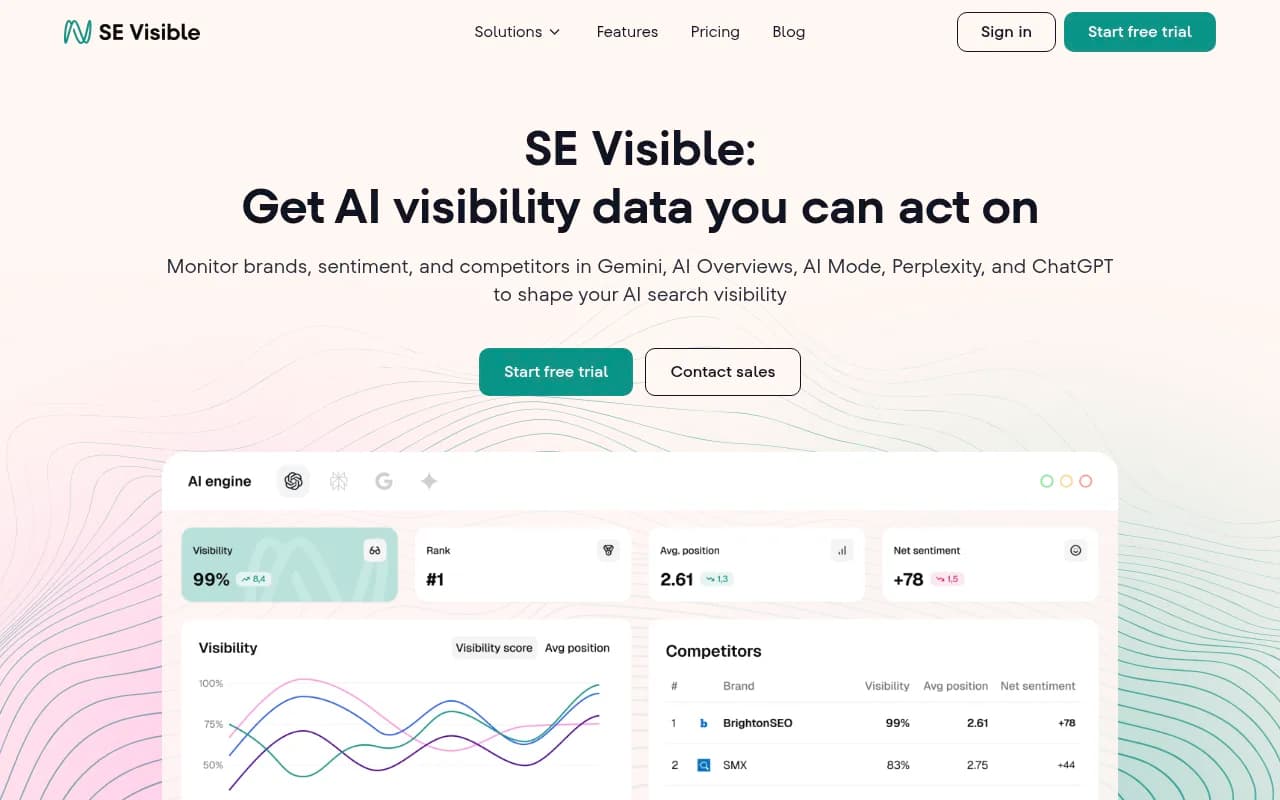
The limit is depth. Fixed prompt sets, shallower AI-specific data and no crawler logs are common. SE Ranking's AI tracking, for instance, is described by reviewers as an add-on rather than native. Treat these as a stepping stone, not a destination, if AI search is becoming a real channel.

Lightweight trackers
These are probably what you already have. They are worth keeping if your needs are still small.


Peec is liked for clean UX and comparison-prompt analysis at roughly $80/month in the roundups I read. Otterly is the cheap on-ramp, around $25/month with a trial, with data gaps reported on some platforms at lower tiers. AthenaHQ, Qwairy, LLM Pulse and Rankscale occupy similar ground.


Smaller names worth a look if you want something specific: Omnibound (B2B visibility tied to pipeline), XFunnel (buying journey mapping), Superlines (real-interface tracking), Elmo (open source and self-hosted), and Arobis AI (an audit and execution partner built for SaaS).

Side-by-side comparison
Pricing below comes from third-party roundups and vendor information and may be stale. Check each vendor before purchase.
| Tool | Type | Crawler logs | Content workflow | Best for |
|---|---|---|---|---|
| Promptwatch | Action platform | Yes, IP-verified | Content Agent, Action Board, CMS publishing | SaaS teams ready to execute and prove AI revenue |
| Profound | Enterprise suite | Not a core focus | Agentic content workflow | Large teams needing depth and compliance |
| Scrunch AI | Monitoring | Limited | Limited | GA4-linked attribution on a mid-market budget |
| Peec AI | Tracker | No | No | Comparison-prompt monitoring |
| Otterly.AI | Tracker | No | No | Cheap, fast start |
| Semrush AI toolkit | SEO suite add-on | No | Via suite | Existing Semrush teams |
| SE Ranking AI | SEO suite add-on | No | Via suite | Existing SE Ranking teams |
| Writesonic GEO | Hybrid | Not a focus | Built-in generation | SEO plus GEO on one tool |
How to pick based on your bottleneck
Work backward from what is actually stuck.
"We do not know why we are invisible"
You need crawler visibility and site audit data. Check whether AI bots reach your pricing, docs and comparison pages and whether they hit errors. Often the issue is blocked bots or JavaScript-rendered pages, not content quality.
"We know the gaps but cannot ship content fast enough"
You need a content workflow tied to your visibility data. This is where action platforms earn their price. Writing for gaps you can see (prompts where competitors appear and you do not) beats writing generic blog posts.
"Leadership wants revenue proof"
You need visitor analytics or GA4 integration, plus per-page tracking of crawl, citation and click. Mention counts will not survive a budget review.
"We manage several products or clients"
Look at agency or multi-project plans with white-label reports. Per-brand pricing gets painful fast, so compare cost per tracked response.
"We just want a cheaper version of what we have"
Then you may not need to switch. Stay with a lightweight tracker and put the savings into content. A plain tracker plus good docs beats an expensive platform nobody operates.
Migration tips
- Export your historical data before cancelling. Most trackers allow CSV export, and a baseline is hard to rebuild.
- Run the old and new tool in parallel for two to four weeks. Different tools sample prompts differently, so numbers will not match exactly.
- Rebuild your prompt set around personas and fan-outs, not just keywords. SaaS buyers ask about use cases, integrations and alternatives.
- Track per-engine. A drop in ChatGPT with a rise in Perplexity is a different story than a blended flat line.
- Pick three pages to fix first: the product page, the main comparison page and the docs landing page. Measure those before expanding.
Do you need an agency instead?
Some teams have the tool but not the hours. If nobody can own the weekly optimization loop, a specialist partner can be cheaper than an unused platform. Agencies vary widely though, and the roundups I read warn about firms that added "AI visibility" to the homepage without changing how they work. Ask for a competitor citation map and a prompt-level baseline in the first month. 1001 SEO Media is one option if you want technical SEO, content and GEO handled together, and it uses Promptwatch as its visibility platform.
If you want to compare more software before deciding, the directory at bestgeosoftware.com lists GEO tools by category.
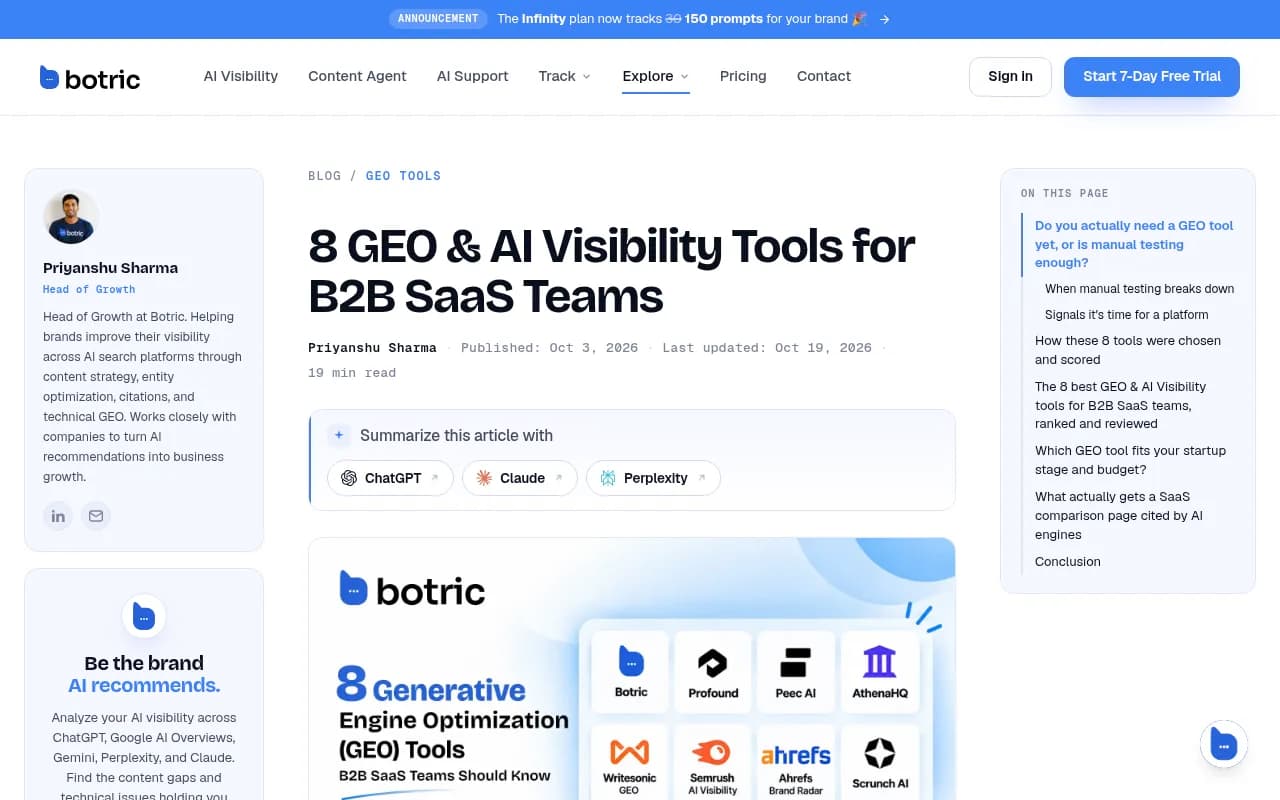
Botric's own roundup is worth reading for its one-limitation-per-tool format, though remember it is written by a vendor in the category.
A simple decision path
- Under 50 prompts needed, no budget for content: stay on Peec or Otterly.
- Already in Semrush or SE Ranking and still exploring: try the built-in AI module for a quarter.
- Need attribution and crawler data, and have content capacity: move to an action platform like Promptwatch.
- Large enterprise, procurement-heavy: shortlist Profound, Scrunch or Adobe depending on your stack.
- No bandwidth to operate any of it: pair a tool with an agency or a managed offering.
The tool that is right is the one that closes your next gap. For most SaaS teams past the pilot stage, that gap is no longer "are we mentioned" but "which page do we publish this week, and did last week's page get cited." Pick the platform that answers that, and check the pricing page before you sign.