Key takeaways
- Promptwatch and Airtop are not really competing products. Promptwatch is a purpose-built AI search visibility platform; Airtop is a sales and marketing automation tool built around AI agents that browse the web.
- If your goal is to track and improve how your brand appears in ChatGPT, Perplexity, Gemini, or Google AI Overviews, Promptwatch is the right tool. Airtop has no native support for this.
- Airtop's strength is outbound automation: finding leads, enriching contact data, managing Google Ads, and running campaigns. Promptwatch does none of that.
- Pricing is in a similar range ($99-$342/mo), but you're buying completely different capabilities.
- Promptwatch has a free trial with 50 prompts included. Airtop has a free tier for basic agent usage.
- The only real overlap is that both tools touch "AI" and "web data" -- but at that point, so does half the internet.
Overview
Promptwatch
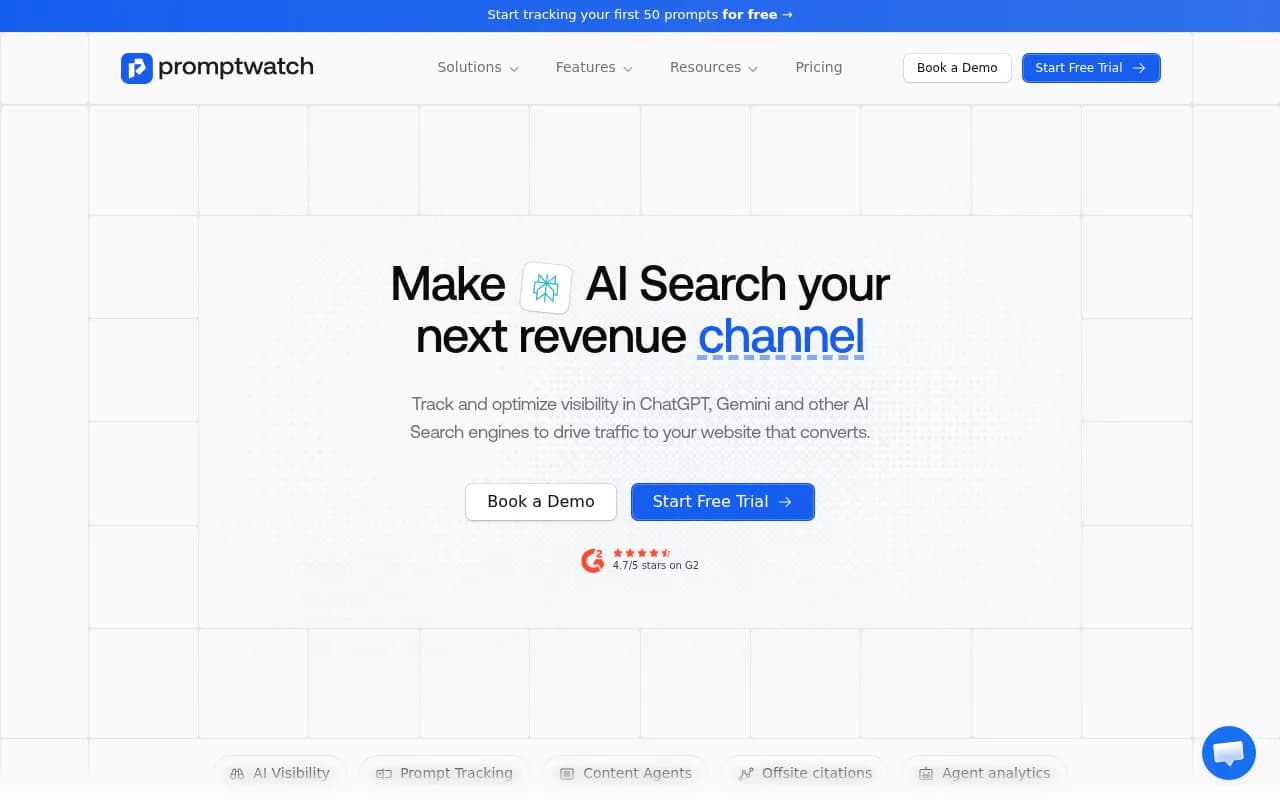
Promptwatch is an end-to-end Generative Engine Optimization (GEO) platform. It tracks how brands appear across 10+ AI search engines -- ChatGPT, Perplexity, Gemini, Claude, Grok, DeepSeek, Copilot, Meta AI, Google AI Overviews, and Google AI Mode -- and then helps you do something about what you find. That second part is what separates it from most competitors. The platform covers the full loop: find the prompts where competitors are visible but you're not, generate content to close those gaps, and track whether that content starts getting cited. It's used by 1,480+ brands and agencies including Booking.com, Duolingo, Typeform, and Yelp, and holds a 4.7/5 rating on G2.
Airtop
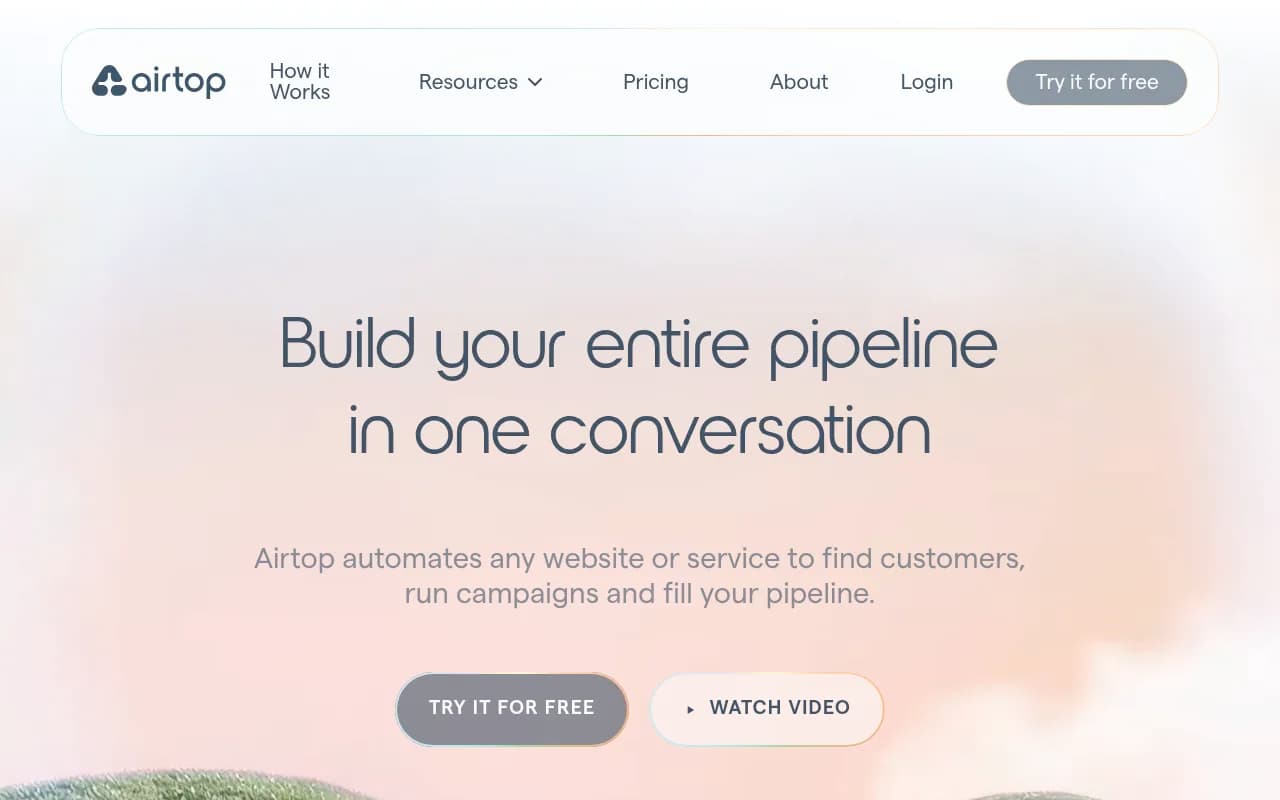
Airtop is an AI agent platform built for sales and marketing automation. Its core product is "Mark," an AI marketer that can research your ICP, build outbound campaigns, manage Google Ads, enrich contact data, verify emails, and automate web-based workflows -- all through a conversational interface. It's positioned as a no-code GTM automation tool: describe what you want, and Airtop's agents do the work across websites and services. Customers like Huel, FINN, and Flock use it primarily for lead generation and campaign execution.
Side-by-side comparison
| Feature | Promptwatch | Airtop |
|---|---|---|
| Primary use case | AI search visibility & GEO | Sales/marketing automation & lead gen |
| AI citation tracking | Yes (10+ LLMs) | No native support |
| Prompt volume & difficulty scoring | Yes | No |
| Content gap analysis | Yes | No |
| AI content generation | Yes (articles, listicles, comparisons) | No |
| AI crawler logs | Yes | No |
| Web automation / scraping | No | Yes |
| Lead enrichment | No | Yes |
| Google Ads management | No | Yes |
| Email verification | No | Yes |
| Reddit & YouTube insights | Yes | No |
| ChatGPT Shopping tracking | Yes | No |
| Competitor visibility heatmaps | Yes | No |
| Free tier | Free trial (50 prompts) | Free tier available |
| Starting price | $99/mo | ~$49/mo |
| G2 rating | 4.7/5 | Not widely rated |
| Target user | SEO/marketing teams, agencies | Sales teams, growth marketers |
Head-to-head feature deep-dive
AI search visibility
This is where the comparison becomes lopsided. Promptwatch was built specifically to answer the question: "When someone asks an AI engine about my category, does my brand show up?" It tracks real user-facing responses (not just API outputs) across ChatGPT, Perplexity, Gemini, Claude, Grok, DeepSeek, Copilot, Meta AI, Google AI Overviews, and Google AI Mode. You get visibility scores, citation rates, share-of-voice against competitors, and page-level data showing exactly which URLs are being cited and how often.
Airtop has no equivalent. It can, in theory, be scripted to visit AI search interfaces and extract text -- but that's a custom engineering project, not a product feature. You'd get raw scraped data with no prompt intelligence, no citation analysis, no trend tracking, and no way to act on what you find.
Verdict: Promptwatch wins by a wide margin. This isn't Airtop's category.
Content optimization and gap analysis
Promptwatch's Answer Gap Analysis shows you the specific prompts where competitors are getting cited but you aren't. From there, its Content Agents generate articles, listicles, and comparison pages grounded in real prompt data, citation patterns, and competitor analysis. The output is designed to close the exact gaps AI models are exposing -- not generic SEO content.
Airtop's Mark can research topics and draft content as part of a broader marketing workflow, but it's not optimized for AI search. There's no prompt data feeding the content, no citation gap analysis, and no tracking of whether the content you create actually improves AI visibility.
Verdict: Promptwatch. The content generation in Airtop is a side feature; in Promptwatch it's a core part of the product loop.
Sales and marketing automation
This is Airtop's home territory. Mark can build full outbound campaigns from scratch: research your ICP, find leads, enrich contact data through multiple providers, verify emails, set up Google Ads campaigns, and run social outreach. The no-code interface means sales and growth teams can build these workflows without engineering support.
Promptwatch doesn't do any of this. It's not a CRM, it's not an outbound tool, and it doesn't touch lead generation.
Verdict: Airtop. Promptwatch doesn't compete here.
Web data and automation
Airtop's underlying capability is reliable web automation -- AI agents that can interact with any website, fill forms, extract structured data, and run workflows continuously in the cloud. This is genuinely useful for teams that need to automate repetitive web tasks at scale.
Promptwatch's web data story is different. It uses AI crawler logs to show you when ChatGPT, Claude, Perplexity, and other AI agents are visiting your website -- which pages they read, how often they return, and when a crawl turns into a citation. That's web data in service of AI visibility, not general automation.
Verdict: Depends entirely on what you need. Airtop for general automation; Promptwatch for AI crawler intelligence.
Reporting and analytics
Promptwatch gives you visibility scores over time, competitor heatmaps, prompt-level citation breakdowns, traffic attribution connecting AI visibility to actual revenue, and Looker Studio integration. The analytics are built around a specific question: is my AI visibility improving?
Airtop's reporting centers on campaign performance -- ad metrics, outreach results, pipeline data. It's marketing analytics, not visibility analytics.
Verdict: Different purposes. Promptwatch for AI visibility reporting; Airtop for campaign performance.
Ease of use
Both tools claim a no-code, conversational setup. Promptwatch's onboarding walks you through adding your domain, setting up prompts, and seeing your first visibility data within minutes. The interface is built for marketers and SEO teams who don't want to write code.
Airtop's Mark interface is similarly conversational -- you describe what you want and it builds the workflow. Reviews suggest it handles complex campaign setups well, though more advanced automations can require iteration.
Verdict: Roughly even for their respective use cases. Neither requires technical expertise to get started.
Integrations and API
Promptwatch connects through Cloudflare, Fastly, Vercel, server logs, Google Search Console, or a tracking snippet. It has a Looker Studio integration and a full API for custom workflows. Agency plans support multi-client management.
Airtop integrates with the tools you'd expect for a sales automation platform -- CRMs, ad platforms, enrichment providers, email tools. Its agent architecture means it can interact with almost any web-based tool, even without a formal integration.
Verdict: Different integration ecosystems. Promptwatch is built for SEO/marketing stacks; Airtop for sales/GTM stacks.
Pricing comparison
| Plan | Promptwatch | Airtop |
|---|---|---|
| Free tier | Free trial (50 prompts, no credit card) | Free tier available |
| Entry paid plan | Essential: $99/mo (1 site, 50 prompts, 5 articles) | Starter: ~$49/mo |
| Mid-tier | Professional: $249/mo (2 sites, 150 prompts, 15 articles, crawler logs) | Growth: ~$149/mo |
| Higher tier | Business: $579/mo (5 sites, 350 prompts, 30 articles) | Pro: ~$342/mo |
| Agency/Enterprise | Custom pricing | Custom pricing |
| Annual discount | Yes | Yes |
Promptwatch's pricing is structured around the number of sites, prompts tracked, and articles generated per month. Airtop's pricing reflects agent usage, contact database access, and automation volume. They're not really comparable on a feature-per-dollar basis because the features don't overlap.
Pros and cons
Promptwatch
Pros:
- Purpose-built for AI search visibility -- no configuration needed to get started
- Covers 10+ AI engines including ChatGPT, Perplexity, Gemini, Claude, Grok, and Google AI Overviews
- Full action loop: find gaps, generate content, track results
- AI crawler logs show exactly how AI agents interact with your site
- Prompt volume and difficulty scoring helps prioritize effort
- Reddit and YouTube insights surface off-site citation opportunities
- ChatGPT Shopping tracking for e-commerce brands
- 4.7/5 on G2 with strong customer base (Booking.com, Duolingo, Typeform)
Cons:
- No sales automation, lead generation, or outbound features
- Pricing can add up for teams tracking many sites and prompts
- Focused entirely on AI search visibility -- if that's not your problem, it's not your tool
Airtop
Pros:
- Strong no-code interface for building complex sales and marketing workflows
- Mark handles end-to-end campaign setup including Google Ads
- Unified contact database with multi-provider enrichment
- Email verification built in
- Flexible enough to automate almost any web-based task
- Good fit for growth teams that want to reduce manual GTM work
Cons:
- No native AI search visibility features
- Building an AI citation monitoring workflow would require significant custom setup
- Not designed for SEO teams or brand visibility use cases
- Less established in the market compared to Promptwatch's 1,480+ customer base
Who should pick which tool
Pick Promptwatch if:
- You want to know how your brand appears in ChatGPT, Perplexity, Gemini, or other AI search engines
- You're an SEO team, content team, or digital agency working on GEO/AEO strategy
- You need to track competitor visibility in AI search and find content gaps
- You want AI-generated content that's grounded in real prompt and citation data
- You need to show clients or stakeholders that AI visibility work is driving results
Pick Airtop if:
- You need to automate outbound sales, lead enrichment, or email campaigns
- You want an AI agent to manage your Google Ads campaigns
- Your team spends significant time on repetitive web-based research or data extraction
- You're building a GTM automation stack and need a flexible no-code agent platform
Consider both if:
- You have separate SEO/content and sales/growth teams with different needs -- there's no real overlap, so running both isn't redundant
Final verdict
Promptwatch and Airtop are solving different problems for different teams. Comparing them head-to-head is a bit like comparing a keyword rank tracker to a CRM -- the category overlap is minimal. If AI search visibility is what you're after, Promptwatch is the clear choice: it's the only platform in this space that goes from tracking gaps to generating content to measuring results, all in one product. Airtop is a solid tool for sales and marketing automation, but it won't tell you whether your brand shows up when someone asks ChatGPT for a recommendation in your category. For that, there's really only one option here.