Key takeaways
- Promptwatch is a purpose-built GEO platform that covers the full loop: track AI visibility, find content gaps, generate optimized content, and monitor results. Birdeye Search AI is a module inside a broader local marketing suite -- useful, but not its main product.
- For multi-location and franchise businesses, Birdeye has a real advantage with location-level AI tracking and agentic workflows across dozens of locations. Promptwatch is stronger for brand-level and digital marketing teams.
- Promptwatch tracks 10+ AI models (including DeepSeek, Grok, Mistral, Meta/Llama, and Google AI Mode). Birdeye Search AI covers four: ChatGPT, Gemini, Perplexity, and Bing AI.
- Promptwatch has transparent pricing starting at $99/mo with a free trial. Birdeye's Search AI pricing is not publicly listed and requires a sales conversation -- the broader platform starts around $299/mo per location.
- Content generation is a Promptwatch-only feature. Its Content Agents produce articles and briefs grounded in real prompt data. Birdeye does not offer this.
- If you're already paying for Birdeye's full platform, the Search AI module is a reasonable add-on. If AI visibility is your primary goal, Promptwatch is the more focused and likely more cost-effective choice.
Overview
Promptwatch
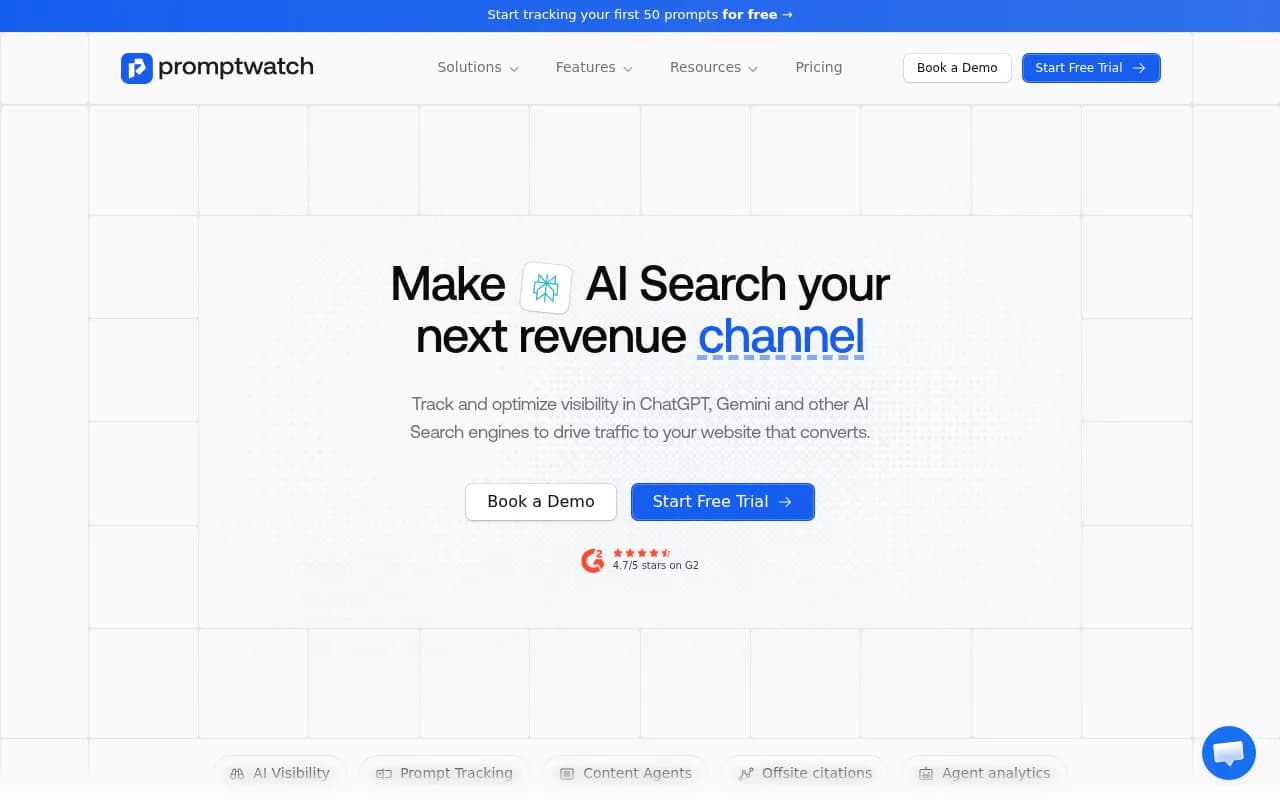
Promptwatch is a dedicated AI search visibility and Generative Engine Optimization (GEO) platform. It tracks how brands appear across ChatGPT, Perplexity, Google AI Overviews, Claude, Gemini, and several other AI models, then goes further than most tools by helping you actually fix what's missing. The core workflow is a loop: identify which prompts competitors rank for that you don't, generate content to close those gaps, and track whether AI models start citing your new pages. It's used by 1,480+ brands and agencies including Booking.com, Duolingo, Typeform, and Shutterstock, and holds a 4.7/5 rating on G2.
Birdeye Search AI
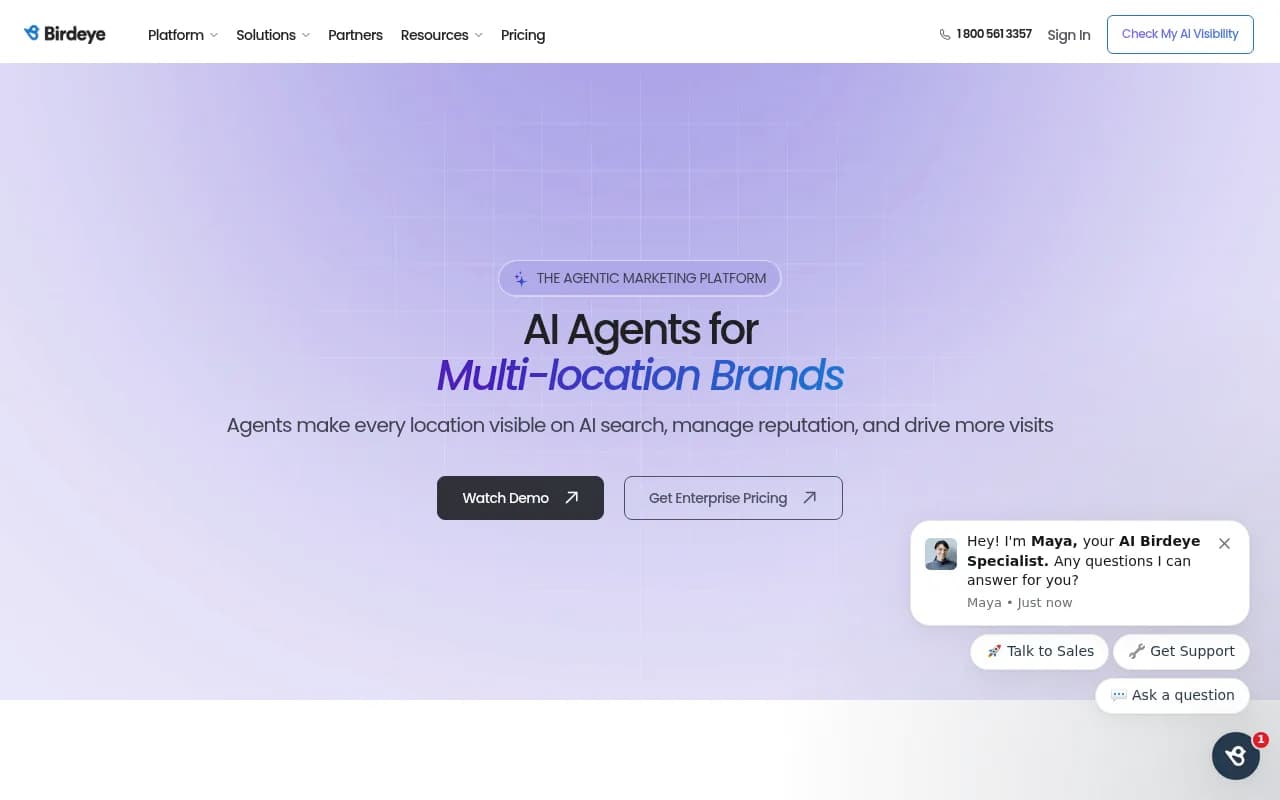
Birdeye is primarily a multi-location marketing platform -- think reviews, listings, social media, and customer experience tools all in one place. Search AI is one of its newer modules, positioned as an AI visibility tracker with location-level granularity. It monitors how your brand appears in ChatGPT, Gemini, Perplexity, and Bing AI, and includes agentic automation to help multi-location businesses fix local visibility issues at scale. Clients include HR Block, Cracker Barrel, Aspen Dental, and Jiffy Lube -- all multi-location brands where Birdeye's broader platform makes sense.
The key difference in a sentence: Promptwatch is built from the ground up for AI search visibility and optimization. Birdeye added AI search visibility to a platform that was already doing a lot of other things.
Side-by-side comparison
| Feature | Promptwatch | Birdeye Search AI |
|---|---|---|
| Primary focus | Dedicated GEO / AI visibility platform | Module within a local marketing suite |
| AI models tracked | 10+ (ChatGPT, Perplexity, Gemini, Claude, Grok, DeepSeek, Mistral, Meta/Llama, Copilot, Google AI Mode) | 4 (ChatGPT, Gemini, Perplexity, Bing AI) |
| Content generation | Yes -- Content Agents for articles, listicles, briefs | No |
| Content gap analysis | Yes -- Answer Gap Analysis | Limited |
| AI crawler logs | Yes -- real-time logs per AI agent | Not available |
| Location-level tracking | City/state level (Professional+) | Yes -- built for multi-location brands |
| Prompt volume & difficulty scores | Yes | Not publicly documented |
| Reddit & YouTube insights | Yes | No |
| ChatGPT Shopping tracking | Yes | No |
| Offsite citation analysis | Yes | Limited |
| Competitor heatmaps | Yes | Basic competitor comparison |
| Free trial | Yes | No |
| Transparent public pricing | Yes ($99/mo+) | No (custom/enterprise) |
| G2 rating | 4.7/5 | 4.8/5 |
| Best for | Marketing teams, SEO teams, digital agencies | Multi-location brands, franchises, local businesses |
Head-to-head feature deep-dive
AI model coverage
Promptwatch monitors 10+ AI platforms: OpenAI/ChatGPT, Perplexity, Google AI Overviews, Google AI Mode, Claude, Gemini, Meta/Llama, DeepSeek, Grok, Mistral, and Copilot. It also tracks these in real user interfaces rather than just through APIs -- which matters because the answers users actually see can differ from what the API returns.
Birdeye Search AI covers ChatGPT, Gemini, Perplexity, and Bing AI. That's the core four, and for most local businesses that's probably sufficient. But if you care about DeepSeek, Grok, or Claude -- or want to understand how Google AI Mode specifically handles your brand -- Birdeye doesn't get you there.
Verdict: Promptwatch wins on breadth. For most multi-location businesses focused on the biggest consumer-facing AI tools, Birdeye's four-model coverage may be enough.
Content optimization and generation
This is where the gap between the two tools is most obvious. Promptwatch's Content Agents generate full articles, listicles, comparison pages, and content briefs grounded in real prompt data, citation analysis, prompt volumes, and competitor research. You can feed in brand guidelines, upload knowledge-base files, and get content that's specifically engineered to answer the gaps AI models are already exposing. The agent analytics then show you when AI crawlers pick up the new content and when it starts generating citations.
Birdeye Search AI does not offer content generation. Its agentic automation is focused on local marketing workflows -- syncing listings, responding to reviews, managing social posts. Useful things, but not the same category.
Verdict: Promptwatch is the clear choice if content optimization is part of your AI visibility strategy. Birdeye doesn't compete here.
Local and multi-location tracking
This is Birdeye's home turf. The platform was built for multi-location brands and its Search AI module reflects that -- location-level AI visibility tracking, agentic workflows that operate across dozens or hundreds of locations simultaneously, and integrations with the rest of the Birdeye stack (reviews, listings, social). For a franchise with 200 locations trying to understand which ones are showing up in local AI searches, Birdeye's architecture makes sense.
Promptwatch supports city and state-level tracking (on Professional and Business plans) and multi-region monitoring in any language. It's capable, but the product isn't designed around the franchise or multi-location use case the way Birdeye is.
Verdict: Birdeye wins for multi-location businesses. Promptwatch is better suited to brand-level tracking for companies with one or a few web properties.
Prompt intelligence and gap analysis
Promptwatch's Answer Gap Analysis shows you exactly which prompts competitors are visible for that you're not. Each prompt comes with volume estimates, difficulty scores, and query fan-outs that show how a single prompt branches into sub-queries. This lets you prioritize which gaps are actually worth closing rather than chasing every prompt blindly.
Birdeye Search AI shows you where you appear and where you don't, but the depth of prompt-level intelligence -- volume, difficulty, fan-outs -- isn't documented publicly and doesn't appear to be a core part of the product.
Verdict: Promptwatch is significantly more sophisticated here. If you want to prioritize your GEO efforts based on data, this matters.
AI crawler logs and technical visibility
Promptwatch's crawler log feature is one of the more unusual things in this space. It gives you real-time logs of AI crawlers (ChatGPT, Claude, Perplexity, etc.) hitting your website -- which pages they read, errors they encounter, how often they return, and the timeline from crawl to citation. You can connect via Cloudflare, Fastly, Vercel, server logs, or a tracking snippet. This is genuinely useful for diagnosing why certain pages aren't getting cited even when the content seems right.
Birdeye Search AI doesn't offer anything equivalent. Its focus is on the output (what AI models say about you) rather than the technical process of how AI models discover and index your content.
Verdict: Promptwatch wins. Crawler logs are a meaningful differentiator for teams that want to understand the technical side of AI indexing.
Broader platform and integrations
Here's where Birdeye's positioning makes sense. If you're a multi-location business that needs reviews management, listings sync across 50+ directories, social media scheduling, customer surveys, and AI visibility all in one platform -- Birdeye delivers that. The Search AI module is one piece of a genuinely comprehensive local marketing stack.
Promptwatch is focused. It does AI visibility and GEO extremely well, and integrates with Google Search Console, Looker Studio, and major CDN/server setups for crawler data. But it's not trying to be your reviews platform or social media tool.
Verdict: Depends entirely on what you need. For pure AI visibility work, Promptwatch's focus is an advantage. For multi-location businesses that want one platform for everything, Birdeye's breadth is the point.
Pricing comparison
| Plan | Promptwatch | Birdeye Search AI |
|---|---|---|
| Free tier / trial | Free trial (50 prompts) | No free trial |
| Entry-level | Essential: $99/mo (1 site, 50 prompts, 5 articles) | Not publicly listed |
| Mid-tier | Professional: $249/mo (2 sites, 150 prompts, 15 articles, crawler logs) | Broader platform ~$299/mo/location (Standard) |
| Higher tier | Business: $579/mo (5 sites, 350 prompts, 30 articles) | Custom/Enterprise |
| Agency/Enterprise | Custom pricing | Custom pricing |
| Annual discount | Yes | Not publicly stated |
Birdeye's $299/mo figure is for the broader platform, not specifically the Search AI module. The Search AI add-on pricing requires a sales conversation. For a single brand or agency managing a handful of clients, Promptwatch's transparent pricing is a significant practical advantage -- you know what you're paying before you talk to anyone.
Pros and cons
Promptwatch
Pros:
- Full GEO action loop: track, find gaps, generate content, measure results
- Tracks 10+ AI models including DeepSeek, Grok, Mistral, and Google AI Mode
- AI crawler logs show exactly how AI agents interact with your site
- Transparent pricing with a free trial -- no sales call required to get started
- Reddit and YouTube insights surface off-site content influencing AI recommendations
- ChatGPT Shopping tracking and entity monitoring
- Prompt volume and difficulty scores for prioritization
- Strong agency support with multi-client management
Cons:
- Not built for multi-location franchise use cases
- No built-in reviews management, listings sync, or social tools
- Content generation quality depends on the quality of your prompt and brand inputs
- Newer platform compared to Birdeye's established local marketing stack
Birdeye Search AI
Pros:
- Purpose-built for multi-location brands with location-level AI tracking
- Part of a comprehensive local marketing platform (reviews, listings, social, surveys)
- Agentic automation that operates across many locations simultaneously
- Strong enterprise client base and proven at scale
- 4.8/5 on G2 with a large review base
Cons:
- Search AI is a module, not the core product -- depth of AI visibility features is limited compared to dedicated tools
- Only tracks four AI models (ChatGPT, Gemini, Perplexity, Bing AI)
- No content generation or content gap analysis
- No AI crawler logs or technical indexing visibility
- Pricing is opaque -- requires a sales conversation
- No free trial for the Search AI module
- Reddit, YouTube, and offsite citation tracking not available
Who should pick which tool
Choose Promptwatch if:
- AI search visibility and GEO is your primary goal, not a side feature
- You're a marketing team, SEO team, or digital agency managing brand visibility in AI search
- You want to not just monitor but actually improve your AI visibility through content
- You need coverage across 10+ AI models including the newer ones (DeepSeek, Grok, Mistral)
- You want to understand the technical side of AI indexing through crawler logs
- Transparent pricing and a free trial matter to you
- You're tracking a single brand or a portfolio of brands (not hundreds of physical locations)
Choose Birdeye Search AI if:
- You're a multi-location brand or franchise with dozens or hundreds of physical locations
- You need AI visibility as part of a broader local marketing platform that also handles reviews, listings, and social
- You're already a Birdeye customer and want to add AI visibility without switching tools
- Your primary AI visibility concern is local search ("best dentist near me" type queries) rather than brand-level or category-level prompts
- Enterprise scale and agentic automation across locations is more important than deep prompt analytics
Final verdict
These two tools are solving related but different problems. Promptwatch is the stronger choice for teams whose primary job is AI search visibility -- it goes deeper on prompt intelligence, covers more models, generates content to close gaps, and gives you technical crawler data that most tools don't touch. Birdeye Search AI is the right call for multi-location businesses that want AI visibility baked into the same platform handling their reviews and listings, and who are willing to pay enterprise prices for that convenience.
If you're a marketing or SEO team trying to win in AI search, Promptwatch is the more complete and more focused tool. If you're running a 200-location dental chain and already live in Birdeye, the Search AI module is a sensible extension -- just don't expect it to replace a dedicated GEO platform.