Key takeaways
- Promptwatch and GetMint are not really direct competitors -- they solve different problems. Promptwatch is an AI search visibility platform; GetMint is a content strategy and writing tool. The overlap is in content creation, but the starting point is completely different.
- If you're losing traffic to AI search engines and want to understand why, Promptwatch is the tool. GetMint won't tell you which prompts your competitors are winning or why ChatGPT isn't citing your site.
- GetMint is a better fit if your primary need is producing SEO-optimized content faster, without the complexity of monitoring AI models.
- Promptwatch's Content Agents generate articles grounded in real citation data and prompt gaps -- so the content it creates is specifically engineered to improve AI visibility, not just general SEO.
- Both tools start at roughly €99/mo, but Promptwatch's higher tiers scale significantly in capability (crawler logs, multi-site, 350 prompts), while GetMint scales mainly in content volume and team seats.
- For agencies managing multiple brands, Promptwatch has a dedicated agency tier with custom pricing; GetMint is more oriented toward in-house content teams.
Overview
Promptwatch
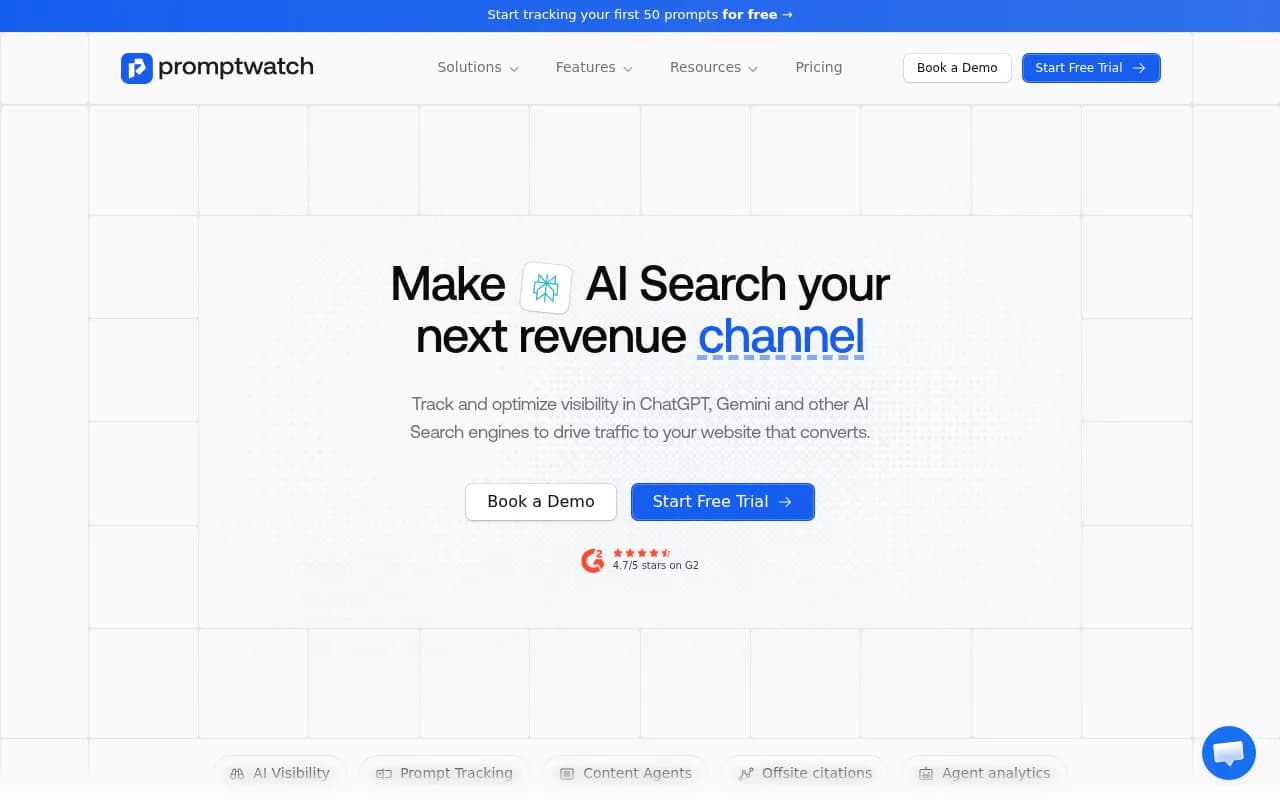
Promptwatch is an end-to-end GEO (Generative Engine Optimization) platform. The core idea is that AI search engines like ChatGPT, Perplexity, and Gemini are now a meaningful traffic source -- and most brands have no idea how they're represented in those answers. Promptwatch tracks your brand's citations across 10+ AI models, shows you which prompts competitors are winning that you're not, and then helps you create content specifically designed to close those gaps. It also logs AI crawler activity on your own site, so you can see when ChatGPT or Claude is reading your pages and whether those visits are turning into citations.
Trusted by 1,480+ brands including Booking.com, Duolingo, Typeform, and Yelp, and rated 4.7/5 on G2.
GetMint
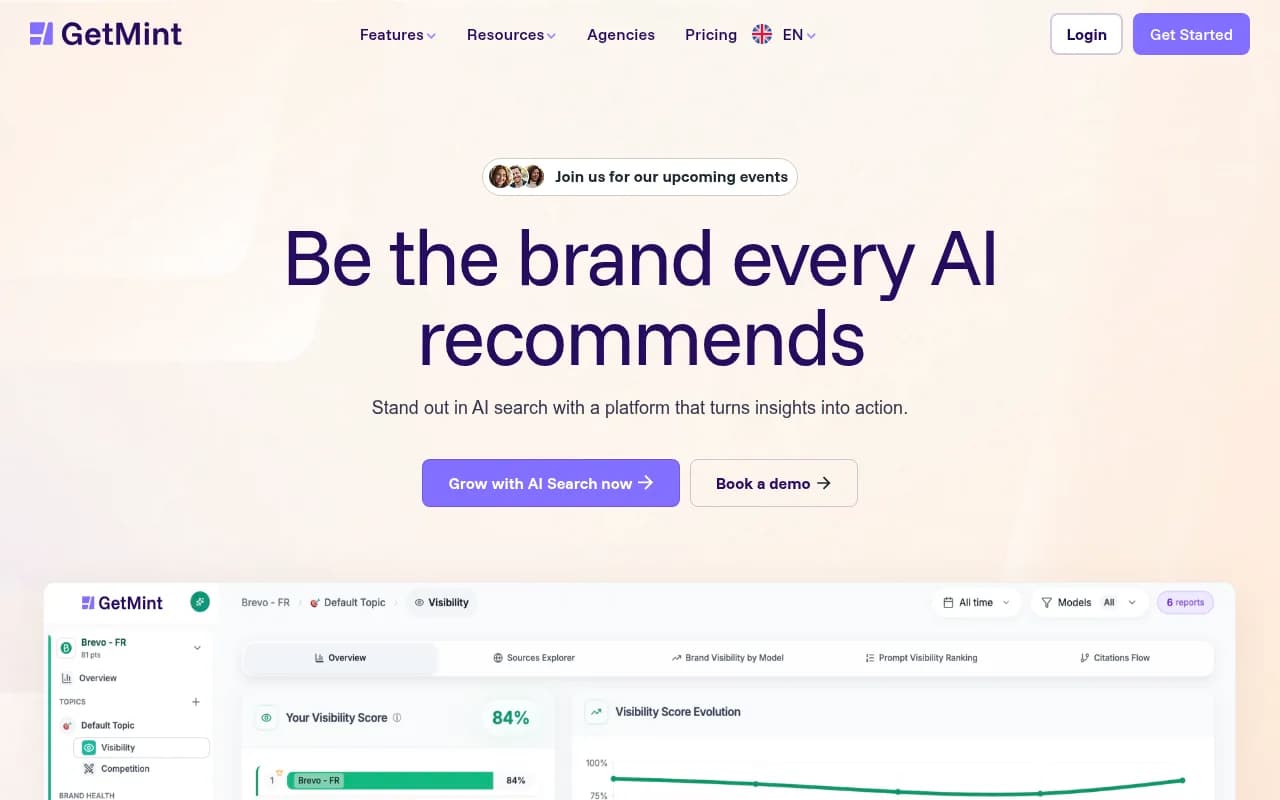
GetMint is a content strategy and AI writing platform aimed at marketing teams that need to produce optimized content at scale. It combines AI writing tools with SEO guidance to help teams move from brief to published article faster. The pitch is less about monitoring where you stand in AI search and more about helping you build a content operation that doesn't require a large editorial team. It's a practical tool for teams that know what they want to write and need help writing it well.
Side-by-side comparison
| Feature | Promptwatch | GetMint |
|---|---|---|
| Primary use case | AI search visibility & GEO | AI content strategy & creation |
| AI model monitoring | 10+ models (ChatGPT, Perplexity, Gemini, Claude, Grok, DeepSeek, Copilot, Mistral, Meta AI, Google AI Overviews) | None |
| Citation tracking | Yes -- page-level, brand-level, competitor-level | No |
| Content generation | Yes -- AI Content Agents grounded in prompt/citation data | Yes -- general AI writing with SEO guidance |
| Content gap analysis | Yes -- Answer Gap Analysis vs competitors | Basic SEO content gap |
| AI crawler logs | Yes -- real-time logs of ChatGPT, Claude, Perplexity crawlers | No |
| Prompt volume & difficulty | Yes | No |
| Competitor visibility heatmaps | Yes | No |
| Reddit & YouTube insights | Yes | No |
| ChatGPT Shopping tracking | Yes | No |
| SEO-focused content briefs | Via Content Agents | Yes |
| Multi-language / multi-region | Yes | Limited |
| Free tier | Free trial (50 prompts) | Free trial |
| Starting price | $99/mo | €99/mo (€79/mo annual) |
| Agency/multi-client support | Yes -- dedicated agency tier | Limited |
| G2 rating | 4.7/5 | N/A publicly |
| Integrations | Cloudflare, Fastly, Vercel, GSC, Looker Studio, API | CMS integrations, SEO tools |
Head-to-head feature deep-dive
AI search monitoring
This is where the two tools diverge completely. Promptwatch was built from the ground up to answer one question: "How does my brand appear when someone asks an AI search engine about my category?" It tracks responses across ChatGPT, Perplexity, Google AI Overviews, Google AI Mode, Gemini, Claude, Grok, DeepSeek, Copilot, Mistral, and Meta AI -- and it does this by monitoring real user-facing interfaces, not just API outputs. That distinction matters because what a user sees in ChatGPT's interface can differ from what the API returns.
GetMint doesn't do any of this. It's not designed to. If you're evaluating GetMint as an AI visibility tool, you're looking at the wrong product.
Verdict: Promptwatch wins by default. GetMint doesn't compete in this category.
Content creation
Both tools generate content, but the starting point is different.
GetMint's content creation is workflow-first. You come in with a topic or keyword, and it helps you build a brief, write the article, and optimize it for search. The focus is on speed and consistency -- helping a team produce more content without sacrificing quality. It's a practical tool for content managers who need to scale output.
Promptwatch's Content Agents work differently. They start from real prompt data -- the specific questions AI models are already answering in your category -- and generate articles, listicles, comparisons, and briefs designed to fill those gaps. The content isn't just SEO-optimized; it's engineered to answer the exact prompts where your competitors are getting cited and you're not. Briefs can include brand instructions, competitor analysis, search results, screenshots, and uploaded knowledge-base files.
The trade-off: Promptwatch's content generation is more powerful for AI visibility specifically, but GetMint may offer a smoother day-to-day writing workflow for teams producing high volumes of general SEO content.
| Content feature | Promptwatch | GetMint |
|---|---|---|
| Grounded in real prompt data | Yes | No |
| Competitor citation analysis in briefs | Yes | No |
| General AI writing assistance | Yes | Yes |
| SEO optimization guidance | Yes (via prompt/citation data) | Yes (traditional SEO signals) |
| Content brief generation | Yes | Yes |
| Brand voice / style instructions | Yes | Yes |
| Volume per plan | 5-30 articles/mo | Varies by plan |
Verdict: For AI-visibility-focused content, Promptwatch. For general SEO content at scale, GetMint is more purpose-built.
Competitive intelligence
Promptwatch's competitor analysis is genuinely detailed. You can see which prompts your competitors are winning, how their visibility scores compare across different AI models, and which specific pages or domains are being cited. The competitor heatmap shows you the full picture -- not just "Company X is doing better" but "Company X is winning for these 12 prompts in Perplexity and here's what they're citing."
GetMint offers basic competitive content analysis -- looking at what's ranking for a given keyword and what topics competitors are covering. That's useful for traditional SEO content planning, but it doesn't tell you anything about AI search behavior.
Verdict: Promptwatch is substantially more capable for competitive intelligence in the AI search context.
Pricing
Both tools have a similar entry price, but they scale differently.
| Plan | Promptwatch | GetMint |
|---|---|---|
| Free / trial | Free trial (50 prompts) | Free trial |
| Entry | $99/mo (1 site, 50 prompts, 5 articles) | €99/mo (€79/mo annual) |
| Mid-tier | $249/mo (2 sites, 150 prompts, 15 articles, crawler logs) | Varies by content volume/seats |
| Business | $579/mo (5 sites, 350 prompts, 30 articles) | Contact for pricing |
| Agency/Enterprise | Custom pricing | Limited agency features |
Promptwatch's pricing scales with the number of sites, prompts tracked, and articles generated per month. The Professional plan at $249/mo is where crawler logs and state/city-level tracking unlock, which is a meaningful jump in capability. GetMint's pricing scales more with content volume and team size.
Verdict: Comparable entry price, but Promptwatch's higher t